
BuddhistCatholicContemplativeEvangelicalGeneral ChristianHinduJewishLatter-day SaintMuslimNew VisionsProgressive Christian
Beliefs
- Buddhist
- Catholic
- Contemplative
- Evangelical
- General Christian
- Hindu
- Jewish
- Latter-day Saint
- More Voices
- Muslim
- New Visions
- Pagan
- Progressive Christian
Topics
- Religion News
- Food and Religion
- Sports and Religion
- Religious Art
- Religious Music and Entertainment
- Religious Events
- History and Religion
- Style and Religion
- Politics and Religion
- Women in Religion
- Recreation Outdoors and Religion
- Business Finance and Religion
- Careers Workplace and Religion
- Education and Religion
- Family Parenting and Religion
- Health Fitness and Religion
- Home and Religion
- Relationships and Religion
- Technology and Religion
- Travel and Religion
Columnists
- Buddhist Columnists
- Business Finance and Religion Columnists
- Careers Workplace and Religion Columnists
- Catholic Columnists
- Contemplative Columnists
- Education and Religion Columnists
- Evangelists Columnists
- Family Parenting and Religion Columnists
- General Christian Columnists
- Health Fitness and Religion Columnists
- Hindu Columnists
- History and Religion Columnists
- Home and Religion Columnists
- Jewish Columnists
- More Voices Columnists
- Latter Day Columnists
- Muslim Columnists
- New Visions Columnists
- Nonreligious Columnists
- Pagan Columnists
- Politics and Religion Columnists
- Progressive Columnists
- Recreation Outdoors and Religion Columnists
- Relationships and Religion Columnists
- Religion News Columnists
- Religious Art Columnists
- Religious Events Columnists
- Religious Music and Entertainment Columnists
- Sports and Religion Columnists
- Style and Religion Columnists
- Technology and Religion Columnists
- Travel and Religion Columnists
- Women in Religion Columnists
Resource Library
- 2026 Calendar
- Library of World Religions
- The 100 Most Holy Places on Earth
- Patheos Answers
- Podcasts
- Videos
- Faith Leaders Database
- Anglican Episcopalian
- Bahai
- Baptist
- Buddhism
- Christianity
- Confucianism
- Eastern Orthodoxy
- Hinduism
- Holiness and Pentecostal
- ISKCON
- Islam
- Judaism
- Lutheran
- Methodist
- The Church of Jesus Christ of Latter-day Saints
- New Age
- Paganism
- Presbytarian and Reformed
- Protestantism
- Religion Behind the Scenes
- Roman Catholic
- Scientology
- Shia Islam
- Sikhism
- Sufism
- Sunni Islam
- Taoism
- Zen
- See all religions
Research Tools
 Ad-Free & Subscriber Log-In Subscription Support
Ad-Free & Subscriber Log-In Subscription Support
Follow Patheos 

- Trending:
- Forgiveness
- |
- Marriage
- |
- Consciousness
- |
- Death Penalty
- |
- Election
- |
- Halloween

- Home
- Religion News
- In Mike Pence, US evangelicals had their ’24-karat-gold’ man in the White House
In Mike Pence, US evangelicals had their ’24-karat-gold’ man in the White House
Last updated on: January 8, 2021 at 11:05 am by The Conversation
In Mike Pence, US evangelicals had their ’24-karat-gold’ man in the White House 2021-01-08T11:05:45-04:00 The Conversation
Patheos Explore the world's faith through different perspectives on religion and spirituality! Patheos has the views of the prevalent religions and spiritualities of the world.
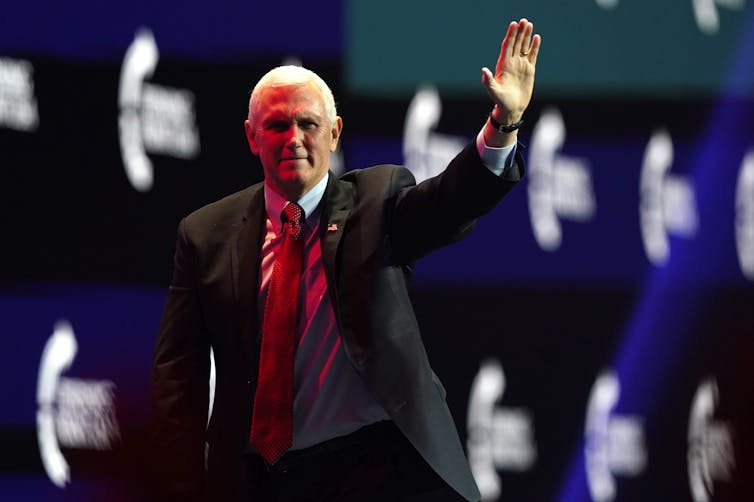
Exit, stage religious right.
AP Photo/Lynne Sladky
By Deborah Whitehead of University of Colorado Boulder
Mike Pence had remained one of the only constants in the often chaotic Trump administration.
Variously described as “vanilla,” “steady” and loyal to the point of being “sycophantic,” he is, in the words of one profile, an “everyman’s man with Midwest humility and approachability,” and in another, a “61-year-old, soft-spoken, deeply religious man.”
That humility and loyalty has been tested in recent days. “I hope Mike Pence comes through for us,” Trump told supporters at a rally on Monday, seemingly under the mistaken belief that Pence could overturn the election result. But presiding over the Electoral College vote count at a joint session of Congress on Wednesday, Pence broke with Trump’s wishes and confirmed Joe Biden as the next president, provoking the ire of Trump.
Balancing the ticket
Throughout the past four years, the vice president has offered a striking contrast to the mercurial, abrasive temperament of his commander in chief. Indeed, in his acceptance speech at the 2016 Republican National Convention, Pence joked that he’d been chosen because Trump, with his “large personality,” “colorful style,” and “lots of charisma,” was “looking for some balance on the ticket.”
Commentators have attributed Pence’s steadiness to his Hoosier roots and his “savvy political operator” skills. But it is his religious beliefs that perhaps inform his politics and style more than anything else; as Pence has oft repeated, he is “a Christian, conservative and Republican – in that order.”
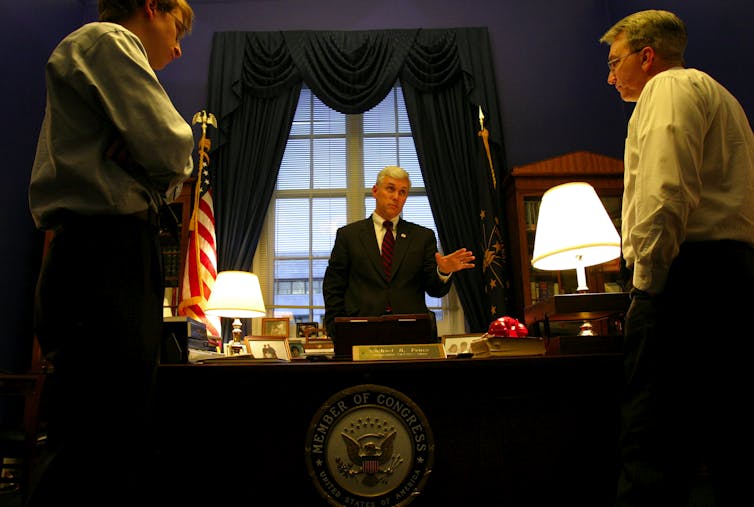
Mike Pence meets with staff at his office in 2005.
The Washington Post/Getty Images
In a 2011 profile during Pence’s run for Indiana governor, noted state political columnist Brian Howey remarked, “Pence doesn’t just wear his faith on his sleeve, he wears the whole Jesus jersey.”
It isn’t a characterization that Pence has shied away from. “My Christian faith is at the very heart of who I am,” Pence said during the 2016 vice presidential debate.
Richard Land, former president of the Southern Baptist Convention’s Ethics & Religious Liberty Commission and current president of Southern Evangelical Seminary in Charlotte, told the Atlantic in 2018, “Mike Pence is the 24-karat-gold model of what we want in an evangelical politician. I don’t know anyone who’s more consistent in bringing his evangelical Christian worldview to public policy.”
But as a scholar of U.S. religion and culture, I believe that Pence’s faith and political identities are more complex than these statements suggest. In fact, one can trace three distinct conversion experiences in his biography.
Three-point conversion
Growing up in an Irish Catholic family with five siblings, working-class roots and Democratic political commitments, Pence attended Catholic school, served as an altar boy at his family’s church, idolized John F. Kennedy and was a youth coordinator for the local Democratic Party in his teens.
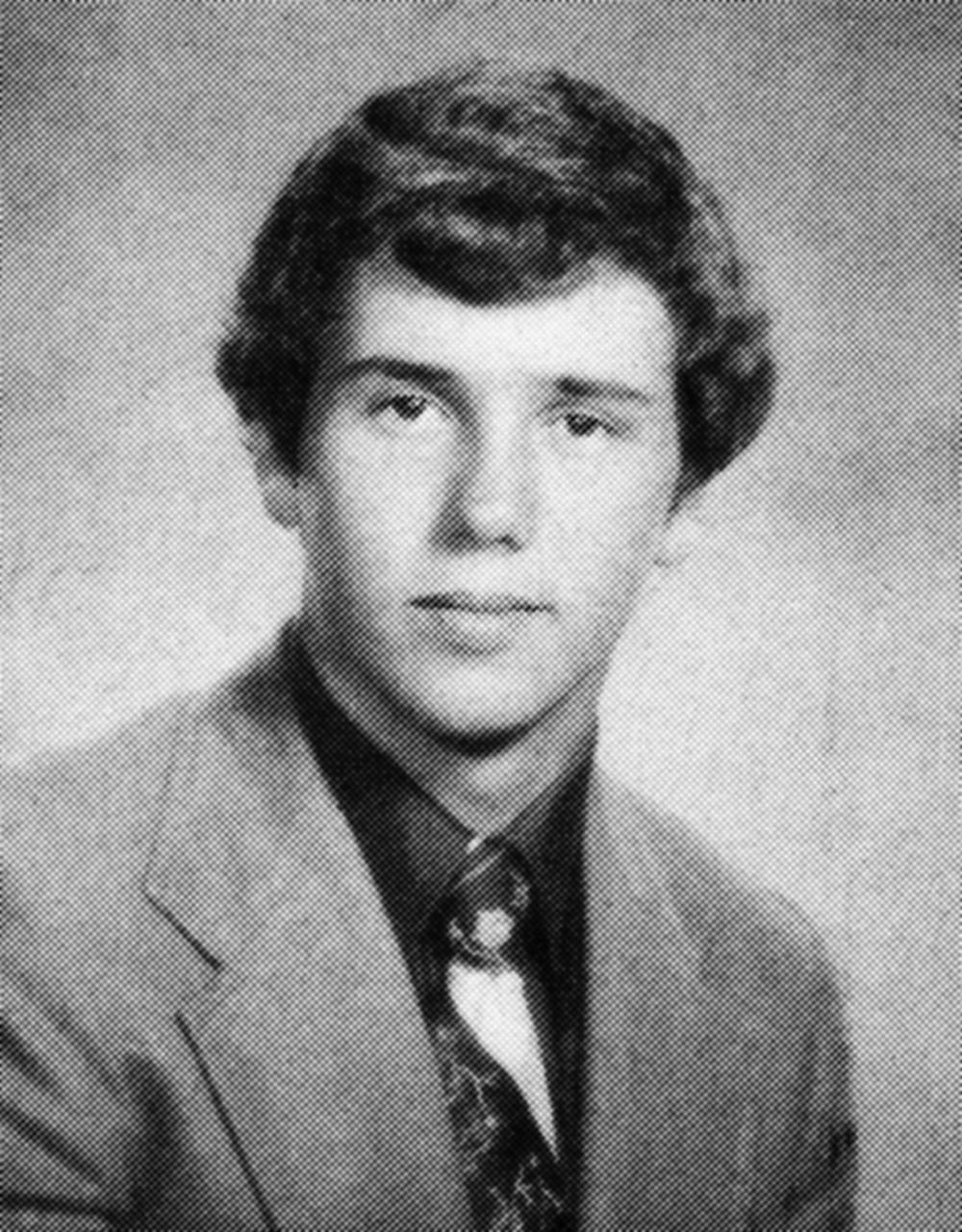
Mike Pence’s 1977 yearbook photo at Columbus North High School.
Columbus North High School
It was as a freshman at Hanover College in 1978 that Pence experienced an evangelical conversion while attending a music festival in Kentucky billed as the “Christian Woodstock.”
For some years afterward he remained active in the Catholic Church, attending Mass regularly, serving as a youth minister and seriously considering joining the priesthood. At the same time, he and his future wife Karen were part of a demographic shift of Americans who “had grown up Catholic and still loved many things about the Catholic Church, but also really loved the concept of having a very personal relationship with Christ,” as a close friend put it.
By the mid-1990s he was a married father of three who identified as a “born-again, evangelical Catholic,” an unusual term that has caused some consternation among both evangelicals and Catholics.
In subsequent interviews, Pence has spoken freely about how his 1978 conversion gave him a “personal relationship with Jesus Christ” that “changed everything.” But he has tended to avoid labeling his religious views when pressed, referring to himself as a “pretty ordinary Christian” who “cherishes his Catholic upbringing.” He has attended nondenominational evangelical churches with his family since at least 1995.
Pence’s political conversion was more clear cut. Though he voted for Jimmy Carter in the 1980 presidential election, he quickly came to embrace Ronald Reagan’s economic and social conservatism and his populist appeal. In a 2016 speech at the Reagan Library, Pence credited Reagan with inspiring him to “leave the party of my youth and become a Republican like he did.” “His broad-shouldered leadership changed my life,” he said. Pence has frequently compared Trump to Reagan, arguing that they have the same “broad shoulders.”
Pence ran unsuccessfully for Congress in 1988 and 1990, and the second bruising loss precipitated a third conversion, this time in political style. In a 1991 published essay titled “Confessions of a Negative Campaigner,” he described himself as a sinner and wrote of his “conversion” to the belief that “negative campaigning is wrong.”
Between 1992 and 1999, Pence honed his blend of family values and fiscal conservatism in an eponymous conservative talk show.
The show’s popularity provided a springboard to a successful run for Congress in 2000. During his six terms in the House, Pence acquired a reputation for “unalloyed traditional conservatism” and principled opposition to Republican Party leadership on issues like No Child Left Behind and Medicare prescription drug expansion.
Religious acts
In addition to his “unsullied” reputation as a “culture warrior,” he also attracted attention for following the “Billy Graham Rule” of avoiding meeting with women alone and avoiding events where alcohol was served when his wife was not present.
During the 2016 vice presidential debate, Pence said that his entire career in public service stems from a commitment to “live out” his religious beliefs, “however imperfectly.”
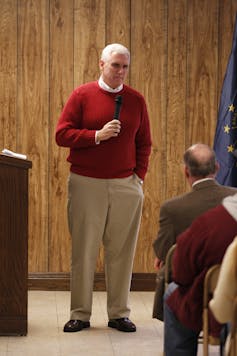
Mike Pence meeting Indiana constituents in 2011.
AP Photo/Michael Conroy
One of those beliefs is his opposition to abortion, grounded in his reading of particular biblical passages. As a congressman in 2007, he was the first to sponsor legislation defunding Planned Parenthood, and did so repeatedly until the first defunding bill passed in 2011. “I long for the day when Roe v. Wade is sent to the ash heap of history,” he said at the time.
In 2016, over the objections of many Republican state representatives, he signed the most restrictive set of anti-abortion measures in the country into law, making him a conservative hero. Among other things, the bill prevented women from terminating pregnancies for reasons including fetal disability such as Down syndrome. Although opponents succeeded in getting the bill overturned in the courts, Indiana is still seen as one of the most anti-abortion states in America.
As vice president, Pence also cast the tie-breaking Senate vote to allow states to withhold federal family planning funds from Planned Parenthood in 2017.
Pence has also been an outspoken opponent of LGBTQ rights. He opposed the inclusion of sexual orientation in hate crimes legislation and the end of the military’s “Don’t Ask, Don’t Tell” policy. He likewise supported both state and federal constitutional amendments to ban same-sex marriage, and expressed disappointment at the 2015 Obergefell decision, which required all states to recognize such unions.
At the same time he has been a strong supporter of “religious freedom,” particularly for Christians.
In March 2015, as Indiana governor, he signed the state’s Religious Freedom Restoration Act “to ensure that religious liberty is fully protected.” The act ignited a firestorm of nationwide controversy: Critics alleged that it would allow for individuals and businesses to legally discriminate against members of the LGBTQ community. Under pressure from LGBTQ activists, liberals, business owners and moderate Republicans, Pence signed an amendment a week later stipulating that it did not authorize discrimination.
Staked reputation
Pence’s religious and political biography mirrors key political and religious shifts over the past 40 years, from the rise of the religious right and its growing influence in the Republican Party to the conservative coalition of evangelicals and Catholics across denominational lines, to the legacy of the “outsider” celebrity president.
These threads converge in Mike Pence, whose “24-karat,” “unalloyed” conservative credentials were instrumental in rallying evangelical voters behind Trump in the 2016 election and whose loyalty to Trump seems to have finally broken with the shocking events of Jan. 6 and whose political future is now uncertain.

This article is republished from The Conversation, a nonprofit news organization dedicated to unlocking ideas from academia, under a Creative Commons license.
[Deep knowledge, daily. Sign up for The Conversation’s newsletter.]

About Deborah Whitehead
Deborah Whitehead is an Associate Professor of Religious Studies at the University of Colorado Boulder. You can read more about the author here.


Browse Our Archives
Select a Category Buddhism Christianity Hinduism Islam Judaism Religion and society Uncategorized
Select a Month July 2024 March 2024 February 2024 January 2024 December 2023 November 2023 October 2023 September 2023 August 2023 July 2023 January 2023 August 2022 July 2022 April 2022 February 2022 January 2022 October 2021 July 2021 June 2021 May 2021 April 2021 March 2021 February 2021 January 2021 December 2020 November 2020 October 2020 September 2020 August 2020 July 2020 June 2020 May 2020
Follow Us!
TAKE THE
Religious Wisdom Quiz
What book has the most references to the word "love" in the New Testament?
Select your answer to see how you score.
John Matthew Romans 1 John
Related posts from The Conversation


Electing A Virtuous President Would Make Immunity Irrelevant

Why The Olympic Games Are A ‘Civil Religious’...

The Catholic Church Is Using The Olympics To...
TRENDING AT PATHEOS Religion News

Catholic Integralists believe that religious values – specifically Christian ones – should...

Electing A Virtuous President Would Make Immunity Irrelevant
Presidential immunity can bring with it many risks. So how can we...

Why The Olympic Games Are A ‘Civil Religious’...
Sporting events form a vital space where Americans display their 'civil religious...

After more than a decade of news, research updates, and insights on...

Q: Why do Southern Baptists and like-minded Protestants...
THE RELIGION GUY’S ANSWER: Why? Simple. Because they believe that’s what the...

THE QUESTION: Is gambling evil? THE RELIGION GUY’S ANSWER: Analysts anticipate a...
view all Religion News blogs
Ad-Free & Subscriber Log-In Subscription Support
- About Us
- 2026 Calendar
- Videos
- Podcasts
- Library of World Religions
- Faith In Media Tracker
- Advertise With Us
- Write for Us
- Privacy Policy
- Terms of Service
- Do Not Sell My Data
- Contact Us
- Radiant Digital
- Manage Newsletter Subscriptions
- Unsubscribe From Notifications
- Sitemap
Copyright 2008-2026, Patheos. All rights reserved.
Subscription Support Ad-Free & Subscriber Log-In
Follow Patheos