
BuddhistCatholicContemplativeEvangelicalGeneral ChristianHinduJewishLatter-day SaintMuslimNew VisionsProgressive Christian
Beliefs
- Buddhist
- Catholic
- Contemplative
- Evangelical
- General Christian
- Hindu
- Jewish
- Latter-day Saint
- More Voices
- Muslim
- New Visions
- Pagan
- Progressive Christian
Topics
- Religion News
- Food and Religion
- Sports and Religion
- Religious Art
- Religious Music and Entertainment
- Religious Events
- History and Religion
- Style and Religion
- Politics and Religion
- Women in Religion
- Recreation Outdoors and Religion
- Business Finance and Religion
- Careers Workplace and Religion
- Education and Religion
- Family Parenting and Religion
- Health Fitness and Religion
- Home and Religion
- Relationships and Religion
- Technology and Religion
- Travel and Religion
Columnists
- Buddhist Columnists
- Business Finance and Religion Columnists
- Careers Workplace and Religion Columnists
- Catholic Columnists
- Contemplative Columnists
- Education and Religion Columnists
- Evangelists Columnists
- Family Parenting and Religion Columnists
- General Christian Columnists
- Health Fitness and Religion Columnists
- Hindu Columnists
- History and Religion Columnists
- Home and Religion Columnists
- Jewish Columnists
- More Voices Columnists
- Latter Day Columnists
- Muslim Columnists
- New Visions Columnists
- Nonreligious Columnists
- Pagan Columnists
- Politics and Religion Columnists
- Progressive Columnists
- Recreation Outdoors and Religion Columnists
- Relationships and Religion Columnists
- Religion News Columnists
- Religious Art Columnists
- Religious Events Columnists
- Religious Music and Entertainment Columnists
- Sports and Religion Columnists
- Style and Religion Columnists
- Technology and Religion Columnists
- Travel and Religion Columnists
- Women in Religion Columnists
Resource Library
- 2026 Calendar
- Library of World Religions
- The 100 Most Holy Places on Earth
- Patheos Answers
- Podcasts
- Videos
- Faith Leaders Database
- Anglican Episcopalian
- Bahai
- Baptist
- Buddhism
- Christianity
- Confucianism
- Eastern Orthodoxy
- Hinduism
- Holiness and Pentecostal
- ISKCON
- Islam
- Judaism
- Lutheran
- Methodist
- The Church of Jesus Christ of Latter-day Saints
- New Age
- Paganism
- Presbytarian and Reformed
- Protestantism
- Religion Behind the Scenes
- Roman Catholic
- Scientology
- Shia Islam
- Sikhism
- Sufism
- Sunni Islam
- Taoism
- Zen
- See all religions
Research Tools
 Ad-Free & Subscriber Log-In Subscription Support
Ad-Free & Subscriber Log-In Subscription Support
Follow Patheos 

- Trending:
- Forgiveness
- |
- Marriage
- |
- Consciousness
- |
- Death Penalty
- |
- Election
- |
- Halloween

- Home
- Religion News
- Armenians displaced from Nagorno-Karabakh fear their medieval churches will be destroyed
Armenians displaced from Nagorno-Karabakh fear their medieval churches will be destroyed
Last updated on: January 5, 2021 at 6:18 am by The Conversation
Armenians displaced from Nagorno-Karabakh fear their medieval churches will be destroyed 2021-01-04T14:19:45-04:00 The Conversation
Patheos Explore the world's faith through different perspectives on religion and spirituality! Patheos has the views of the prevalent religions and spiritualities of the world.
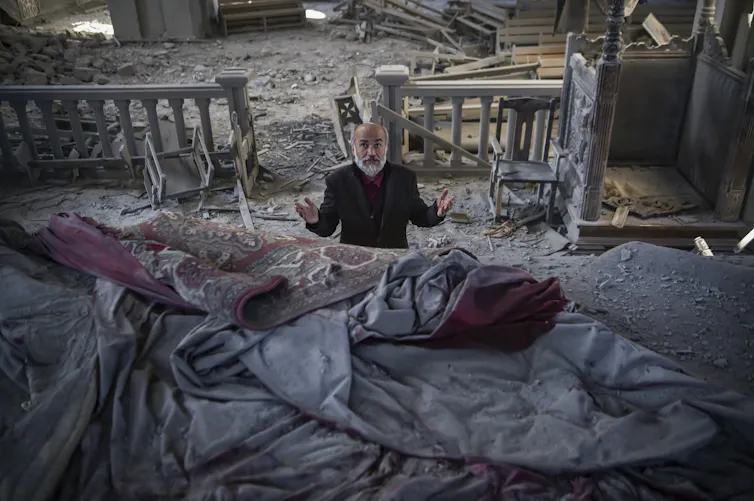
The Ghazanchetsots Cathedral was damaged earlier this year during fighting between Armenia and Azerbaijan.
Aris Messinis/AFP via Getty Images
By Christina Maranci of Tufts University
A six-week war in Nagorno-Karabakh, a mountainous region in the South Caucasus, ended on Nov. 9 after Russia brokered a peace deal between Armenia and Azerbaijan.
Under the deal, several ethnically Armenian provinces in Nagorno-Karabakh, which Armenians call Artsakh, were surrendered to Azerbaijan in November and December.
This is the latest chapter in a conflict that dates back at least a century. In 1921, the Soviet Union declared Nagorno-Karabakh part of Azerbaijan despite its ethnic Armenian majority. Since that time, the territory has been the site of massive demonstrations, failed international agreements and a brutal war from 1992 to 1994.
The human tragedy has been devastating. In the 2020 fighting alone, over 5,000 soldiers died and more than 100,000 people were displaced. Though the war is over, the rich architectural heritage of the region is still at risk.
Heritage organizations worry that the numerous historic Armenian churches, monasteries and tombstones of the region may face damage or destruction now that they are out of Armenian hands.
Damage to historic churches
The war had already damaged many Armenian monuments. In the fall, Azerbaijani offensives shelled the ancient city of Tigranakert, founded in the first century B.C. by the Armenian king Tigranes the Great.
It also damaged the historic Holy Saviour “Ghazanchetsots” Cathedral in Shusha, one of the largest Armenian cathedrals in the world. Shusha, called Shushi by Armenians, is Karabakh’s cultural capital.
After Azerbaijani soldiers took control of the city, online images showed its 19th-century Armenian cathedral defaced with graffiti. Another 19th-century church nearby, known as the Kanach Zham and dedicated to Saint John the Baptist, also appears to be damaged.
The Armenian monuments of Nagorno-Karabakh form part of the broader architectural tradition of Armenian art and architecture which I study. For over 20 years, I have conducted research and fieldwork in historical regions of Armenia, including Nagorno-Karabakh.
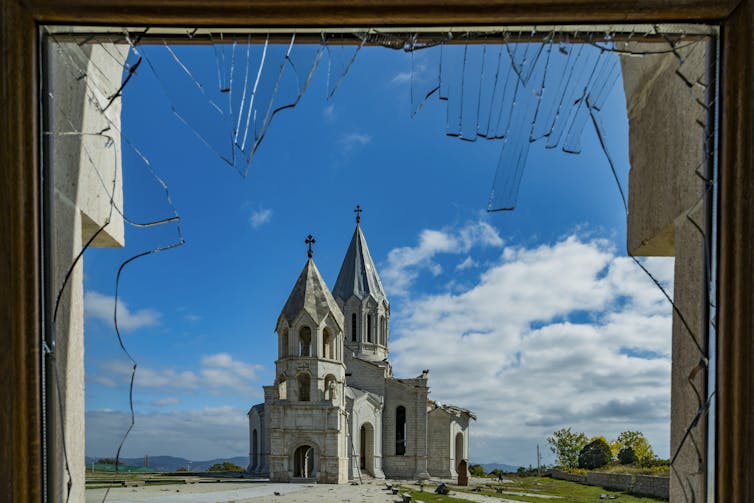
The roof of the 19th-century Ghazanchetsots Cathedral in Shusha was partially destroyed by Azerbaijani shelling in October 2020.
Celestino Arce/NurPhoto via Getty Images
Medieval heritage
Nagorno-Karabakh forms a remarkable chapter in Armenian art history because of its antiquity and its visual and religious distinctiveness.
The Monastery of Amaras, in the southeast, was founded in the fourth century, when Armenia became the first country to make Christianity its national religion.
It is the burial place of Saint Grigoris, grandson of Gregory the Illuminator, the patron saint and evangelizer of Armenia. It is also the site of the first school to use the Armenian script.
The walled complex houses a large basilica. Underneath it lies Grigoris’ fifth-century tomb – one of the oldest surviving Armenian Christian burial structures.
Recent archaeological excavations show that this tomb could be entered from the east – quite unusual in traditional church architecture. Scholars link the layout to the Holy Sepulcher in Jerusalem, the place both of the crucifixion and the tomb of Jesus.
Many other churches in Nagorno-Karabakh date later, from the 13th to 18th centuries, and incorporate carved cross-stones called khachkars into their walls. Khachkars often feature inscriptions written in Armenian that record the donor’s name and family members.
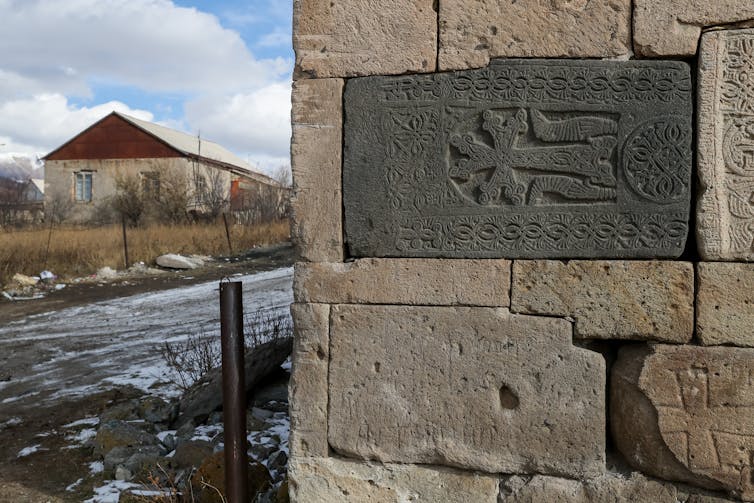
A cross-stone, or khachkar, is built into a church wall in the Armenian village of Sotk.
Alexander Ryumin\TASS via Getty Images
In a church in Takyaghaya, the entrance is a beautiful patchwork of khachkars of various sizes and shapes. To the south, near Handaberd, a khachkar that likely dates to the 12th or 13th century is carved with a rare image of the Virgin Mary breastfeeding the Christ Child.
Meanwhile, the church of Tzitzernavank, in the west, is an extraordinary example of an intact early Christian basilica. It dates from the fifth or sixth century. An upper-level gallery above its sanctuary is an unusual design in church architecture. It is not clear why worshipers would be permitted to stand above the holiest area of the church.
Tzitzernavank also offers evidence of continued Armenian presence through the early modern period. An inscription on the church from before the 10th century asks Christ to “Remember the prayers of your servant, the undeserving Grigor, for his beloved brother Azat.” Another, from 1613, states that “By the will of God … the fortress wall was repaired by the hand of Prince Haikaz…”
Bearing the names of parents, children and other individuals, these inscriptions – and the monuments on which they appear – form a veritable history book of the region.
Rich past, but uncertain future
Nagorno-Karabakh is home to multiple architectural traditions. There are prehistoric caves and petroglyphs, or rock carvings, as well as medieval and modern Islamic tombs and mosques, and bridges, fortresses and palaces. They reflect the layered and diverse communities of the region.
But heritage organizations, museums, scholars, journalists and church leaders are most concerned about the fate of the vast number of Armenian Christian monuments which represent the indigenous Armenian populations – and which may suffer for precisely that reason.
Scholars worry the monuments could face the same fate as the Armenian sites located in the nearby Azerbaijani exclave of Nakhchivan, where soldiers demolished thousands of khachkars between 1997 and 2007.
I believe digital documentation of the Armenian monuments in Nagorno-Karabakh is crucial to record their condition in the immediate aftermath of war. If destroyed, they are gone forever, which scholars like me believe would be a tragic impoverishment of world heritage.
This article is republished from The Conversation, a nonprofit news organization dedicated to unlocking ideas from academia, under a Creative Commons license.
[Deep knowledge, daily. Sign up for The Conversation’s newsletter.]

About Christina Maranci
Christina Maranci is a Professor of Armenian Art and Architecture at Tufts University. You can read more about the author here.

Next Post

January 6, 2021 The morality of feeling equal empathy for strangers and family alike
Browse Our Archives
Select a Category Buddhism Christianity Hinduism Islam Judaism Religion and society Uncategorized
Select a Month July 2024 March 2024 February 2024 January 2024 December 2023 November 2023 October 2023 September 2023 August 2023 July 2023 January 2023 August 2022 July 2022 April 2022 February 2022 January 2022 October 2021 July 2021 June 2021 May 2021 April 2021 March 2021 February 2021 January 2021 December 2020 November 2020 October 2020 September 2020 August 2020 July 2020 June 2020 May 2020
Follow Us!
TAKE THE
Religious Wisdom Quiz
Who did Paul send to check on the Thessalonians when he could not come himself?
Select your answer to see how you score.
Timothy Titus Luke Silas
Related posts from The Conversation


How Christians Hold Differing Views On The Resurrection
Faith leaders have been protecting migrant rights for...
Latin America’s colonial period was less Catholic
TRENDING AT PATHEOS Religion News

Catholic Integralists believe that religious values – specifically Christian ones – should...

Electing A Virtuous President Would Make Immunity Irrelevant
Presidential immunity can bring with it many risks. So how can we...

Why The Olympic Games Are A ‘Civil Religious’...
Sporting events form a vital space where Americans display their 'civil religious...

After more than a decade of news, research updates, and insights on...

Q: Why do Southern Baptists and like-minded Protestants...
THE RELIGION GUY’S ANSWER: Why? Simple. Because they believe that’s what the...

THE QUESTION: Is gambling evil? THE RELIGION GUY’S ANSWER: Analysts anticipate a...
view all Religion News blogs
Ad-Free & Subscriber Log-In Subscription Support
- About Us
- 2026 Calendar
- Videos
- Podcasts
- Library of World Religions
- Faith In Media Tracker
- Advertise With Us
- Write for Us
- Privacy Policy
- Terms of Service
- Do Not Sell My Data
- Contact Us
- Radiant Digital
- Manage Newsletter Subscriptions
- Unsubscribe From Notifications
- Sitemap
Copyright 2008-2026, Patheos. All rights reserved.
Subscription Support Ad-Free & Subscriber Log-In
Follow Patheos