
BuddhistCatholicContemplativeEvangelicalGeneral ChristianHinduJewishLatter-day SaintMuslimNew VisionsProgressive Christian
Beliefs
- Buddhist
- Catholic
- Contemplative
- Evangelical
- General Christian
- Hindu
- Jewish
- Latter-day Saint
- More Voices
- Muslim
- New Visions
- Pagan
- Progressive Christian
Topics
- Religion News
- Food and Religion
- Sports and Religion
- Religious Art
- Religious Music and Entertainment
- Religious Events
- History and Religion
- Style and Religion
- Politics and Religion
- Women in Religion
- Recreation Outdoors and Religion
- Business Finance and Religion
- Careers Workplace and Religion
- Education and Religion
- Family Parenting and Religion
- Health Fitness and Religion
- Home and Religion
- Relationships and Religion
- Technology and Religion
- Travel and Religion
Columnists
- Buddhist Columnists
- Business Finance and Religion Columnists
- Careers Workplace and Religion Columnists
- Catholic Columnists
- Contemplative Columnists
- Education and Religion Columnists
- Evangelists Columnists
- Family Parenting and Religion Columnists
- General Christian Columnists
- Health Fitness and Religion Columnists
- Hindu Columnists
- History and Religion Columnists
- Home and Religion Columnists
- Jewish Columnists
- More Voices Columnists
- Latter Day Columnists
- Muslim Columnists
- New Visions Columnists
- Nonreligious Columnists
- Pagan Columnists
- Politics and Religion Columnists
- Progressive Columnists
- Recreation Outdoors and Religion Columnists
- Relationships and Religion Columnists
- Religion News Columnists
- Religious Art Columnists
- Religious Events Columnists
- Religious Music and Entertainment Columnists
- Sports and Religion Columnists
- Style and Religion Columnists
- Technology and Religion Columnists
- Travel and Religion Columnists
- Women in Religion Columnists
Resource Library
- 2026 Calendar
- Library of World Religions
- The 100 Most Holy Places on Earth
- Patheos Answers
- Podcasts
- Videos
- Faith Leaders Database
- Anglican Episcopalian
- Bahai
- Baptist
- Buddhism
- Christianity
- Confucianism
- Eastern Orthodoxy
- Hinduism
- Holiness and Pentecostal
- ISKCON
- Islam
- Judaism
- Lutheran
- Methodist
- The Church of Jesus Christ of Latter-day Saints
- New Age
- Paganism
- Presbytarian and Reformed
- Protestantism
- Religion Behind the Scenes
- Roman Catholic
- Scientology
- Shia Islam
- Sikhism
- Sufism
- Sunni Islam
- Taoism
- Zen
- See all religions
Research Tools
 Ad-Free & Subscriber Log-In Subscription Support
Ad-Free & Subscriber Log-In Subscription Support
Follow Patheos 

- Trending:
- Forgiveness
- |
- Marriage
- |
- Consciousness
- |
- Death Penalty
- |
- Election
- |
- Halloween

- Home
- Religion News
- How to fight Holocaust denial in social media – with the evidence of what really happened
How to fight Holocaust denial in social media – with the evidence of what really happened
Last updated on: December 8, 2020 at 8:15 am by The Conversation
How to fight Holocaust denial in social media – with the evidence of what really happened 2020-12-07T10:17:07-04:00 The Conversation
Patheos Explore the world's faith through different perspectives on religion and spirituality! Patheos has the views of the prevalent religions and spiritualities of the world.
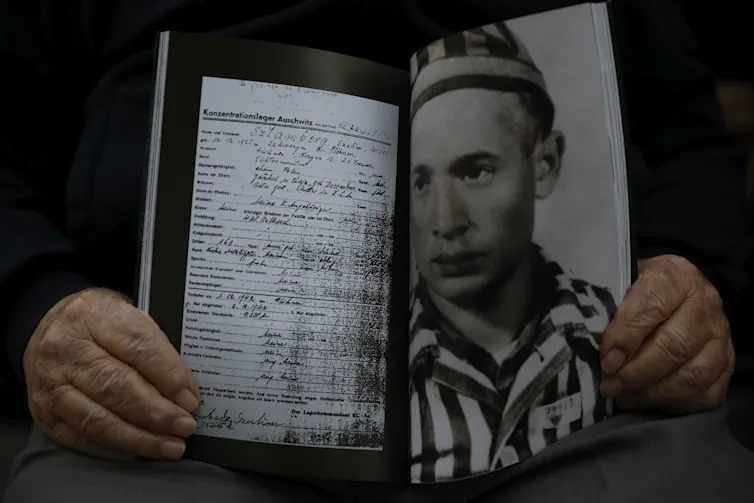
Holocaust survivor Shalom Stamberg holds a book with a photo of himself in Auschwitz, alongside a copy of his concentration camp record.
AP Photo/Ariel Schalit
By Adam G. Klein of Pace University
One in four American millennials believe the Holocaust was exaggerated or entirely made up, according to a recent national survey that sought to find out what young adults know about the genocide of nearly 6 million Jews at the hands of Nazis some 80 years ago.
That startling statistic was cited as one of the main reasons that Facebook CEO Mark Zuckerberg decided in October to finally ban Holocaust denial across the social network. Denying the Holocaust ever happened is an enduring form of anti-Semitic propaganda that attempts to deny or minimize the atrocities committed by the Nazis against the Jews during World War II.
Following Facebook’s lead, Twitter announced it, too, would remove any posts that denied the history of the Holocaust, though CEO Jack Dorsey appeared to contradict that policy at a Senate hearing weeks later.
Holocaust deniers have continued to emerge in social media, and perhaps predictably, many have migrated to less restrictive sites like Parler, where hashtags like #HolocaustNeverHappened and #HolocaustIsALie are widespread. “If you want Holocaust denial, hey, Parler is going to be great for you,” Bill Gates recently said of the social network.
While some tech companies address the rise in Holocaust revisionism, and others leave the door open, social networks have played an unwitting role in helping to distort the memory of these horrific events. But as a scholar who studies online extremism, I believe that same community could do more to protect Holocaust remembrance by highlighting the digitized accounts of those who lived through it.
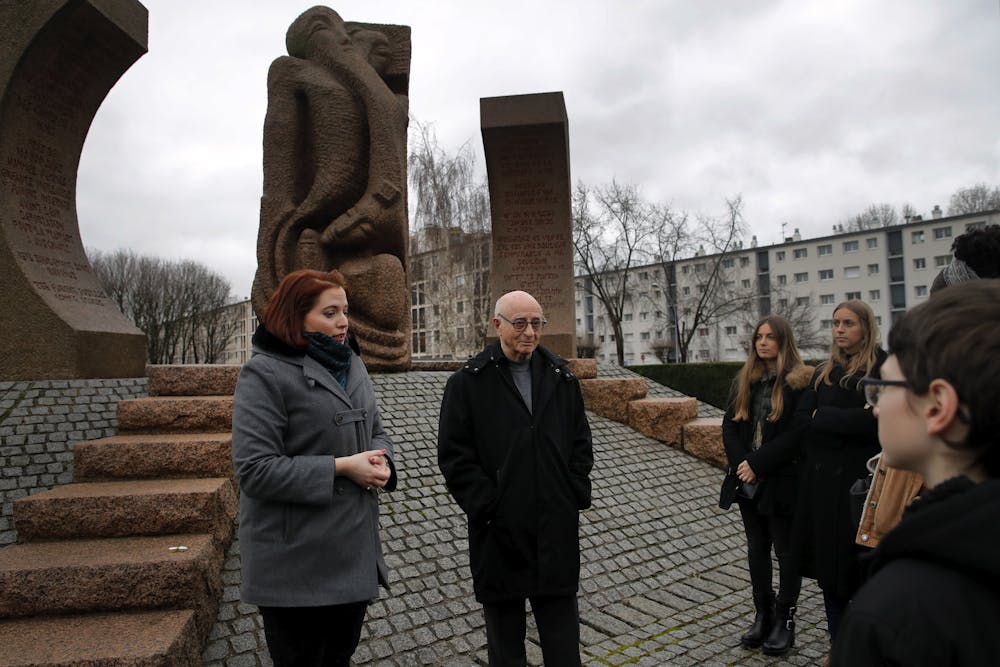
French Holocaust survivor Victor Perahia, interned as a child in the Drancy camp outside Paris and then deported to Bergen-Belsen, speaks to students during a January 2020 workshop dedicated to Holocaust remembrance at Drancy.
AP Photo/Christophe Ena
A decadeslong campaign
Holocaust denial has been a tool of anti-Semitic movements since the 1960s. Pseudo-academic groups like the Institute for Historical Review, for example, spent years working to distort the public’s aging memory of the Holocaust, which took place between 1933 and 1945.
They tried to cast doubt on the feasibility of the mass executions, and even the existence of the gas chambers. They held annual conferences and gathered fellow deniers to share their beliefs that these events were conjured up by the Jewish people mostly as a means to justify the creation of the state of Israel in 1948.
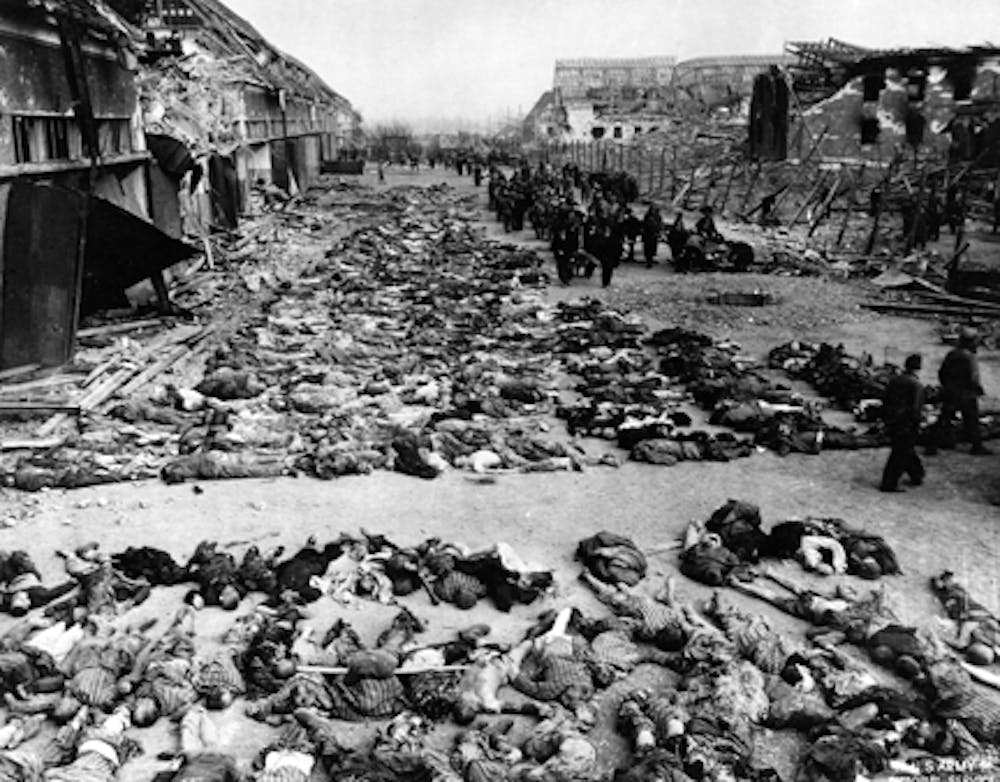
A photo taken April 12, 1945, shows just some of the bodies found by U.S. troops when they arrived at Nordhausen concentration camp in Germany.
Dwight D. Eisenhower Presidential Library
For decades, most people quickly discarded those claims, because they had heard the firsthand accounts of the survivors who were sent to the camps and witnessed the daily operation of genocide and murder of family members. The allegations of the deniers could also not withstand the accounts of soldiers who liberated the camps and made the terrible discoveries of body-filled crematoriums and mass graves.
But for deniers, Holocaust revision has little to do with history. Denialism is really a pretext for delivering anti-Semitism in the form of “scholarship,” although few academics ever gave it such attention. So hate groups had to find other means of circulation. They found it online.
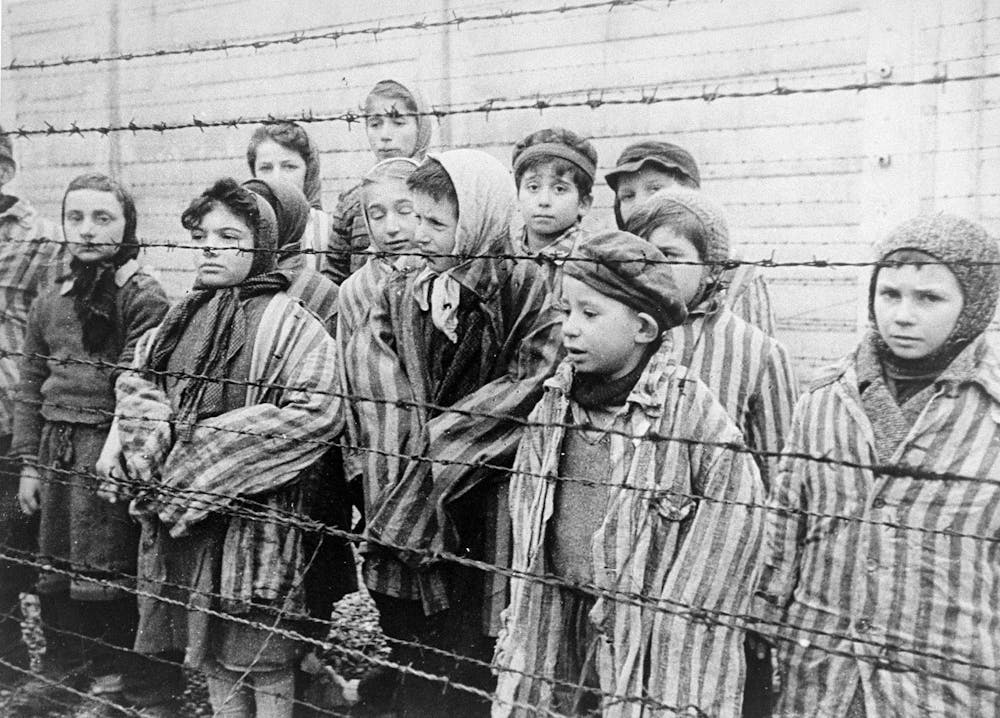
An image from a film taken during the Soviet liberation of the Auschwitz concentration camp in early 1945 shows children who had survived the Holocaust.
Belarusian State Archive of Documentary Film and Photography/United States Holocaust Memorial Museum via Wikimedia Commons
A conspiracy resurrected
When the internet took off in the late 1990s, Holocaust deniers and countless other conspiracy theorists saw an opportunity to spread their ideas to new audiences. Anti-Semitic groups could now publish their distortions in well-visited forums, and later in faux-informational websites like Metapedia and The Occidental Observer – extremist communities, in fact, that collectively receive some 350,000 visitors each month.
The internet also gave Holocaust deniers an opportunity to reach a much wider public through social media. As early as 2009, Facebook groups emerged that were dedicated to “debunking” the Holocaust, as #Holohoax became a popular hashtag on Twitter, which it continues to be today. Reddit also became a far-right haven for Holocaust deniers, one of whom gained national attention when he was the invited guest of a Florida congressman to the 2018 State of the Union address.
For deniers, the internet helped repackage their conspiracy into something less recognizable than hate. I’ve long studied this process, which I call information laundering, tracking illegitimate forms of information, like Holocaust denial, that flow through social networks, blogs and search engines. There they intermix with mainstream ideas and slowly become washed of their radical origins.
This decadeslong campaign has resulted in the current surveys that show nearly a quarter of young adults are misinformed or skeptical about the Holocaust. Only now, few survivors are left to correct the record. That makes it even more important to spread the truth. Perhaps the internet can help.
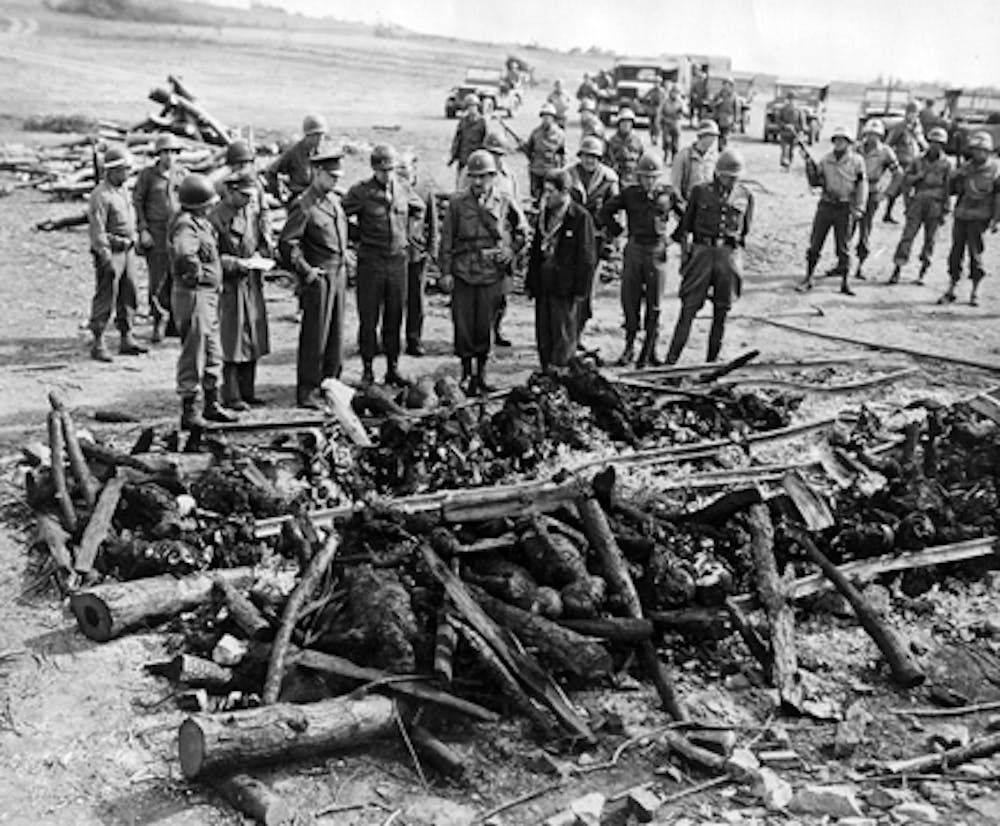
Gen. Dwight Eisenhower views the charred bodies of prisoners after the 1945 liberation of the Nazis’ Ohrdruf concentration camp.
Dwight D. Eisenhower Presidential Library
Eisenhower’s intuition
When Gen. Dwight Eisenhower visited the Buchenwald concentration camp in 1945, after its liberation by U.S. forces, he realized how impossible it might be for people to believe the scale of Nazi atrocities. He wrote powerfully of the experience, and of his reasons for going to see it in person:
“The things I saw beggar description. … In one room, where they were piled up twenty or thirty naked men, killed by starvation, George Patton would not even enter. … I made the visit deliberately, in order to be in position to give first-hand evidence of these things if ever, in the near future, there develops a tendency to charge these allegations merely to ‘propaganda.’”
Eisenhower’s words are instructions for future generations. They underscore the need to be a witness to human cruelty in order to protect the memory of, and lessons learned from, these events from those who would try to distort them.
Back online, it may not be enough for social networks to ban Holocaust denial. Similar bans in Europe haven’t limited the rise of anti-Semitism there. Instead, social networks could follow Eisenhower’s example by answering the falsehoods of Holocaust deniers with the true stories of survivors.
The internet is already home to thousands of digitized survivor testimonies. They include oral histories that could be readily activated by social networks to refute those who deny the existence of the gas chambers with the accounts of those who stood inside them or witnessed them at work. Platforms like Facebook, Twitter and Reddit might share the firsthand stories of the Nazi persecutions, separations at the camps or rare reunions, wherever false claims arise, to counter denials with facts.
Holocaust survivor Cecilie Klein-Pollack, the author’s grandmother.
United States Holocaust Memorial Museum
In the spirit of that counternarrative, I will place my grandmother’s story here. She was a Holocaust survivor. She later wrote about her experiences in Auschwitz, where, upon arrival, she and her sister were separated from their mother and her sister’s son, never to see them again. There are millions of other experiences like hers, and survivors of other genocides whose stories must be retold as well, from Armenia to Rwanda.
[Deep knowledge, daily. Sign up for The Conversation’s newsletter.]
Holocaust deniers have long waited for the time when there were no remaining survivors or witnesses to keep these histories alive. But the internet is a powerful archive. Social networks have an opportunity to combat hateful disinformation by posting the personal stories of these tragedies, and end the so-called “debate” about whether the Holocaust ever happened.
As Eisenhower well understood, history needs protecting.
This article is republished from The Conversation, a nonprofit news organization dedicated to unlocking ideas from academia, under a Creative Commons license.

About Adam G. Klein
Adam G. Klein is an associate professor of media studies at Pace University. You can read more about the author here.
Previous Post

December 7, 2020
How Hanukkah came to be an annual White House celebration


Browse Our Archives
Select a Category Buddhism Christianity Hinduism Islam Judaism Religion and society Uncategorized
Select a Month July 2024 March 2024 February 2024 January 2024 December 2023 November 2023 October 2023 September 2023 August 2023 July 2023 January 2023 August 2022 July 2022 April 2022 February 2022 January 2022 October 2021 July 2021 June 2021 May 2021 April 2021 March 2021 February 2021 January 2021 December 2020 November 2020 October 2020 September 2020 August 2020 July 2020 June 2020 May 2020
Follow Us!
TAKE THE
Religious Wisdom Quiz
Who recognized Jesus as "the Christ" in the Temple as an infant?
Select your answer to see how you score.
Zechariah Joseph Simeon Peter
Related posts from The Conversation


Electing A Virtuous President Would Make Immunity Irrelevant

Why The Olympic Games Are A ‘Civil Religious’...

The Catholic Church Is Using The Olympics To...
TRENDING AT PATHEOS Religion News

Catholic Integralists believe that religious values – specifically Christian ones – should...

Electing A Virtuous President Would Make Immunity Irrelevant
Presidential immunity can bring with it many risks. So how can we...

Why The Olympic Games Are A ‘Civil Religious’...
Sporting events form a vital space where Americans display their 'civil religious...

After more than a decade of news, research updates, and insights on...

Q: Why do Southern Baptists and like-minded Protestants...
THE RELIGION GUY’S ANSWER: Why? Simple. Because they believe that’s what the...

THE QUESTION: Is gambling evil? THE RELIGION GUY’S ANSWER: Analysts anticipate a...
view all Religion News blogs
Ad-Free & Subscriber Log-In Subscription Support
- About Us
- 2026 Calendar
- Videos
- Podcasts
- Library of World Religions
- Faith In Media Tracker
- Advertise With Us
- Write for Us
- Privacy Policy
- Terms of Service
- Do Not Sell My Data
- Contact Us
- Radiant Digital
- Manage Newsletter Subscriptions
- Unsubscribe From Notifications
- Sitemap
Copyright 2008-2026, Patheos. All rights reserved.
Subscription Support Ad-Free & Subscriber Log-In
Follow Patheos