
BuddhistCatholicContemplativeEvangelicalGeneral ChristianHinduJewishLatter-day SaintMuslimNew VisionsProgressive Christian
Beliefs
- Buddhist
- Catholic
- Contemplative
- Evangelical
- General Christian
- Hindu
- Jewish
- Latter-day Saint
- More Voices
- Muslim
- New Visions
- Pagan
- Progressive Christian
Topics
- Religion News
- Food and Religion
- Sports and Religion
- Religious Art
- Religious Music and Entertainment
- Religious Events
- History and Religion
- Style and Religion
- Politics and Religion
- Women in Religion
- Recreation Outdoors and Religion
- Business Finance and Religion
- Careers Workplace and Religion
- Education and Religion
- Family Parenting and Religion
- Health Fitness and Religion
- Home and Religion
- Relationships and Religion
- Technology and Religion
- Travel and Religion
Columnists
- Buddhist Columnists
- Business Finance and Religion Columnists
- Careers Workplace and Religion Columnists
- Catholic Columnists
- Contemplative Columnists
- Education and Religion Columnists
- Evangelists Columnists
- Family Parenting and Religion Columnists
- General Christian Columnists
- Health Fitness and Religion Columnists
- Hindu Columnists
- History and Religion Columnists
- Home and Religion Columnists
- Jewish Columnists
- More Voices Columnists
- Latter Day Columnists
- Muslim Columnists
- New Visions Columnists
- Nonreligious Columnists
- Pagan Columnists
- Politics and Religion Columnists
- Progressive Columnists
- Recreation Outdoors and Religion Columnists
- Relationships and Religion Columnists
- Religion News Columnists
- Religious Art Columnists
- Religious Events Columnists
- Religious Music and Entertainment Columnists
- Sports and Religion Columnists
- Style and Religion Columnists
- Technology and Religion Columnists
- Travel and Religion Columnists
- Women in Religion Columnists
Resource Library
- 2026 Calendar
- Library of World Religions
- The 100 Most Holy Places on Earth
- Patheos Answers
- Podcasts
- Videos
- Faith Leaders Database
- Anglican Episcopalian
- Bahai
- Baptist
- Buddhism
- Christianity
- Confucianism
- Eastern Orthodoxy
- Hinduism
- Holiness and Pentecostal
- ISKCON
- Islam
- Judaism
- Lutheran
- Methodist
- The Church of Jesus Christ of Latter-day Saints
- New Age
- Paganism
- Presbytarian and Reformed
- Protestantism
- Religion Behind the Scenes
- Roman Catholic
- Scientology
- Shia Islam
- Sikhism
- Sufism
- Sunni Islam
- Taoism
- Zen
- See all religions
Research Tools
 Ad-Free & Subscriber Log-In Subscription Support
Ad-Free & Subscriber Log-In Subscription Support
Follow Patheos 

- Trending:
- Forgiveness
- |
- Marriage
- |
- Consciousness
- |
- Death Penalty
- |
- Election
- |
- Halloween

- Home
- Religion News
- Who are patron saints and why do Catholics venerate them?
Who are patron saints and why do Catholics venerate them?
Last updated on: November 10, 2020 at 9:57 am by The Conversation
Who are patron saints and why do Catholics venerate them? 2020-11-10T09:57:20-04:00 The Conversation
Patheos Explore the world's faith through different perspectives on religion and spirituality! Patheos has the views of the prevalent religions and spiritualities of the world.
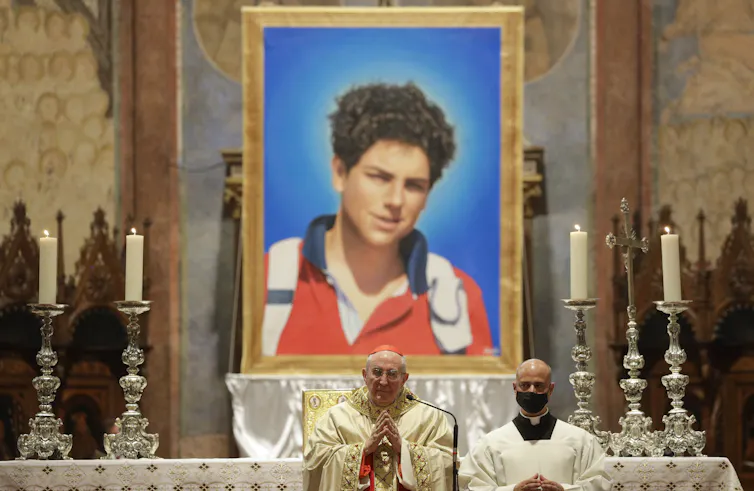
An image of 15-year-old Carlo Acutis during his beatification ceremony in Assisi, Italy.
AP Photo/Gregorio Borgia)
By Joanne M. Pierce of College of the Holy Cross
On Oct. 10, 2020, Carlo Acutis, a computer enthusiast, was beatified and given the title of “Blessed,” in the town of Assisi in Italy. Already, Catholics are calling this 15-year-old video gamer and computer programmer the “patron saint of the internet.”
Acutis, a devout Roman Catholic, died of leukemia in 2006. After his death, people in his hometown of Milan claimed that miracles took place when they prayed for his assistance with their specific needs.
So what is a “patron saint”?
Spiritual mentors
As a scholar of medieval Christian liturgy and culture, I have studied how saints have been venerated in Western Christianity and their effect on Western culture.
Since the early centuries of Christianity, men and women who died as martyrs for their faith or who lived what were deemed to be exemplary lives in other ways came to be venerated. They were believed to be men and women of “heroic virtue” who after their deaths held a privileged place with God in heaven.
Because of this, saints were considered to be spiritual guides and mentors, who would add their prayers in heaven to those offered by Christians still living in the material world. In this way, they would “intercede” with God on behalf of those who asked for their aid. Devout people would go to their tombs to receive God’s healing grace, and perhaps seek a miraculous cure for their suffering.
During the Middle Ages, the number of saints increased and the popes took charge of approving candidates for sainthood. If their cases withstood scrutiny, these locally venerated holy men and women would be declared official saints. Subsequently, their names would be added to the official list of saints.
Many patron saints
In addition, many saints were venerated for a more specific reason. These saints came to be known as patron saints. Some saints are considered patron saints of nations, cities or other geographical areas. Others were adopted by members of a particular guild or profession.
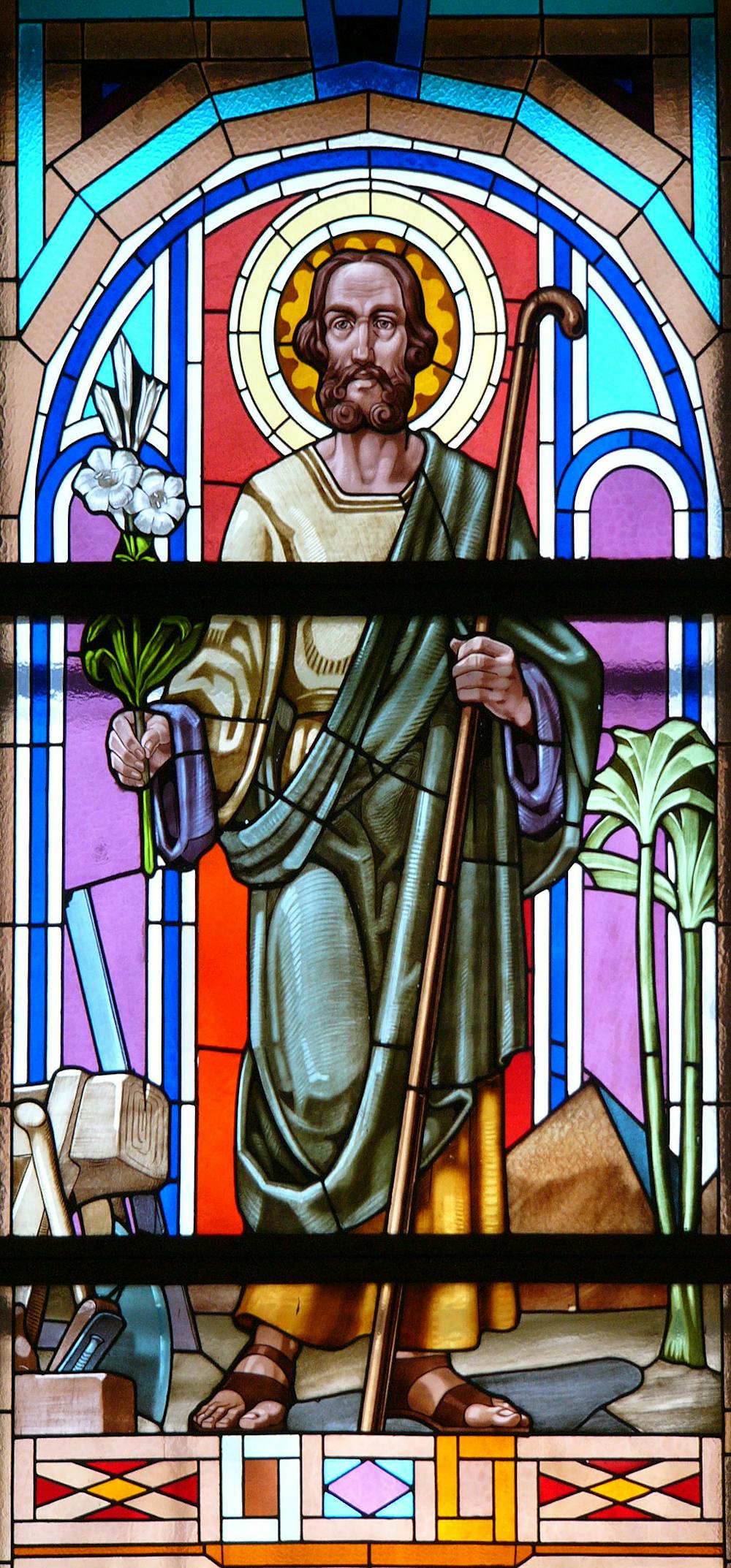
Saint Joseph – Saints Cyril and Methodius’s Church in Olomouc, Czech Republic.
CC BY
Take for example St. Florian, a patron saint of both Austria and Poland. A third-century Roman military commander in Central Europe, Florian was martyred for refusing to offer a sacrifice to the Roman state gods.
Today, he is the patron saint of firefighters as well, because of the special military unit he organized specifically to fight fires.
Patron saints are also venerated by those with particular illnesses or concerns. St. Peregrine Laziosi, a 14th-century priest who suffered from cancer himself, is the patron saint of cancer patients.
Some patron saints are invoked in unusual ways. For example, St. Joseph, honored as the spouse of the Virgin Mary and guardian of the child Jesus, was invoked in prayer for centuries by Catholics for assistance in selling a house or property. The custom may date back the 16th century, when the Spanish nun St. Teresa of Avila and her community prayed to St. Joseph for assistance in purchasing a house. They may have chosen St. Joseph because he is the patron saint of fathers, families and carpenters.
Sometimes a holy medal of St. Joseph would be buried in the property. In the United States, it has become popular for homeowners, Catholic or not, to buy a statue of St. Joseph and bury it in the front yard of the house to help it sell more quickly.
Miracles and popular culture
Other saints too have had an influence on popular culture in the United States. For example, the figure of Santa Claus is based on St. Nicholas of Myra.
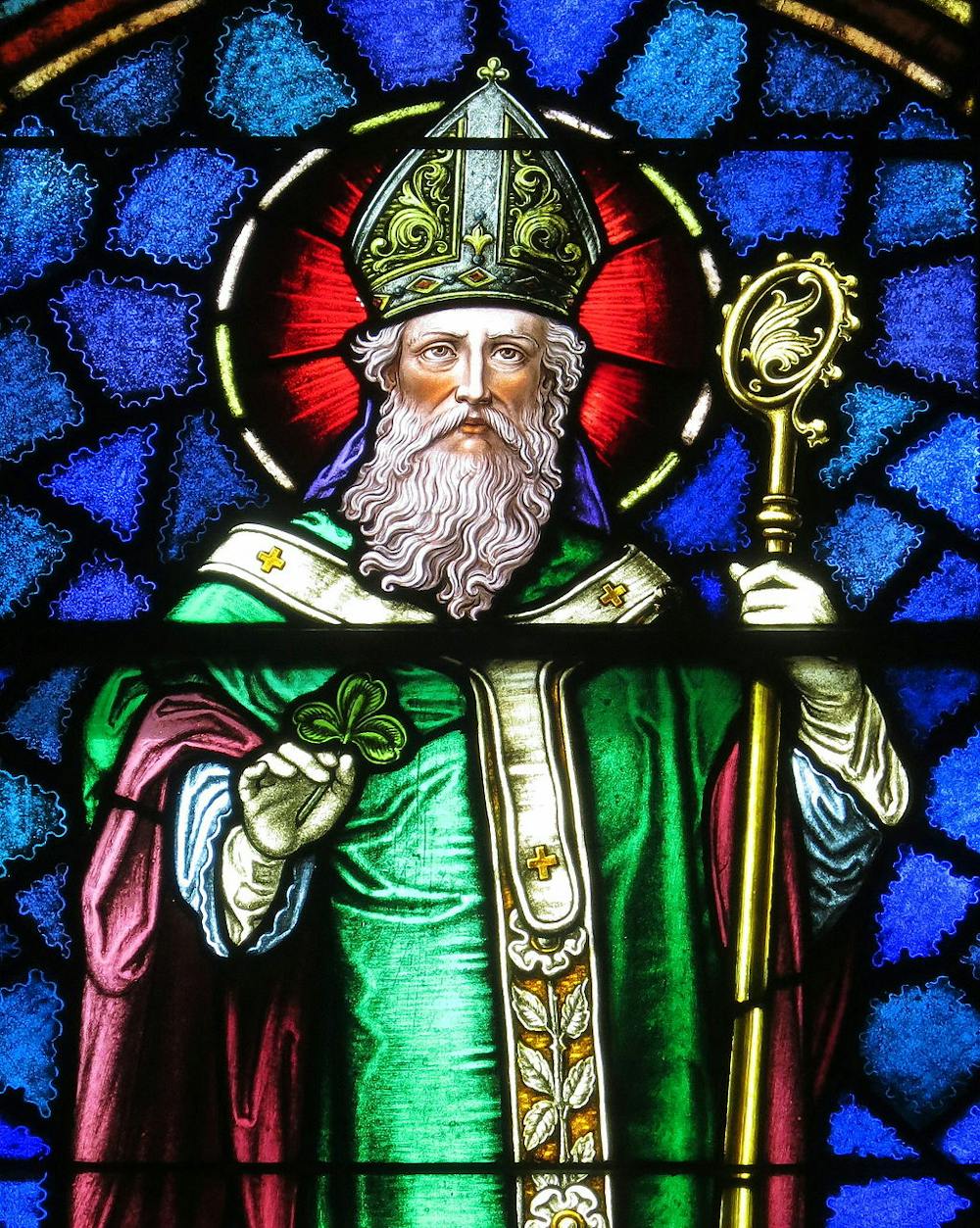
Saint Patrick Catholic Church, Junction City, Ohio.
Nheyob – Own work/Wikimedia Commons, CC BY-NC-SA
Nicholas is not only the patron saint of children, but also certain professions. Nicholas was a real bishop active in the fourth century, but the later legend of his life included some dubious miracle stories, including bringing back to life three young students who had been killed by an innkeeper. The man had hidden their dismembered bodies in a barrel, so medieval brewers and barrel-makers claimed him as their patron saint.
Another popular saint in the United States is St. Patrick, a fifth-century Christian missionary to the people of Ireland; he was soon regarded as the patron saint of that country.
For centuries, the Irish observed his feast day on March 17. In the 17th century this was made a universal feast day for all Roman Catholics.
Irish Catholic immigrants brought his feast to the United States, where it is celebrated in many cities through parades, wearing green clothing and drinking green beer. The city of Chicago for decades has dyed the Chicago river green on that day.
Keeping up with modern times
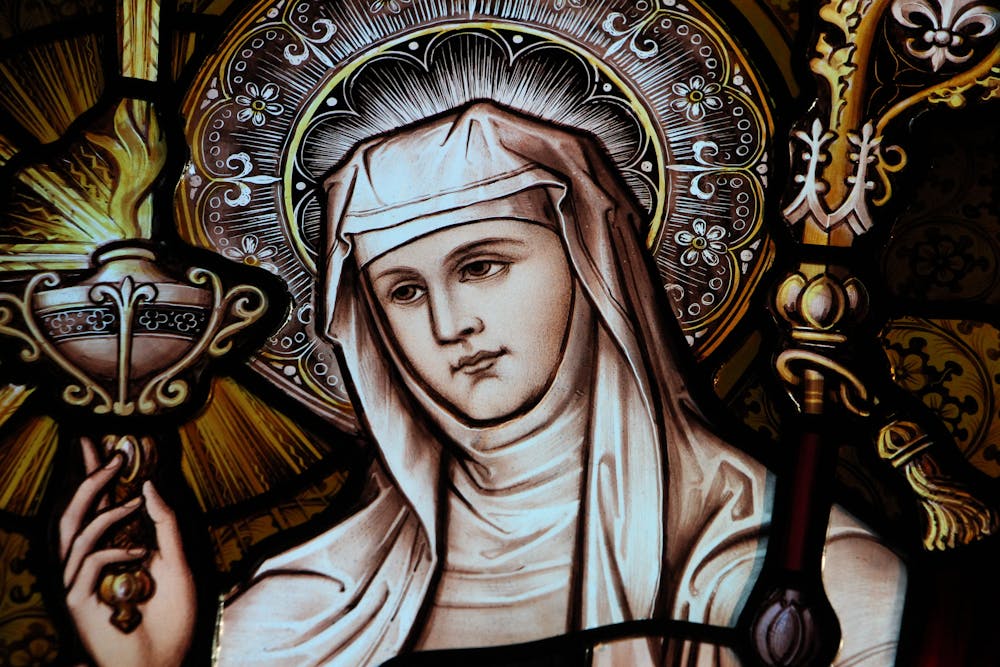
St. Clare of Assisi.
Fr James Bradley/Flickr, CC BY
Assignment of patron saints also keeps up with technological advances. In 1958, for example, Pope Pius XII named St. Clare of Assisi, who died in the 13th century, the patron saint of television. On her deathbed, St. Clare is said to have miraculously seen events at Christmas Eve Mass being celebrated some two miles away.
[Deep knowledge, daily. Sign up for The Conversation’s newsletter.]
It is not only the young, 21st-century teenager Carlo Acutis, who loved computers and designed web pages, who is slated to be the patron saint of the internet: St. Isidore of Seville, a seventh-century bishop and scholar who authored a then-comprehensive encyclopedia, is already venerated as such.
But contemporary Catholics should not be surprised that another more contemporary patron saint is being chosen to guide those on the internet to use its knowledge and influence wisely. In the end, this is the role of all patron saints.
This article is republished from The Conversation, a nonprofit news organization dedicated to unlocking ideas from academia, under a Creative Commons license.
[Deep knowledge, daily. Sign up for The Conversation’s newsletter.]

About Joanne M. Pierce
Joanne M. Pierce is a Professor of Religious Studies at the College of the Holy Cross. Her research interests include liturgical studies, medieval Christianity, ritual studies, ecumenical theology, theology and speculative/science fiction. You can read more about the author here.

Next Post

November 22, 2020 Pro-mask or anti-mask? Your moral beliefs probably predict your stance
Browse Our Archives
Select a Category Buddhism Christianity Hinduism Islam Judaism Religion and society Uncategorized
Select a Month July 2024 March 2024 February 2024 January 2024 December 2023 November 2023 October 2023 September 2023 August 2023 July 2023 January 2023 August 2022 July 2022 April 2022 February 2022 January 2022 October 2021 July 2021 June 2021 May 2021 April 2021 March 2021 February 2021 January 2021 December 2020 November 2020 October 2020 September 2020 August 2020 July 2020 June 2020 May 2020
Follow Us!
TAKE THE
Religious Wisdom Quiz
Which city did David conquer and make his capital?
Select your answer to see how you score.
Bethel Jerusalem Gibeon Hebron
Related posts from The Conversation


Electing A Virtuous President Would Make Immunity Irrelevant

Why The Olympic Games Are A ‘Civil Religious’...

The Catholic Church Is Using The Olympics To...
TRENDING AT PATHEOS Religion News

Catholic Integralists believe that religious values – specifically Christian ones – should...

Electing A Virtuous President Would Make Immunity Irrelevant
Presidential immunity can bring with it many risks. So how can we...

Why The Olympic Games Are A ‘Civil Religious’...
Sporting events form a vital space where Americans display their 'civil religious...

After more than a decade of news, research updates, and insights on...

Q: Why do Southern Baptists and like-minded Protestants...
THE RELIGION GUY’S ANSWER: Why? Simple. Because they believe that’s what the...

THE QUESTION: Is gambling evil? THE RELIGION GUY’S ANSWER: Analysts anticipate a...
view all Religion News blogs
Ad-Free & Subscriber Log-In Subscription Support
- About Us
- 2026 Calendar
- Videos
- Podcasts
- Library of World Religions
- Faith In Media Tracker
- Advertise With Us
- Write for Us
- Privacy Policy
- Terms of Service
- Do Not Sell My Data
- Contact Us
- Radiant Digital
- Manage Newsletter Subscriptions
- Unsubscribe From Notifications
- Sitemap
Copyright 2008-2026, Patheos. All rights reserved.
Subscription Support Ad-Free & Subscriber Log-In
Follow Patheos