
BuddhistCatholicContemplativeEvangelicalGeneral ChristianHinduJewishLatter-day SaintMuslimNew VisionsProgressive Christian
Beliefs
- Buddhist
- Catholic
- Contemplative
- Evangelical
- General Christian
- Hindu
- Jewish
- Latter-day Saint
- More Voices
- Muslim
- New Visions
- Pagan
- Progressive Christian
Topics
- Religion News
- Food and Religion
- Sports and Religion
- Religious Art
- Religious Music and Entertainment
- Religious Events
- History and Religion
- Style and Religion
- Politics and Religion
- Women in Religion
- Recreation Outdoors and Religion
- Business Finance and Religion
- Careers Workplace and Religion
- Education and Religion
- Family Parenting and Religion
- Health Fitness and Religion
- Home and Religion
- Relationships and Religion
- Technology and Religion
- Travel and Religion
Columnists
- Buddhist Columnists
- Business Finance and Religion Columnists
- Careers Workplace and Religion Columnists
- Catholic Columnists
- Contemplative Columnists
- Education and Religion Columnists
- Evangelists Columnists
- Family Parenting and Religion Columnists
- General Christian Columnists
- Health Fitness and Religion Columnists
- Hindu Columnists
- History and Religion Columnists
- Home and Religion Columnists
- Jewish Columnists
- More Voices Columnists
- Latter Day Columnists
- Muslim Columnists
- New Visions Columnists
- Nonreligious Columnists
- Pagan Columnists
- Politics and Religion Columnists
- Progressive Columnists
- Recreation Outdoors and Religion Columnists
- Relationships and Religion Columnists
- Religion News Columnists
- Religious Art Columnists
- Religious Events Columnists
- Religious Music and Entertainment Columnists
- Sports and Religion Columnists
- Style and Religion Columnists
- Technology and Religion Columnists
- Travel and Religion Columnists
- Women in Religion Columnists
Resource Library
- 2026 Calendar
- Library of World Religions
- The 100 Most Holy Places on Earth
- Patheos Answers
- Podcasts
- Videos
- Faith Leaders Database
- Anglican Episcopalian
- Bahai
- Baptist
- Buddhism
- Christianity
- Confucianism
- Eastern Orthodoxy
- Hinduism
- Holiness and Pentecostal
- ISKCON
- Islam
- Judaism
- Lutheran
- Methodist
- The Church of Jesus Christ of Latter-day Saints
- New Age
- Paganism
- Presbytarian and Reformed
- Protestantism
- Religion Behind the Scenes
- Roman Catholic
- Scientology
- Shia Islam
- Sikhism
- Sufism
- Sunni Islam
- Taoism
- Zen
- See all religions
Research Tools
 Ad-Free & Subscriber Log-In Subscription Support
Ad-Free & Subscriber Log-In Subscription Support
Follow Patheos 

- Trending:
- Forgiveness
- |
- Marriage
- |
- Consciousness
- |
- Death Penalty
- |
- Election
- |
- Halloween

- Home
- Religion News
- What’s next for American evangelicals after Trump leaves office?
What’s next for American evangelicals after Trump leaves office?
Last updated on: November 22, 2020 at 5:47 pm by The Conversation
What’s next for American evangelicals after Trump leaves office? 2020-11-22T17:47:53-04:00 The Conversation
Patheos Explore the world's faith through different perspectives on religion and spirituality! Patheos has the views of the prevalent religions and spiritualities of the world.
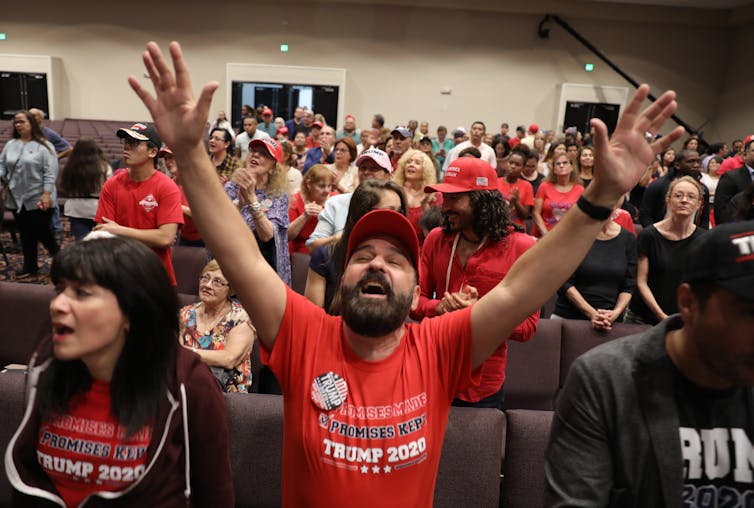
Many evangelical voters believe they found a protector in chief in Donald Trump.
Joe Raedle/Getty Images
By Stewart Clem of Aquinas Institute of Theology
Donald Trump, by his own words and actions, does not appear to be the most religious person.
He has claimed he doesn’t seek forgiveness from God, and he once tried to put money in a Communion plate. Apart from his controversial photo op while holding up a Bible in front of St. John’s Episcopal Church, he doesn’t seem especially concerned with Christian symbolism.
And yet 76% of white evangelical voters supported him in the 2020 election. It’s clear American evangelicals value something other than his religious devotion.
As a Christian ethicist, I’m especially interested in the ways Christians seek to gain and use political power. Why did so many Christians vote for Trump? And what are they afraid of losing when he leaves?
Many evangelical Christians are drawn to Trump’s promises to protect religious liberty. President-elect Biden, meanwhile, has also promised to protect religious liberty. But it might not be on evangelicals’ terms.
Diminishing power?
The power of evangelical Christians in the U.S. has never been officially state sanctioned. The First Amendment to the U.S. Constitution prohibits it.
For over 200 years, American evangelicals have relied on Christianity’s cultural influence to preserve their vision of public life. And that influence is not to be underestimated.
In his bestselling book, “Dominion: How the Christian Revolution Remade the World,” Tom Holland explains, “To live in a Western country is to live in a society still utterly saturated by Christian concepts and assumptions.”
This is why so many refer to America as a “Christian nation” even though it has never officially recognized Christianity as the state religion.
Conservative Christian political organizations have been buoyed by Christianity’s cultural capital. In the late 1970s and 1980s, for example, the Moral Majority formed a broad coalition of Christians to advance conservative social values across the nation.
But that cultural capital has declined as America becomes more diverse. Today, far fewer Americans identify as Christian than 10 years ago, and only 1 in 4 Americans call themselves evangelical Christian.
Why evangelicals love Trump
American evangelicals, aware that their numbers and influence are in decline, have tried to undercut that decline through political means. Their highest priority is electing leaders whose policies will allow evangelicalism to flourish.
Typically, this means that evangelicals prefer to vote for evangelical candidates. As Christian conservative leader Beverly LaHaye declared, “Politicians who do not use the Bible to guide their public and private lives do not belong in government.”
But this is why President Trump has been such an anomaly. He has demonstrated a lack of familiarity with the Bible and basic Christian teachings. Yet, his religious supporters don’t seem to mind. Even among white evangelicals, only 12% believe he is “very religious.”
This suggests that today’s evangelicals are unfazed by Trump’s apparent lack of personal piety. They believe religious liberty is under threat, and they want a president who promises to protect that liberty.
A protector in chief
Evangelical Protestants are more likely than any other large U.S. religious denomination to believe their religious freedom is under attack, according to a recent AP-NORC poll.
Many people are puzzled by evangelicals’ anxiety over religious freedom. While it’s true that government restrictions on religion are rising across the globe, this simply isn’t the case in the U.S.
As conservative Christian political commentator David French recently argued, “People of faith in the United States of America enjoy more liberty and more real political power than any faith community in the developed world.” He argues that while religious liberty has always been under attack in the U.S., Christians have no reason to fear that it’s going away anytime soon.
But for many American evangelicals, the threat of attack is enough to create the need for a protector in chief. And President Trump has been happy to assume that role.
In 2018, he signed an executive order that established the White House Faith and Opportunity Initiative. “This Initiative is working to remove barriers which have unfairly prevented faith based organizations from working with or receiving funding from the federal government,” he explained.
Biden and religious liberty
President-elect Joe Biden has proposed his own plan for safeguarding religious freedom. It articulates a number of broad protections that most evangelicals would be likely to support, at least in theory.
But in Biden’s plan to advance LGTBQ equality, he proposes the very thing many American evangelicals fear:
“Religious freedom is a fundamental American value. But states have inappropriately used broad exemptions to allow businesses, medical providers, social service agencies, state and local government officials, and others to discriminate against LGBTQ+ people … Biden will reverse Trump’s policies misusing these broad exemptions and fight so that no one is turned away from a business or refused service by a government official just because of who they are or who they love.”
In an essay written just before the election, Al Mohler, president of the Southern Baptist Theological Seminary, warned, “The primary front of religious liberty controversy is likely to be related to LGBTQ issues, and both Biden and Harris are eager to advance the sexual revolution on every front.” Given what the incoming president and vice president have said on the issue, he is probably right.
American evangelicals’ political power is in decline, and that decline would likely continue with or without Trump in office. His Supreme Court appointments have made evangelicals happy and will have a lasting impact. But changing demographics and a growing number of nonreligious voters mean that evangelicals will need to develop a strategy for the long game. In light of this, it may be wise for them not to direct all of their energy toward electing a protector in chief.
Perhaps instead they might seek to answer a question posed by Christian ethicist Luke Bretherton: “In loving my neighbor, how can I keep faith with my distinctive commitments while also forming a common life with neighbors who have a different vision of life than I do?”
[Deep knowledge, daily. Sign up for The Conversation’s newsletter.]
Unless evangelicals can manage some major political victories in the coming years, they may not have much choice.

This article is republished from The Conversation, a nonprofit news organization dedicated to unlocking ideas from academia, under a Creative Commons license.

About Stewart Clem
Stewart Clem is a Christian ethicist and a priest in The Episcopal Church and an Assistant Professor of Moral Theology, Aquinas Institute of Theology. You can read more about the author here.


Browse Our Archives
Select a Category Buddhism Christianity Hinduism Islam Judaism Religion and society Uncategorized
Select a Month July 2024 March 2024 February 2024 January 2024 December 2023 November 2023 October 2023 September 2023 August 2023 July 2023 January 2023 August 2022 July 2022 April 2022 February 2022 January 2022 October 2021 July 2021 June 2021 May 2021 April 2021 March 2021 February 2021 January 2021 December 2020 November 2020 October 2020 September 2020 August 2020 July 2020 June 2020 May 2020
Follow Us!
TAKE THE
Religious Wisdom Quiz
What instrument did David play?
Select your answer to see how you score.
Lyre Trumpet Flute Harp
Related posts from The Conversation


Why The Olympic Games Are A ‘Civil Religious’...

How Christians Hold Differing Views On The Resurrection
Tattooing Dates Back To The Crucifixion
TRENDING AT PATHEOS Religion News

Catholic Integralists believe that religious values – specifically Christian ones – should...

Electing A Virtuous President Would Make Immunity Irrelevant
Presidential immunity can bring with it many risks. So how can we...

Why The Olympic Games Are A ‘Civil Religious’...
Sporting events form a vital space where Americans display their 'civil religious...

After more than a decade of news, research updates, and insights on...

Q: Why do Southern Baptists and like-minded Protestants...
THE RELIGION GUY’S ANSWER: Why? Simple. Because they believe that’s what the...

THE QUESTION: Is gambling evil? THE RELIGION GUY’S ANSWER: Analysts anticipate a...
view all Religion News blogs
Ad-Free & Subscriber Log-In Subscription Support
- About Us
- 2026 Calendar
- Videos
- Podcasts
- Library of World Religions
- Faith In Media Tracker
- Advertise With Us
- Write for Us
- Privacy Policy
- Terms of Service
- Do Not Sell My Data
- Contact Us
- Radiant Digital
- Manage Newsletter Subscriptions
- Unsubscribe From Notifications
- Sitemap
Copyright 2008-2026, Patheos. All rights reserved.
Subscription Support Ad-Free & Subscriber Log-In
Follow Patheos