
BuddhistCatholicContemplativeEvangelicalGeneral ChristianHinduJewishLatter-day SaintMuslimNew VisionsProgressive Christian
Beliefs
- Buddhist
- Catholic
- Contemplative
- Evangelical
- General Christian
- Hindu
- Jewish
- Latter-day Saint
- More Voices
- Muslim
- New Visions
- Pagan
- Progressive Christian
Topics
- Religion News
- Food and Religion
- Sports and Religion
- Religious Art
- Religious Music and Entertainment
- Religious Events
- History and Religion
- Style and Religion
- Politics and Religion
- Women in Religion
- Recreation Outdoors and Religion
- Business Finance and Religion
- Careers Workplace and Religion
- Education and Religion
- Family Parenting and Religion
- Health Fitness and Religion
- Home and Religion
- Relationships and Religion
- Technology and Religion
- Travel and Religion
Columnists
- Buddhist Columnists
- Business Finance and Religion Columnists
- Careers Workplace and Religion Columnists
- Catholic Columnists
- Contemplative Columnists
- Education and Religion Columnists
- Evangelists Columnists
- Family Parenting and Religion Columnists
- General Christian Columnists
- Health Fitness and Religion Columnists
- Hindu Columnists
- History and Religion Columnists
- Home and Religion Columnists
- Jewish Columnists
- More Voices Columnists
- Latter Day Columnists
- Muslim Columnists
- New Visions Columnists
- Nonreligious Columnists
- Pagan Columnists
- Politics and Religion Columnists
- Progressive Columnists
- Recreation Outdoors and Religion Columnists
- Relationships and Religion Columnists
- Religion News Columnists
- Religious Art Columnists
- Religious Events Columnists
- Religious Music and Entertainment Columnists
- Sports and Religion Columnists
- Style and Religion Columnists
- Technology and Religion Columnists
- Travel and Religion Columnists
- Women in Religion Columnists
Resource Library
- 2026 Calendar
- Library of World Religions
- The 100 Most Holy Places on Earth
- Patheos Answers
- Podcasts
- Videos
- Faith Leaders Database
- Anglican Episcopalian
- Bahai
- Baptist
- Buddhism
- Christianity
- Confucianism
- Eastern Orthodoxy
- Hinduism
- Holiness and Pentecostal
- ISKCON
- Islam
- Judaism
- Lutheran
- Methodist
- The Church of Jesus Christ of Latter-day Saints
- New Age
- Paganism
- Presbytarian and Reformed
- Protestantism
- Religion Behind the Scenes
- Roman Catholic
- Scientology
- Shia Islam
- Sikhism
- Sufism
- Sunni Islam
- Taoism
- Zen
- See all religions
Research Tools
 Ad-Free & Subscriber Log-In Subscription Support
Ad-Free & Subscriber Log-In Subscription Support
Follow Patheos 

- Trending:
- Forgiveness
- |
- Marriage
- |
- Consciousness
- |
- Death Penalty
- |
- Election
- |
- Halloween

- Home
- Religion News
- Pro-mask or anti-mask? Your moral beliefs probably predict your stance
Pro-mask or anti-mask? Your moral beliefs probably predict your stance
Last updated on: November 22, 2020 at 5:46 pm by The Conversation
Pro-mask or anti-mask? Your moral beliefs probably predict your stance 2020-11-22T17:46:06-04:00 The Conversation
Patheos Explore the world's faith through different perspectives on religion and spirituality! Patheos has the views of the prevalent religions and spiritualities of the world.
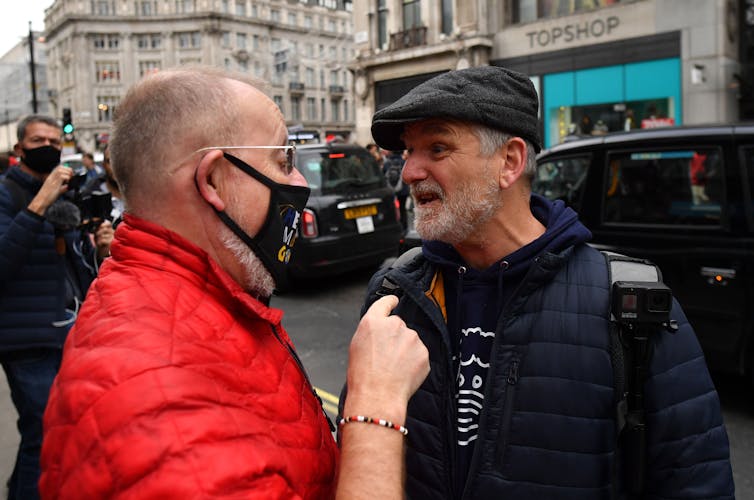
Moral combat: Do you wear a face mask to show you care about others? Or do you refuse because you believe they defy human nature?
Justin Tallis/AFP via Getty Images
By Eugene Y. Chan of Purdue University
Governments around the world have recommended or mandated various behaviors to slow the spread of COVID-19. These include staying at home, wearing face masks and practicing social distancing.
Yet individuals continue to flout these recommendations and ignore explicit rules about wearing face masks. In the U.S., U.K. and Australia, crowds have gathered closely together to protest against lockdowns.
All this poses the question: Why are people not following the rules that protect not only their own health but the health of their community and nation? And how can policymakers and public health officials design better messages to encourage uptake?
How morals guide our decisions
In my latest research, I studied how people perceive the three main recommended behaviors as either “right” or “wrong.” I grounded my research on Moral Foundations Theory, which states that people judge the “rightness” or “wrongness” of behaviors along five different moral concerns or “foundations.”
The first is whether an action shows you care; the second is whether an action upholds standards of equality; the third is whether it shows loyalty to the group; the fourth is whether it shows deference to authority; and the last is whether it conforms to impulses and the natural way of doing things.
Some foundations are relevant to certain behaviors; others, not so much. For example, parents who are “anti-vaxxers” hold this view because they see vaccines as harming a child’s natural immunological defenses. Although that is not true, vaccines still challenge their perception of what’s natural. Likewise, when it comes to charitable giving, people donate because they see it as showing they care – not because they see it as “natural” to do so.
One benefit of exploring which moral foundation is relevant to a certain behavior is that it offers a better understanding of how to encourage or discourage that behavior.
For example, policymakers now understand that to encourage vaccinations for children, messages aimed at hesitant parents need to help them see how vaccinations can actually boost a child’s natural defenses. But telling these parents that “it shows you care for your child” has little effect, because the “caring” foundation is less relevant.
Morality and COVID-19
I surveyed 1,033 Americans during the last week in April 2020, asking them how relevant each moral foundation is to staying at home, wearing face masks and practicing social distancing.
I found that Americans, on the whole, associated all three behaviors with the “caring” and “equality” foundations. Indeed, staying at home when you don’t need to go out shows you care about others – I call this the caring foundation. But staying at home helps flatten the curve only if everyone does it – the equality foundation. The same can be said for wearing face masks and social distancing.
But I also found important age differences in two other moral foundations.
Younger adults felt that staying at home and wearing face masks go against their nature – what I call the nature foundation. It would make sense. Younger adults are more likely to crave social interactions, and so staying at home goes against what they perceive to be natural human behavior.
Meanwhile, wearing face masks not only is uncomfortable but hides one’s face, which also goes against beliefs about how human beings are supposed to socialize.
Older adults, on the other hand, felt that all three behaviors show a greater value placed on communal goals and public health over personal comfort.
Interestingly, the authority foundation didn’t relate to any of the three behaviors, regardless of age.
Policy implications
By understanding which moral foundations are relevant, social marketers, public health officials and policymakers can design more effective appeals to get people to stay at home, wear face masks and stay 6 feet apart.
For example, because Americans see the actions as showing they care, emphasizing how those behaviors show caring will likely increase compliance.
To target younger adults, who see staying at home and wearing face masks as going against the social nature of human beings, messages should suggest how these actions can actually facilitate socialization.
For example: “Wearing a mask lets you stay in touch, safely.” Common slogans such as “Staying Apart, Together,” while whimsical and a play on words, are unlikely to increase younger adults’ uptake, since the “communal” foundation is a less relevant concern for them. Those slogans may be more effective for older adults.
If governments and public health officials really want to promote staying at home, wearing face masks and practicing social distancing, they can’t just say “it’s moral to do so.” They might want to learn to appeal to the relevant moral convictions of the population they are targeting.
This article is republished from The Conversation, a nonprofit news organization dedicated to unlocking ideas from academia, under a Creative Commons license.

About Eugene Y. Chan
Eugene Chan is Associate Professor in the College of Health and Human Sciences at Purdue University. You can read more about the author here.
Previous Post

November 10, 2020
Who are patron saints and why do Catholics venerate them?
Next Post

November 22, 2020 What's next for American evangelicals after Trump leaves office?
Browse Our Archives
Select a Category Buddhism Christianity Hinduism Islam Judaism Religion and society Uncategorized
Select a Month July 2024 March 2024 February 2024 January 2024 December 2023 November 2023 October 2023 September 2023 August 2023 July 2023 January 2023 August 2022 July 2022 April 2022 February 2022 January 2022 October 2021 July 2021 June 2021 May 2021 April 2021 March 2021 February 2021 January 2021 December 2020 November 2020 October 2020 September 2020 August 2020 July 2020 June 2020 May 2020
Follow Us!
TAKE THE
Religious Wisdom Quiz
Which Christian group is known for following a strict dress code and pacifism?
Select your answer to see how you score.
Baptists Amish Pentecostals Lutherans
Related posts from The Conversation


Electing A Virtuous President Would Make Immunity Irrelevant

Why The Olympic Games Are A ‘Civil Religious’...

The Catholic Church Is Using The Olympics To...
TRENDING AT PATHEOS Religion News

Catholic Integralists believe that religious values – specifically Christian ones – should...

Electing A Virtuous President Would Make Immunity Irrelevant
Presidential immunity can bring with it many risks. So how can we...

Why The Olympic Games Are A ‘Civil Religious’...
Sporting events form a vital space where Americans display their 'civil religious...

After more than a decade of news, research updates, and insights on...

Q: Why do Southern Baptists and like-minded Protestants...
THE RELIGION GUY’S ANSWER: Why? Simple. Because they believe that’s what the...

THE QUESTION: Is gambling evil? THE RELIGION GUY’S ANSWER: Analysts anticipate a...
view all Religion News blogs
Ad-Free & Subscriber Log-In Subscription Support
- About Us
- 2026 Calendar
- Videos
- Podcasts
- Library of World Religions
- Faith In Media Tracker
- Advertise With Us
- Write for Us
- Privacy Policy
- Terms of Service
- Do Not Sell My Data
- Contact Us
- Radiant Digital
- Manage Newsletter Subscriptions
- Unsubscribe From Notifications
- Sitemap
Copyright 2008-2026, Patheos. All rights reserved.
Subscription Support Ad-Free & Subscriber Log-In
Follow Patheos