
BuddhistCatholicContemplativeEvangelicalGeneral ChristianHinduJewishLatter-day SaintMuslimNew VisionsProgressive Christian
Beliefs
- Buddhist
- Catholic
- Contemplative
- Evangelical
- General Christian
- Hindu
- Jewish
- Latter-day Saint
- More Voices
- Muslim
- New Visions
- Pagan
- Progressive Christian
Topics
- Religion News
- Food and Religion
- Sports and Religion
- Religious Art
- Religious Music and Entertainment
- Religious Events
- History and Religion
- Style and Religion
- Politics and Religion
- Women in Religion
- Recreation Outdoors and Religion
- Business Finance and Religion
- Careers Workplace and Religion
- Education and Religion
- Family Parenting and Religion
- Health Fitness and Religion
- Home and Religion
- Relationships and Religion
- Technology and Religion
- Travel and Religion
Columnists
- Buddhist Columnists
- Business Finance and Religion Columnists
- Careers Workplace and Religion Columnists
- Catholic Columnists
- Contemplative Columnists
- Education and Religion Columnists
- Evangelists Columnists
- Family Parenting and Religion Columnists
- General Christian Columnists
- Health Fitness and Religion Columnists
- Hindu Columnists
- History and Religion Columnists
- Home and Religion Columnists
- Jewish Columnists
- More Voices Columnists
- Latter Day Columnists
- Muslim Columnists
- New Visions Columnists
- Nonreligious Columnists
- Pagan Columnists
- Politics and Religion Columnists
- Progressive Columnists
- Recreation Outdoors and Religion Columnists
- Relationships and Religion Columnists
- Religion News Columnists
- Religious Art Columnists
- Religious Events Columnists
- Religious Music and Entertainment Columnists
- Sports and Religion Columnists
- Style and Religion Columnists
- Technology and Religion Columnists
- Travel and Religion Columnists
- Women in Religion Columnists
Resource Library
- 2026 Calendar
- Library of World Religions
- The 100 Most Holy Places on Earth
- Patheos Answers
- Podcasts
- Videos
- Faith Leaders Database
- Anglican Episcopalian
- Bahai
- Baptist
- Buddhism
- Christianity
- Confucianism
- Eastern Orthodoxy
- Hinduism
- Holiness and Pentecostal
- ISKCON
- Islam
- Judaism
- Lutheran
- Methodist
- The Church of Jesus Christ of Latter-day Saints
- New Age
- Paganism
- Presbytarian and Reformed
- Protestantism
- Religion Behind the Scenes
- Roman Catholic
- Scientology
- Shia Islam
- Sikhism
- Sufism
- Sunni Islam
- Taoism
- Zen
- See all religions
Research Tools
 Ad-Free & Subscriber Log-In Subscription Support
Ad-Free & Subscriber Log-In Subscription Support
Follow Patheos 

- Trending:
- Forgiveness
- |
- Marriage
- |
- Consciousness
- |
- Death Penalty
- |
- Election
- |
- Halloween

- Home
- Religion News
- How George Washington used his first Thanksgiving as president to unite a new country
How George Washington used his first Thanksgiving as president to unite a new country
Last updated on: November 25, 2020 at 1:44 pm by The Conversation
How George Washington used his first Thanksgiving as president to unite a new country 2020-11-25T13:44:31-04:00 The Conversation
Patheos Explore the world's faith through different perspectives on religion and spirituality! Patheos has the views of the prevalent religions and spiritualities of the world.
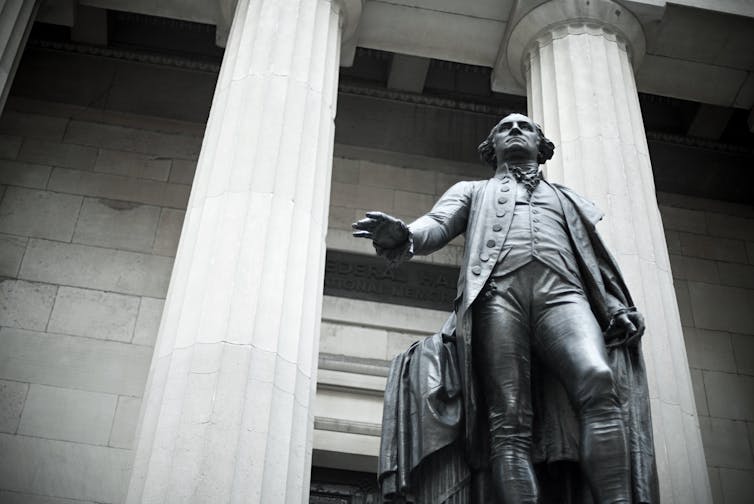
President George Washington aimed to unify the country with his first Thanksgiving message.
Getty Images
By Maurizio Valsania of Università di Torino
On Thursday, Nov. 26, 1789, George Washington woke early. Assisted by his enslaved valets – William “Billy” Lee and the young Christopher Sheels – he powdered his hair, put on his favorite black velvet suit, tied his white neckwear and donned his yellow gloves.
Finally ready, he set out to travel the short distance from the President’s House, at what used to be 3 Cherry Street, New York, and St. Paul’s Chapel, which still stands at 209 Broadway.
He had an important aim that day: to celebrate Thanksgiving. Washington had thought carefully about this Thanksgiving, the first of his presidency. On Oct. 3, 1789, following the recommendation of a joint committee of the Senate and House of Representatives, Washington had issued a proclamation. He urged the people of the United States to celebrate “a day of public thanksgiving and prayer.”
But Washington believed that particular Thanksgiving in 1789 was a crucial occasion. He would use it to call on the people he now led to hold their new country together in the face of forces that he knew could pull it apart.
Devotion in the service of unity
It was not the first Thanksgiving Americans celebrated. The first took place at Plymouth colony in the autumn of 1621 – Pilgrims held a feast to thank God for their first harvest and invited members of the neighboring Wampanoag tribe.
It was not even the first national Thanksgiving – which was held on Dec. 18, 1777, at then-General Washington’s behest. Nor was Thanksgiving yet a federal holiday to be observed every last Thursday of November – it became so with the 1863 proclamation of President Abraham Lincoln.
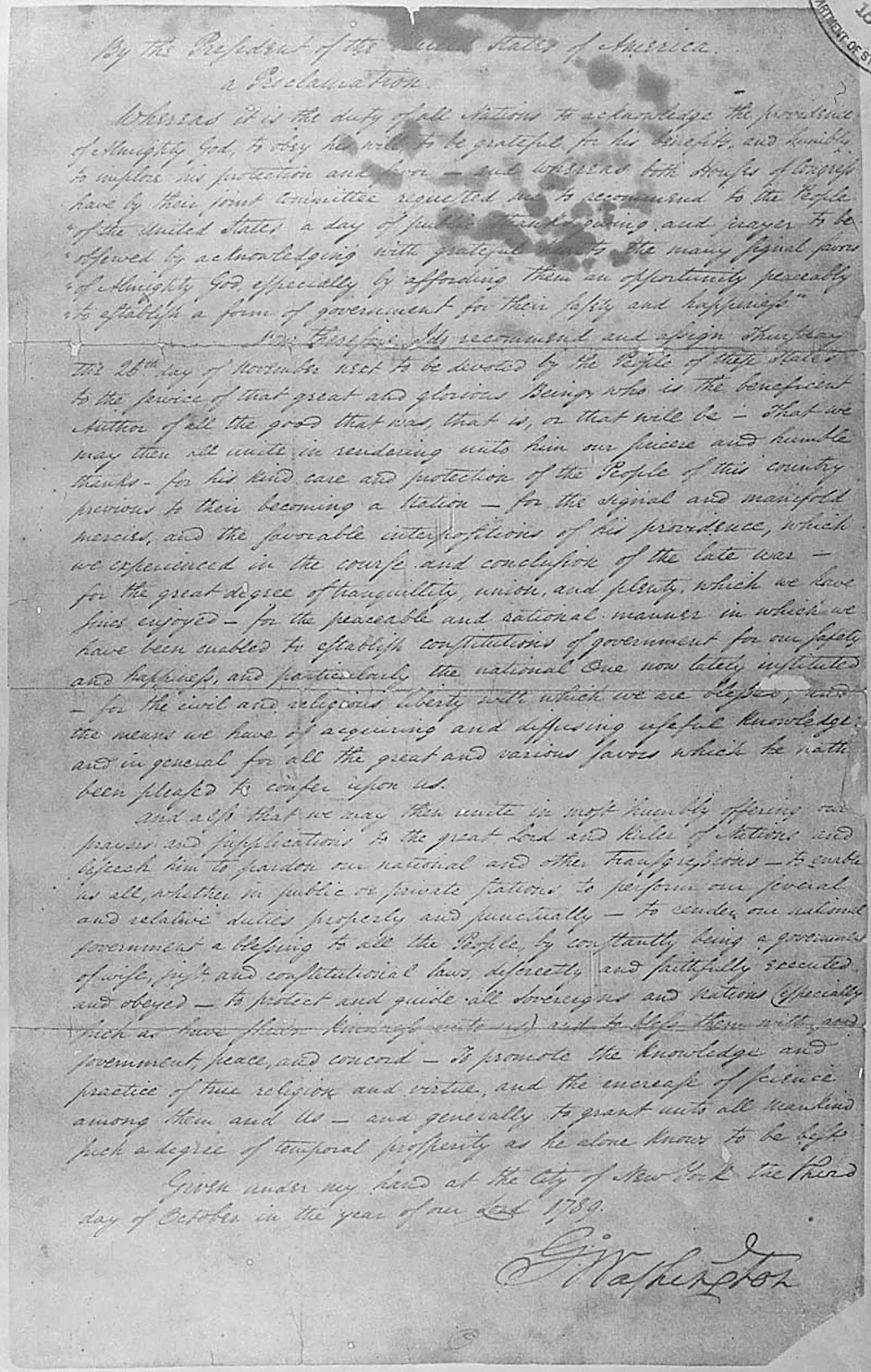
George Washington’s Oct. 3, 1789, Thanksgiving Day Proclamation.
National Archives
November 26, 1789, was a Thursday, and the weather was miserable. Few New Yorkers showed up at St. Paul’s Chapel to see the president: “I went to St. Pauls Chapel,” Washington wrote in his diary, “though it was most inclement and stormy.” There were “but few people at Church.”
The president had prepared for the occasion. He also contributed a sizable sum of his own money to buy beer and food for prisoners confined for debt in the New York City jail. The donation was deemed to be a magnanimous and moving gesture, suitable to the spirit of the holiday. A week later, in an advertisement in the Dec. 3 issue of the New York Journal, those very prisoners returned their “grateful thanks” to their president “for his very acceptable donation on Thursday last.”
Washington’s first Thanksgiving as a president may have not been tremendously successful, given the scarce attendance at the church service.
Yet, as a scholar writing a biography about Washington, I believe it was an important step in his much larger political plan to bring the executive branch to the people’s doorstep.
What Washington wanted was a virtuous kind of populism in the new country he led. Washington’s populism wasn’t about inciting an angry mob; it was about sharing in their rituals, worshiping their God, speaking their own language. And he did so in the sole interest of the American people.
Thanksgiving 1789, for Washington, was at once religious and more than religious. Washington’s proclamation invoked devotional language, literally. The upcoming festivity, in his words, could “be devoted by the People of these States to the service of that great and glorious Being, who is the beneficent Author of all the good that was, that is, or that will be.”
But Washington’s main concern was political. The nation was recently formed, and he feared that it could easily collapse. Its many internal divisions and separate interests could be lethal. Consequently, the president wanted this holiday to be a civic celebration in which “we may then all unite.”

Washington’s proclamation was printed in newspapers throughout the country.
George Washington’s Mt. Vernon
‘Pardon our national…transgressions’
As its first president, Washington recognized that the United States was born out of slavery, conquest and violence as much as of sacred principle. Civic unification required acknowledgment of these flaws. Thus, in the proclamation, Washington asked God “to pardon our national and other transgressions.”
A tremendously self-aware man, Washington knew that he was a deeply flawed person himself.
He was a slave owner, a relentless pursuer of African American fugitives and a destroyer of Native American villages. He was also a warrior who deployed brutality against enemies. He was a commander who resorted to corporal punishment with his own soldiers. Washington believed that he was not a saint to be mindlessly imitated. This made him humble in his duties.
More importantly, Washington also grasped the power of his symbolic position as president. He sought to leverage that for the good of the nation.
As president, Washington could not advertise his actions effectively via Twitter and social media. He had to show himself around constantly, no matter the weather. He had to painstakingly attend balls, plays, dinners, public receptions and of course the church. Every occasion, every Thanksgiving counted.
Through his outings, Washington met with a diversity of people, including those who were second-class citizens or were not citizens at all. Women, for example, greeted Washington at nearly every stop of the extended presidential trips he took between 1789 and 1791. Textile workers in New England, Jewish leaders in Newport, many enslaved persons in the South and churchgoers everywhere did the same.
[Deep knowledge, daily. Sign up for The Conversation’s newsletter.]
These women and men, in bondage or free, believers or skeptics, played a part in the invention of a new political theater. Maybe, it was just a theatrical illusion. But these individuals – just like the prisoners in the New York City jail – thanked President Washington because they felt they were voices in a larger political culture.
Washington made sure his Thanksgiving message – not simply a message, but a “proclamation” – sounded clear and strong: May God “render our national government a blessing to all the people, by constantly being a Government of wise, just, and constitutional laws, discreetly and faithfully executed and obeyed.”
This article is republished from The Conversation, a nonprofit news organization dedicated to unlocking ideas from academia, under a Creative Commons license.

About Maurizio Valsania
Maurizio Valsania is a Professor of American History at Università di Torino. He is currently working on a biography of George Washington which emphasizes the complexities of 18th-century masculinity. You can read more about the author here.

Next Post

December 7, 2020 How Hanukkah came to be an annual White House celebration
Browse Our Archives
Select a Category Buddhism Christianity Hinduism Islam Judaism Religion and society Uncategorized
Select a Month July 2024 March 2024 February 2024 January 2024 December 2023 November 2023 October 2023 September 2023 August 2023 July 2023 January 2023 August 2022 July 2022 April 2022 February 2022 January 2022 October 2021 July 2021 June 2021 May 2021 April 2021 March 2021 February 2021 January 2021 December 2020 November 2020 October 2020 September 2020 August 2020 July 2020 June 2020 May 2020
Follow Us!
TAKE THE
Religious Wisdom Quiz
How long did it take to rebuild Jerusalem's walls under Nehemiah?
Select your answer to see how you score.
40 days 52 days 7 years 12 months
Related posts from The Conversation


Electing A Virtuous President Would Make Immunity Irrelevant

Why The Olympic Games Are A ‘Civil Religious’...

The Catholic Church Is Using The Olympics To...
TRENDING AT PATHEOS Religion News

Catholic Integralists believe that religious values – specifically Christian ones – should...

Electing A Virtuous President Would Make Immunity Irrelevant
Presidential immunity can bring with it many risks. So how can we...

Why The Olympic Games Are A ‘Civil Religious’...
Sporting events form a vital space where Americans display their 'civil religious...

After more than a decade of news, research updates, and insights on...

Q: Why do Southern Baptists and like-minded Protestants...
THE RELIGION GUY’S ANSWER: Why? Simple. Because they believe that’s what the...

THE QUESTION: Is gambling evil? THE RELIGION GUY’S ANSWER: Analysts anticipate a...
view all Religion News blogs
Ad-Free & Subscriber Log-In Subscription Support
- About Us
- 2026 Calendar
- Videos
- Podcasts
- Library of World Religions
- Faith In Media Tracker
- Advertise With Us
- Write for Us
- Privacy Policy
- Terms of Service
- Do Not Sell My Data
- Contact Us
- Radiant Digital
- Manage Newsletter Subscriptions
- Unsubscribe From Notifications
- Sitemap
Copyright 2008-2026, Patheos. All rights reserved.
Subscription Support Ad-Free & Subscriber Log-In
Follow Patheos