
BuddhistCatholicContemplativeEvangelicalGeneral ChristianHinduJewishLatter-day SaintMuslimNew VisionsProgressive Christian
Beliefs
- Buddhist
- Catholic
- Contemplative
- Evangelical
- General Christian
- Hindu
- Jewish
- Latter-day Saint
- More Voices
- Muslim
- New Visions
- Pagan
- Progressive Christian
Topics
- Religion News
- Food and Religion
- Sports and Religion
- Religious Art
- Religious Music and Entertainment
- Religious Events
- History and Religion
- Style and Religion
- Politics and Religion
- Women in Religion
- Recreation Outdoors and Religion
- Business Finance and Religion
- Careers Workplace and Religion
- Education and Religion
- Family Parenting and Religion
- Health Fitness and Religion
- Home and Religion
- Relationships and Religion
- Technology and Religion
- Travel and Religion
Columnists
- Buddhist Columnists
- Business Finance and Religion Columnists
- Careers Workplace and Religion Columnists
- Catholic Columnists
- Contemplative Columnists
- Education and Religion Columnists
- Evangelists Columnists
- Family Parenting and Religion Columnists
- General Christian Columnists
- Health Fitness and Religion Columnists
- Hindu Columnists
- History and Religion Columnists
- Home and Religion Columnists
- Jewish Columnists
- More Voices Columnists
- Latter Day Columnists
- Muslim Columnists
- New Visions Columnists
- Nonreligious Columnists
- Pagan Columnists
- Politics and Religion Columnists
- Progressive Columnists
- Recreation Outdoors and Religion Columnists
- Relationships and Religion Columnists
- Religion News Columnists
- Religious Art Columnists
- Religious Events Columnists
- Religious Music and Entertainment Columnists
- Sports and Religion Columnists
- Style and Religion Columnists
- Technology and Religion Columnists
- Travel and Religion Columnists
- Women in Religion Columnists
Resource Library
- 2026 Calendar
- Library of World Religions
- The 100 Most Holy Places on Earth
- Patheos Answers
- Podcasts
- Videos
- Faith Leaders Database
- Anglican Episcopalian
- Bahai
- Baptist
- Buddhism
- Christianity
- Confucianism
- Eastern Orthodoxy
- Hinduism
- Holiness and Pentecostal
- ISKCON
- Islam
- Judaism
- Lutheran
- Methodist
- The Church of Jesus Christ of Latter-day Saints
- New Age
- Paganism
- Presbytarian and Reformed
- Protestantism
- Religion Behind the Scenes
- Roman Catholic
- Scientology
- Shia Islam
- Sikhism
- Sufism
- Sunni Islam
- Taoism
- Zen
- See all religions
Research Tools
 Ad-Free & Subscriber Log-In Subscription Support
Ad-Free & Subscriber Log-In Subscription Support
Follow Patheos 

- Trending:
- Forgiveness
- |
- Marriage
- |
- Consciousness
- |
- Death Penalty
- |
- Election
- |
- Halloween

- Home
- Religion News
- Why is it so hard for atheists to get voted in to Congress?
Why is it so hard for atheists to get voted in to Congress?
Last updated on: October 8, 2020 at 6:06 am by The Conversation
Why is it so hard for atheists to get voted in to Congress? 2020-10-07T13:10:21-04:00 The Conversation
Patheos Explore the world's faith through different perspectives on religion and spirituality! Patheos has the views of the prevalent religions and spiritualities of the world.
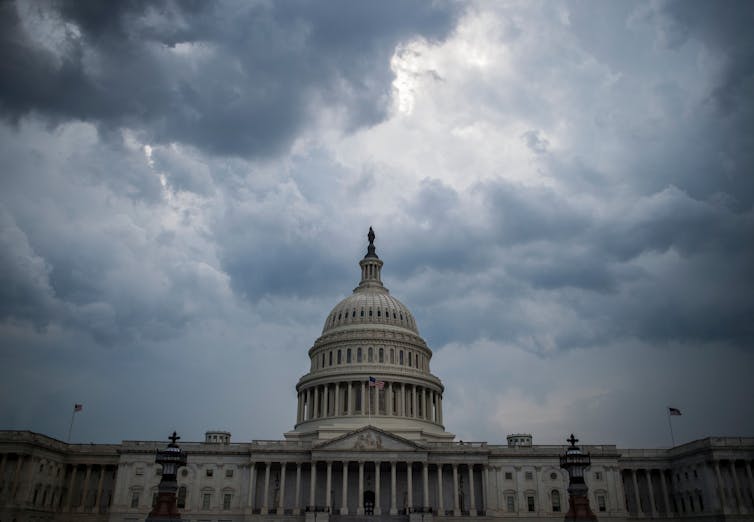
Above it, only skies? In it, only believers? Imagine that!
Andrew Caballero-Reynolds/AFP via Getty Images
By Phil Zuckerman of Pitzer College
Every election cycle has its “firsts.”
This year, the selection of Kamala Harris as Joe Biden’s running mate presented the U.S. with its first politician of Indian heritage – and the first Black woman – to be on a major party ticket. It followed Hillary Clinton’s becoming the first woman to win the popular vote for president in a 2016 election to replace America’s first Black president, Barack Obama.
Meanwhile, Pete Buttigieg became the first openly gay candidate to win a presidential primary and Ted Cruz became the first Latino to do so. In recent years Americans saw the first Jewish American win a primary, Bernie Sanders, and Rashida Tlaib and Ilhan Omar became the first Muslim women elected to Congress.
But in this era of increasing diversity and the breaking of long-rigid political-demographic barriers, there is no self-identifying atheist in national politics. Indeed, throughout history, only one self-identified atheist in the U.S. Congress comes to mind, the late California Democrat Peter Stark.
‘In atheists, they don’t trust’
This puts the country at odds with democracies the world over that have elected openly godless – or at least openly skeptical – leaders who went on to become revered national figures, such as Jawaharlal Nehru in India, Sweden’s Olof Palme, Jose Mujica in Uruguay and Israel’s Golda Meir. New Zealand’s Jacinda Ardern, the global leader who has arguably navigated the coronavirus crisis with the most credit, says she is agnostic.
But in the United States, self-identified nonbelievers are at a distinct disadvantage. A 2019 poll asking Americans who they were willing to vote for in a hypothetical presidential election found that 96% would vote for a candidate who is Black, 94% for a woman, 95% for a Hispanic candidate, 93% for a Jew, 76% for a gay or lesbian candidate and 66% for a Muslim – but atheists fall below all of these, down at 60%. That is a sizable chunk who would not vote for a candidate simply on the basis of their nonreligion.
In fact, a 2014 survey found Americans would be more willing to vote for a presidential candidate who had never held office before, or who had extramarital affairs, than for an atheist.
In a country that changed its original national motto in 1956 from the secular “E pluribus unum” – “out of many, one” – to the faithful “In God We Trust,” it seems people don’t trust someone who doesn’t believe in God.
As a scholar who studies atheism in the U.S., I have long sought to understand what is behind such antipathy toward nonbelievers seeking office.
Branding issue?
There appear to be two primary reasons atheism remains the kiss of death for aspiring politicians in the U.S. – one is rooted in a reaction to historical and political events, while the other is rooted in baseless bigotry.
Let’s start with the first: atheism’s prominence within communist regimes. Some of the most murderous dictatorships of the 20th century – including Stalin’s Soviet Union and Pol Pot’s Cambodia – were explicitly atheistic. Bulldozing humans right and persecuting religious believers were fundamental to their oppressive agendas. Talk about a branding problem for atheists.
For those who considered themselves lovers of liberty, democracy and the First Amendment guarantee of the free exercise of religion, it made sense to develop fearful distrust of atheism, given its association with such brutal dictatorships.
And even though such regimes have long since met their demise, the association of atheism with a lack of freedom lingered long after.
The second reason atheists find it hard to get elected in America, however, is the result of an irrational linkage in many people’s minds between atheism and immorality. Some assume that because atheists don’t believe in a deity watching and judging their every move, they must be more likely to murder, steal, lie and cheat. One recent study, for example, found that Americans even intuitively link atheism with necrobestiality and cannibalism.
Such bigoted associations between atheism and immorality do not align with reality. There is simply no empirical evidence that most people who lack a belief in God are immoral. If anything, the evidence points in the other direction. Research has shown that atheists tend to be less racist, less homophobic and less misogynistic than those professing a belief in God.
Most atheists subscribe to humanistic ethics based on compassion and a desire to alleviate suffering. This may help explain why atheists have been found to be more supportive of efforts to fight climate change, as well as more supportive of refugees and of the right to die.
This may also explain why, according to my research, those states within the U.S. with the least religious populations – as well as democratic nations with the most secular citizens – tend to be the most humane, safe, peaceful and prosperous.
[You’re too busy to read everything. We get it. That’s why we’ve got a weekly newsletter. Sign up for good Sunday reading. ]
Freethought caucus
Although the rivers of anti-atheism run deep throughout the American political landscape, they are starting to thin. More and more nonbelievers are openly expressing their godlessness, and swelling numbers of Americans are becoming secular: In the past 15 years, the percentage of Americans claiming no religious affiliation has risen from 16% to 26%. Meanwhile, some find the image of a Bible-wielding Trump troubling, opening up the possibility that suddenly Christianity may be contending with a branding problem of its own, especially in the skeptical eyes of younger Americans.
In 2018, a new group emerged in Washington, D.C.: The Congressional Freethought Caucus. Although it only has 13 members, it portends a significant shift in which some elected members of Congress are no longer afraid of being identified as, at the very least, agnostic. Given this new development, as well as the growing number of nonreligious Americans, it shouldn’t be a surprise if one day a self-identified atheist makes it to the White House.
Will that day come sooner rather than later? God only knows. Or rather, only time will tell.
This article is republished from The Conversation, a nonprofit news organization dedicated to unlocking ideas from academia, under a Creative Commons license.

About Phil Zuckerman
Phil Zuckerman is a Professor of Sociology and Secular Studies at Pitzer College. You can read more about the author here.

Next Post

October 9, 2020 Finding joy in 2020? It's not such an absurd idea, really
Browse Our Archives
Select a Category Buddhism Christianity Hinduism Islam Judaism Religion and society Uncategorized
Select a Month July 2024 March 2024 February 2024 January 2024 December 2023 November 2023 October 2023 September 2023 August 2023 July 2023 January 2023 August 2022 July 2022 April 2022 February 2022 January 2022 October 2021 July 2021 June 2021 May 2021 April 2021 March 2021 February 2021 January 2021 December 2020 November 2020 October 2020 September 2020 August 2020 July 2020 June 2020 May 2020
Follow Us!
TAKE THE
Religious Wisdom Quiz
Which Old Testament book does not mention God?
Select your answer to see how you score.
Esther Ruth Ecclesiastes Song of Solomon
Related posts from The Conversation


Electing A Virtuous President Would Make Immunity Irrelevant

Why The Olympic Games Are A ‘Civil Religious’...

The Catholic Church Is Using The Olympics To...
TRENDING AT PATHEOS Religion News

Catholic Integralists believe that religious values – specifically Christian ones – should...

Electing A Virtuous President Would Make Immunity Irrelevant
Presidential immunity can bring with it many risks. So how can we...

Why The Olympic Games Are A ‘Civil Religious’...
Sporting events form a vital space where Americans display their 'civil religious...

After more than a decade of news, research updates, and insights on...

Q: Why do Southern Baptists and like-minded Protestants...
THE RELIGION GUY’S ANSWER: Why? Simple. Because they believe that’s what the...

THE QUESTION: Is gambling evil? THE RELIGION GUY’S ANSWER: Analysts anticipate a...
view all Religion News blogs
Ad-Free & Subscriber Log-In Subscription Support
- About Us
- 2026 Calendar
- Videos
- Podcasts
- Library of World Religions
- Faith In Media Tracker
- Advertise With Us
- Write for Us
- Privacy Policy
- Terms of Service
- Do Not Sell My Data
- Contact Us
- Radiant Digital
- Manage Newsletter Subscriptions
- Unsubscribe From Notifications
- Sitemap
Copyright 2008-2026, Patheos. All rights reserved.
Subscription Support Ad-Free & Subscriber Log-In
Follow Patheos