
BuddhistCatholicContemplativeEvangelicalGeneral ChristianHinduJewishLatter-day SaintMuslimNew VisionsProgressive Christian
Beliefs
- Buddhist
- Catholic
- Contemplative
- Evangelical
- General Christian
- Hindu
- Jewish
- Latter-day Saint
- More Voices
- Muslim
- New Visions
- Pagan
- Progressive Christian
Topics
- Religion News
- Food and Religion
- Sports and Religion
- Religious Art
- Religious Music and Entertainment
- Religious Events
- History and Religion
- Style and Religion
- Politics and Religion
- Women in Religion
- Recreation Outdoors and Religion
- Business Finance and Religion
- Careers Workplace and Religion
- Education and Religion
- Family Parenting and Religion
- Health Fitness and Religion
- Home and Religion
- Relationships and Religion
- Technology and Religion
- Travel and Religion
Columnists
- Buddhist Columnists
- Business Finance and Religion Columnists
- Careers Workplace and Religion Columnists
- Catholic Columnists
- Contemplative Columnists
- Education and Religion Columnists
- Evangelists Columnists
- Family Parenting and Religion Columnists
- General Christian Columnists
- Health Fitness and Religion Columnists
- Hindu Columnists
- History and Religion Columnists
- Home and Religion Columnists
- Jewish Columnists
- More Voices Columnists
- Latter Day Columnists
- Muslim Columnists
- New Visions Columnists
- Nonreligious Columnists
- Pagan Columnists
- Politics and Religion Columnists
- Progressive Columnists
- Recreation Outdoors and Religion Columnists
- Relationships and Religion Columnists
- Religion News Columnists
- Religious Art Columnists
- Religious Events Columnists
- Religious Music and Entertainment Columnists
- Sports and Religion Columnists
- Style and Religion Columnists
- Technology and Religion Columnists
- Travel and Religion Columnists
- Women in Religion Columnists
Resource Library
- 2026 Calendar
- Library of World Religions
- The 100 Most Holy Places on Earth
- Patheos Answers
- Podcasts
- Videos
- Faith Leaders Database
- Anglican Episcopalian
- Bahai
- Baptist
- Buddhism
- Christianity
- Confucianism
- Eastern Orthodoxy
- Hinduism
- Holiness and Pentecostal
- ISKCON
- Islam
- Judaism
- Lutheran
- Methodist
- The Church of Jesus Christ of Latter-day Saints
- New Age
- Paganism
- Presbytarian and Reformed
- Protestantism
- Religion Behind the Scenes
- Roman Catholic
- Scientology
- Shia Islam
- Sikhism
- Sufism
- Sunni Islam
- Taoism
- Zen
- See all religions
Research Tools
 Ad-Free & Subscriber Log-In Subscription Support
Ad-Free & Subscriber Log-In Subscription Support
Follow Patheos 

- Trending:
- Forgiveness
- |
- Marriage
- |
- Consciousness
- |
- Death Penalty
- |
- Election
- |
- Halloween

- Home
- Religion News
- Beheading in France could bolster president’s claim that Islam is in ‘crisis’ – but so is French secularism
Beheading in France could bolster president’s claim that Islam is in ‘crisis’ – but so is French secularism
Last updated on: October 21, 2020 at 10:16 am by The Conversation
Beheading in France could bolster president’s claim that Islam is in ‘crisis’ – but so is French secularism 2020-10-21T10:16:03-04:00 The Conversation
Patheos Explore the world's faith through different perspectives on religion and spirituality! Patheos has the views of the prevalent religions and spiritualities of the world.

An homage to Samuel Paty, a teacher murdered after showing caricatures of the Prophet Mohammed from the satirical magazine Charlie Hebdo, Oct. 18, 2020.
Adnan Farzat/NurPhoto via Getty Images
By Ahmet T. Kuru of San Diego State University
A French high school teacher who had shown caricatures of the Prophet Muhammad to his class was beheaded on Oct. 16 by an 18-year-old Muslim refugee in what France’s President Emmanuel Macron characterized as an “Islamist terrorist attack.”
The killing is the latest high-profile attack by a Muslim extremist in France, coming after the 2015 massacre at Charlie Hebdo magazine and the 2016 truck attack in Nice. It also occurred two weeks after Macron gave a controversial speech defining Islam as “a religion that is in crisis today all over the world.”
France, which colonized many Muslim-majority territories in Africa and the Levant in the 19th and 20th centuries, such as Algeria and Mali, has Western Europe’s largest Muslim minority – 6 million people, or 9% of its population.
Macron’s Oct. 2 speech outlined a legislative proposal to fight “Islamist separatism.” If passed in Parliament, it would essentially ban home-schooling of all children aged 3 and up and prevent foreign-trained imams from leading French mosques. The goal, said the president, is “to build an Islam in France that can be compatible with the Enlightenment.”
Macron’s analysis concludes, simply, that Islam is somehow at odds with modern Western society. But my research on state secularism and religion shows that the reality is much more complicated.

French President Emmanuel Macron.
Sebastien Bozon/AFP via Getty Images
French versus American secularism
French secularism, which is embraced by both the progressive left and the Islamophobic right, goes well beyond the American democratic concept of separating religion and state. Called “laïcité,” it essentially excludes religious symbols from public institutions. France has banned Muslim women’s headscarves in schools and outlawed religious face coverings everywhere. There are no such bans in the United States.
While both America and France have ongoing debates about “Islamic fundamentalism” and “Muslim terrorists” and views that can be defined as Islamophobic and have some popular support, American democracy generally provides better opportunities for the integration of various religious groups.
In France, the Constitution defines the state only as secular, without delineating the boundaries of that secularism. In the United States, the First Amendment restricts the secular state’s engagement with religion, saying the government can neither establish a religion nor prohibit a religion’s free exercise.
It would be difficult for the U.S. to announce, as Macron did, a state-sponsored project to “forge a type of Enlightenment Islam.”
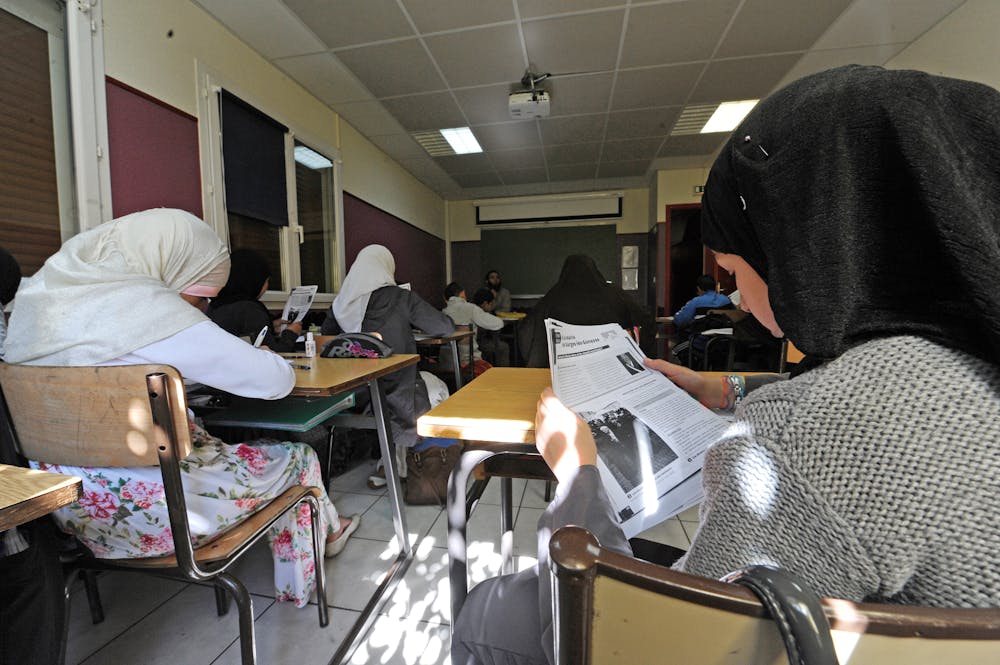
In France, Muslim girls may wear headscarves in Islamic private schools like the Alif school in Toulouse, but not in public schools.
Eric Cabanis/AFP via Getty Images
Indeed, 11 years before Macron voiced his provocative view, U.S. President Barack Obama gave a famous speech on Islam in Egypt in 2009, attempting to reset the relationship between America and the Muslim world.
Emphasizing Muslims’ contributions to American society, Obama said, “It is important for Western countries to avoid impeding Muslim citizens from practicing religion as they see fit – for instance, by dictating what clothes a Muslim woman should wear.”
Obama’s speech reflected an idealized American melting pot, a place where hyphenated identities like Muslim-American are common.
French secularism sees no hyphenated identities – only French or Not French.
Islam and the secular state
Some in France also see this rigid secularism as unequal to the challenges of multiculturalism and migration. The eminent scholar Jean Bauberot, for example, defends a more “pluralistic secularism” – one that tolerates certain religious symbols in public institutions.
France has in fact made many exceptions for Catholics. The government provides substantial public funding to private Catholic schools, which educate about a quarter of all K-12 students, and six of 11 official holidays in France are Catholic holidays.
Too often, laïcité translates into an unwillingness to accommodate the religiously based demands of Muslims.
In 2015, a Muslim advocacy organization sued a municipal authority in France’s Burgundy region for refusing to offer an alternative to pork in public school cafeterias. The court compelled the town to reverse its policy, but not because it violated religious freedom. The court found the menu violated the children’s rights.
France’s founding commitment to equality under the law likewise forestalls meaningful social debate on racial discrimination; its census does not even collect information on race. Although France’s biggest minority is mostly composed of nonwhite Muslim immigrants from its former colonies in Africa and their descendents, Macron’s speech referenced only in passing to French colonialism.
Blasphemy
That said, I find some truth in Macron’s speech. But the “crisis” facing Islam lies in the historical and political failings of the Muslim world, not in the religion itself.
As my 2019 book, “Islam, Authoritarianism, and Underdevelopment,” documents, many Muslim countries like Egypt, Iran and Saudi Arabia have long-lasting authoritarian regimes and chronic underdevelopment. In 32 of the world’s 49 Muslim-majority countries, blasphemy laws punish people who speak sacrilegiously about sacred things; in six countries, blasphemy is a capital offense.
These laws, which block freedom of expression, are more rooted in the interests of the conservative clergy and authoritarian rulers than in the Islamic faith, my research shows. They actually contradict several Quranic verses that urge Muslims not to coerce or retaliate against people of other faiths.
Still, in Western countries where Muslims are a minority, extremists occasionally take it upon themselves to punish those who, in their view, mock the Prophet Muhammad. That has caused global controversies over cartoons and movies. At times, in France and beyond, it has led to an unacceptable outcome: murder.
Such killings, whether perpetrated by the state or by individuals, are tragedies. But to frame them as a purely religious problem ignores the socioeconomic and political origins of Islamic blasphemy laws, and the anti-democratic cultural consequences of authoritarianism in many Muslim countries.
It also overlooks the difficult reality that social alienation is an underlying factor in the radicalization of some young Muslims in the West.
Multiple secularisms, multiple Islams
Macron’s speech made some gestures toward greater inclusion.
“I want France to become a country where we can teach the thoughts of Averreos and Ibn Khaldun,” he said, referencing two eminent Muslim thinkers of the 12th and 14th centuries, and envisioned “a country that excels in the study of Muslim civilizations.”
That plural in “civilizations” is meaningful. It acknowledges that Islam is not monolithic. Neither is French secularism. Both are complex systems with varied interpretations.
In truth, Macron doesn’t need to “build an Islam in France that can be compatible with the Enlightenment,” because that already exists. Whether French secularism can adapt to Islam is another question.
This article is republished from The Conversation, a nonprofit news organization dedicated to unlocking ideas from academia, under a Creative Commons license.
[Deep knowledge, daily. Sign up for The Conversation’s newsletter.]

About Ahmet T. Kuru
Ahmet T. Kuru is a Professor of Political Science at San Diego State University. You can read more about the author here.


Browse Our Archives
Select a Category Buddhism Christianity Hinduism Islam Judaism Religion and society Uncategorized
Select a Month July 2024 March 2024 February 2024 January 2024 December 2023 November 2023 October 2023 September 2023 August 2023 July 2023 January 2023 August 2022 July 2022 April 2022 February 2022 January 2022 October 2021 July 2021 June 2021 May 2021 April 2021 March 2021 February 2021 January 2021 December 2020 November 2020 October 2020 September 2020 August 2020 July 2020 June 2020 May 2020
Follow Us!
TAKE THE
Religious Wisdom Quiz
What type of wood was Noah’s Ark made from?
Select your answer to see how you score.
Cedar Gopher wood Oak Olive wood
Related posts from The Conversation


Electing A Virtuous President Would Make Immunity Irrelevant

Why The Olympic Games Are A ‘Civil Religious’...

The Catholic Church Is Using The Olympics To...
TRENDING AT PATHEOS Religion News

Catholic Integralists believe that religious values – specifically Christian ones – should...

Electing A Virtuous President Would Make Immunity Irrelevant
Presidential immunity can bring with it many risks. So how can we...

Why The Olympic Games Are A ‘Civil Religious’...
Sporting events form a vital space where Americans display their 'civil religious...

After more than a decade of news, research updates, and insights on...

Q: Why do Southern Baptists and like-minded Protestants...
THE RELIGION GUY’S ANSWER: Why? Simple. Because they believe that’s what the...

THE QUESTION: Is gambling evil? THE RELIGION GUY’S ANSWER: Analysts anticipate a...
view all Religion News blogs
Ad-Free & Subscriber Log-In Subscription Support
- About Us
- 2026 Calendar
- Videos
- Podcasts
- Library of World Religions
- Faith In Media Tracker
- Advertise With Us
- Write for Us
- Privacy Policy
- Terms of Service
- Do Not Sell My Data
- Contact Us
- Radiant Digital
- Manage Newsletter Subscriptions
- Unsubscribe From Notifications
- Sitemap
Copyright 2008-2026, Patheos. All rights reserved.
Subscription Support Ad-Free & Subscriber Log-In
Follow Patheos