
BuddhistCatholicContemplativeEvangelicalGeneral ChristianHinduJewishLatter-day SaintMuslimNew VisionsProgressive Christian
Beliefs
- Buddhist
- Catholic
- Contemplative
- Evangelical
- General Christian
- Hindu
- Jewish
- Latter-day Saint
- More Voices
- Muslim
- New Visions
- Pagan
- Progressive Christian
Topics
- Religion News
- Food and Religion
- Sports and Religion
- Religious Art
- Religious Music and Entertainment
- Religious Events
- History and Religion
- Style and Religion
- Politics and Religion
- Women in Religion
- Recreation Outdoors and Religion
- Business Finance and Religion
- Careers Workplace and Religion
- Education and Religion
- Family Parenting and Religion
- Health Fitness and Religion
- Home and Religion
- Relationships and Religion
- Technology and Religion
- Travel and Religion
Columnists
- Buddhist Columnists
- Business Finance and Religion Columnists
- Careers Workplace and Religion Columnists
- Catholic Columnists
- Contemplative Columnists
- Education and Religion Columnists
- Evangelists Columnists
- Family Parenting and Religion Columnists
- General Christian Columnists
- Health Fitness and Religion Columnists
- Hindu Columnists
- History and Religion Columnists
- Home and Religion Columnists
- Jewish Columnists
- More Voices Columnists
- Latter Day Columnists
- Muslim Columnists
- New Visions Columnists
- Nonreligious Columnists
- Pagan Columnists
- Politics and Religion Columnists
- Progressive Columnists
- Recreation Outdoors and Religion Columnists
- Relationships and Religion Columnists
- Religion News Columnists
- Religious Art Columnists
- Religious Events Columnists
- Religious Music and Entertainment Columnists
- Sports and Religion Columnists
- Style and Religion Columnists
- Technology and Religion Columnists
- Travel and Religion Columnists
- Women in Religion Columnists
Resource Library
- 2026 Calendar
- Library of World Religions
- The 100 Most Holy Places on Earth
- Patheos Answers
- Podcasts
- Videos
- Faith Leaders Database
- Anglican Episcopalian
- Bahai
- Baptist
- Buddhism
- Christianity
- Confucianism
- Eastern Orthodoxy
- Hinduism
- Holiness and Pentecostal
- ISKCON
- Islam
- Judaism
- Lutheran
- Methodist
- The Church of Jesus Christ of Latter-day Saints
- New Age
- Paganism
- Presbytarian and Reformed
- Protestantism
- Religion Behind the Scenes
- Roman Catholic
- Scientology
- Shia Islam
- Sikhism
- Sufism
- Sunni Islam
- Taoism
- Zen
- See all religions
Research Tools
 Ad-Free & Subscriber Log-In Subscription Support
Ad-Free & Subscriber Log-In Subscription Support
Follow Patheos 

- Trending:
- Forgiveness
- |
- Marriage
- |
- Consciousness
- |
- Death Penalty
- |
- Election
- |
- Halloween

- Home
- Religion News
- Amid COVID-19 spike in ultra-Orthodox areas, Jewish history may explain reluctance of some to restrictions
Amid COVID-19 spike in ultra-Orthodox areas, Jewish history may explain reluctance of some to restrictions
Last updated on: October 7, 2020 at 1:06 pm by The Conversation
Amid COVID-19 spike in ultra-Orthodox areas, Jewish history may explain reluctance of some to restrictions 2020-10-07T13:06:46-04:00 The Conversation
Patheos Explore the world's faith through different perspectives on religion and spirituality! Patheos has the views of the prevalent religions and spiritualities of the world.
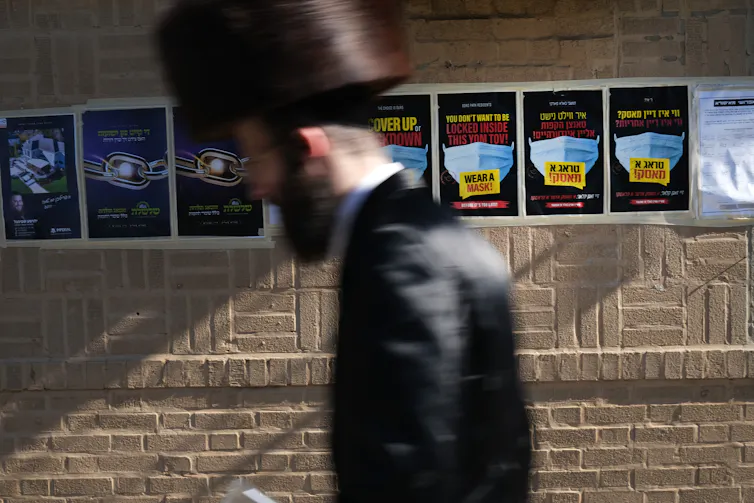
COVID-19 has spiked in ultra-Orthodox Jewish parts of New York City.
Spencer Platt/Getty Images
By Joyce Dalsheim of University of North Carolina – Charlotte
A spike in coronavirus cases in several Orthodox Jewish areas of New York has prompted state and city authorities to impose new localized restrictions aimed at halting the spread.
On Oct. 5, New York Gov. Andrew Cuomo announced that nearly 100 public schools and 200 private schools in 20 ZIP codes – many of which have a large ultra-Orthodox population and have seen increased rates of positive test results of COVID-19 – would end in-person classes “temporarily.”
The move has sparked animosity among some Orthodox Jews, who claim that they are being unfairly singled out. It comes amid warnings from New York Mayor Bill de Blasio of further action to prevent the spread and follows earlier instances, including the breaking up a funeral for an Orthodox Jewish rabbi by police in Brooklyn on April 28.
Similar tensions have played out in Israel, where recent plans to implement a system to identify coronavirus hot spots met resistance from some ultra-Orthodox leaders, who suggested it was unfair to place restrictions on their communities while many secular Israelis have been gathering regularly to demonstrate against the government. Rather than loosen restrictions on the ultra-Orthodox community, the government tightened restrictions on demonstrations, resulting in additional tension between secular and ultra-Orthodox Israelis.
Most prominent rabbis around the world have supported government regulations intended to curb the spread of coronavirus, even if it means closing places of study and worship. But some observant Jewish communities in the United States and Israel have been reluctant to adopt social distancing.
Outsiders are often outraged when religious communities defy policies meant to protect the general public.
As an anthropologist who studies religion, politics, identity and conflict in Israel and Palestine, my research helps explain why some strictly observant Jewish communities disobey public health guidelines – and it’s more complicated than simply flouting the rules.
Who are Haredi Jews?
Ultra-Orthodox, or Haredi, Jewish communities are a diverse population, with varying spiritual and cultural practices. But they all follow Halacha, loosely translated as Jewish law.
As such, many do not share the same information sources that others take for granted. In accordance with the rulings of their rabbis, internet access, television broadcasts and certain cellphone functions are generally limited in strictly observant Jewish communities.
Maintaining their closeness to God by distancing themselves from the secular world prevented many Haredim from seeing news reports of the virus spreading worldwide in February and March.
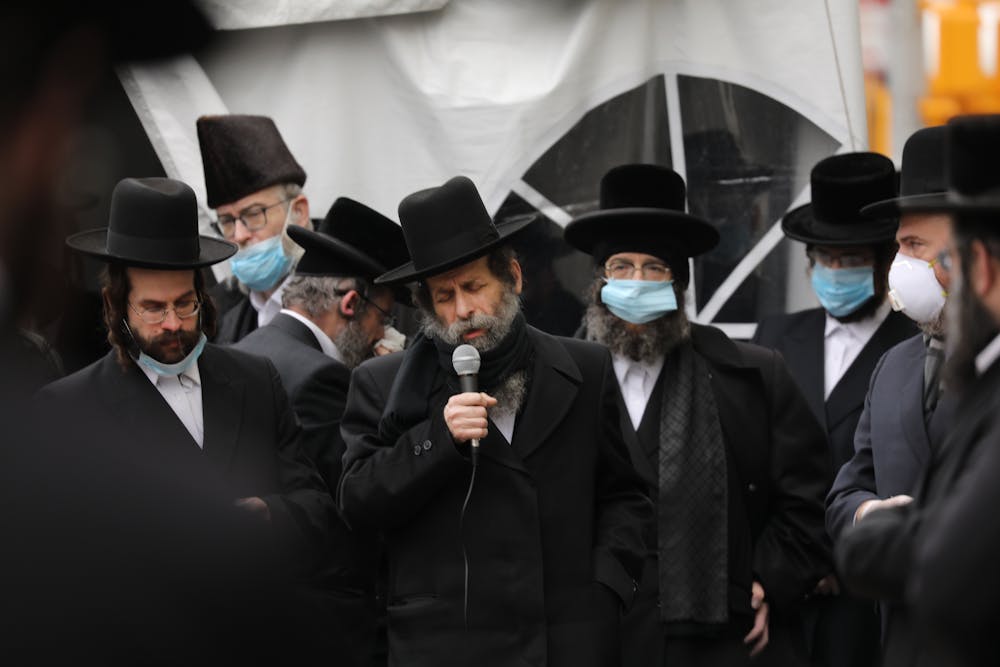
The funeral for a Brooklyn rabbi who died from COVID-19 in the ultra-Orthodox Borough Park neighborhood in New York on April 5.
Spencer Platt/Getty Images
Some Haredi leaders maintained that gathering to pray and study remained paramount. Studying the Hebrew scriptures, or Torah, is a commandment and a duty in Judaism. Haredi men generally gather to pray three times daily. Students at yeshivas, or Jewish seminaries, may spend 18 hours a day studying together.
More than a way of life, prayer and study are believed to be the means for protecting life itself. According to Jewish sages, “One who engages in Torah study also protects the entire world.” Indeed, “without Torah the world falls.”
The importance of engaging with the Torah explains why one prominent rabbi in Israel insisted in March that “canceling Torah study is more dangerous than the coronavirus.”
Ultimately, the Israeli government intervened to enforce its coronavirus restrictions. On March 22, police were sent into Me’a She’arim, a Haredi neighborhood in Jerusalem, to end public gatherings, close synagogues and shutter schools.
They were met with curses, slurs and thrown stones. Some Haredim even called the Israeli police “Nazis.”
Collective memory
While such responses might seem extreme to outsiders, they become clearer when considering Jewish history and the memories provoked by police intervention.
Anthropological research demonstrates that people give meaning to their experiences in different ways. Our perception, imagination and actions are deeply embedded in the whole of our experiences. The past – whether individually experienced or collectively nourished by the community – gives meaning to the present.
Henri Bergson, a French philosopher, used the term “duration” to explain how the past shifts to show itself in ways that appeal to current experiences in different ways for different people.
In times of crisis like the coronavirus pandemic, this sense of duration becomes more acute.
For some, hospital tents erected in public places evoke World War I. A Holocaust survivor recently told me the stay-at-home order brought back memories of her childhood years of confinement hiding from the Nazis. One New Orleans resident found that the “flood” of coronavirus deaths recalled Hurricane Katrina.
Duration as personal memory is central to an individual’s sense of self, but it arises in collective memories, too.
Collective memory, including the stories we all tell ourselves and our children about our past, gives meaning and purpose to our collective selves. These stories recount struggles and triumphs and help define our moral community.
Duration interacts with collective memory, and is key to the formation of group identity.
History of persecution
The historical persecution of Jews around the world is central to both secular and strictly observant Jews. However, how that memory works in contemporary circumstances is not predetermined. My research demonstrates that different aspects of the past inform collective meaning and actions differently.
Unlike most Israelis – who see Jewish history as a justification for the state of Israel and understand the Israeli army and police as existing to protect them – some Israeli Haredim distrust the government and its functionaries.
In fact, Haredi Jews, who make up about 10% of Israel’s population, are foundationally opposed to Zionism, the political ideology of Jewish nationalism that led to the establishment of Israel in 1948.
While Haredi Jews believe that God promised the land of Israel to the Jewish people, they are also certain that promise cannot be fulfilled by human intervention in God’s work, such as the establishment of a nation state. They have previously clashed with the Israeli government and law enforcement over compulsory military service and other policies.

Israeli police officers disperse ultra-Orthodox protesters who oppose military conscription in Jerusalem, July 2, 2019.
Faiz Abu Rmeleh/Anadolu Agency/Getty Images
Suspicion of police
So when armed men in uniform entered their neighborhoods to close down synagogues and yeshivas, members of the Haredi community drew on their collective memories of soldiers and police wreaking havoc and destruction on Jewish communities in czarist Russia and later in Western Europe. Rather than feeling protected by the state, they were fearful and suspicious.
Suspicion of the police is common in other communities historically mistreated by law enforcement. The collective memories of both Black Americans and the Roma of Europe, for example, associate police with violence and danger.
When facing a crisis like the coronavirus, many people rely primarily on science, technology and governments for protection. And the Haredim do not reject science or medicine.
But for them, living the Torah life through daily study and prayer is the primary means by which all human life is maintained and preserved. When the political order interferes with their work, the consequences could be more disastrous than a pandemic. It could mean the end of Jewish life, if not humanity itself.

This article is republished from The Conversation, a nonprofit news organization dedicated to unlocking ideas from academia, under a Creative Commons license.

About Joyce Dalsheim
Joyce Dalsheim is an Associate Professor of Global Studies at the University of North Carolina – Charlotte. You can read more about the author here.

Next Post
October 8, 2020 Why is it so hard for atheists to get voted in to Congress?
Browse Our Archives
Select a Category Buddhism Christianity Hinduism Islam Judaism Religion and society Uncategorized
Select a Month July 2024 March 2024 February 2024 January 2024 December 2023 November 2023 October 2023 September 2023 August 2023 July 2023 January 2023 August 2022 July 2022 April 2022 February 2022 January 2022 October 2021 July 2021 June 2021 May 2021 April 2021 March 2021 February 2021 January 2021 December 2020 November 2020 October 2020 September 2020 August 2020 July 2020 June 2020 May 2020
Follow Us!
TAKE THE
Religious Wisdom Quiz
What type of wood was Noah’s Ark made from?
Select your answer to see how you score.
Cedar Gopher wood Oak Olive wood
Related posts from The Conversation


Electing A Virtuous President Would Make Immunity Irrelevant

Why The Olympic Games Are A ‘Civil Religious’...

The Catholic Church Is Using The Olympics To...
TRENDING AT PATHEOS Religion News

Catholic Integralists believe that religious values – specifically Christian ones – should...

Electing A Virtuous President Would Make Immunity Irrelevant
Presidential immunity can bring with it many risks. So how can we...

Why The Olympic Games Are A ‘Civil Religious’...
Sporting events form a vital space where Americans display their 'civil religious...

After more than a decade of news, research updates, and insights on...

Q: Why do Southern Baptists and like-minded Protestants...
THE RELIGION GUY’S ANSWER: Why? Simple. Because they believe that’s what the...

THE QUESTION: Is gambling evil? THE RELIGION GUY’S ANSWER: Analysts anticipate a...
view all Religion News blogs
Ad-Free & Subscriber Log-In Subscription Support
- About Us
- 2026 Calendar
- Videos
- Podcasts
- Library of World Religions
- Faith In Media Tracker
- Advertise With Us
- Write for Us
- Privacy Policy
- Terms of Service
- Do Not Sell My Data
- Contact Us
- Radiant Digital
- Manage Newsletter Subscriptions
- Unsubscribe From Notifications
- Sitemap
Copyright 2008-2026, Patheos. All rights reserved.
Subscription Support Ad-Free & Subscriber Log-In
Follow Patheos