
BuddhistCatholicContemplativeEvangelicalGeneral ChristianHinduJewishLatter-day SaintMuslimNew VisionsProgressive Christian
Beliefs
- Buddhist
- Catholic
- Contemplative
- Evangelical
- General Christian
- Hindu
- Jewish
- Latter-day Saint
- More Voices
- Muslim
- New Visions
- Pagan
- Progressive Christian
Topics
- Religion News
- Food and Religion
- Sports and Religion
- Religious Art
- Religious Music and Entertainment
- Religious Events
- History and Religion
- Style and Religion
- Politics and Religion
- Women in Religion
- Recreation Outdoors and Religion
- Business Finance and Religion
- Careers Workplace and Religion
- Education and Religion
- Family Parenting and Religion
- Health Fitness and Religion
- Home and Religion
- Relationships and Religion
- Technology and Religion
- Travel and Religion
Columnists
- Buddhist Columnists
- Business Finance and Religion Columnists
- Careers Workplace and Religion Columnists
- Catholic Columnists
- Contemplative Columnists
- Education and Religion Columnists
- Evangelists Columnists
- Family Parenting and Religion Columnists
- General Christian Columnists
- Health Fitness and Religion Columnists
- Hindu Columnists
- History and Religion Columnists
- Home and Religion Columnists
- Jewish Columnists
- More Voices Columnists
- Latter Day Columnists
- Muslim Columnists
- New Visions Columnists
- Nonreligious Columnists
- Pagan Columnists
- Politics and Religion Columnists
- Progressive Columnists
- Recreation Outdoors and Religion Columnists
- Relationships and Religion Columnists
- Religion News Columnists
- Religious Art Columnists
- Religious Events Columnists
- Religious Music and Entertainment Columnists
- Sports and Religion Columnists
- Style and Religion Columnists
- Technology and Religion Columnists
- Travel and Religion Columnists
- Women in Religion Columnists
Resource Library
- 2026 Calendar
- Library of World Religions
- The 100 Most Holy Places on Earth
- Patheos Answers
- Podcasts
- Videos
- Faith Leaders Database
- Anglican Episcopalian
- Bahai
- Baptist
- Buddhism
- Christianity
- Confucianism
- Eastern Orthodoxy
- Hinduism
- Holiness and Pentecostal
- ISKCON
- Islam
- Judaism
- Lutheran
- Methodist
- The Church of Jesus Christ of Latter-day Saints
- New Age
- Paganism
- Presbytarian and Reformed
- Protestantism
- Religion Behind the Scenes
- Roman Catholic
- Scientology
- Shia Islam
- Sikhism
- Sufism
- Sunni Islam
- Taoism
- Zen
- See all religions
Research Tools
 Ad-Free & Subscriber Log-In Subscription Support
Ad-Free & Subscriber Log-In Subscription Support
Follow Patheos 

- Trending:
- Forgiveness
- |
- Marriage
- |
- Consciousness
- |
- Death Penalty
- |
- Election
- |
- Halloween

- Home
- Religion News
- Yes, God can be hurt, but not in the way Trump claims, according to theologians
Yes, God can be hurt, but not in the way Trump claims, according to theologians
Last updated on: August 24, 2020 at 8:51 am by The Conversation
Yes, God can be hurt, but not in the way Trump claims, according to theologians 2020-08-21T15:55:56-04:00 The Conversation
Patheos Explore the world's faith through different perspectives on religion and spirituality! Patheos has the views of the prevalent religions and spiritualities of the world.

God creating night and day.
Photo by Hulton Archive/Getty Images
By Sameer Yadav of Westmont College and Helen De Cruz of Saint Louis University
President Trump claimed recently that the prospect of a Biden presidency would “hurt God.”
More specifically, he said, Biden would be “following the radical left agenda, take away your guns, destroy your Second Amendment, no religion, no anything, hurt the Bible, hurt God. He’s against God. He’s against guns.”
With this speech, delivered in a rally-style address on Cleveland, Ohio’s airport tarmac on Aug. 6, Trump conveyed that a vote for Biden would weaken religion in the public sphere and restrict access to guns, thus tapping into the anxieties of his conservative Christian base.
As experts in Christian theology and the philosophy of religion, we explain how under in Christian thinking, it might actually be possible to hurt God – just not in the way that Trump claims.
Impassibility
Classically, Christians have held that the God described in the Bible is metaphysically ultimate – meaning that everything that isn’t God was created by God and depends for its existence on God. God is believed to be a perfect being, without defect in mind or will.
If, as Christians suppose, God is an ultimately perfect being, then God’s perfect personhood necessarily involves a fulfilled inner life, a perfectly satisfied mind and will. God must possess perfect beatitude, perfect happiness and perfect well-being.
God then is believed to not be susceptible to sadness and other such emotions that are expressions of unfulfilled desires.
Theologians have coined the term “impassibility” to this idea that God’s well-being must be unaffected by anything or anyone, for good or for ill. The root of this term is the Latin “passiones,” which means emotions or “passions.”
There are many proponents of this view. Bishop and early Christian author Ignatius of Antioch described God as “impalpable and impassible,” in a letter to a Polycarp, another bishop in the early Christian Church, that dates from around A.D. 118.
A detailed defense of this idea appeared centuries later with the fifth-century theologian Augustine of Hippo. In later years, Thomas Aquinas, a 13th-century Italian theologian with enormous influence in the Catholic tradition, also supported this view.
In the 16th century, the Swiss theologian John Calvin and the German reformer and theologian Martin Luther, who started the Protestant Reformation, made impassibility a standard picture of the divine.
But Christian thought does allow for the possibility of “hurting God” in other ways.
Harming God’s honor
The medieval theologian Anselm of Canterbury examined how humans might hurt God in his book “Cur Deus Homo” or “Why God became human.”
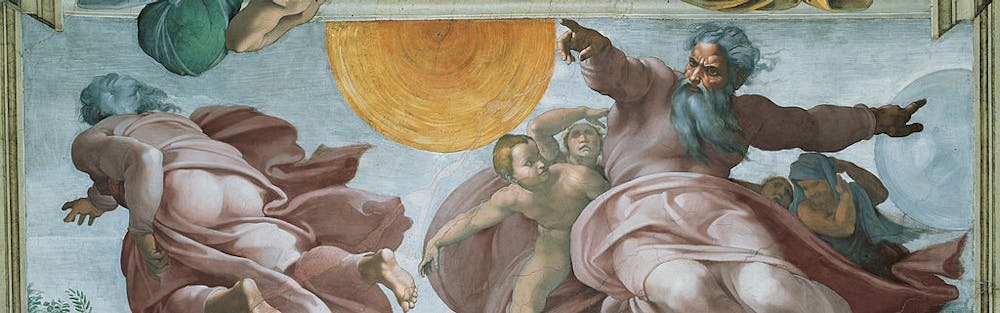
Sistine Chapel, by Michelangelo Buonarroti, 16th century, fresco, Vatican Museums. God is represented with his arms outstretched as he creates.
Photo by Mondadori Portfolio via Getty Images
In that book, he aimed to answer the following question: If Jesus atoned for our sins, what does this mean?
Sin, as understood by Anselm and other Christians, is wrongdoing against God. Anselm thought that God is impassible, so sin can’t mean that we literally harm God’s inner happiness. However, Anselm thought that it is still possible to harm God’s honor.
To understand what it would mean to harm God’s honor, consider this analogy by Catholic philosopher of religion Eleonore Stump. She asks us to imagine a situation where you spread a false, hurtful rumor about your colleague Beth to your friend Priya. Priya knows you’re lying, so you haven’t harmed Beth. But there is still a sense in which you’ve done wrong by Beth – you have done her an injustice.
Theologians believe that humans can harm God in similar ways: They can’t hurt God, but can still do God an injustice. But unlike human beings, God can’t feel upset or otherwise emotionally dissatisfied. Any such emotional dissatisfaction would be inconsistent with the fulfilled inner life that a perfect divine person must have.
Yet, a puzzle arises: The scriptures frequently talk about God’s emotions. For example, God is often depicted as angry or as taking pleasure in things creatures do.
Aquinas helps us reconcile divine emotions with impassibility, as religion scholar Anastasia Scrutton, explains. Aquinas draws a distinction between “passiones,” emotions that are not under our voluntary control, and “affectiones,” which are voluntary and rational. These constitute ways in which God evaluates situations.
In human beings, affectiones and passiones are always bound up together. For example, when a human being is angry – when she witnesses an unjust situation, for example – she will also feel upset. By contrast, theologians imagine that God can become angry without becoming upset.
In Aquinas’ views, when our character and conduct occasion God’s negative affectiones, we harm not God’s inner well-being but God’s relationship to us.
[Deep knowledge, daily. Sign up for The Conversation’s newsletter.]
A view from the Scriptures
Under this interpretation, the question arises: What kinds of character and conduct dishonor God, displease God and therefore do God an injustice?
In the Bible, the Prophet Isaiah says that the time when the Messiah returns is a time when the people of all nations “will beat their swords into plowshares and their spears into pruning hooks. Nation will not take up sword against nation, nor will they train for war anymore.”
Put in today’s context, Isaiah’s vision of the social order God aims to establish is one in which tools of war are exchanged for tools of agriculture and ecological caretaking.

The Bible shows that God prefers justice.
alex.ch/Flickr.com, CC BY-NC-SA
For those who take Isaiah’s words to express divine intentions for human beings here and now – those who read Isaiah religiously as Scripture through which God addresses us – this vision calls readers to forfeit their implements of war, such as guns, in today’s world. Thus, in Isaiah being “against guns” does not imply being “against God.” In fact, it is quite the contrary.
On erasing religion from the public sphere, God speaks through the mouth of the Hebrew Bible prophet: “I hate, I despise your religious festivals; your assemblies are a stench to me.” God despises these festivals, because the people are, in God’s views unjust. Thus, the Prophet says “Even though you bring me burnt offerings and grain offerings, I will not accept them.” Instead of religious festivals, God exhorts people to “let justice roll on like a river, righteousness like a never-failing stream.”
It would appear then, for readers who take these words in Isaiah to heart, that harming God is not the same as removing religion from the public sphere. Indeed, being unjust would be a greater harm.
No one better embodies this repudiation of violence and being a voice for the underclass than Jesus himself.
According to traditional Christian teaching, Jesus is God manifest as a human being. The Gospels clearly state how he advocated “love your enemies and pray for those who persecute you.” He condemned the religious hypocrisy of seeking the place of honor and public respect while neglecting the poor, oppressed and socially marginalized.
Dishonoring these stances taken by Jesus, God in the flesh, would then appear to harm God. As religion scholars, we then argue that the Christian tradition to which Trump appeals when he claims that a Biden presidency would “hurt God” does not support that claim.
This article is republished from The Conversation, a nonprofit news organization dedicated to unlocking ideas from academia, under a Creative Commons license.

About Sameer Yadav
Sameer Yadav is an Assistant Professor of Religious Studies at Westmont College and Helen De Cruz is the Danforth Chair of Humanities at Saint Louis University. You can read more about the author here.


Browse Our Archives
Select a Category Buddhism Christianity Hinduism Islam Judaism Religion and society Uncategorized
Select a Month July 2024 March 2024 February 2024 January 2024 December 2023 November 2023 October 2023 September 2023 August 2023 July 2023 January 2023 August 2022 July 2022 April 2022 February 2022 January 2022 October 2021 July 2021 June 2021 May 2021 April 2021 March 2021 February 2021 January 2021 December 2020 November 2020 October 2020 September 2020 August 2020 July 2020 June 2020 May 2020
Follow Us!
TAKE THE
Religious Wisdom Quiz
What does Proverbs compare wisdom to?
Select your answer to see how you score.
A woman A mountain A river A city
Related posts from The Conversation


Electing A Virtuous President Would Make Immunity Irrelevant

Why The Olympic Games Are A ‘Civil Religious’...

The Catholic Church Is Using The Olympics To...
TRENDING AT PATHEOS Religion News

Catholic Integralists believe that religious values – specifically Christian ones – should...

Electing A Virtuous President Would Make Immunity Irrelevant
Presidential immunity can bring with it many risks. So how can we...

Why The Olympic Games Are A ‘Civil Religious’...
Sporting events form a vital space where Americans display their 'civil religious...

After more than a decade of news, research updates, and insights on...

Q: Why do Southern Baptists and like-minded Protestants...
THE RELIGION GUY’S ANSWER: Why? Simple. Because they believe that’s what the...

THE QUESTION: Is gambling evil? THE RELIGION GUY’S ANSWER: Analysts anticipate a...
view all Religion News blogs
Ad-Free & Subscriber Log-In Subscription Support
- About Us
- 2026 Calendar
- Videos
- Podcasts
- Library of World Religions
- Faith In Media Tracker
- Advertise With Us
- Write for Us
- Privacy Policy
- Terms of Service
- Do Not Sell My Data
- Contact Us
- Radiant Digital
- Manage Newsletter Subscriptions
- Unsubscribe From Notifications
- Sitemap
Copyright 2008-2026, Patheos. All rights reserved.
Subscription Support Ad-Free & Subscriber Log-In
Follow Patheos