
BuddhistCatholicContemplativeEvangelicalGeneral ChristianHinduJewishLatter-day SaintMuslimNew VisionsProgressive Christian
Beliefs
- Buddhist
- Catholic
- Contemplative
- Evangelical
- General Christian
- Hindu
- Jewish
- Latter-day Saint
- More Voices
- Muslim
- New Visions
- Pagan
- Progressive Christian
Topics
- Religion News
- Food and Religion
- Sports and Religion
- Religious Art
- Religious Music and Entertainment
- Religious Events
- History and Religion
- Style and Religion
- Politics and Religion
- Women in Religion
- Recreation Outdoors and Religion
- Business Finance and Religion
- Careers Workplace and Religion
- Education and Religion
- Family Parenting and Religion
- Health Fitness and Religion
- Home and Religion
- Relationships and Religion
- Technology and Religion
- Travel and Religion
Columnists
- Buddhist Columnists
- Business Finance and Religion Columnists
- Careers Workplace and Religion Columnists
- Catholic Columnists
- Contemplative Columnists
- Education and Religion Columnists
- Evangelists Columnists
- Family Parenting and Religion Columnists
- General Christian Columnists
- Health Fitness and Religion Columnists
- Hindu Columnists
- History and Religion Columnists
- Home and Religion Columnists
- Jewish Columnists
- More Voices Columnists
- Latter Day Columnists
- Muslim Columnists
- New Visions Columnists
- Nonreligious Columnists
- Pagan Columnists
- Politics and Religion Columnists
- Progressive Columnists
- Recreation Outdoors and Religion Columnists
- Relationships and Religion Columnists
- Religion News Columnists
- Religious Art Columnists
- Religious Events Columnists
- Religious Music and Entertainment Columnists
- Sports and Religion Columnists
- Style and Religion Columnists
- Technology and Religion Columnists
- Travel and Religion Columnists
- Women in Religion Columnists
Resource Library
- 2026 Calendar
- Library of World Religions
- The 100 Most Holy Places on Earth
- Patheos Answers
- Podcasts
- Videos
- Faith Leaders Database
- Anglican Episcopalian
- Bahai
- Baptist
- Buddhism
- Christianity
- Confucianism
- Eastern Orthodoxy
- Hinduism
- Holiness and Pentecostal
- ISKCON
- Islam
- Judaism
- Lutheran
- Methodist
- The Church of Jesus Christ of Latter-day Saints
- New Age
- Paganism
- Presbytarian and Reformed
- Protestantism
- Religion Behind the Scenes
- Roman Catholic
- Scientology
- Shia Islam
- Sikhism
- Sufism
- Sunni Islam
- Taoism
- Zen
- See all religions
Research Tools
 Ad-Free & Subscriber Log-In Subscription Support
Ad-Free & Subscriber Log-In Subscription Support
Follow Patheos 

- Trending:
- Forgiveness
- |
- Marriage
- |
- Consciousness
- |
- Death Penalty
- |
- Election
- |
- Halloween

- Home
- Religion News
- How the sound of religion has changed in the pandemic
How the sound of religion has changed in the pandemic
Last updated on: August 12, 2020 at 3:49 pm by The Conversation
How the sound of religion has changed in the pandemic 2020-08-12T09:58:20-04:00 The Conversation
Patheos Explore the world's faith through different perspectives on religion and spirituality! Patheos has the views of the prevalent religions and spiritualities of the world.
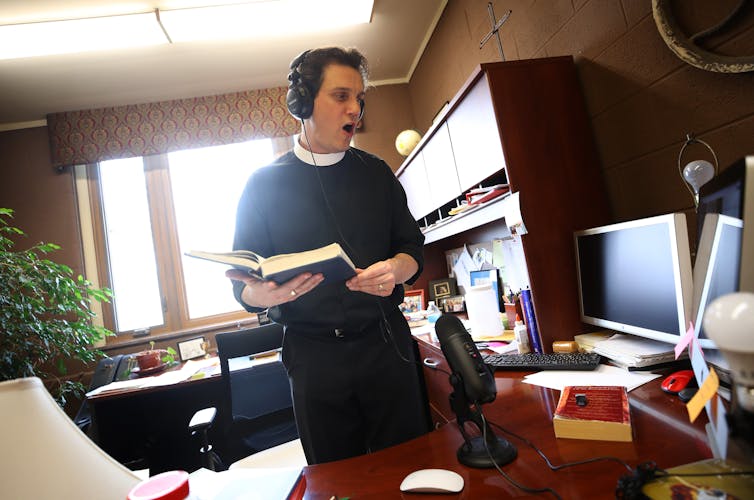
The Rev. Philip Dinwiddie sings to a pre-recording of mass at St. James Episcopal Church in Grosse Ile, Michigan.
Gregory Shamus/Getty Images
By Amy Derogatis of Michigan State University and Isaac Weiner of The Ohio State University
Things sound different in a lockdown. The silence of usually bustling streets, the two-tone whirr of ambulance sirens and the sudden awareness of birdsong, all formed an aural backdrop to the coronavirus pandemic.
Nowhere has the change in sound been more noticeable than at houses of worship. The voices of congregants praying, chanting and singing has been quietened in churches, mosques and temples. Instead, congregants have had to work in new acoustic settings, both in person and online.
In short, religion, too, sounds different during the pandemic. We know this, because we have been documenting the sounds of religious life in America. Over the last six years, our teams of faculty and student researchers at Michigan State University and The Ohio State University have cataloged hundreds of audio recordings, tuning in to what religion sounds like across a wide variety of spaces and traditions.
Sound and space
It might seem unusual to think about religion through sounds. Scholars are more inclined to define religions in terms of beliefs and doctrine, or focus on visual iconography and sacred architecture.
But there are good reasons why it is useful to turn to sound to understand religious diversity in the United States.
Listening for religion directs our attention to the things that religious people and communities do, not just what they believe. It brings us into formal spaces and times of religious life, as well as into more mundane moments of everyday practice, such as people chatting while preparing food for a religious festival or the sounds of removing shoes before entering a worship space.
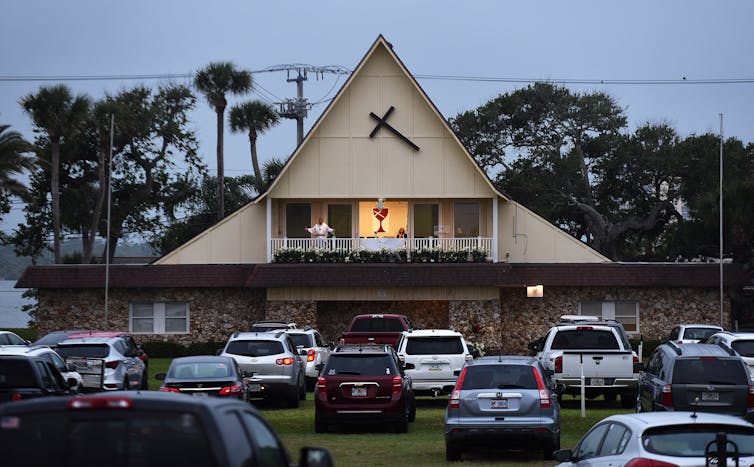
Car horns mark ‘amens’ at drive-in church services, such as this one in Daytona Beach, Florida.
Paul Hennessy/SOPA Images/LightRocket via Getty Images
Paying attention to religious sounds can serve as a reminder that religious practice is subjective, often spontaneous and shaped by participants – it takes place in particular moments and spaces.
Listening for religion
The religious sounds and silences being made during this pandemic provide extraordinary examples of the power of listening to understand the diversity of religious practices in the United States today.
Prior to the lockdown, we visited sites that might seem obviously religious, like churches, synagogues and mosques. But we also went to places that might seem ostensibly secular – a race track, rodeo, political rally or college football game. We adopted a broad approach to thinking about what counts as a religious sound or space.
By gathering these recordings together and curating them on a custom-built digital platform, we hoped to inspire new ways of thinking about religion in the United States.
Sonic Zoom?
When the coronavirus hit, we realized that we, too, would have to change the ways that we conducted our research. In March 2020, we announced a public call for sounds and invited anyone with a smartphone or other recording device to submit audio recordings documenting how their practices were shifting.
We were overwhelmed by the public response. Since March, we have received over 120 audio files from across the U.S. And key patterns are starting to emerge from our collection.
We have noted a strong desire to maintain continuity of religious practices with the help of technology. For example, after the Baha’i House of Worship in Wilmette, Illinois, closed, its regular public worship transitioned to virtual prayer sessions via Zoom for hundreds of attendees from around the world.
Baha’i Virtual Prayer.
American Religious Sounds Project, CC BY
Performing rituals online also opened up opportunities for religious tourism and hearing religious sounds in new places. Some of our submissions are live-streamed services recorded by practitioners who always wanted to visit a particular worship space in their own tradition, such as an Episcopalian attending Easter services at the National Cathedral in Washington, D.C. Others are recorded by people who wished to visit a new religious community, as in the case of non-Muslim contributors who “visited” online mosques during the month of Ramadan.
Along with this continuity of religious practice, there is acknowledgment that the circumstances of the pandemic require transforming rituals to align with the moment. We heard the sounds of a hospital chaplain in Quincy, Illinois, who replaced the Christian Maundy Thursday feet washing ritual with a ritual washing of hands in a health care context.
Ritual Handwashing.
American Religious Sounds Project, CC BY
Another key theme emerging is the sounds of religious practices alongside sounds specific to the pandemic. For example, a New York Buddhist practitioner recorded herself chanting with an online community and captured the background sounds of neighbors clapping during the nightly 7 p.m. celebration for first responders. An Easter Sunday service in a parking lot in Walnut Grove, Missouri, recorded parishioners honking their horns to shout “Amen!”
Buddhist chanting.
American Religious Sounds Project, CC BY
Cars Honking Amen.
American Religious Sounds Project, CC BY
Shelter-in-place orders opened up domestic spaces as primary locations for religious practice. We have heard from practitioners performing religious rituals at home. These spaces have created new worship sounds. Many of our recordings include pets vocalizing, phones beeping, babies crying and private conversations amplified that would generally not be heard in a formal worship setting. This ambient noise is part of the sound of religion during the pandemic.
Baby crying.
American Religious Sounds Project, CC BY
Sometimes these new contexts produce innovative blending of religious and secular practices. A viral Tweet submitted to our archive of an Orthodox Jewish father chanting the children’s book “Goodnight Moon” to the tune of traditional Torah reading brought together the sounds of formal ritual practice with the increased demands of child care during this crisis.
The domestic worship spaces have also provided opportunities for new religious agency and authority. Lay practitioners are deciding how they will participate in services and, in some cases, performing rituals that ordinarily are reserved for clergy, as in a recording of Christian parents administering Communion to their children.
As religious communities navigate worship services via Zoom, the etiquette and practice around “muting” raises important questions about who should be heard and who has the authority to speak. It also presents challenges for communal singing and chanting.
In our archive we have multiple recordings of a Wiccan Coven in Westerville, Ohio participating in a Cone of Power ritual, a practice to raise energy for magical purposes. In the pre-pandemic version, participants stood together in a circle with linked hands and wove their voices together like a beautiful tapestry.
In the recording produced during the pandemic, the group attempted to re-create this ritual via Zoom, but the overlapping sounds became too cacophonous. All the participants except the priests ended up muting their microphones, which produced a strikingly different sonic experience.
Wiccan Beltane Ritual.
American Religious Sounds Project, CC BY
Inclusion and innovation
Our collection also includes voices that might not otherwise be heard – or welcomed – in formal religious settings. One of the submitted recordings is of a family participating in a Protestant worship service via Zoom. The audio includes the loud vocalizations of their autistic son. In this case, at least, online offerings made religious rituals more accessible and more inclusive.
[Get the best of The Conversation, every weekend. Sign up for our weekly newsletter.]
The recordings in our crowdsourced archive are helping us document in real time the numerous ways that COVID-19 is transforming American religious life. The sounds that we are hearing make audible how, even during a time of physical and social distancing, individuals are striving to worship together.
The pandemic is inspiring new, innovative ways of imagining what it means to be a community and who is included as part of that community.
As houses of worship begin to reopen, we are interested in tracking which of these changes may endure and which may prove more fleeting.
You can contribute recordings to the American Religious Sounds Project religioussounds.osu.edu
This article is republished from The Conversation, a nonprofit news organization dedicated to unlocking ideas from academia, under a Creative Commons license.

About Amy Derogatis & Isaac Weiner
Amy Derogatis is a Professor of Religion and American Culture at Michigan State University and Isaac Weiner is an Associate Professor of Comparative Studies and Religious Studies at The Ohio State University. You can read more about the author here.
Previous Post

August 12, 2020
Freedom of religion doesn't mean freedom from mask mandates
Browse Our Archives
Select a Category Buddhism Christianity Hinduism Islam Judaism Religion and society Uncategorized
Select a Month July 2024 March 2024 February 2024 January 2024 December 2023 November 2023 October 2023 September 2023 August 2023 July 2023 January 2023 August 2022 July 2022 April 2022 February 2022 January 2022 October 2021 July 2021 June 2021 May 2021 April 2021 March 2021 February 2021 January 2021 December 2020 November 2020 October 2020 September 2020 August 2020 July 2020 June 2020 May 2020
Follow Us!
TAKE THE
Religious Wisdom Quiz
I cleansed the temple in sixteen days and celebrated Passover so joyfully that we extended it another seven days. Who am I?
Select your answer to see how you score.
Asa Hezekiah Jehoshaphat Josiah
Related posts from The Conversation


Electing A Virtuous President Would Make Immunity Irrelevant

Why The Olympic Games Are A ‘Civil Religious’...

The Catholic Church Is Using The Olympics To...
TRENDING AT PATHEOS Religion News

Catholic Integralists believe that religious values – specifically Christian ones – should...

Electing A Virtuous President Would Make Immunity Irrelevant
Presidential immunity can bring with it many risks. So how can we...

Why The Olympic Games Are A ‘Civil Religious’...
Sporting events form a vital space where Americans display their 'civil religious...

After more than a decade of news, research updates, and insights on...

Q: Why do Southern Baptists and like-minded Protestants...
THE RELIGION GUY’S ANSWER: Why? Simple. Because they believe that’s what the...

THE QUESTION: Is gambling evil? THE RELIGION GUY’S ANSWER: Analysts anticipate a...
view all Religion News blogs
Ad-Free & Subscriber Log-In Subscription Support
- About Us
- 2026 Calendar
- Videos
- Podcasts
- Library of World Religions
- Faith In Media Tracker
- Advertise With Us
- Write for Us
- Privacy Policy
- Terms of Service
- Do Not Sell My Data
- Contact Us
- Radiant Digital
- Manage Newsletter Subscriptions
- Unsubscribe From Notifications
- Sitemap
Copyright 2008-2026, Patheos. All rights reserved.
Subscription Support Ad-Free & Subscriber Log-In
Follow Patheos