
BuddhistCatholicContemplativeEvangelicalGeneral ChristianHinduJewishLatter-day SaintMuslimNew VisionsProgressive Christian
Beliefs
- Buddhist
- Catholic
- Contemplative
- Evangelical
- General Christian
- Hindu
- Jewish
- Latter-day Saint
- More Voices
- Muslim
- New Visions
- Pagan
- Progressive Christian
Topics
- Religion News
- Food and Religion
- Sports and Religion
- Religious Art
- Religious Music and Entertainment
- Religious Events
- History and Religion
- Style and Religion
- Politics and Religion
- Women in Religion
- Recreation Outdoors and Religion
- Business Finance and Religion
- Careers Workplace and Religion
- Education and Religion
- Family Parenting and Religion
- Health Fitness and Religion
- Home and Religion
- Relationships and Religion
- Technology and Religion
- Travel and Religion
Columnists
- Buddhist Columnists
- Business Finance and Religion Columnists
- Careers Workplace and Religion Columnists
- Catholic Columnists
- Contemplative Columnists
- Education and Religion Columnists
- Evangelists Columnists
- Family Parenting and Religion Columnists
- General Christian Columnists
- Health Fitness and Religion Columnists
- Hindu Columnists
- History and Religion Columnists
- Home and Religion Columnists
- Jewish Columnists
- More Voices Columnists
- Latter Day Columnists
- Muslim Columnists
- New Visions Columnists
- Nonreligious Columnists
- Pagan Columnists
- Politics and Religion Columnists
- Progressive Columnists
- Recreation Outdoors and Religion Columnists
- Relationships and Religion Columnists
- Religion News Columnists
- Religious Art Columnists
- Religious Events Columnists
- Religious Music and Entertainment Columnists
- Sports and Religion Columnists
- Style and Religion Columnists
- Technology and Religion Columnists
- Travel and Religion Columnists
- Women in Religion Columnists
Resource Library
- 2026 Calendar
- Library of World Religions
- The 100 Most Holy Places on Earth
- Patheos Answers
- Podcasts
- Videos
- Faith Leaders Database
- Anglican Episcopalian
- Bahai
- Baptist
- Buddhism
- Christianity
- Confucianism
- Eastern Orthodoxy
- Hinduism
- Holiness and Pentecostal
- ISKCON
- Islam
- Judaism
- Lutheran
- Methodist
- The Church of Jesus Christ of Latter-day Saints
- New Age
- Paganism
- Presbytarian and Reformed
- Protestantism
- Religion Behind the Scenes
- Roman Catholic
- Scientology
- Shia Islam
- Sikhism
- Sufism
- Sunni Islam
- Taoism
- Zen
- See all religions
Research Tools
 Ad-Free & Subscriber Log-In Subscription Support
Ad-Free & Subscriber Log-In Subscription Support
Follow Patheos 

- Trending:
- Forgiveness
- |
- Marriage
- |
- Consciousness
- |
- Death Penalty
- |
- Election
- |
- Halloween

- Home
- Religion News
- Hagia Sophia has been converted back into a mosque, but the veiling of its figural icons is not a Muslim tradition
Hagia Sophia has been converted back into a mosque, but the veiling of its figural icons is not a Muslim tradition
Last updated on: August 18, 2020 at 1:29 pm by The Conversation
Hagia Sophia has been converted back into a mosque, but the veiling of its figural icons is not a Muslim tradition 2020-08-18T13:29:19-04:00 The Conversation
Patheos Explore the world's faith through different perspectives on religion and spirituality! Patheos has the views of the prevalent religions and spiritualities of the world.
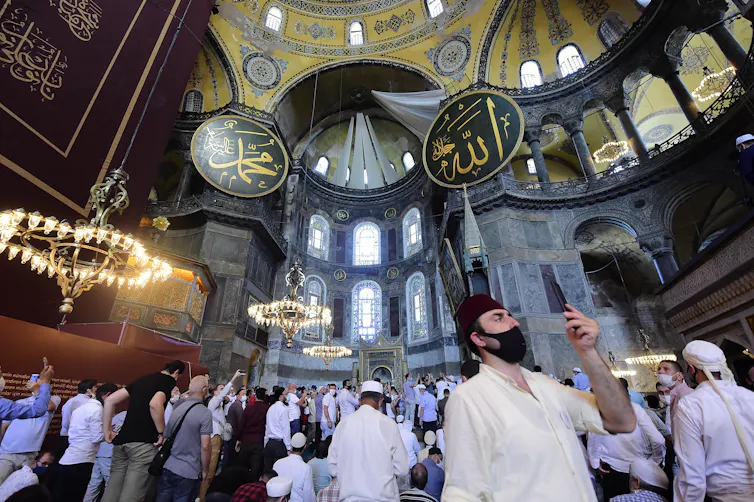
People pray inside the Byzantine-era Hagia Sophia, with sail-like drapes covering mosaic figures of the Virgin Mary and Jesus.
AP Photo/Yasin Akgul
By Christiane Gruber and Paroma Chatterjee of the University of Michigan
Ever since the reversion of Hagia Sophia back into a mosque, the Muslim call to prayer has been resounding from its minarets.
Originally built as a Christian Orthodox church and serving that purpose for centuries, Hagia Sophia was transformed into a mosque by the Ottomans upon their conquest of Constantinople in 1453.
In 1934, it was declared a museum by the secularist Turkish leader Mustafa Kemal Atatürk.
As of June 24 of this year, Hagia Sophia’s icons of the Virgin Mary and infant Christ are covered by fabric curtains as the edifice yet again changes functions.
Turkish officials have stated that the veiling of the images, especially the interior mosaics, is necessary to transform the interior into a Muslim prayer space.
As historians of Byzantine and Islamic art, we argue that in their rush to reassert the monument’s Islamic past, Turkey’s President Recep Tayyip Erdoğan and his associates have inadvertently – and superficially – emulated certain Orthodox Christian practices.
Images of Mary and Christ were often ritually veiled and unveiled in Byzantium, while later Ottoman Muslim rulers did not engage in such practices.
Images of Mary and Jesus in Islam
When Sultan Mehmed II, known as the “Conqueror” or Fatih, took over Constantinople, he headed straight to Hagia Sophia, declared it a mosque and ordered it protected in perpetuity.
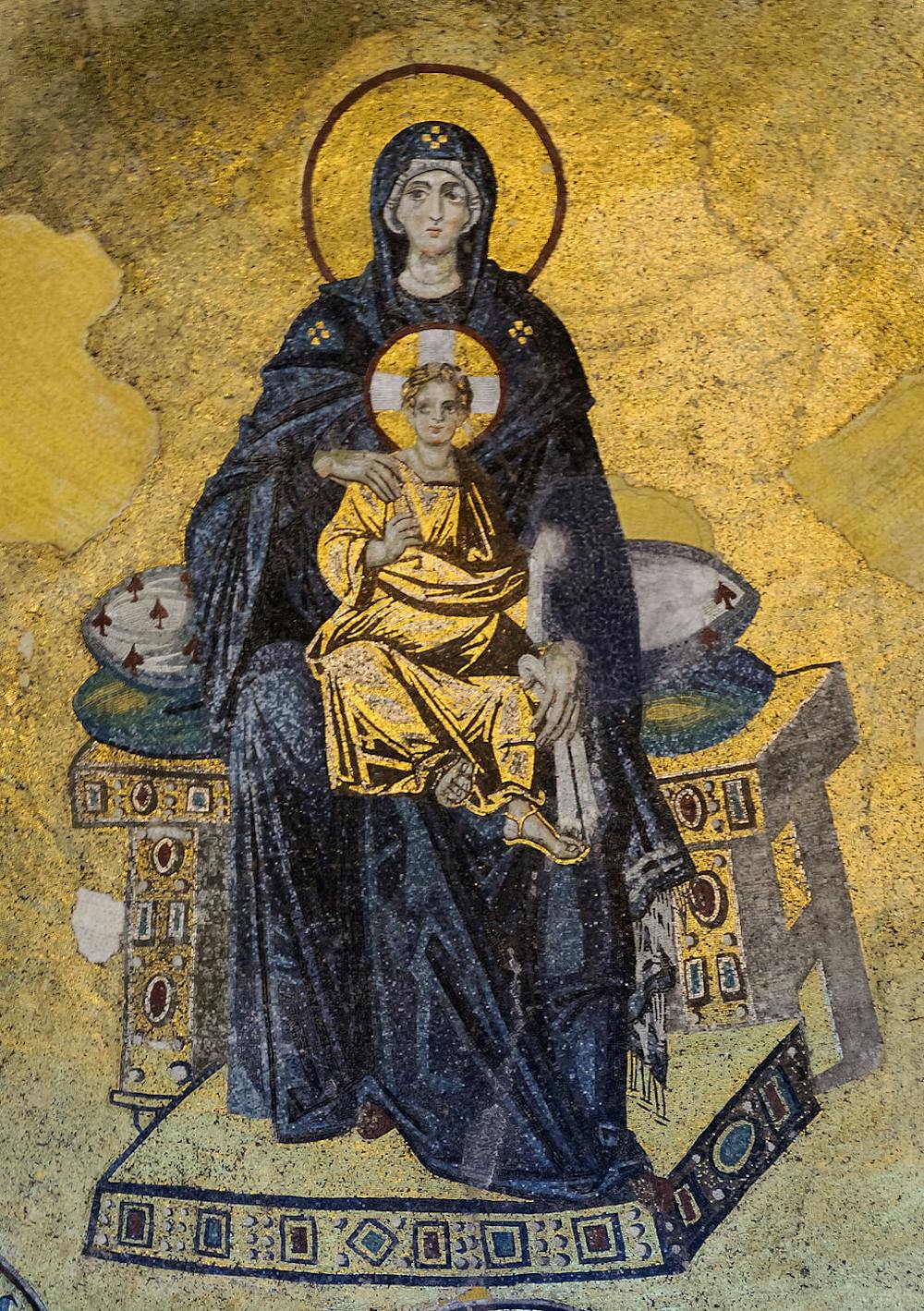
Mosaic of the Virgin Mary and infant Jesus in Hagia Sophia.
Myrabella
He did not order the ninth-century mosaic of Mary and Christ in the interior removed or covered. Instead, Ottoman historians tell us that he stood in awe, feeling that the eyes of the Christ child followed him as he moved about the structure.
Although images of humans are almost never found in mosque architecture, the depictions of Mary and Jesus remained uncovered in the mosque of Hagia Sophia until 1739. At that time, the mosaic was plastered over. The plaster was later removed during the building’s 1934 conversion into a museum.
The centuries-long display may have been a gesture in appreciation of the Prophet Muhammad, who is said to have preserved an icon of the Virgin and Christ when he destroyed the pagan statues at the Kaaba, Islam’s holy sanctuary, in Mecca, Saudi Arabia.
In this and other cases, Muslim rulers clearly understood that religious figures can be used for devotional purposes without necessarily being idolatrous. This nuance has been lost as of late in the more recent debates surrounding representations of the Prophet Muhammad.
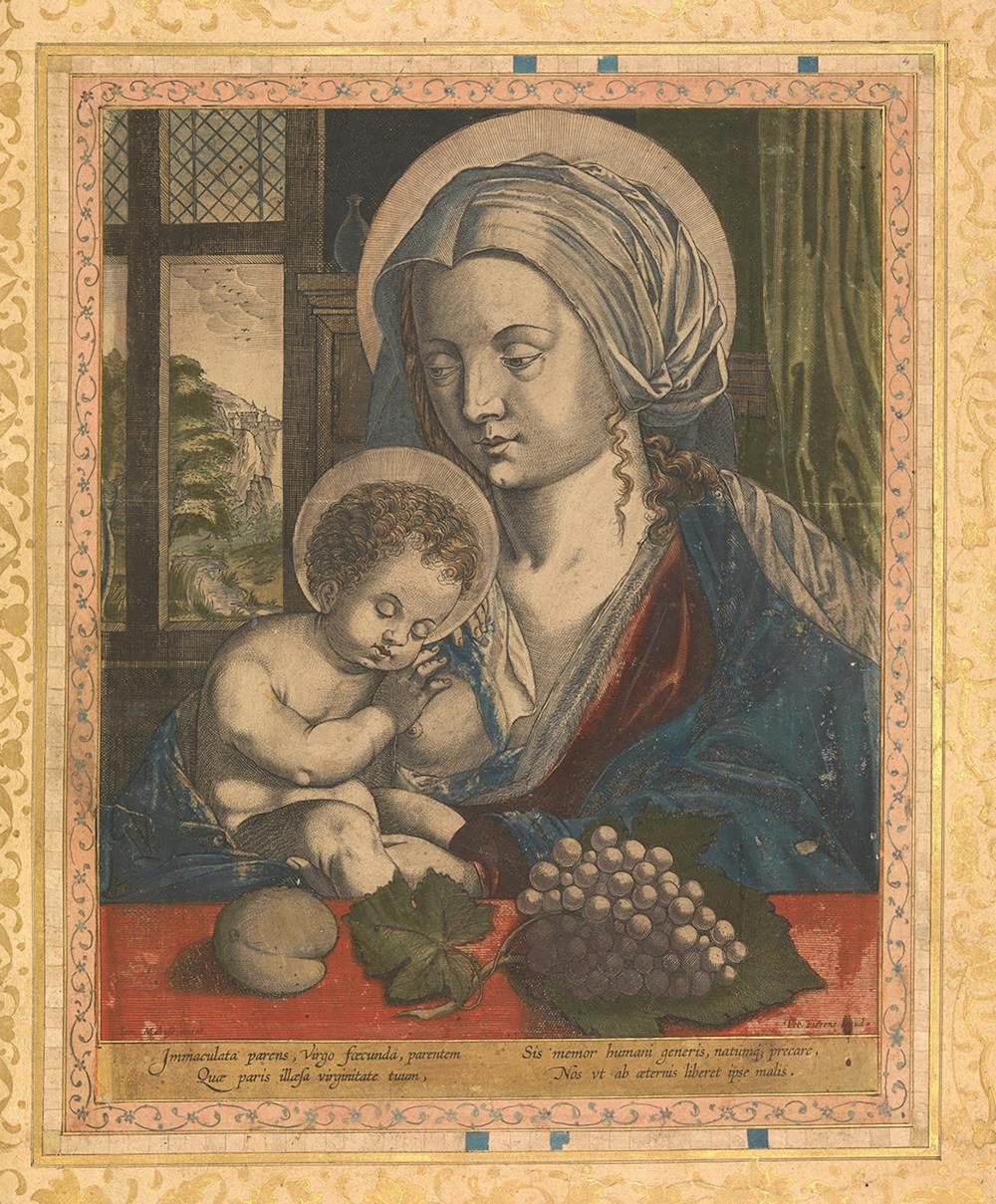
European print of the Virgin Mary and Christ Infant included in an Ottoman album around 1600.
The Metropolitan Museum
From the medieval period onward, Mary and Christ are in fact a recurring motif in Islamic art. They are depicted in metalwork, on glassware and book paintings.
European prints of the mother-and-child pair were also collected into albums by the Ottoman elites of Constantinople in the 17th century. Not shunned or destroyed, these images were sought after, safeguarded and even embellished with colorful paints.
Veiling icons in Christianity
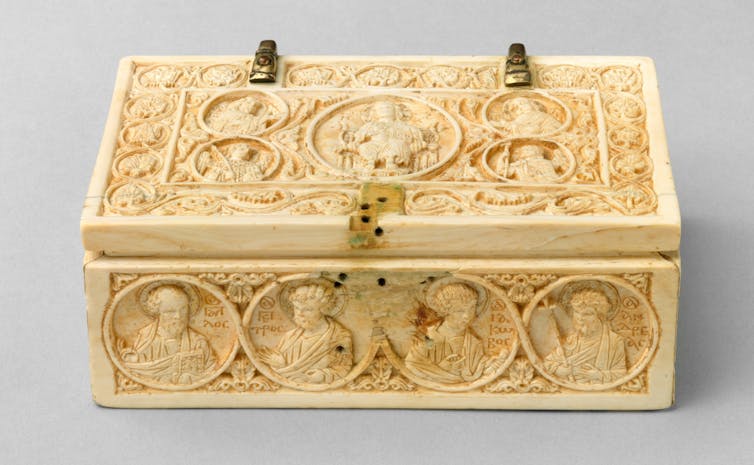
A Byzantine-era casket. On the lid is a composition showing Christ enthroned in majesty, flanked by the Virgin Mary, archangels and Apostles.
The Metropolitan Museum
In the history of Christianity, covering images, and revealing them at significant moments, often testified to their power. The wrapping, encasing, framing and veiling of the most precious images and objects signaled and guaranteed their divine qualities.
Thus relics were stored in containers and icons strategically enshrouded. Sometimes, paintings of Mary and Christ in medieval Western European manuscripts were screened by veils sewn onto folio pages.
Lifting these cloth “shields” enabled viewers a full visual and tactile experience of the divine depiction beneath.
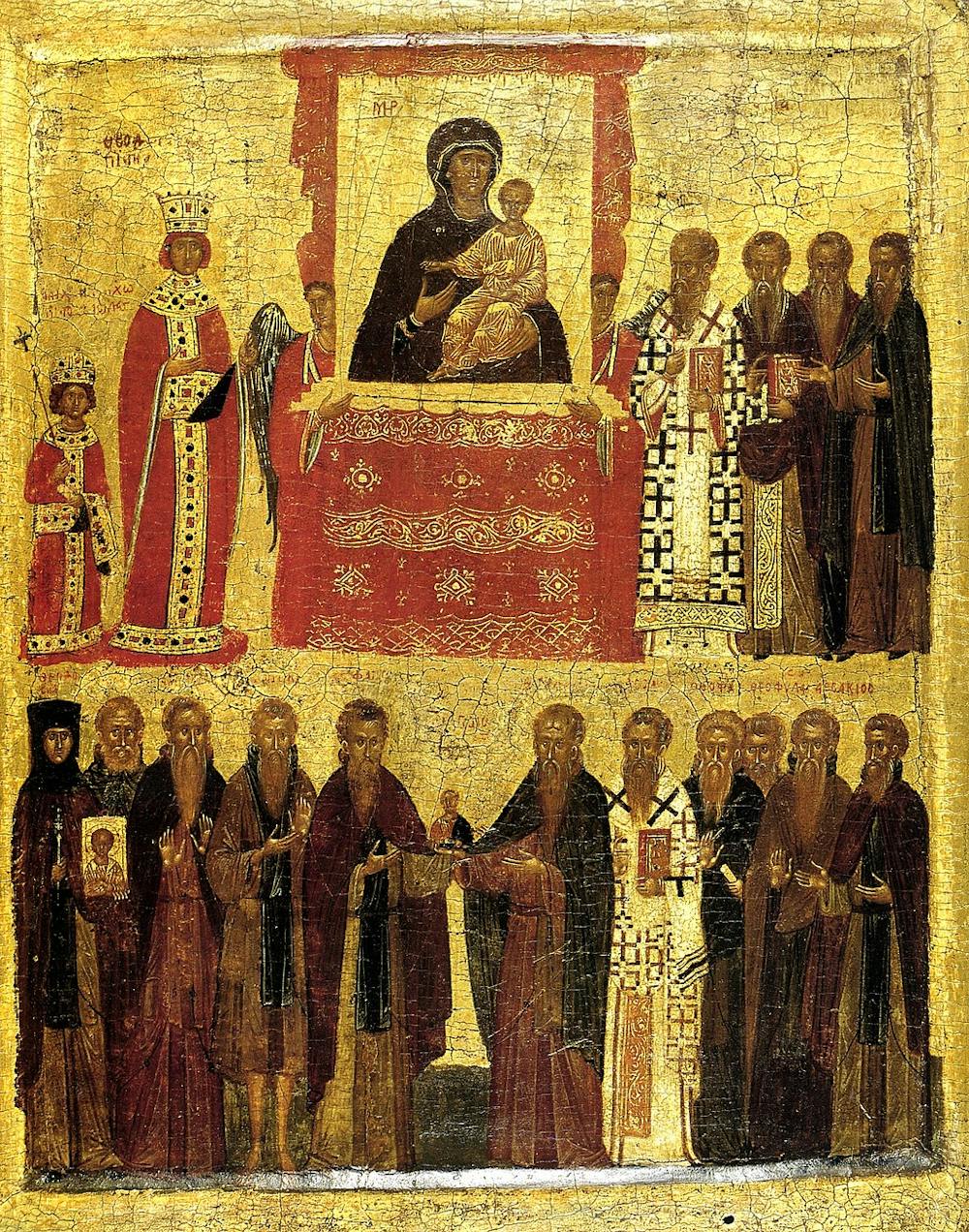
A medieval icon depicting a painted image of of the Virgin Mary and Christ Infant flanked by fabric veils.
The British Museum, CC BY-NC-SA
The Virgin Mary, or Theotokos, as she was known in Byzantium, is closely associated with veils. The “maphorion,” or the cloth with which she is believed to have covered her head and shoulders, was housed in Constantinople. It was said to be invested with protective powers and believed to ward off enemies.
A Byzantine miracle
Turkish officials claim that the curtains covering the mosaics are on an electronic rail system and that they shall be lowered to cover the icons only during prayer times.
But if the strips of cloth covering the Mary and Christ mosaic are to be raised intermittently and nonmanually between prayers as proposed, then a startling – if purely cursory – coincidence would emerge.
[You’re too busy to read everything. We get it. That’s why we’ve got a weekly newsletter. Sign up for good Sunday reading. ]
It would resemble somewhat a well-known 11th-century Christian miracle in Constantinople. The story goes that each Friday evening, the veil covering an icon of Mary and Christ would rise by itself after prayers. It would remain lifted until the following day when it fell again – on its own.
The raised veil was interpreted, among other things, as a sign of the tangible interface between the divine and mortal worlds and, more specifically, as the Virgin Mary’s embrace of her devotees.
The paradox of the past
The rich symbolism of the 11th-century miracle and other instances of Orthodox practice is certainly lost in the current strategy of veiling at Hagia Sophia. Ideological struggles over this world heritage structure since 1934 reveal the extent to which the monument serves as a symbol for the staking of political power and religious authority among Christians, Muslims and secularists in Turkey and beyond.
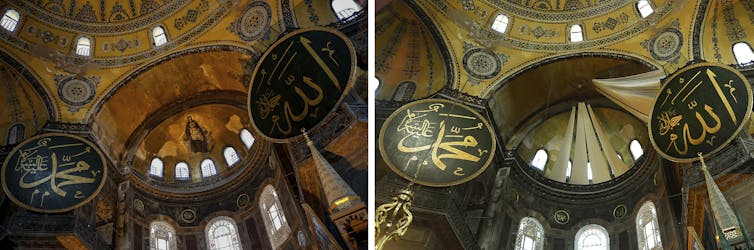
The mosaic, left, depicts The Virgin Mary and Jesus in the Byzantine-era Hagia Sophia. On the photo on the right, the mosaic is covered with sail-like drapes.
AP Photo/Emrah Gurel/Yasin Akgul
This time around, rather than maintain Hagia Sophia as a monument of coexistence, the Turkish government’s actions have sharpened an already tense ideological divide between pious and secular Turks, and between Muslims and Christians worldwide.
But beyond the political and religious posturing, we argue that Erdoğan and his team have also accidentally, and speciously, brought back the fabric veiling of icons, one of the practices of Byzantine Orthodoxy.
This article is republished from The Conversation, a nonprofit news organization dedicated to unlocking ideas from academia, under a Creative Commons license.

About Christiane Gruber & Paroma Chatterjee
Christiane Gruber is a Professor of Islamic Art at the University of Michigan and Paroma Chatterjee is an Associate Professor of History of Art at the University of Michigan. You can read more about the author here.
Previous Post

August 12, 2020
How the sound of religion has changed in the pandemic


Browse Our Archives
Select a Category Buddhism Christianity Hinduism Islam Judaism Religion and society Uncategorized
Select a Month July 2024 March 2024 February 2024 January 2024 December 2023 November 2023 October 2023 September 2023 August 2023 July 2023 January 2023 August 2022 July 2022 April 2022 February 2022 January 2022 October 2021 July 2021 June 2021 May 2021 April 2021 March 2021 February 2021 January 2021 December 2020 November 2020 October 2020 September 2020 August 2020 July 2020 June 2020 May 2020
Follow Us!
TAKE THE
Religious Wisdom Quiz
Which empire conquered the Northern Kingdom of Israel?
Select your answer to see how you score.
Egyptian Babylonian Assyrian Persian
Related posts from The Conversation


Why The Olympic Games Are A ‘Civil Religious’...

How Christians Hold Differing Views On The Resurrection
Pope Francis called surrogacy ‘deplorable’
TRENDING AT PATHEOS Religion News

Catholic Integralists believe that religious values – specifically Christian ones – should...

Electing A Virtuous President Would Make Immunity Irrelevant
Presidential immunity can bring with it many risks. So how can we...

Why The Olympic Games Are A ‘Civil Religious’...
Sporting events form a vital space where Americans display their 'civil religious...

After more than a decade of news, research updates, and insights on...

Q: Why do Southern Baptists and like-minded Protestants...
THE RELIGION GUY’S ANSWER: Why? Simple. Because they believe that’s what the...

THE QUESTION: Is gambling evil? THE RELIGION GUY’S ANSWER: Analysts anticipate a...
view all Religion News blogs
Ad-Free & Subscriber Log-In Subscription Support
- About Us
- 2026 Calendar
- Videos
- Podcasts
- Library of World Religions
- Faith In Media Tracker
- Advertise With Us
- Write for Us
- Privacy Policy
- Terms of Service
- Do Not Sell My Data
- Contact Us
- Radiant Digital
- Manage Newsletter Subscriptions
- Unsubscribe From Notifications
- Sitemap
Copyright 2008-2026, Patheos. All rights reserved.
Subscription Support Ad-Free & Subscriber Log-In
Follow Patheos