
BuddhistCatholicContemplativeEvangelicalGeneral ChristianHinduJewishLatter-day SaintMuslimNew VisionsProgressive Christian
Beliefs
- Buddhist
- Catholic
- Contemplative
- Evangelical
- General Christian
- Hindu
- Jewish
- Latter-day Saint
- More Voices
- Muslim
- New Visions
- Pagan
- Progressive Christian
Topics
- Religion News
- Food and Religion
- Sports and Religion
- Religious Art
- Religious Music and Entertainment
- Religious Events
- History and Religion
- Style and Religion
- Politics and Religion
- Women in Religion
- Recreation Outdoors and Religion
- Business Finance and Religion
- Careers Workplace and Religion
- Education and Religion
- Family Parenting and Religion
- Health Fitness and Religion
- Home and Religion
- Relationships and Religion
- Technology and Religion
- Travel and Religion
Columnists
- Buddhist Columnists
- Business Finance and Religion Columnists
- Careers Workplace and Religion Columnists
- Catholic Columnists
- Contemplative Columnists
- Education and Religion Columnists
- Evangelists Columnists
- Family Parenting and Religion Columnists
- General Christian Columnists
- Health Fitness and Religion Columnists
- Hindu Columnists
- History and Religion Columnists
- Home and Religion Columnists
- Jewish Columnists
- More Voices Columnists
- Latter Day Columnists
- Muslim Columnists
- New Visions Columnists
- Nonreligious Columnists
- Pagan Columnists
- Politics and Religion Columnists
- Progressive Columnists
- Recreation Outdoors and Religion Columnists
- Relationships and Religion Columnists
- Religion News Columnists
- Religious Art Columnists
- Religious Events Columnists
- Religious Music and Entertainment Columnists
- Sports and Religion Columnists
- Style and Religion Columnists
- Technology and Religion Columnists
- Travel and Religion Columnists
- Women in Religion Columnists
Resource Library
- 2026 Calendar
- Library of World Religions
- The 100 Most Holy Places on Earth
- Patheos Answers
- Podcasts
- Videos
- Faith Leaders Database
- Anglican Episcopalian
- Bahai
- Baptist
- Buddhism
- Christianity
- Confucianism
- Eastern Orthodoxy
- Hinduism
- Holiness and Pentecostal
- ISKCON
- Islam
- Judaism
- Lutheran
- Methodist
- The Church of Jesus Christ of Latter-day Saints
- New Age
- Paganism
- Presbytarian and Reformed
- Protestantism
- Religion Behind the Scenes
- Roman Catholic
- Scientology
- Shia Islam
- Sikhism
- Sufism
- Sunni Islam
- Taoism
- Zen
- See all religions
Research Tools
 Ad-Free & Subscriber Log-In Subscription Support
Ad-Free & Subscriber Log-In Subscription Support
Follow Patheos 

- Trending:
- Forgiveness
- |
- Marriage
- |
- Consciousness
- |
- Death Penalty
- |
- Election
- |
- Halloween

- Home
- Religion News
- Freedom of religion doesn’t mean freedom from mask mandates
Freedom of religion doesn’t mean freedom from mask mandates
Last updated on: August 12, 2020 at 9:49 am by The Conversation
Freedom of religion doesn’t mean freedom from mask mandates 2020-08-12T09:49:00-04:00 The Conversation
Patheos Explore the world's faith through different perspectives on religion and spirituality! Patheos has the views of the prevalent religions and spiritualities of the world.
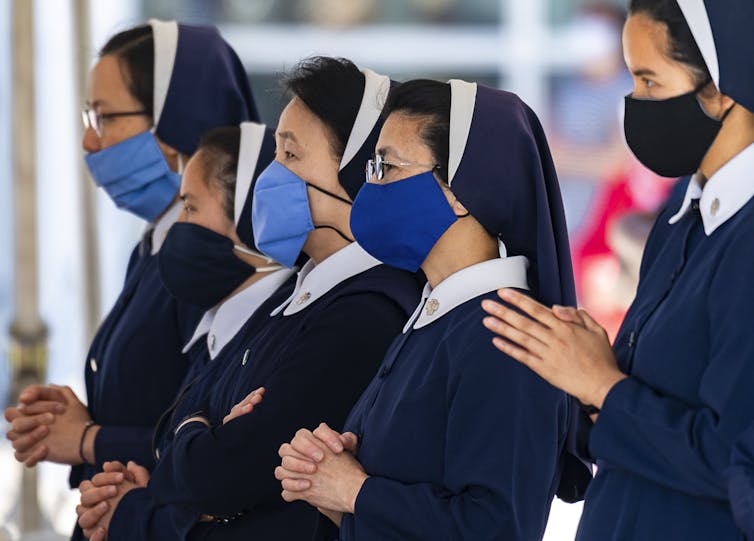
Some church members have no problem wearing masks; others say it’s an unconstitutional mandate.
Leonard Ortiz/MediaNews Group/Orange County Register via Getty Images
By John E. Finn of Wesleyan University
Mask mandates do not violate the First Amendment’s protections for freedom of speech, assembly and association, as I wrote recently in a story that examined Constitution-based objections to mask-wearing requirements.
But a recent lawsuit filed in Florida, Tillis v. Manatee County, raises a different question: Do mask mandates violate the free exercise of religion?
The answer is no. No matter what you believe or why you believe it, the First Amendment guarantee of freedom of religion, known as the Free Exercise Clause, does not exempt you from a public health requirement to wear a mask.
Interferes with praying
In the Tillis case, the claim is that a mask mandate “should not apply within churches, synagogues and other houses of worship because it interferes with the ability to pray.”
The lawsuit, filed by Rev. Joel D. Tillis and Florida State Rep. Anthony Sabatini as Tillis’ attorney, challenges a mandate imposed by Manatee County. The plaintiffs allege that masks make “it more difficult … to preach and for members of the choir to sing.”
Rev. Joel Tillis, who filed the lawsuit against the Manatee County mask mandate, preaching on Aug. 8, 2020: ‘The issue is bigger than about safety now; it’s about freedom tomorrow.’
Courts typically assess freedom of religion claims based on the Free Exercise Clause, using what constitutional lawyers call the “rational basis” test.
As Justice Antonin Scalia wrote for the Supreme Court in the 1983 case of Employment Division v. Smith, laws that do not intend to single out religion but instead apply widely must be “rationally related” to a “legitimate” governmental interest to be constitutional.
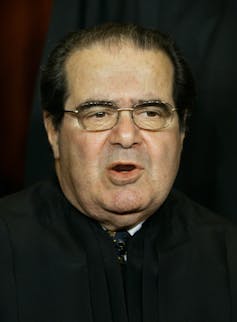
Supreme Court Justice Antonin Scalia helped articulate a constitutional test for whether a law violates freedom of religion.
AP Photo/J. Scott Applewhite
By design, that test is highly deferential to the government. Only rarely will the government fail to pass it.
If we assume that a mask mandate applies to everyone and is not intended to single out religion or people of faith, then the government’s undoubted interest in protecting public health will almost certainly satisfy the rational basis test.
[Get the best of The Conversation, every weekend. Sign up for our weekly newsletter.]
Alternatively, many states, including Florida, have passed “Religious Freedom Restoration Acts,” which typically require courts to use a much more rigorous standard of review, a standard called “strict scrutiny,” in free exercise cases.
Under this test, a court will require the law to further a “compelling governmental interest,” and the law must be “narrowly tailored” to achieve that interest. This is a much more demanding test than the rational basis test, and puts a much higher burden on the government to justify the law in question.
Compelling state interest
Which test a court will use thus depends on whether the claim is that a mask mandate violates the First Amendment to the federal Constitution or that it violates a state constitutional guarantee of religious freedom. The lawsuit filed by Rev. Tillis, for example, complains only that the mandate violates the Florida State Constitution.
Which test applies also depends on what the lawsuit claims. If the suit alleges a violation of the First Amendment, a court will ask if the mandate has a rational basis. If the lawsuit alleges a violation of a state Religious Freedom Restoration Act, a court will ask if the law is narrowly tailored to further a compelling state interest.
As I wrote previously, courts are very likely to rule that mask mandates do advance a compelling state interest – the protection of public health – and do so in a way that minimizes the restriction on the constitutional right involved, whether of speech or religion.
Face masks, for example, are far less burdensome than stay-at-home orders or quarantines. Mask mandates that are carefully drafted and that indicate where, and when, the mandate does not apply, such as exemptions for situations where masking is impossible, like swimming or eating or in dental offices, are very likely to pass strict scrutiny.
Consequently, whether a court uses the more demanding strict scrutiny test or the less demanding rational basis test, the result will probably be the same. In the end, religious objections to masks are no more a constitutional obstacle to mask requirements than are objections grounded in free speech.
This article is republished from The Conversation, a nonprofit news organization dedicated to unlocking ideas from academia, under a Creative Commons license.

About John E. Finn
John E. Finn is the Professor Emeritus of Government at Wesleyan University. You can read more about the author here.

Next Post

August 12, 2020 How the sound of religion has changed in the pandemic
Browse Our Archives
Select a Category Buddhism Christianity Hinduism Islam Judaism Religion and society Uncategorized
Select a Month July 2024 March 2024 February 2024 January 2024 December 2023 November 2023 October 2023 September 2023 August 2023 July 2023 January 2023 August 2022 July 2022 April 2022 February 2022 January 2022 October 2021 July 2021 June 2021 May 2021 April 2021 March 2021 February 2021 January 2021 December 2020 November 2020 October 2020 September 2020 August 2020 July 2020 June 2020 May 2020
Follow Us!
TAKE THE
Religious Wisdom Quiz
What instrument did David play?
Select your answer to see how you score.
Lyre Trumpet Flute Harp
Related posts from The Conversation


Electing A Virtuous President Would Make Immunity Irrelevant

Why The Olympic Games Are A ‘Civil Religious’...

The Catholic Church Is Using The Olympics To...
TRENDING AT PATHEOS Religion News

Catholic Integralists believe that religious values – specifically Christian ones – should...

Electing A Virtuous President Would Make Immunity Irrelevant
Presidential immunity can bring with it many risks. So how can we...

Why The Olympic Games Are A ‘Civil Religious’...
Sporting events form a vital space where Americans display their 'civil religious...

After more than a decade of news, research updates, and insights on...

Q: Why do Southern Baptists and like-minded Protestants...
THE RELIGION GUY’S ANSWER: Why? Simple. Because they believe that’s what the...

THE QUESTION: Is gambling evil? THE RELIGION GUY’S ANSWER: Analysts anticipate a...
view all Religion News blogs
Ad-Free & Subscriber Log-In Subscription Support
- About Us
- 2026 Calendar
- Videos
- Podcasts
- Library of World Religions
- Faith In Media Tracker
- Advertise With Us
- Write for Us
- Privacy Policy
- Terms of Service
- Do Not Sell My Data
- Contact Us
- Radiant Digital
- Manage Newsletter Subscriptions
- Unsubscribe From Notifications
- Sitemap
Copyright 2008-2026, Patheos. All rights reserved.
Subscription Support Ad-Free & Subscriber Log-In
Follow Patheos