
BuddhistCatholicContemplativeEvangelicalGeneral ChristianHinduJewishLatter-day SaintMuslimNew VisionsProgressive Christian
Beliefs
- Buddhist
- Catholic
- Contemplative
- Evangelical
- General Christian
- Hindu
- Jewish
- Latter-day Saint
- More Voices
- Muslim
- New Visions
- Pagan
- Progressive Christian
Topics
- Religion News
- Food and Religion
- Sports and Religion
- Religious Art
- Religious Music and Entertainment
- Religious Events
- History and Religion
- Style and Religion
- Politics and Religion
- Women in Religion
- Recreation Outdoors and Religion
- Business Finance and Religion
- Careers Workplace and Religion
- Education and Religion
- Family Parenting and Religion
- Health Fitness and Religion
- Home and Religion
- Relationships and Religion
- Technology and Religion
- Travel and Religion
Columnists
- Buddhist Columnists
- Business Finance and Religion Columnists
- Careers Workplace and Religion Columnists
- Catholic Columnists
- Contemplative Columnists
- Education and Religion Columnists
- Evangelists Columnists
- Family Parenting and Religion Columnists
- General Christian Columnists
- Health Fitness and Religion Columnists
- Hindu Columnists
- History and Religion Columnists
- Home and Religion Columnists
- Jewish Columnists
- More Voices Columnists
- Latter Day Columnists
- Muslim Columnists
- New Visions Columnists
- Nonreligious Columnists
- Pagan Columnists
- Politics and Religion Columnists
- Progressive Columnists
- Recreation Outdoors and Religion Columnists
- Relationships and Religion Columnists
- Religion News Columnists
- Religious Art Columnists
- Religious Events Columnists
- Religious Music and Entertainment Columnists
- Sports and Religion Columnists
- Style and Religion Columnists
- Technology and Religion Columnists
- Travel and Religion Columnists
- Women in Religion Columnists
Resource Library
- 2026 Calendar
- Library of World Religions
- The 100 Most Holy Places on Earth
- Patheos Answers
- Podcasts
- Videos
- Faith Leaders Database
- Anglican Episcopalian
- Bahai
- Baptist
- Buddhism
- Christianity
- Confucianism
- Eastern Orthodoxy
- Hinduism
- Holiness and Pentecostal
- ISKCON
- Islam
- Judaism
- Lutheran
- Methodist
- The Church of Jesus Christ of Latter-day Saints
- New Age
- Paganism
- Presbytarian and Reformed
- Protestantism
- Religion Behind the Scenes
- Roman Catholic
- Scientology
- Shia Islam
- Sikhism
- Sufism
- Sunni Islam
- Taoism
- Zen
- See all religions
Research Tools
 Ad-Free & Subscriber Log-In Subscription Support
Ad-Free & Subscriber Log-In Subscription Support
Follow Patheos 

- Trending:
- Forgiveness
- |
- Marriage
- |
- Consciousness
- |
- Death Penalty
- |
- Election
- |
- Halloween

- Home
- Religion News
- 75 years after Hiroshima and Nagasaki, the Vatican is providing moral guidance on nuclear weapons
75 years after Hiroshima and Nagasaki, the Vatican is providing moral guidance on nuclear weapons
Last updated on: August 4, 2020 at 2:34 pm by The Conversation
75 years after Hiroshima and Nagasaki, the Vatican is providing moral guidance on nuclear weapons 2020-08-04T14:34:27-04:00 The Conversation
Patheos Explore the world's faith through different perspectives on religion and spirituality! Patheos has the views of the prevalent religions and spiritualities of the world.
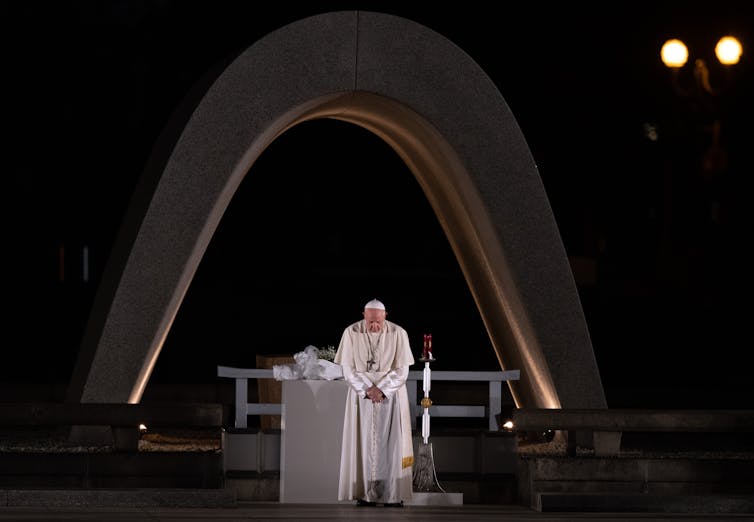
Pope Francis observes a minute of silence for the victims of Hiroshima at the city’s Peace Memorial Park.
Carl Court/Getty Images
By Rev. Drew Christiansen and Carole Sargent of Georgetown University
Ahead of the 75th anniversary year of the atomic bombings of Hiroshima and Nagasaki, Pope Francis visited both cities.
At a solemn event at the Hiroshima Peace Park in November 2019, Francis declared the use of atomic energy for war to be “a crime not only against the dignity of human beings but against any possible future for our common home.” “How,” he asked, “can we speak of peace even as we build terrifying new weapons of war?”
His comments came nearly 40 years after John Paul II became the first pope to visit the site of the atomic bomb attacks, which pulverized the two cities on Aug. 6 and 9, 1945 and killed in excess of 200,000 in the process.
Deterrence to abolition
During his visit, Francis reiterated what he previously told assembled Nobel Peace Prize laureates, diplomats and civil society representatives at a Vatican symposium in 2017, that nuclear weapons, along with chemical weapons and landmines, were impermissible. “The threat of their use, as well as their very possession, is to be firmly condemned,” he said.
We were at that 2017 symposium – Fr. Christiansen was a participant – and we later co-edited a book of testimonies from that landmark event, titled “A World Free from Nuclear Weapons: The Vatican Conference on Disarmament.”
As scholars who study how the Vatican’s position on nuclear arms has evolved, we see an ongoing role for the Catholic Church in providing moral guidance on the issue. A year after the Cuban Missile Crisis in 1962, during which the U.S. and the Soviet Union came perilously close to nuclear conflict, Pope John XXIII published the encyclical “Pacem in terris” – translated as Peace on Earth – in which he argued for balanced reduction of nuclear weapons leading ultimately to abolition.
In 1965, bishops at Vatican II, while contemplating nuclear war, urged in the pastoral constitution document “Gaudium et spes” – translated as Joy and Hope – that, “Whatever may be the case with deterrence…the arms race…[will not] preserve a sure and authentic peace.”
Pope John Paul II conditionally accepted deterrence in a 1982 address to the U.N. General Assembly. He wanted abolition and disarmament, but was constrained by the politics and technology of the day. The Cold War was still raging, and the Vatican accepted, albeit reluctantly, nuclear deterrence – the concept of keeping weapons to stop others from using them – rather than outright abolition at that time. Some 30 years later, in a changed global reality, the Vatican foreign minister told the U.N. that deterrence was the chief obstacle to disarmament, setting up the position of the Vatican today.
In 2017, the Holy See became one of the first signers of the U.N. Treaty on the Prohibition of Nuclear Weapons. Article 1 prohibits signers to “develop, test, produce, manufacture, otherwise acquire, possess or stockpile nuclear weapons…” This was the backdrop for Pope Francis’ historic condemnation of deterrence and call for disarmament later that fall.
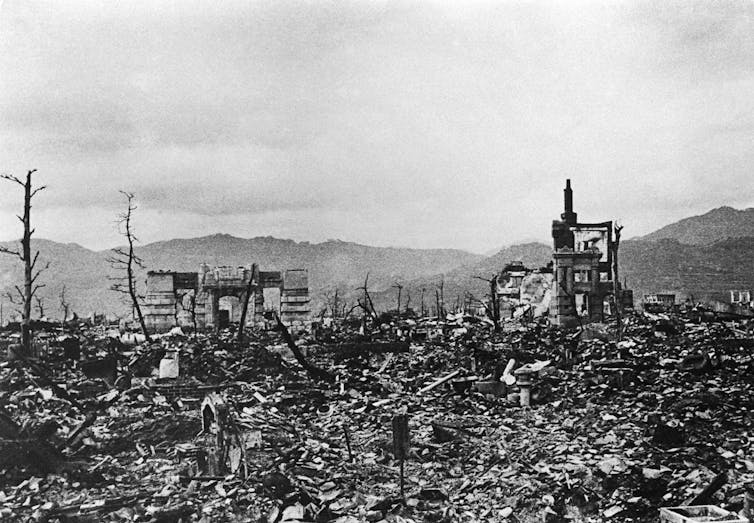
Hiroshima’s city center after the explosion of an atomic bomb on Aug. 6, 1945.
Paolo KOCH/Gamma-Rapho via Getty Images
One hundred and twenty-two nations voted for the Treaty on the Prohibition of Nuclear Weapons. For its labors on behalf of the treaty, ICAN, the International Campaign Against Nuclear Weapons, an umbrella group of civil society opponents of nuclear weapons, won the 2017 Nobel Peace Prize.
Beyond the hierarchy
But the guidance provided by the Catholic Church is not simply through official statements and positions from the top.
Across the church, various groups have long campaigned for abolition of nuclear weapons. Catholic nuns have often been at the forefront of this work. In Japan, several activist hibakusha – survivors of Hiroshima and Nagasaki – are sisters of Notre Dame de Namur and the Society of the Helper of Holy Souls, among other congregations.
In the U.S., Sister Jennifer Kane was a nuclear engineer before realizing, in the words of her congregation in 2019, “that God was calling her to a more spiritual combat” as an antinuclear activist.
And Dominicans, Religious of the Sacred Heart, and Society of the Holy Child Jesus have participated in the grassroots anti-nuclear direct-action movement Plowshares, at times resulting in prison time for activist nuns.
This willingness to speak out against nuclear violence is consistent with Pope Francis’ example. He offers a style of moral deliberation that calls for discernment, not blind obedience. Francis has urged those who work in the nuclear field to educate themselves, preferably accompanied by a spiritual adviser, and explore alternatives in line with their conscience.
This creative exercise in moral responsibility is for anyone, religious or not. It is reflected in the work of the Project on Revitalizing Catholic Engagement on Nuclear Disarmament – a body co-sponsored by, among others, The University of Notre Dame, Georgetown University, The Catholic University of America, and the Catholic Peacebuilding Network.
Courage of conscience
Church teaching demands that conscientious officials and nuclear workers resist orders they deem to be immoral.
The Second Vatican Council of the early 1960s taught that obeying orders is no excuse for participating in atrocities, and urged anyone, whether top military leader or rank-and-file citizen, to display “the courage of those who openly and fearlessly resist.”
[Deep knowledge, daily. Sign up for The Conversation’s newsletter.]
Indeed, in 2018 two chiefs of the U.S. Strategic Air Command testified in a Senate hearing that they would not comply with illegal orders to deploy nuclear weapons, and that they would offer civilian authorities alternative courses of action to pursue.
There may be more than one right answer for those of us who are called to respond to the moral challenge of nuclear weapons.
But 75 years on from the destruction of Hiroshima and Nagasaki, the Vatican gives us clear moral guidance that disarmament is possible, and for all of us, religious or secular, its time has long since come.
This article is republished from The Conversation, a nonprofit news organization dedicated to unlocking ideas from academia, under a Creative Commons license.

About Rev Drew Christiansen & Carole Sargent
Rev. Christiansen is a Distinguished Professor of Ethics and Human Development and Carole Sargent is Faculty Director of the Office of Scholarly Publications at Georgetown University. You can read more about the author here.
Previous Post

July 14, 2020
Why we knock on wood for luck
Next Post
August 12, 2020 Freedom of religion doesn't mean freedom from mask mandates
Browse Our Archives
Select a Category Buddhism Christianity Hinduism Islam Judaism Religion and society Uncategorized
Select a Month July 2024 March 2024 February 2024 January 2024 December 2023 November 2023 October 2023 September 2023 August 2023 July 2023 January 2023 August 2022 July 2022 April 2022 February 2022 January 2022 October 2021 July 2021 June 2021 May 2021 April 2021 March 2021 February 2021 January 2021 December 2020 November 2020 October 2020 September 2020 August 2020 July 2020 June 2020 May 2020
Follow Us!
TAKE THE
Religious Wisdom Quiz
Who did Paul send to check on the Thessalonians when he could not come himself?
Select your answer to see how you score.
Timothy Titus Luke Silas
Related posts from The Conversation


Electing A Virtuous President Would Make Immunity Irrelevant

Why The Olympic Games Are A ‘Civil Religious’...

The Catholic Church Is Using The Olympics To...
TRENDING AT PATHEOS Religion News

Catholic Integralists believe that religious values – specifically Christian ones – should...

Electing A Virtuous President Would Make Immunity Irrelevant
Presidential immunity can bring with it many risks. So how can we...

Why The Olympic Games Are A ‘Civil Religious’...
Sporting events form a vital space where Americans display their 'civil religious...

After more than a decade of news, research updates, and insights on...

Q: Why do Southern Baptists and like-minded Protestants...
THE RELIGION GUY’S ANSWER: Why? Simple. Because they believe that’s what the...

THE QUESTION: Is gambling evil? THE RELIGION GUY’S ANSWER: Analysts anticipate a...
view all Religion News blogs
Ad-Free & Subscriber Log-In Subscription Support
- About Us
- 2026 Calendar
- Videos
- Podcasts
- Library of World Religions
- Faith In Media Tracker
- Advertise With Us
- Write for Us
- Privacy Policy
- Terms of Service
- Do Not Sell My Data
- Contact Us
- Radiant Digital
- Manage Newsletter Subscriptions
- Unsubscribe From Notifications
- Sitemap
Copyright 2008-2026, Patheos. All rights reserved.
Subscription Support Ad-Free & Subscriber Log-In
Follow Patheos