
BuddhistCatholicContemplativeEvangelicalGeneral ChristianHinduJewishLatter-day SaintMuslimNew VisionsProgressive Christian
Beliefs
- Buddhist
- Catholic
- Contemplative
- Evangelical
- General Christian
- Hindu
- Jewish
- Latter-day Saint
- More Voices
- Muslim
- New Visions
- Pagan
- Progressive Christian
Topics
- Religion News
- Food and Religion
- Sports and Religion
- Religious Art
- Religious Music and Entertainment
- Religious Events
- History and Religion
- Style and Religion
- Politics and Religion
- Women in Religion
- Recreation Outdoors and Religion
- Business Finance and Religion
- Careers Workplace and Religion
- Education and Religion
- Family Parenting and Religion
- Health Fitness and Religion
- Home and Religion
- Relationships and Religion
- Technology and Religion
- Travel and Religion
Columnists
- Buddhist Columnists
- Business Finance and Religion Columnists
- Careers Workplace and Religion Columnists
- Catholic Columnists
- Contemplative Columnists
- Education and Religion Columnists
- Evangelists Columnists
- Family Parenting and Religion Columnists
- General Christian Columnists
- Health Fitness and Religion Columnists
- Hindu Columnists
- History and Religion Columnists
- Home and Religion Columnists
- Jewish Columnists
- More Voices Columnists
- Latter Day Columnists
- Muslim Columnists
- New Visions Columnists
- Nonreligious Columnists
- Pagan Columnists
- Politics and Religion Columnists
- Progressive Columnists
- Recreation Outdoors and Religion Columnists
- Relationships and Religion Columnists
- Religion News Columnists
- Religious Art Columnists
- Religious Events Columnists
- Religious Music and Entertainment Columnists
- Sports and Religion Columnists
- Style and Religion Columnists
- Technology and Religion Columnists
- Travel and Religion Columnists
- Women in Religion Columnists
Resource Library
- 2026 Calendar
- Library of World Religions
- The 100 Most Holy Places on Earth
- Patheos Answers
- Podcasts
- Videos
- Faith Leaders Database
- Anglican Episcopalian
- Bahai
- Baptist
- Buddhism
- Christianity
- Confucianism
- Eastern Orthodoxy
- Hinduism
- Holiness and Pentecostal
- ISKCON
- Islam
- Judaism
- Lutheran
- Methodist
- The Church of Jesus Christ of Latter-day Saints
- New Age
- Paganism
- Presbytarian and Reformed
- Protestantism
- Religion Behind the Scenes
- Roman Catholic
- Scientology
- Shia Islam
- Sikhism
- Sufism
- Sunni Islam
- Taoism
- Zen
- See all religions
Research Tools
 Ad-Free & Subscriber Log-In Subscription Support
Ad-Free & Subscriber Log-In Subscription Support
Follow Patheos 

- Trending:
- Forgiveness
- |
- Marriage
- |
- Consciousness
- |
- Death Penalty
- |
- Election
- |
- Halloween

- Home
- Religion News
- Muslim Americans assert solidarity with Black Lives Matter, finding unity within a diverse faith group
Muslim Americans assert solidarity with Black Lives Matter, finding unity within a diverse faith group
Last updated on: July 1, 2020 at 12:50 pm by The Conversation
Muslim Americans assert solidarity with Black Lives Matter, finding unity within a diverse faith group 2020-07-01T12:50:02-04:00 The Conversation
Patheos Explore the world's faith through different perspectives on religion and spirituality! Patheos has the views of the prevalent religions and spiritualities of the world.
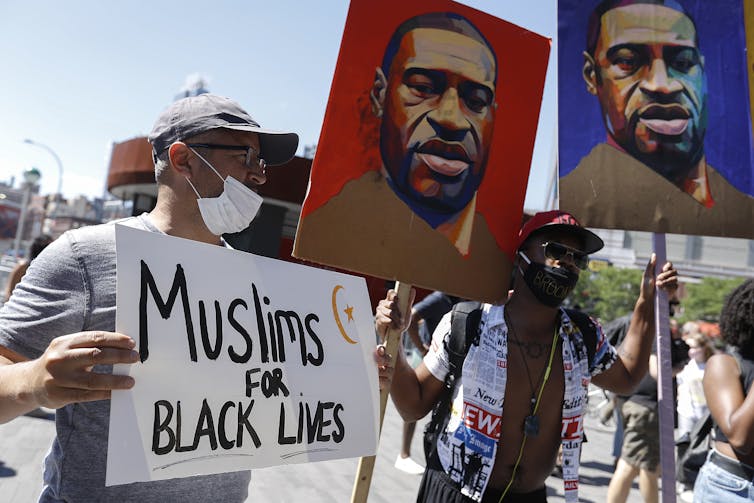
Muslims demonstrate against police brutality and racial injustice in Brooklyn.
John Lamparski/NurPhoto via Getty Images
By Amir Hussain, of Loyola Marymount University
The killing of George Floyd took place at the doorstep of Muslim America.
He was killed in front of Cup Foods, a store owned by an Arab American Muslim, whose teenage employee – also a Muslim – had earlier reported to police that Floyd tried to use a counterfeit $20 bill to buy cigarettes.
Muslim American businesses are common in lower-income areas, such as the part of Minneapolis where Floyd died after a police officer knelt on his neck. And as the writer Moustafa Bayoumi has noted, this puts stores in a precarious position – catering for the community while also duty-bound to report crime to the police, sometimes under the threat of being closed down if they don’t comply.
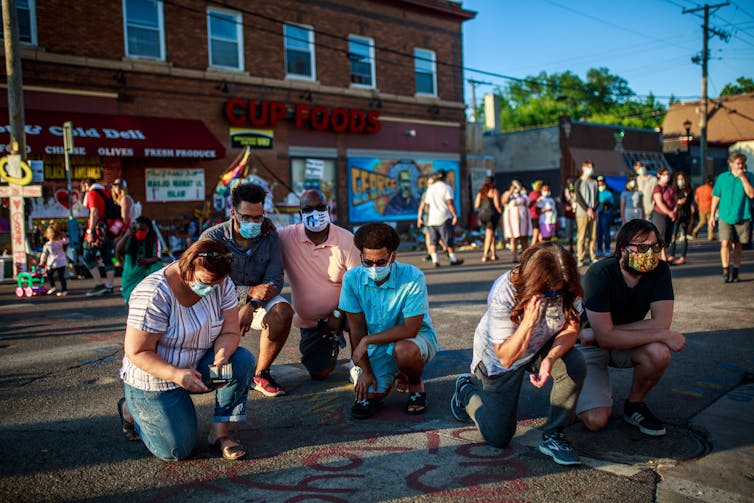
People kneel and pray outside Cup Foods in Minneapolis.
Kerem Yucel/AFP via Getty Images
As a Muslim scholar of Islam who has written about the role of Muslims in the making of the United States, I recognize that the circumstances of Floyd’s death hint at the proximity and complex relationship that different sections of America’s Muslim community have with law enforcement and with the Black Lives Matter movement.
‘Too often silent’
Since Floyd’s killing, Muslim Americans have mostly shown solidarity with the Black Lives Matter movement.
Mahmoud Abumayyaleh, the owner of Cup Foods, has said that the store will no longer call the police on customers. Nationally, there have been numerous statements from groups such as the Muslim Public Affairs Council, the Council on American Islamic Relations and the American Muslim Institution.
A joint announcement by over 35 national Muslim civil rights and faith groups and more than 60 regional groups noted that Black people were “often marginalized” within the broader Muslim community. It continued: “And when they fall victim to police violence, non-Black Muslims are too often silent, which leads to complicity.”
[Get the best of The Conversation, every weekend. Sign up for our weekly newsletter.]
There have been Muslims in America for almost 500 years. Estevanico the Moor was brought as a slave to what is now Florida in 1528 and is memorialized on the Texas African American history monument as the first African to enter Texas. At least 10% of the slaves brought from West Africa were Muslim, and the National Museum of African American History and Culture tells some of their stories as part of its collection.
But, many African Americans came to Islam later through the Nation of Islam, which wove a Black nationalist element into their faith.
Speaking up
Black Muslims played a crucial role in the U.S. civil rights movement. Even today, quotes and images of civil rights activist Malcolm X, who converted to Sunni Islam in 1964 after leaving the Nation of Islam, remain potent in the current protests.
Meanwhile Muhammad Ali, who at one time was perhaps the most recognizable Muslim in the world, gained fame as much for his political stances as his boxing prowess. Ali led the way for other Muslim American athletes who have pushed for social change, including NBA great Kareem Abdul-Jabbar, who was involved in discussions by the Olympic Project for Human Rights for Black athletes to boycott the 1968 games.
And 20 years before Colin Kaepernick, NBA player Mahmoud Abdul-Rauf refused to stand for the national anthem while playing for the Denver Nuggets because of his “Muslim conscience.” Polling shows many of these protests were greeted with disdain by the majority of white America.
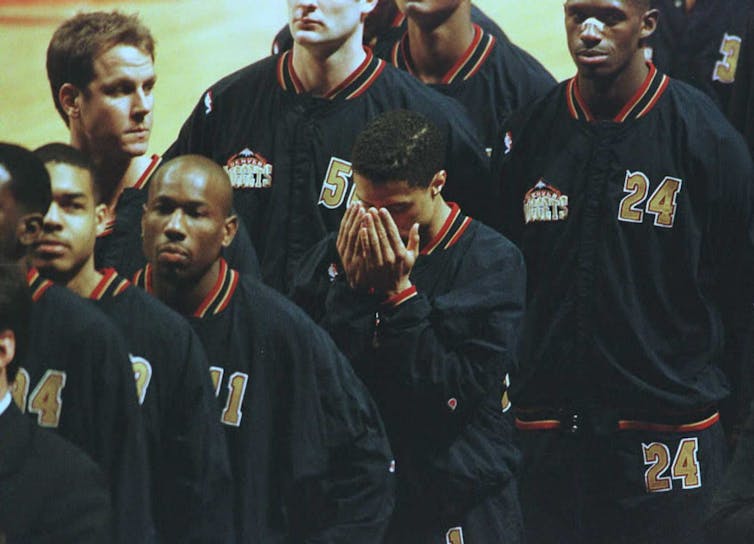
Mahmoud Abdul-Rauf bows his head in prayer during the singing of the national anthem.
Eric Chu/AFP via Getty Images
Today, at least 20% of Muslims in the U.S. are Black Americans. But starting from the 1965 Immigration and Nationality Act, there has been a growth in immigrant Muslims coming to America.
While increasing overall numbers of Muslims in U.S., immigration has created a dividing line in the American Muslim community – between Muslims with an American heritage that stretched back generations and newer arrivals. Immigrant Muslims were often assumed by American Muslims to know more about Islam as they came from Muslim majority countries, and so they were given more authority in Muslim organizations and as Islamic leaders.
They also built mosques that served their own ethnic communities, with immigrant Muslim communities often worshiping separately from Black American Muslims.
There is also a split in the economic status of American Muslims. According to the Pew Forum, 24% of American Muslims have an annual income above US$100,000, while 40% have an income below $30,000. Many of those who are wealthy – like billionaire Shahid Khan, an immigrant from Pakistan who now owns the NFL’s Jacksonville Jaguars – are from immigrant Muslim communities.
Police and protests
The intersection of race, class and national identity means that views vary on issues such as police, protests and discrimination. A 2019 survey found that 92% of Black Muslims believe there is a lot of discrimination against Black people, compared with 66% of non-Black Muslims.
Nonimmigrant Muslims are more likely to have lived out the history of the United States, including the unjust legacy of slavery. As Americans, they were also taught early on and often that the right to protest is protected under the Constitution.
Immigrant Muslims may have a very different experience with protest if they come from a country where dissent can lead to imprisonment or death. They may also be more wary of being seen as “anti-American.” Immigrant Muslims expressed more pride in being American than U.S.-born Black Muslims, in a 2017 Pew poll.
Both communities, however, share a complicated history of U.S. law enforcement. For Black Americans, police violence dates back to slavery. Since the terrorist attacks of Sept. 11, 2001, police in cities like Los Angeles and New York have tried to infiltrate and surveil American Muslims.
In vowing to stop calling the police on its customers, the Muslim-owned Cup Foods in Minneapolis is standing in solidarity with the largely Black community it serves. In a similar fashion, the soul-searching that has followed Floyd’s killing provides an opportunity for Muslim Americans of all backgrounds to unite and side with the oppressed, many of whom share their faith.
This article is republished from The Conversation a nonprofit news site dedicated to unlocking knowledge from academic experts, under a Creative Commons license..

About Amir Hussain
Amir Hussain is a professor of theological studies at Loyola Marymount University. You can read more about the author here.

Next Post
July 10, 2020 Islam's anti-racist message from the 7th century still resonates today
Browse Our Archives
Select a Category Buddhism Christianity Hinduism Islam Judaism Religion and society Uncategorized
Select a Month July 2024 March 2024 February 2024 January 2024 December 2023 November 2023 October 2023 September 2023 August 2023 July 2023 January 2023 August 2022 July 2022 April 2022 February 2022 January 2022 October 2021 July 2021 June 2021 May 2021 April 2021 March 2021 February 2021 January 2021 December 2020 November 2020 October 2020 September 2020 August 2020 July 2020 June 2020 May 2020
Follow Us!
TAKE THE
Religious Wisdom Quiz
Who said: "Michael the archangel, when contending with the devil he disputed about the body of Moses, dared not bring against him a reviling accusation"?
Select your answer to see how you score.
Jude Peter James Paul
Related posts from The Conversation

Saudi Reforms Are Softening Islam’s Role, But Critics...
Quran Burning in Sweden Prompts Debate on the...
Islam’s call to prayer is ringing out in...

There is no one Islamic interpretation on ethics...
TRENDING AT PATHEOS Religion News

Catholic Integralists believe that religious values – specifically Christian ones – should...

Electing A Virtuous President Would Make Immunity Irrelevant
Presidential immunity can bring with it many risks. So how can we...

Why The Olympic Games Are A ‘Civil Religious’...
Sporting events form a vital space where Americans display their 'civil religious...

After more than a decade of news, research updates, and insights on...

Q: Why do Southern Baptists and like-minded Protestants...
THE RELIGION GUY’S ANSWER: Why? Simple. Because they believe that’s what the...

THE QUESTION: Is gambling evil? THE RELIGION GUY’S ANSWER: Analysts anticipate a...
view all Religion News blogs
Ad-Free & Subscriber Log-In Subscription Support
- About Us
- 2026 Calendar
- Videos
- Podcasts
- Library of World Religions
- Faith In Media Tracker
- Advertise With Us
- Write for Us
- Privacy Policy
- Terms of Service
- Do Not Sell My Data
- Contact Us
- Radiant Digital
- Manage Newsletter Subscriptions
- Unsubscribe From Notifications
- Sitemap
Copyright 2008-2026, Patheos. All rights reserved.
Subscription Support Ad-Free & Subscriber Log-In
Follow Patheos