
BuddhistCatholicContemplativeEvangelicalGeneral ChristianHinduJewishLatter-day SaintMuslimNew VisionsProgressive Christian
Beliefs
- Buddhist
- Catholic
- Contemplative
- Evangelical
- General Christian
- Hindu
- Jewish
- Latter-day Saint
- More Voices
- Muslim
- New Visions
- Pagan
- Progressive Christian
Topics
- Religion News
- Food and Religion
- Sports and Religion
- Religious Art
- Religious Music and Entertainment
- Religious Events
- History and Religion
- Style and Religion
- Politics and Religion
- Women in Religion
- Recreation Outdoors and Religion
- Business Finance and Religion
- Careers Workplace and Religion
- Education and Religion
- Family Parenting and Religion
- Health Fitness and Religion
- Home and Religion
- Relationships and Religion
- Technology and Religion
- Travel and Religion
Columnists
- Buddhist Columnists
- Business Finance and Religion Columnists
- Careers Workplace and Religion Columnists
- Catholic Columnists
- Contemplative Columnists
- Education and Religion Columnists
- Evangelists Columnists
- Family Parenting and Religion Columnists
- General Christian Columnists
- Health Fitness and Religion Columnists
- Hindu Columnists
- History and Religion Columnists
- Home and Religion Columnists
- Jewish Columnists
- More Voices Columnists
- Latter Day Columnists
- Muslim Columnists
- New Visions Columnists
- Nonreligious Columnists
- Pagan Columnists
- Politics and Religion Columnists
- Progressive Columnists
- Recreation Outdoors and Religion Columnists
- Relationships and Religion Columnists
- Religion News Columnists
- Religious Art Columnists
- Religious Events Columnists
- Religious Music and Entertainment Columnists
- Sports and Religion Columnists
- Style and Religion Columnists
- Technology and Religion Columnists
- Travel and Religion Columnists
- Women in Religion Columnists
Resource Library
- 2026 Calendar
- Library of World Religions
- The 100 Most Holy Places on Earth
- Patheos Answers
- Podcasts
- Videos
- Faith Leaders Database
- Anglican Episcopalian
- Bahai
- Baptist
- Buddhism
- Christianity
- Confucianism
- Eastern Orthodoxy
- Hinduism
- Holiness and Pentecostal
- ISKCON
- Islam
- Judaism
- Lutheran
- Methodist
- The Church of Jesus Christ of Latter-day Saints
- New Age
- Paganism
- Presbytarian and Reformed
- Protestantism
- Religion Behind the Scenes
- Roman Catholic
- Scientology
- Shia Islam
- Sikhism
- Sufism
- Sunni Islam
- Taoism
- Zen
- See all religions
Research Tools
 Ad-Free & Subscriber Log-In Subscription Support
Ad-Free & Subscriber Log-In Subscription Support
Follow Patheos 

- Trending:
- Forgiveness
- |
- Marriage
- |
- Consciousness
- |
- Death Penalty
- |
- Election
- |
- Halloween

- Home
- Religion News
- Lynching preachers: How black pastors resisted Jim Crow and white pastors incited racial violence
Lynching preachers: How black pastors resisted Jim Crow and white pastors incited racial violence
Last updated on: June 24, 2020 at 1:18 pm by The Conversation
Lynching preachers: How black pastors resisted Jim Crow and white pastors incited racial violence 2020-06-24T13:18:52-04:00 The Conversation
Patheos Explore the world's faith through different perspectives on religion and spirituality! Patheos has the views of the prevalent religions and spiritualities of the world.
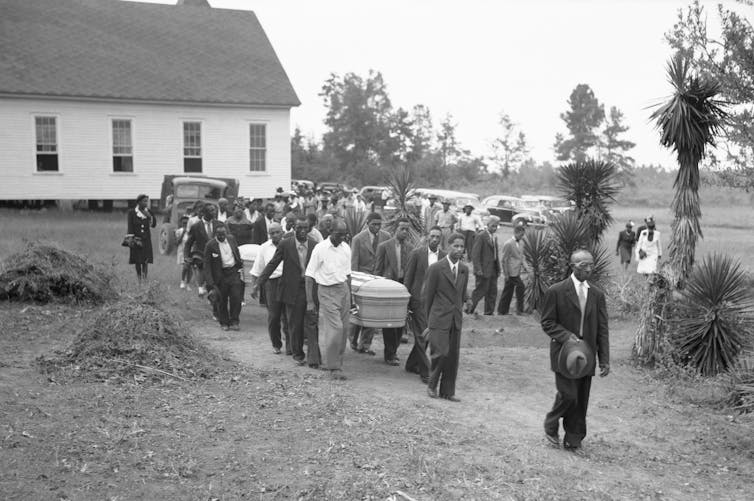
A funeral held in July 1945 for two victims of the Ku Klux Klan, George Dorsey and his sister, Dorothy Dorsey Malcolm, of Walton County, Georgia, held at the Mt. Perry Baptist Church Sunday.
Bettman via Getty
By Malcolm Brian Foley, of Baylor University
White lynch mobs in America murdered at least 4,467 people between 1883 and 1941, hanging, burning, dismembering, garroting and blowtorching their victims.
Their violence was widespread but not indiscriminate: About 3,300 of the lynched were black, according to the most recent count by sociologists Charles Seguin and David Rigby. The remaining dead were white, Mexican, of Mexican descent, Native American, Chinese or Japanese.
Such numbers, based on verifiable newspaper reports, represent a minimum. The full human toll of racial lynching may remain ever beyond reach.
Religion was no barrier for these white murderers, as I’ve discovered in my research on Christianity and lynch mobs in the Reconstruction-era South. White preachers incited racial violence, joined the Ku Klux Klan and lynched black people.
Sometimes, the victim was a pastor.
Buttressing white supremacy
When considering American racial terror, the first question to answer is not how a lynch mob could kill a man of the cloth but why white lynch mobs killed at all.
The typical answer from Southern apologists was that only black men who raped white women were targeted. In this view, lynching was “popular justice” – the response of an aggrieved community to a heinous crime.
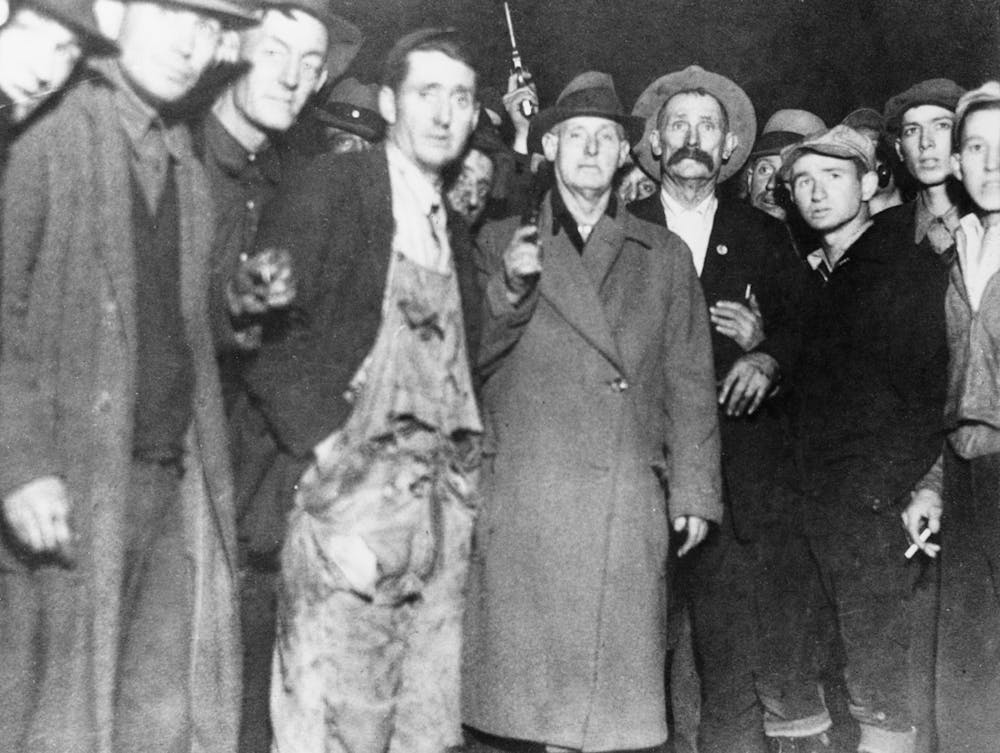
A white lynch mob in Shelbyville, Tennessee, in 1941.
Bettmann via Getty
Journalists like Ida B. Wells and early sociologists like Monroe Work saw through that smokescreen, finding that only about 20% to 25% of lynching victims were alleged rapists. About 3% were women. Some were children.
Black people were lynched for murder or assault, or on suspicion that they committed those crimes. They could also be lynched for looking at a white woman or for bumping the shoulder of a white woman. Some were killed for being near or related to someone accused of the aforementioned offenses.
Identifying the dead is supremely difficult work. As sociologists Amy Kate Bailey and Stewart Tolnay argue persuasively in their 2015 book “Lynched,” very little is known about lynching victims beyond their gender and race.
But by cross-referencing news reports with census data, scholars and civil rights organizations are uncovering more details.
One might expect that mobs seeking to destabilize the black community would focus on the successful and the influential – people like preachers or prominent business owners.
Instead, lynching disproportionately targeted lower-status black people – individuals society would not protect, like the agricultural worker Sam Hose of Georgia and men like Henry Smith, a Texas handyman accused of raping and killing a three-year-old girl.

The National Memorial For Peace And Justice in Montgomery, Alabama, commemorates the victims of lynching.
Bob Miller/Getty Images
The rope and the pyre snuffed out primarily the socially marginal: the unemployed, the unmarried, the precarious – often not the prominent – who expressed any discontentment with racial caste.
That’s because lynching was a form of social control. By killing workers with few connections who could be economically replaced – and doing so in brutal, public ways that struck terror into black communities – lynching kept white supremacy on track.
Fight from the front lines
So black ministers weren’t often lynching victims, but they could be targeted if they got in the way.
I.T. Burgess, a preacher in Putnam County, Florida, was hanged in 1894 after being accused of planning to instigate a revolt, according to a May 30, 1894, story in the Atlanta Constitution newspaper. Later that year, in December, the Constitution also reported, Lucius Turner, a preacher near West Point, Georgia, was shot by two brothers for apparently writing an insulting note to their sister.
Ida B. Wells wrote in her 1895 editorial “A Red Record” about Reverend King, a minister in Paris, Texas, who was beaten with a Winchester Rifle and placed on a train out of town. His offense, he said, was being the only person in Lamar County to speak against the horrific 1893 lynching of the handyman Henry Smith.
In each of these cases, the victim’s profession was ancillary to their lynching. But preaching was not incidental to black pastors’ resistance to lynching.
My dissertation research shows black pastors across the U.S. spoke out against racial violence during its worst period, despite the clear danger that it put them in.
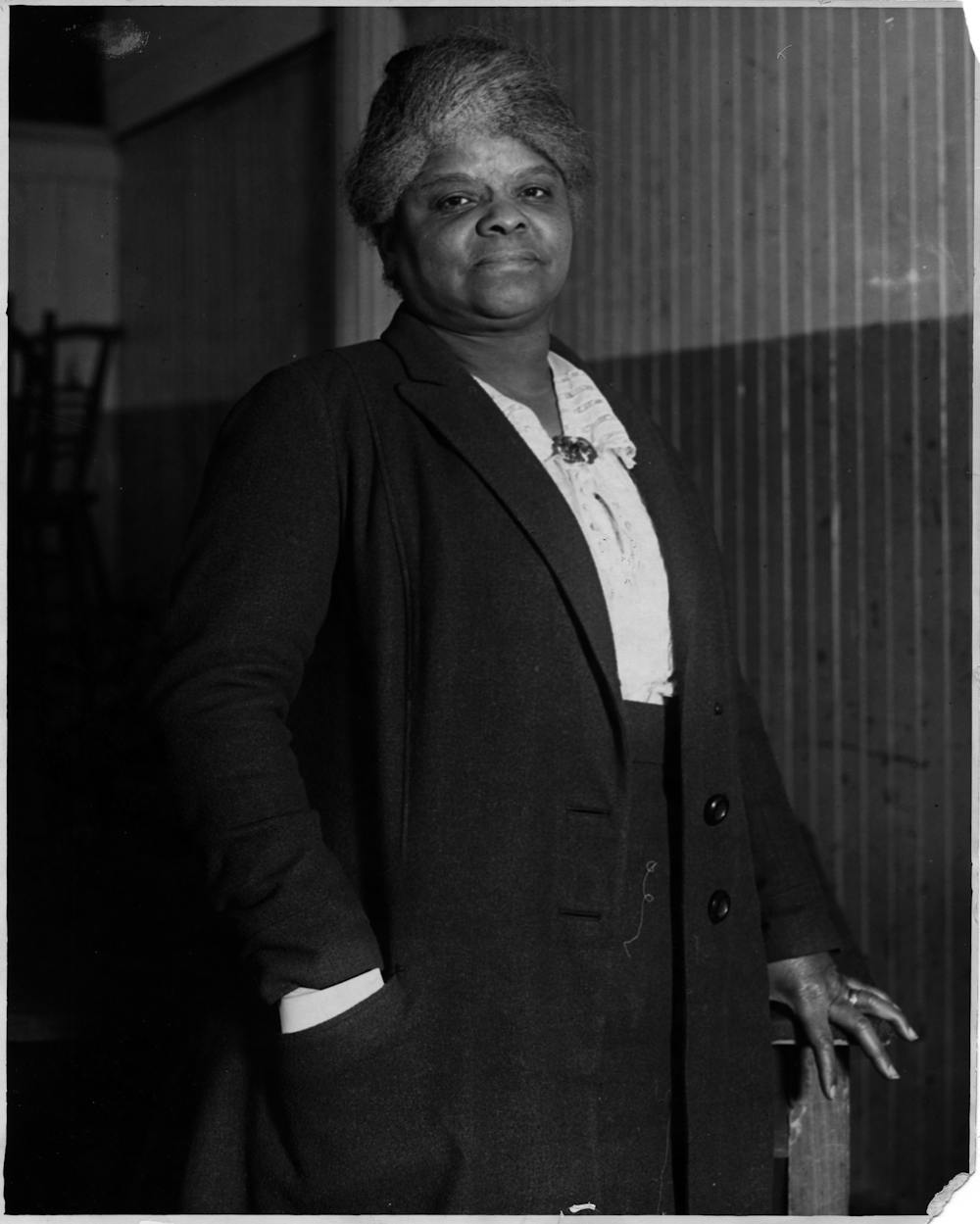
Ida B. Wells, the great documentarian of the lynching era, in 1920.
Chicago History Museum/Getty Images
Many, like the Washington, D.C., Presbyterian pastor Francis Grimke, preached to their congregations about racial violence. Grimke argued for comprehensive anti-racist education as a way to undermine the narratives that led to lynching.
Other pastors wrote furiously about anti-black violence.
Charles Price Jones, the founder of the Church of God (Holiness) in Mississippi, for example, wrote poetry affirming the African heritage of black Americans. Sutton Griggs, a black Baptist pastor from Texas, wrote novels that were, in reality, thinly veiled political treatises. Pastors wrote articles against lynching in their own denominational newspapers.
By any means necessary
Some white pastors decried racial terror, too. But others used the pulpit to instigate violence.
On June 21, 1903, the white pastor of Olivet Presbyterian church in Delaware used his religious leadership to incite a lynching.
Preaching to a crowd of 3,000 gathered in downtown Wilmington, Reverend Robert A. Elwood urged the jury in the trial of George White – a black farm laborer accused of raping and killing a 17-year-old white girl, Helen Bishop – to pronounce White guilty speedily.
Otherwise, Elwood continued, according to a June 23, 1903 New York Times article, White should be lynched. He cited the Biblical text 1 Corinthians 5:13, which orders Christians to “expel the wicked person from among you.”
“The responsibility for lynching would be yours for delaying the execution of the law,” Elwood thundered, exhorting the jury.
George White was dragged out of jail the next day, bound and burned alive in front of 2,000 people.
The following Sunday, a black pastor named Montrose W. Thornton discussed the week’s barbarities with his own congregation in Wilmington. He urged self-defense.
“There is but one part left for the persecuted negro when charged with crime and when innocent. Be a law unto yourself,” he told his parishioners. “Die in your tracks, perhaps drinking the blood of your pursuer.”
Newspapers around the country denounced both sermons. An editorial in the Washington Star said both pastors had “contributed to the worst passions of the mob.”
By inciting lynching and advocating for self defense, the editors judged, Elwood and Thornton had “brought the pulpit into disrepute.”
[You’re smart and curious about the world. So are The Conversation’s authors and editors. You can get our highlights each weekend.]
This article is republished from The Conversation, a nonprofit news site dedicated to unlocking knowledge from academic experts, under a Creative Commons license.

About Malcolm Brian Foley
Malcolm Brian Foley is a PhD Candidate in Religion - Historical Studies at Baylor University. He is currently finishing his dissertation on Black Protestant responses to lynching from 1890 to 1919. You can read more about the author here.

Browse Our Archives
Select a Category Buddhism Christianity Hinduism Islam Judaism Religion and society Uncategorized
Select a Month July 2024 March 2024 February 2024 January 2024 December 2023 November 2023 October 2023 September 2023 August 2023 July 2023 January 2023 August 2022 July 2022 April 2022 February 2022 January 2022 October 2021 July 2021 June 2021 May 2021 April 2021 March 2021 February 2021 January 2021 December 2020 November 2020 October 2020 September 2020 August 2020 July 2020 June 2020 May 2020
Follow Us!
TAKE THE
Religious Wisdom Quiz
I cleansed the temple in sixteen days and celebrated Passover so joyfully that we extended it another seven days. Who am I?
Select your answer to see how you score.
Asa Hezekiah Jehoshaphat Josiah
Related posts from The Conversation


How Christians Hold Differing Views On The Resurrection

Tattooing Dates Back To The Crucifixion
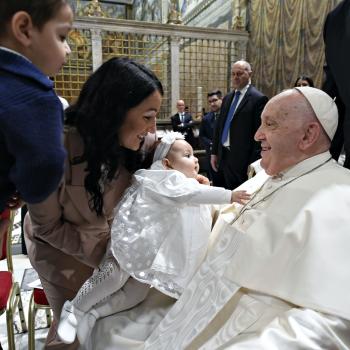
Pope Francis called surrogacy ‘deplorable’
TRENDING AT PATHEOS Religion News

Catholic Integralists believe that religious values – specifically Christian ones – should...

Electing A Virtuous President Would Make Immunity Irrelevant
Presidential immunity can bring with it many risks. So how can we...

Why The Olympic Games Are A ‘Civil Religious’...
Sporting events form a vital space where Americans display their 'civil religious...

After more than a decade of news, research updates, and insights on...

Q: Why do Southern Baptists and like-minded Protestants...
THE RELIGION GUY’S ANSWER: Why? Simple. Because they believe that’s what the...

THE QUESTION: Is gambling evil? THE RELIGION GUY’S ANSWER: Analysts anticipate a...
view all Religion News blogs
Ad-Free & Subscriber Log-In Subscription Support
- About Us
- 2026 Calendar
- Videos
- Podcasts
- Library of World Religions
- Faith In Media Tracker
- Advertise With Us
- Write for Us
- Privacy Policy
- Terms of Service
- Do Not Sell My Data
- Contact Us
- Radiant Digital
- Manage Newsletter Subscriptions
- Unsubscribe From Notifications
- Sitemap
Copyright 2008-2026, Patheos. All rights reserved.
Subscription Support Ad-Free & Subscriber Log-In
Follow Patheos