
BuddhistCatholicContemplativeEvangelicalGeneral ChristianHinduJewishLatter-day SaintMuslimNew VisionsProgressive Christian
Beliefs
- Buddhist
- Catholic
- Contemplative
- Evangelical
- General Christian
- Hindu
- Jewish
- Latter-day Saint
- More Voices
- Muslim
- New Visions
- Pagan
- Progressive Christian
Topics
- Religion News
- Food and Religion
- Sports and Religion
- Religious Art
- Religious Music and Entertainment
- Religious Events
- History and Religion
- Style and Religion
- Politics and Religion
- Women in Religion
- Recreation Outdoors and Religion
- Business Finance and Religion
- Careers Workplace and Religion
- Education and Religion
- Family Parenting and Religion
- Health Fitness and Religion
- Home and Religion
- Relationships and Religion
- Technology and Religion
- Travel and Religion
Columnists
- Buddhist Columnists
- Business Finance and Religion Columnists
- Careers Workplace and Religion Columnists
- Catholic Columnists
- Contemplative Columnists
- Education and Religion Columnists
- Evangelists Columnists
- Family Parenting and Religion Columnists
- General Christian Columnists
- Health Fitness and Religion Columnists
- Hindu Columnists
- History and Religion Columnists
- Home and Religion Columnists
- Jewish Columnists
- More Voices Columnists
- Latter Day Columnists
- Muslim Columnists
- New Visions Columnists
- Nonreligious Columnists
- Pagan Columnists
- Politics and Religion Columnists
- Progressive Columnists
- Recreation Outdoors and Religion Columnists
- Relationships and Religion Columnists
- Religion News Columnists
- Religious Art Columnists
- Religious Events Columnists
- Religious Music and Entertainment Columnists
- Sports and Religion Columnists
- Style and Religion Columnists
- Technology and Religion Columnists
- Travel and Religion Columnists
- Women in Religion Columnists
Resource Library
- 2026 Calendar
- Library of World Religions
- The 100 Most Holy Places on Earth
- Patheos Answers
- Podcasts
- Videos
- Faith Leaders Database
- Anglican Episcopalian
- Bahai
- Baptist
- Buddhism
- Christianity
- Confucianism
- Eastern Orthodoxy
- Hinduism
- Holiness and Pentecostal
- ISKCON
- Islam
- Judaism
- Lutheran
- Methodist
- The Church of Jesus Christ of Latter-day Saints
- New Age
- Paganism
- Presbytarian and Reformed
- Protestantism
- Religion Behind the Scenes
- Roman Catholic
- Scientology
- Shia Islam
- Sikhism
- Sufism
- Sunni Islam
- Taoism
- Zen
- See all religions
Research Tools
 Ad-Free & Subscriber Log-In Subscription Support
Ad-Free & Subscriber Log-In Subscription Support
Follow Patheos 

- Trending:
- Forgiveness
- |
- Marriage
- |
- Consciousness
- |
- Death Penalty
- |
- Election
- |
- Halloween

- Home
- Religion News
- How to be as safe as possible in your house of worship
How to be as safe as possible in your house of worship
Last updated on: June 5, 2020 at 1:39 pm by The Conversation
How to be as safe as possible in your house of worship 2020-06-05T13:39:24-04:00 The Conversation
Patheos Explore the world's faith through different perspectives on religion and spirituality! Patheos has the views of the prevalent religions and spiritualities of the world.
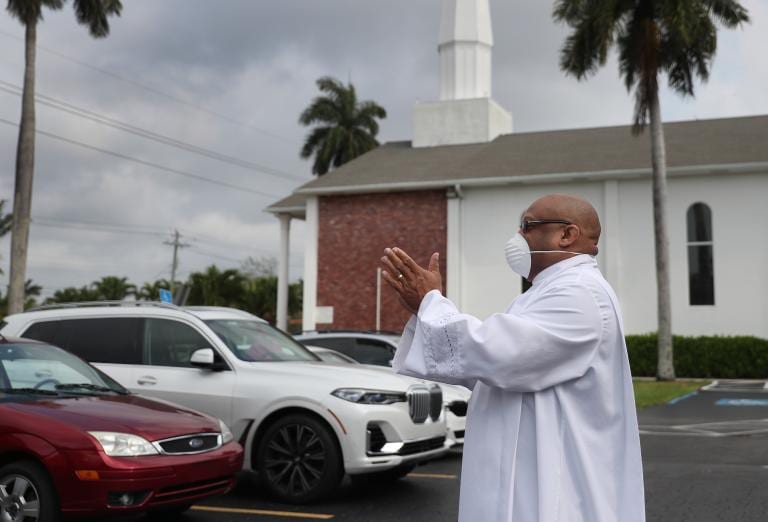
In Fort Lauderdale, Florida, the Sunshine Cathedral holds a drive-in Easter service in its parking lot. Each car received a Ziploc bag with a prayer card, palm leaf and pre-packaged communion. (Photo: Getty Images / Joe Raedle)
The Centers for Disease Control and Prevention has released what it calls “general considerations” on safe actions for reopening houses of worship, but worship communities can accept or reject those considerations.
Religious worship allows tens of millions of Americans to demonstrate devotion to a higher power. It gives people an opportunity to commit – and recommit – to a set of values. In-person services foster a sense of community and belonging. Unfortunately for millions whose lives are enriched by communal worship, traditional services are ideal places for virus transmission: lots of people, close together.
As a physician specializing in internal medicine, I suggest, for now at least, that we reexamine how we worship. After all, what better way to embody the values of your faith than to take steps to protect one another?
Even with the uncertainty and variability of reopening plans, scientifically and medically sound information is available. For starters, you’ll want to assess your individual risk, the prevalence of the virus in your area and the availability of testing.
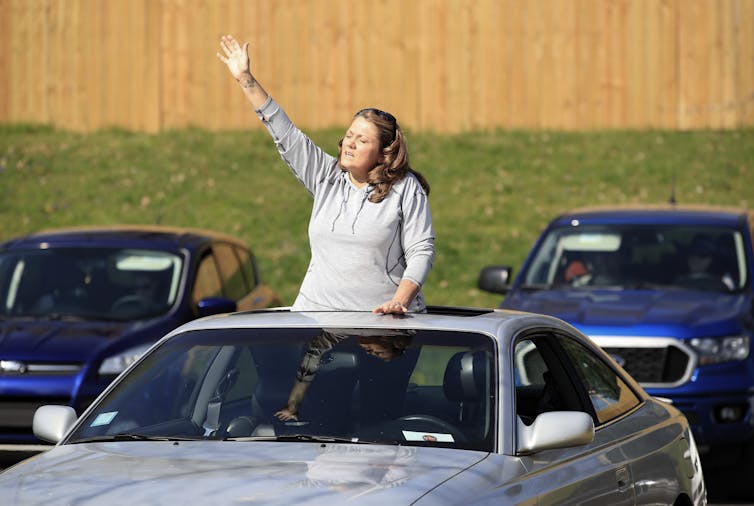
A worshiper raises her hand to the skies at a drive-in service in Louisville, Kentucky. Getty Images / Andy Lyons
The four pillars
You may consider guidelines suggested by Dr. Atul Gawande, noted surgeon and author. He proposes four essential pillars for safe reentry into communal spaces: hygiene, distancing, screening and mask use.
All four must operate together to minimize transmission. Will your place of worship be able to enact these pillars?
For example: Will you have easy access to hand-washing or sanitizing? Will communal surfaces and shared spaces be wiped down? Will attendance be limited to allow distancing, and will attendees be screened with temperature checks and self-screening questionnaires? Will your place of worship enforce mask use and distancing? Anything short of all four pillars increases transmission risk.
And even with all the precautions, people with infections can be asymptomatic – so despite the screening measures, you can’t be sure who has the virus and whether you might become exposed.
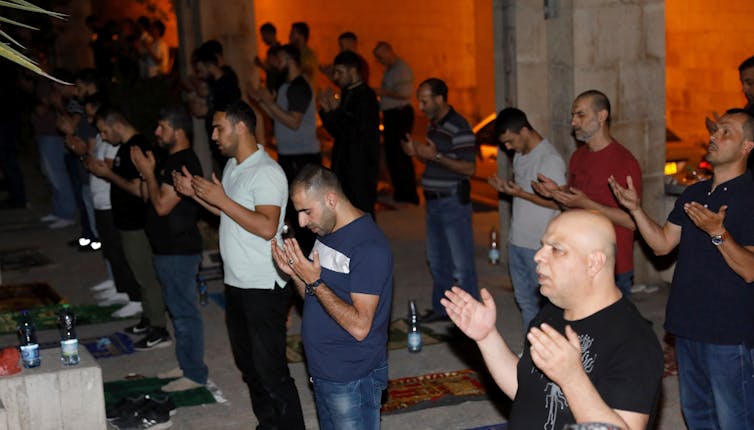
Palestinian Muslim worshipers, distanced from each other due to the COVID-19 coronavirus pandemic, pray outside the closed Aqsa mosque compound in the Old City of Jerusalem on May 19, 2020. Ahmad Gharabli AFP via Getty Images)
Today’s services: Short, outside – and cut the choir
Other factors influence viral spread. The dose you receive is higher when you’re close to someone not wearing a face covering. Someone sneezing and coughing increases the number of virus particles near you. Singing or speaking forcefully releases more virus than speaking quietly. Outdoor rates of transmission are much lower than those indoors.
That’s why it’s best if services are short, outdoors and with no singing or physical contact. Only a limited number of attendees, spaced widely and wearing masks properly, would participate.
Early in the pandemic, faith leaders adapted their services: removing holy water, forbidding handshakes, limiting group size and livestreaming. Buddhist monks seeking alms wore face shields. But others protested any restrictions.
In dealing with the virus, we still have much to learn. But values common to all religions exist – compassion, kindness, respect for fellow humans and some variation of the Golden Rule. Until more is known about COVID-19, let’s choose a path following one of the major tenets of my profession: First, do no harm.
[You need to understand the coronavirus pandemic, and we can help. Read The Conversation’s newsletter.]
This article is republished from The Conversation, a nonprofit news site dedicated to unlocking knowledge from academic experts, under a Creative Commons license.

About Claudia Finkelstein
Dr. Claudia Finkelstein is Associate Professor of Family Medicine at Michigan State University. You can read more about the author here.
Browse Our Archives
Select a Category Buddhism Christianity Hinduism Islam Judaism Religion and society Uncategorized
Select a Month July 2024 March 2024 February 2024 January 2024 December 2023 November 2023 October 2023 September 2023 August 2023 July 2023 January 2023 August 2022 July 2022 April 2022 February 2022 January 2022 October 2021 July 2021 June 2021 May 2021 April 2021 March 2021 February 2021 January 2021 December 2020 November 2020 October 2020 September 2020 August 2020 July 2020 June 2020 May 2020
Follow Us!
TAKE THE
Religious Wisdom Quiz
Though the fig tree does not bud and there are no grapes on the vines, yet I will rejoice in the Lord. What will God make my feet like?
Select your answer to see how you score.
A gazelle's legs Lions' paws The feet of a deer Eagles' wings
Related posts from The Conversation


Electing A Virtuous President Would Make Immunity Irrelevant

Why The Olympic Games Are A ‘Civil Religious’...

The Catholic Church Is Using The Olympics To...
TRENDING AT PATHEOS Religion News

Catholic Integralists believe that religious values – specifically Christian ones – should...

Electing A Virtuous President Would Make Immunity Irrelevant
Presidential immunity can bring with it many risks. So how can we...

Why The Olympic Games Are A ‘Civil Religious’...
Sporting events form a vital space where Americans display their 'civil religious...

After more than a decade of news, research updates, and insights on...

Q: Why do Southern Baptists and like-minded Protestants...
THE RELIGION GUY’S ANSWER: Why? Simple. Because they believe that’s what the...

THE QUESTION: Is gambling evil? THE RELIGION GUY’S ANSWER: Analysts anticipate a...
view all Religion News blogs
Ad-Free & Subscriber Log-In Subscription Support
- About Us
- 2026 Calendar
- Videos
- Podcasts
- Library of World Religions
- Faith In Media Tracker
- Advertise With Us
- Write for Us
- Privacy Policy
- Terms of Service
- Do Not Sell My Data
- Contact Us
- Radiant Digital
- Manage Newsletter Subscriptions
- Unsubscribe From Notifications
- Sitemap
Copyright 2008-2026, Patheos. All rights reserved.
Subscription Support Ad-Free & Subscriber Log-In
Follow Patheos