
BuddhistCatholicContemplativeEvangelicalGeneral ChristianHinduJewishLatter-day SaintMuslimNew VisionsProgressive Christian
Beliefs
- Buddhist
- Catholic
- Contemplative
- Evangelical
- General Christian
- Hindu
- Jewish
- Latter-day Saint
- More Voices
- Muslim
- New Visions
- Pagan
- Progressive Christian
Topics
- Religion News
- Food and Religion
- Sports and Religion
- Religious Art
- Religious Music and Entertainment
- Religious Events
- History and Religion
- Style and Religion
- Politics and Religion
- Women in Religion
- Recreation Outdoors and Religion
- Business Finance and Religion
- Careers Workplace and Religion
- Education and Religion
- Family Parenting and Religion
- Health Fitness and Religion
- Home and Religion
- Relationships and Religion
- Technology and Religion
- Travel and Religion
Columnists
- Buddhist Columnists
- Business Finance and Religion Columnists
- Careers Workplace and Religion Columnists
- Catholic Columnists
- Contemplative Columnists
- Education and Religion Columnists
- Evangelists Columnists
- Family Parenting and Religion Columnists
- General Christian Columnists
- Health Fitness and Religion Columnists
- Hindu Columnists
- History and Religion Columnists
- Home and Religion Columnists
- Jewish Columnists
- More Voices Columnists
- Latter Day Columnists
- Muslim Columnists
- New Visions Columnists
- Nonreligious Columnists
- Pagan Columnists
- Politics and Religion Columnists
- Progressive Columnists
- Recreation Outdoors and Religion Columnists
- Relationships and Religion Columnists
- Religion News Columnists
- Religious Art Columnists
- Religious Events Columnists
- Religious Music and Entertainment Columnists
- Sports and Religion Columnists
- Style and Religion Columnists
- Technology and Religion Columnists
- Travel and Religion Columnists
- Women in Religion Columnists
Resource Library
- 2026 Calendar
- Library of World Religions
- The 100 Most Holy Places on Earth
- Patheos Answers
- Podcasts
- Videos
- Faith Leaders Database
- Anglican Episcopalian
- Bahai
- Baptist
- Buddhism
- Christianity
- Confucianism
- Eastern Orthodoxy
- Hinduism
- Holiness and Pentecostal
- ISKCON
- Islam
- Judaism
- Lutheran
- Methodist
- The Church of Jesus Christ of Latter-day Saints
- New Age
- Paganism
- Presbytarian and Reformed
- Protestantism
- Religion Behind the Scenes
- Roman Catholic
- Scientology
- Shia Islam
- Sikhism
- Sufism
- Sunni Islam
- Taoism
- Zen
- See all religions
Research Tools
 Ad-Free & Subscriber Log-In Subscription Support
Ad-Free & Subscriber Log-In Subscription Support
Follow Patheos 

- Trending:
- Forgiveness
- |
- Marriage
- |
- Consciousness
- |
- Death Penalty
- |
- Election
- |
- Halloween

- Home
- Religion News
- Different faiths, same pain: How to grieve a death in the coronavirus pandemic
Different faiths, same pain: How to grieve a death in the coronavirus pandemic
Last updated on: June 2, 2020 at 6:58 pm by The Conversation
Different faiths, same pain: How to grieve a death in the coronavirus pandemic 2020-06-02T18:58:52-04:00 The Conversation
Patheos Explore the world's faith through different perspectives on religion and spirituality! Patheos has the views of the prevalent religions and spiritualities of the world.
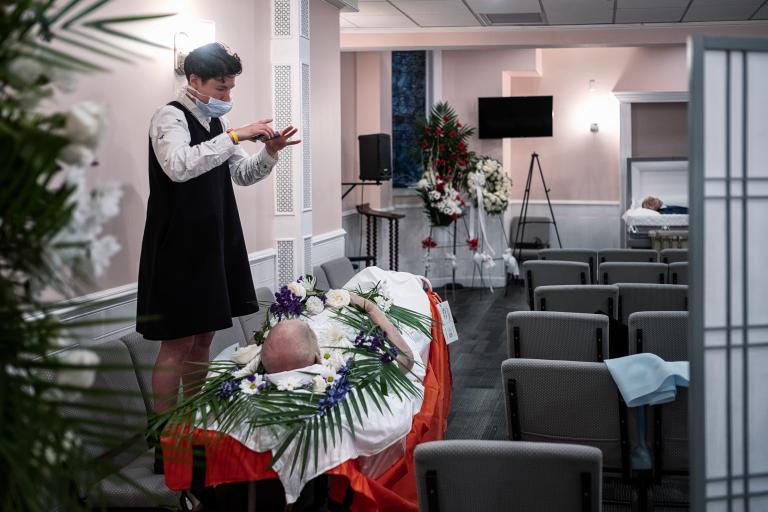
A funeral director calls relatives of a COVID-19 victim for a virtual viewing before cremation on May 22, 2020 in New York City. (Credit: Misha Friedman/Getty Images)
Editor’s note: Every religion has its death rites, communal practices developed over millennia to honor the dead and console the living. Some of these rituals are unique to one faith, but more are shared – a reminder there’s a common path toward healing. Yet COVID-19 is forcing many people to grieve in isolation. We asked three faith leaders and religion scholars for their counsel on mourning during the pandemic.
Honoring the dead and comforting mourners
Rabbi David A. Schuck
Jewish mourning rituals follow the principles of “k’vod hamet,” honoring the deceased, and “nichum aveilim,” comforting mourners.
K’vod hamet includes sitting and praying with the body, ritual washing and burial within two days of death. At a Jewish funeral, family and friends take turns filling the grave with earth – a final act of love. Focus then turns to the family, who return to their home to observe shiva, seven days of intense mourning in which the community provides meals, prayer and comfort.
With these communal rituals inaccessible during the coronavirus pandemic, the trauma of losing loved ones is profound. For synagogues in the center of this pandemic, there’s collective trauma, too. I live in New York, and each week my congregants receive several death notices of longtime friends, but have no avenue to grieve together.
I’m broadcasting funerals online and coordinating shiva visits through Zoom, but technology will never approximate the comfort of a home full of people. During shiva, our community holds us in our grief until we discover ways to move forward alone again.

A family sits for a remote Zoom shiva, the traditional Jewish time of mourning, New Canaan, Connecticut, April 11, 2020. (credit: Andrew Lichtenstein/Corbis via Getty Images)
The first funeral I officiated during the coronavirus pandemic was for a woman who would have wanted blaring trumpets to announce her death and throngs of admirers to come pay tribute. Instead, four people bid her farewell. As I grabbed earth with my fingers and dropped it onto her casket, I whispered an apology for how the world stole the dignity of her final moments.
Finding solace in the psalms of lament
Prof. Gina Hens-Piazza
In normal circumstances, the death of a loved one taxes the heart and mind with a paralyzing numbness. And, in normal circumstances, the traditional rituals of the Catholic faith – the vigil, funeral mass and graveside committal service – give mourners an occasion to honor the memory of the deceased and provide comfort.
A pandemic is not normal circumstances. The absence of these traditional practices compounds the rawness of grief.
In a recent interview with the American Catholic magazine Commonweal, Pope Francis suggested that this is a time “for inventing, for creativity” within the Church, urging Christians to find new ways to express their faith during lockdown.
I find examples of this creativity in how U.S. Catholic communities are using technology to accommodate gatherings of friends and family for consoling prayer, recitation of the rosary, online memorials and notes of remembrance. Some Catholic parishes have developed ministries of listening and consolation, with volunteers calling the bereaved or visiting online to offer support.
People are also commemorating their dead loved ones at home, lighting candles in their memory or playing their favorite hymns.
And while memorial liturgies have been postponed, families may find some comforting expressions of loss more immediately in biblical texts. The “psalms of lament” – especially Psalms 91, 121 and 130 – are prayers for help in surviving times of great pain. Such recitations provide words to narrate a pain and suffering so devastating it seems to eclipse words.
Healing begins after the homegoing
The Rev. Dr. Rodney Sadler Jr.
For African Americans of the Baptist faith, death is a communal experience. It is in this coming together of family and friends and associates and neighbors that the healing begins.
As the Rev. Dr. Peter Wherry writes in his book “Preaching Funerals,” black Baptists often call funerals “homegoing services,” denoting the fact that the believer once transitioning is in a better state than when here…they have “gone home to live with [the] Lord.”
When someone transitions, despite the clear suffering attendant to a loss, we celebrate their life. This occasions sayings like “trouble don’t last always,” or “we will see X again.”
Though well worn, these cliches seek to comfort the mourning that their loved one is not really dead, but lives on with God.
Since homegoing services can bring together family from across the world, they usually take place a week or more after death to ensure everyone may participate. There is typically a viewing for people to pay their last respects before the service, and afterwards there is usually a parade to the cemetery. Burial comes with its own mini-service.
Following that is the repast – a meal expected to feed the guests and to allow for fellowship, storytelling, reuniting with distant loved ones and meeting those known only by name. This, though quite reverent, is also festive. It facilitates the resolution needed to progress after a loss.
I have presided at many such services, though not during the coronavirus pandemic. One piece of advice I would offer to those who mourn now is this: In the coming months, stay in close contact with those who also mourn. Call someone whenever you feel longing for the departed – share a sorrow, a song, a funny anecdote or a recollection of their quirks.
Share your grief. When you feel the urge to cry, let it out. Emotions are best handled not with reason, but by allowing yourself the freedom to feel them fully. And remember, the nadir of your grief is not a curse – it is an indication of how deeply you loved.
Rabbi David A. Schuck is Lecturer at the Rabbinical School, Jewish Theological Seminary; Prof. Gina Hens-Piazza is Professor of Biblical Studies at the Jesuit School of Theology, Santa Clara University; and The Rev. Dr. Rodney Sadler Jr. is Associate Professor of Bible and Director of the Center for Social Justice and Reconciliation at Union Presbyterian Seminary.
This article is republished from The Conversation under a Creative Commons license. The Jesuit School of Theology and Union Presbyterian Seminary are members of the Association of Theological Schools, a funding partner of The Conversation US.


Browse Our Archives
Select a Category Buddhism Christianity Hinduism Islam Judaism Religion and society Uncategorized
Select a Month July 2024 March 2024 February 2024 January 2024 December 2023 November 2023 October 2023 September 2023 August 2023 July 2023 January 2023 August 2022 July 2022 April 2022 February 2022 January 2022 October 2021 July 2021 June 2021 May 2021 April 2021 March 2021 February 2021 January 2021 December 2020 November 2020 October 2020 September 2020 August 2020 July 2020 June 2020 May 2020
Follow Us!
TAKE THE
Religious Wisdom Quiz
Who did Paul send to check on the Thessalonians when he could not come himself?
Select your answer to see how you score.
Timothy Titus Luke Silas
Related posts from The Conversation


Electing A Virtuous President Would Make Immunity Irrelevant

Why The Olympic Games Are A ‘Civil Religious’...

The Catholic Church Is Using The Olympics To...
TRENDING AT PATHEOS Religion News

Catholic Integralists believe that religious values – specifically Christian ones – should...

Electing A Virtuous President Would Make Immunity Irrelevant
Presidential immunity can bring with it many risks. So how can we...

Why The Olympic Games Are A ‘Civil Religious’...
Sporting events form a vital space where Americans display their 'civil religious...

After more than a decade of news, research updates, and insights on...

Q: Why do Southern Baptists and like-minded Protestants...
THE RELIGION GUY’S ANSWER: Why? Simple. Because they believe that’s what the...

THE QUESTION: Is gambling evil? THE RELIGION GUY’S ANSWER: Analysts anticipate a...
view all Religion News blogs
Ad-Free & Subscriber Log-In Subscription Support
- About Us
- 2026 Calendar
- Videos
- Podcasts
- Library of World Religions
- Faith In Media Tracker
- Advertise With Us
- Write for Us
- Privacy Policy
- Terms of Service
- Do Not Sell My Data
- Contact Us
- Radiant Digital
- Manage Newsletter Subscriptions
- Unsubscribe From Notifications
- Sitemap
Copyright 2008-2026, Patheos. All rights reserved.
Subscription Support Ad-Free & Subscriber Log-In
Follow Patheos