
BuddhistCatholicContemplativeEvangelicalGeneral ChristianHinduJewishLatter-day SaintMuslimNew VisionsProgressive Christian
Beliefs
- Buddhist
- Catholic
- Contemplative
- Evangelical
- General Christian
- Hindu
- Jewish
- Latter-day Saint
- More Voices
- Muslim
- New Visions
- Pagan
- Progressive Christian
Topics
- Religion News
- Food and Religion
- Sports and Religion
- Religious Art
- Religious Music and Entertainment
- Religious Events
- History and Religion
- Style and Religion
- Politics and Religion
- Women in Religion
- Recreation Outdoors and Religion
- Business Finance and Religion
- Careers Workplace and Religion
- Education and Religion
- Family Parenting and Religion
- Health Fitness and Religion
- Home and Religion
- Relationships and Religion
- Technology and Religion
- Travel and Religion
Columnists
- Buddhist Columnists
- Business Finance and Religion Columnists
- Careers Workplace and Religion Columnists
- Catholic Columnists
- Contemplative Columnists
- Education and Religion Columnists
- Evangelists Columnists
- Family Parenting and Religion Columnists
- General Christian Columnists
- Health Fitness and Religion Columnists
- Hindu Columnists
- History and Religion Columnists
- Home and Religion Columnists
- Jewish Columnists
- More Voices Columnists
- Latter Day Columnists
- Muslim Columnists
- New Visions Columnists
- Nonreligious Columnists
- Pagan Columnists
- Politics and Religion Columnists
- Progressive Columnists
- Recreation Outdoors and Religion Columnists
- Relationships and Religion Columnists
- Religion News Columnists
- Religious Art Columnists
- Religious Events Columnists
- Religious Music and Entertainment Columnists
- Sports and Religion Columnists
- Style and Religion Columnists
- Technology and Religion Columnists
- Travel and Religion Columnists
- Women in Religion Columnists
Resource Library
- 2026 Calendar
- Library of World Religions
- The 100 Most Holy Places on Earth
- Patheos Answers
- Podcasts
- Videos
- Faith Leaders Database
- Anglican Episcopalian
- Bahai
- Baptist
- Buddhism
- Christianity
- Confucianism
- Eastern Orthodoxy
- Hinduism
- Holiness and Pentecostal
- ISKCON
- Islam
- Judaism
- Lutheran
- Methodist
- The Church of Jesus Christ of Latter-day Saints
- New Age
- Paganism
- Presbytarian and Reformed
- Protestantism
- Religion Behind the Scenes
- Roman Catholic
- Scientology
- Shia Islam
- Sikhism
- Sufism
- Sunni Islam
- Taoism
- Zen
- See all religions
Research Tools
 Ad-Free & Subscriber Log-In Subscription Support
Ad-Free & Subscriber Log-In Subscription Support
Follow Patheos 

- Trending:
- Forgiveness
- |
- Marriage
- |
- Consciousness
- |
- Death Penalty
- |
- Election
- |
- Halloween

- Home
- Religion News
- Churchgoers aren’t able to lift every voice and sing during the pandemic – here’s why that matters
Churchgoers aren’t able to lift every voice and sing during the pandemic – here’s why that matters
Last updated on: June 12, 2020 at 11:30 am by The Conversation
Churchgoers aren’t able to lift every voice and sing during the pandemic – here’s why that matters 2020-06-12T11:30:22-04:00 The Conversation
Patheos Explore the world's faith through different perspectives on religion and spirituality! Patheos has the views of the prevalent religions and spiritualities of the world.
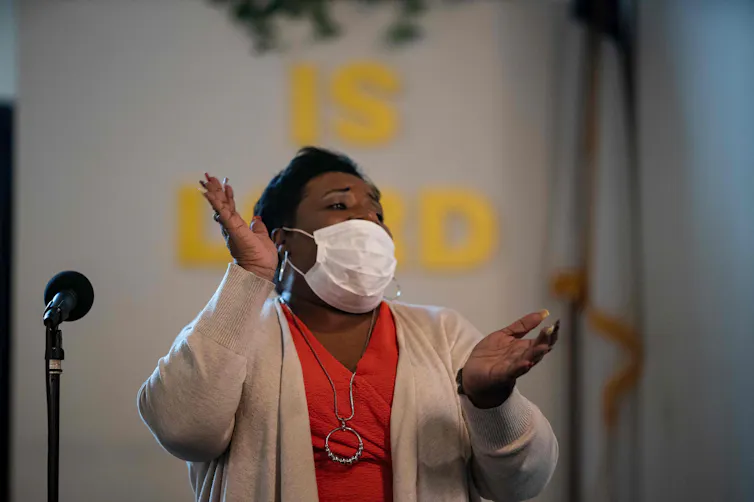
Even when singing does take place, voices are muffled.
Alex Edelman/AFP via Getty Images
By Donna M. Cox, University of Dayton
Because of COVID-19, churches no longer reverberate with song; hymnals are neatly stacked and projection screens blank. Even as church leaders plan for reopening, scientists warn that it might be too early to resume singing in groups.
Though such restrictions are understandable, they rob congregations of an important aspect of their Christian faith. As the Apostle Paul wrote in Ephesians 5, Believers should be “filled with the spirit, speaking to one another in psalms and hymns and spiritual songs, singing and making melody in your heart to the Lord.”
As a choral conductor, scholar in African American sacred music and teacher of sacred music and worship, I have studied the relationship between singing and worship for over three decades. Singing is critical to identity and faith. In some traditions, it is as important as the sermon. In African American churches, for instance, there is an equal emphasis on preaching, praying and singing.
First, verse
The importance of song in Christian worship can be traced to its Judaic beginnings. Throughout the biblical canon, the Apocrypha, the collection of books omitted from the Protestant Bible and noncanonical biblical texts, there are hundreds of references to Christians singing.
In the Old Testament, singing was used to praise God, provide lessons for the community, confess sins, provide solace in times of lamentation and joy in times of celebration. For instance, Moses and sister Miriam memorialized the miraculous exodus from Egypt through the Red Sea in song.
Early Christians even sang their prayers. The Book of Psalms – a collection of 150 songs and proclamations – served as the songbook of the early church.
The New Testament is similarly filled with song. In the Book of James, the Apostle Paul and his companion, Silas, sang their way to freedom in a jail. After the Last Supper, Jesus led the disciples in song.
Main chorus
Singing has tremendous power, both spiritually and physically.
When people sing, sound runs through the body, giving rise to emotion and facilitating transformation. It acts as a natural antidepressant by releasing endorphins, the feel-good chemical. Studies have also linked singing with improved mental alertness, memory and concentration through increased oxygenated blood to the brain. Neuroscientist Andrew Newberg found that changes in the brain during worship make people “nicer, more forgiving, and trustful.”
Choral singing creates the kind of community togetherness that is necessary in churches. It brings disparate parts into a cohesive oneness, just as corporate worship – the gathering of the faithful to worship together – brings individuals into oneness in Christ.
Bringing people together for song has proven to be dangerous in the coronavirus pandemic. On March 10, a group of 61 singers met at the Mount Vernon Presbyterian Church in Washington state for rehearsal. One of the members unknowingly infected 52 people with COVID-19; two people died.
Stay-at-home orders designed to stem the spread of diseases hit church music programs hard – some more than others.
Conversations I have had with church music directors around the country reveal the creativity employed to keep the music going: utilizing solo performers, prerecorded music, reducing the amount of music to the essential in liturgical services and creating virtual choirs.
Those with praise teams and bands that lead the congregation in song found it easier to provide music in online services – with fewer people, social distancing was easier to maintain. As a result, they continued to rehearse and perform in livestreamed or prerecorded services.
For churches that rely on choirs to carry the music, things have been tougher.
National guidelines limiting gatherings to 10 or fewer people meant no in-person choir rehearsals. Virtual choir rehearsals and performances are very problematic. Differences in bandwidth create lags that challenge the essence of choral singing: cohesion and community. Virtual performances demand technological expertise most choral directors are not trained to execute.
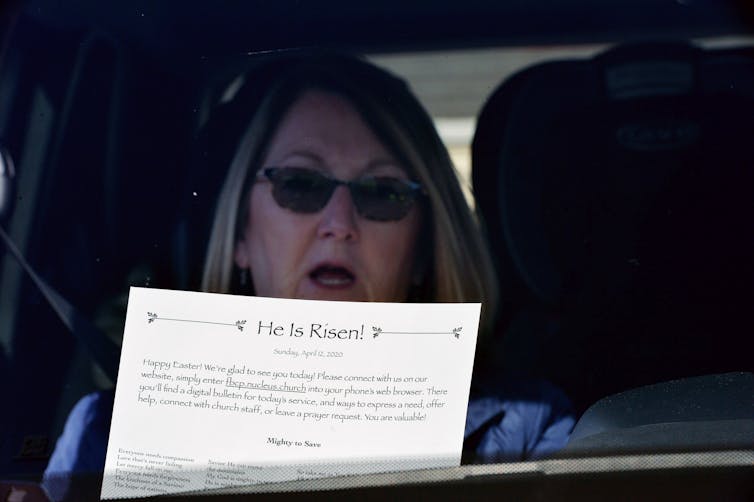
A drive-in singalong during an Easter service at the First Baptist Church in Plaistow, New Hampshire.
Joseph Prezioso/AFP via Getty Images
The resulting experience often falls short of a true choral experience. My own gospel choir, the Ebony Heritage Singers, recorded a song for the University of Dayton’s virtual commencement using this technique. The result was pleasing, but it lacked the true feel of a gospel music performance.
In my experience, virtual choral experiences are pale imitations of the real thing. Being connected in a physical way, feeling each others’ inhalations, coordinating exhalations and blending voices gives life to singers and to congregations.
A codetta?
Although research on the spread of COVID-19 is rapidly changing, singing in groups might be deemed too risky to enable churches to return to anything approaching “normal” for a long time.
So, until further notice, congregations are being advised to consider alternatives to singing. Worship may still be joyful, but it will likely be more quiet.
[Get facts about coronavirus and the latest research. Sign up for The Conversation’s newsletter.]
This article is republished from The Conversation, a nonprofit news site dedicated to unlocking knowledge from academic experts, under a Creative Commons license.

About Donna M. Cox
Dr. Donna Cox is a professor of music at the University of Dayton. You can read more about the author here.

Browse Our Archives
Select a Category Buddhism Christianity Hinduism Islam Judaism Religion and society Uncategorized
Select a Month July 2024 March 2024 February 2024 January 2024 December 2023 November 2023 October 2023 September 2023 August 2023 July 2023 January 2023 August 2022 July 2022 April 2022 February 2022 January 2022 October 2021 July 2021 June 2021 May 2021 April 2021 March 2021 February 2021 January 2021 December 2020 November 2020 October 2020 September 2020 August 2020 July 2020 June 2020 May 2020
Follow Us!
TAKE THE
Religious Wisdom Quiz
What does James say about friendship with the world?
Select your answer to see how you score.
It is foolishness It creates emnity with God It pulls you from God It is dangerous
Related posts from The Conversation


How Christians Hold Differing Views On The Resurrection
Tattooing Dates Back To The Crucifixion
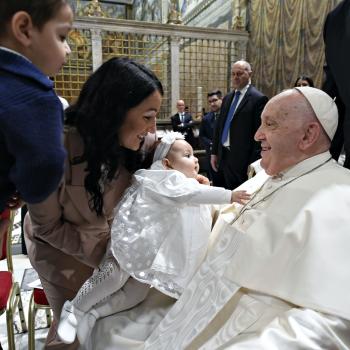
Pope Francis called surrogacy ‘deplorable’
TRENDING AT PATHEOS Religion News

Catholic Integralists believe that religious values – specifically Christian ones – should...

Electing A Virtuous President Would Make Immunity Irrelevant
Presidential immunity can bring with it many risks. So how can we...

Why The Olympic Games Are A ‘Civil Religious’...
Sporting events form a vital space where Americans display their 'civil religious...

After more than a decade of news, research updates, and insights on...

Q: Why do Southern Baptists and like-minded Protestants...
THE RELIGION GUY’S ANSWER: Why? Simple. Because they believe that’s what the...

THE QUESTION: Is gambling evil? THE RELIGION GUY’S ANSWER: Analysts anticipate a...
view all Religion News blogs
Ad-Free & Subscriber Log-In Subscription Support
- About Us
- 2026 Calendar
- Videos
- Podcasts
- Library of World Religions
- Faith In Media Tracker
- Advertise With Us
- Write for Us
- Privacy Policy
- Terms of Service
- Do Not Sell My Data
- Contact Us
- Radiant Digital
- Manage Newsletter Subscriptions
- Unsubscribe From Notifications
- Sitemap
Copyright 2008-2026, Patheos. All rights reserved.
Subscription Support Ad-Free & Subscriber Log-In
Follow Patheos