
BuddhistCatholicContemplativeEvangelicalGeneral ChristianHinduJewishLatter-day SaintMuslimNew VisionsProgressive Christian
Beliefs
- Buddhist
- Catholic
- Contemplative
- Evangelical
- General Christian
- Hindu
- Jewish
- Latter-day Saint
- More Voices
- Muslim
- New Visions
- Pagan
- Progressive Christian
Topics
- Religion News
- Food and Religion
- Sports and Religion
- Religious Art
- Religious Music and Entertainment
- Religious Events
- History and Religion
- Style and Religion
- Politics and Religion
- Women in Religion
- Recreation Outdoors and Religion
- Business Finance and Religion
- Careers Workplace and Religion
- Education and Religion
- Family Parenting and Religion
- Health Fitness and Religion
- Home and Religion
- Relationships and Religion
- Technology and Religion
- Travel and Religion
Columnists
- Buddhist Columnists
- Business Finance and Religion Columnists
- Careers Workplace and Religion Columnists
- Catholic Columnists
- Contemplative Columnists
- Education and Religion Columnists
- Evangelists Columnists
- Family Parenting and Religion Columnists
- General Christian Columnists
- Health Fitness and Religion Columnists
- Hindu Columnists
- History and Religion Columnists
- Home and Religion Columnists
- Jewish Columnists
- More Voices Columnists
- Latter Day Columnists
- Muslim Columnists
- New Visions Columnists
- Nonreligious Columnists
- Pagan Columnists
- Politics and Religion Columnists
- Progressive Columnists
- Recreation Outdoors and Religion Columnists
- Relationships and Religion Columnists
- Religion News Columnists
- Religious Art Columnists
- Religious Events Columnists
- Religious Music and Entertainment Columnists
- Sports and Religion Columnists
- Style and Religion Columnists
- Technology and Religion Columnists
- Travel and Religion Columnists
- Women in Religion Columnists
Resource Library
- 2026 Calendar
- Library of World Religions
- The 100 Most Holy Places on Earth
- Patheos Answers
- Podcasts
- Videos
- Faith Leaders Database
- Anglican Episcopalian
- Bahai
- Baptist
- Buddhism
- Christianity
- Confucianism
- Eastern Orthodoxy
- Hinduism
- Holiness and Pentecostal
- ISKCON
- Islam
- Judaism
- Lutheran
- Methodist
- The Church of Jesus Christ of Latter-day Saints
- New Age
- Paganism
- Presbytarian and Reformed
- Protestantism
- Religion Behind the Scenes
- Roman Catholic
- Scientology
- Shia Islam
- Sikhism
- Sufism
- Sunni Islam
- Taoism
- Zen
- See all religions
Research Tools
 Ad-Free & Subscriber Log-In Subscription Support
Ad-Free & Subscriber Log-In Subscription Support
Follow Patheos 

- Trending:
- Forgiveness
- |
- Marriage
- |
- Consciousness
- |
- Death Penalty
- |
- Election
- |
- Halloween

- Home
- Religion News
- Are religious communities reviving the revival? In the US, outdoor worship has a long tradition
Are religious communities reviving the revival? In the US, outdoor worship has a long tradition
Last updated on: June 11, 2020 at 10:29 am by The Conversation
Are religious communities reviving the revival? In the US, outdoor worship has a long tradition 2020-06-11T10:29:14-04:00 The Conversation
Patheos Explore the world's faith through different perspectives on religion and spirituality! Patheos has the views of the prevalent religions and spiritualities of the world.
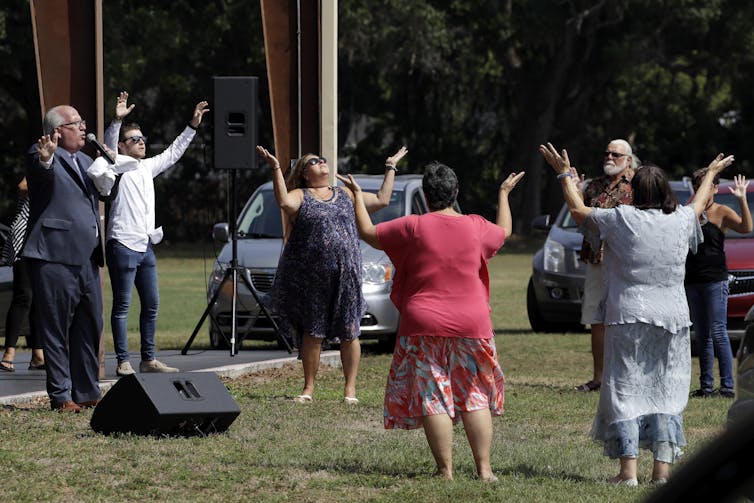
A pastor leads a prayer at an outdoor Easter service (Photo: AP/Chris O’Meara)
Religious communities have been forced to find alternative ways to worship together during the coronavirus pandemic. For some that has meant going online, but others have turned to a distinctly non-digital practice steeped in this history of the American religious experience: outdoor worship.
Prayer sessions in parking lots and services in green spaces formed part of an improvised response to the lockdown by religious leaders and they may now be part of the plan as the United States emerges from the crisis. Indeed, a team of clergy and scientists have issued a new guide suggesting, among other recommendations, that baptisms could take place in “flowing streams, lakes or in beach settings.”
So are brick-and-mortar houses of worship essential?
It is a question that states and courts, including the U.S. Supreme Court, have asked in considering the extent to which states can or should place restrictions on meetings in religious buildings.
Religious communities, too, have reflected on whether the terms “church,” “mosque,” “temple” or “synagogue” describe a building or a community – it is as much a religious question as a legal one. The responses to this question vary between traditions, communities and individuals.
The history of outdoor worship in the United States reveals a diversity of understandings of the proper place of worship. As a scholar of American religious history, I believe it also reveals an irony: While white evangelical Protestants have been some of the more vocal protesters of government restrictions on houses of worship during the pandemic, they actually have a long history of embracing outdoor worship.
Observing outside
A variety of American religious communities in the 18th and 19th centuries made do without physical houses of worship. They turned to alternative spaces for worship out of necessity – due to lack of institutional support and issues of religious freedom – or even preference.
Protestant communities were chief among the groups who considered making do without a physical church. Protestantism emerged in the 16th-century Reformation in part as a protest against some of the more formal aspects of the Roman Catholic Church, such as elaborate buildings, holy objects and even regular access to religious authority figures. As such, Protestants in this period were theologically more open to holding services outside of churches.
The emergence of evangelical forms of worship in the 18th and 19th centuries included outdoor revival meetings, which Protestant groups such as the Methodists, Baptists and Shakers helped popularize. Revivals included spontaneous preaching, hymns, displays of emotion and an emphasis on conversion.
Large crowds met for days at a time at outdoor sites like the one at Cane Ridge, Kentucky, where thousands congregated in 1801. Though not the first, the Cane Ridge Revival signaled the emerging popularity of evangelical outdoor services in the 19th century.
Historian Brett Grainger has argued that evangelicals, through revivalism, formed a mystical relationship with nature. For white settlers in America, hosting revivals in frontier spaces was also a way of sanctifying the colonization of land held by indigenous peoples, who have their own intricate relationships with nature and outdoor worship.
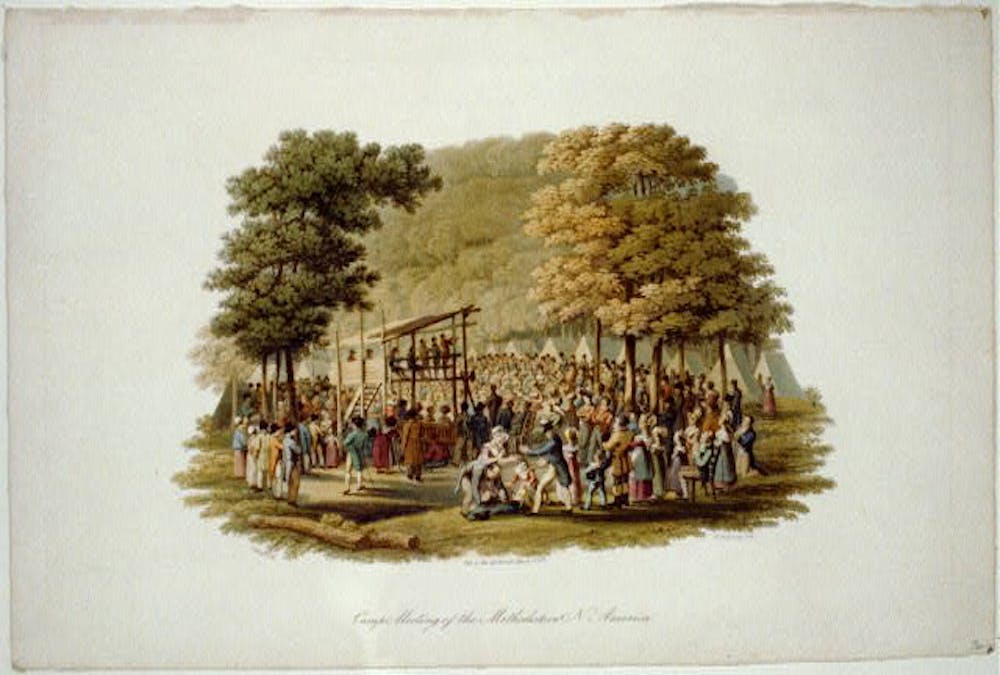
Camp meeting of the Methodists.
Library on Congress
Enslaved black people, too, embraced forms of outdoor worship. Some met in what were called “hush harbors,” or secret meetings held outside of established churches. In these meetings, as scholar of religion Albert Raboteau has examined, black people could partake in Christian and African-derived worship practices apart from white surveillance and pro-slavery Christianity. The outdoors provided a refuge.
Meanwhile, 19th-century white transcendentalists such as Margaret Fuller, Ralph Waldo Emerson and Henry David Thoreau emphasized nature as a site of devotional reflection to discern the reality of the divine. Emerson wrote in his essay “Nature” that: “The aspect of nature is devout. Like the figure of Jesus, she stands with bended head, and hands folded upon the breast. The happiest man is he who learns from nature the lesson of worship.”
They sought to transcend their individual selves into a greater universal being. This required not churches but the experience and appreciation of nature.
Parking lot prayers
During the pandemic, different religious communities responded differently to the restrictions on indoor worship and the possible alternative of hosting events outdoors.
The emphasis on ritual prayer in the Islamic tradition comes with a degree of flexibility for the safety and convenience of pious Muslims. A statement by the National Muslim Task Force on COVID-19, for example, considers recommendations from the Centers of Disease Control and Prevention, local laws and Islamic moral tradition in asking Muslims to use caution and discernment in how they meet to pray. Where practical, the statement suggests that communities use mosque grounds or parking lots for Friday prayers.
Most Jewish denominations have emphasized the need to keep synagogue buildings closed. Instead, many Jews have turned to virtual or outdoor worship services. Some Hasidic Jews have debated the permissibility of this and even questioned the scale of the threat of COVID-19, as have a minority in all faiths.
In-person services play an important role in the Catholic tradition. Some Catholic leaders, such as Cardinal Raymond Burke have pushed for churches to remain open. Nonetheless, Pope Francis has urged churches to take precautions and follow the recommendations and mandates of local governments. Priests have had to adapt and find ways to bring the sacraments to parishioners outside of the church.
Nave or nature?
If any group’s theologies and histories suggest an adaptability to the present situation, Protestants would be high up there. Some Protestant communities today affirm outdoor worship as a positive good. For example, the Wild Church Network comprises Christians who “question the wisdom and consequences of regarding ‘church’ as a building where you gather away from the rest of the world for a couple hours on Sundays.” Nature, more than the inside of a building, is a proper space for Christian devotion for this network.
Evangelical Protestants have been among those who have defied government shutdowns of houses of worship. As scholar of religion Pamela Klassen has argued, the resistance is especially evident in the United States, where conservative religious groups have long developed suspicions to government authorities and modern science, especially when it concerns public health.
But as the history of outdoor worship in the United States shows, adapting religious services to an outdoor setting is not uncommon. Historically, religious communities have long contested the essentialness of brick-and-mortar houses of worship.
[You’re smart and curious about the world. So are The Conversation’s authors and editors. You can read us daily by subscribing to our newsletter.]
This article is republished from The Conversation, a nonprofit news site dedicated to unlocking knowledge from academic experts, under a Creative Commons license.

About Jeffrey Wheatley
Jeffrey Wheatley is an Instructor of Philosophy & Religious Studies at Iowa State University. You can read more about the author here.
Previous Post

June 5, 2020
How to be as safe as possible in your house of worship

Browse Our Archives
Select a Category Buddhism Christianity Hinduism Islam Judaism Religion and society Uncategorized
Select a Month July 2024 March 2024 February 2024 January 2024 December 2023 November 2023 October 2023 September 2023 August 2023 July 2023 January 2023 August 2022 July 2022 April 2022 February 2022 January 2022 October 2021 July 2021 June 2021 May 2021 April 2021 March 2021 February 2021 January 2021 December 2020 November 2020 October 2020 September 2020 August 2020 July 2020 June 2020 May 2020
Follow Us!
TAKE THE
Religious Wisdom Quiz
Who provided bread and Goliath's sword to David at Nob?
Select your answer to see how you score.
Abiathar Abner Ahimelech the priest Jonathan
Related posts from The Conversation


How Christians Hold Differing Views On The Resurrection
Tattooing Dates Back To The Crucifixion
Pope Francis called surrogacy ‘deplorable’
TRENDING AT PATHEOS Religion News

Catholic Integralists believe that religious values – specifically Christian ones – should...

Electing A Virtuous President Would Make Immunity Irrelevant
Presidential immunity can bring with it many risks. So how can we...

Why The Olympic Games Are A ‘Civil Religious’...
Sporting events form a vital space where Americans display their 'civil religious...

After more than a decade of news, research updates, and insights on...

Q: Why do Southern Baptists and like-minded Protestants...
THE RELIGION GUY’S ANSWER: Why? Simple. Because they believe that’s what the...

THE QUESTION: Is gambling evil? THE RELIGION GUY’S ANSWER: Analysts anticipate a...
view all Religion News blogs
Ad-Free & Subscriber Log-In Subscription Support
- About Us
- 2026 Calendar
- Videos
- Podcasts
- Library of World Religions
- Faith In Media Tracker
- Advertise With Us
- Write for Us
- Privacy Policy
- Terms of Service
- Do Not Sell My Data
- Contact Us
- Radiant Digital
- Manage Newsletter Subscriptions
- Unsubscribe From Notifications
- Sitemap
Copyright 2008-2026, Patheos. All rights reserved.
Subscription Support Ad-Free & Subscriber Log-In
Follow Patheos