
BuddhistCatholicContemplativeEvangelicalGeneral ChristianHinduJewishLatter-day SaintMuslimNew VisionsProgressive Christian
Beliefs
- Buddhist
- Catholic
- Contemplative
- Evangelical
- General Christian
- Hindu
- Jewish
- Latter-day Saint
- More Voices
- Muslim
- New Visions
- Pagan
- Progressive Christian
Topics
- Religion News
- Food and Religion
- Sports and Religion
- Religious Art
- Religious Music and Entertainment
- Religious Events
- History and Religion
- Style and Religion
- Politics and Religion
- Women in Religion
- Recreation Outdoors and Religion
- Business Finance and Religion
- Careers Workplace and Religion
- Education and Religion
- Family Parenting and Religion
- Health Fitness and Religion
- Home and Religion
- Relationships and Religion
- Technology and Religion
- Travel and Religion
Columnists
- Buddhist Columnists
- Business Finance and Religion Columnists
- Careers Workplace and Religion Columnists
- Catholic Columnists
- Contemplative Columnists
- Education and Religion Columnists
- Evangelists Columnists
- Family Parenting and Religion Columnists
- General Christian Columnists
- Health Fitness and Religion Columnists
- Hindu Columnists
- History and Religion Columnists
- Home and Religion Columnists
- Jewish Columnists
- More Voices Columnists
- Latter Day Columnists
- Muslim Columnists
- New Visions Columnists
- Nonreligious Columnists
- Pagan Columnists
- Politics and Religion Columnists
- Progressive Columnists
- Recreation Outdoors and Religion Columnists
- Relationships and Religion Columnists
- Religion News Columnists
- Religious Art Columnists
- Religious Events Columnists
- Religious Music and Entertainment Columnists
- Sports and Religion Columnists
- Style and Religion Columnists
- Technology and Religion Columnists
- Travel and Religion Columnists
- Women in Religion Columnists
Resource Library
- 2026 Calendar
- Library of World Religions
- The 100 Most Holy Places on Earth
- Patheos Answers
- Podcasts
- Videos
- Faith Leaders Database
- Anglican Episcopalian
- Bahai
- Baptist
- Buddhism
- Christianity
- Confucianism
- Eastern Orthodoxy
- Hinduism
- Holiness and Pentecostal
- ISKCON
- Islam
- Judaism
- Lutheran
- Methodist
- The Church of Jesus Christ of Latter-day Saints
- New Age
- Paganism
- Presbytarian and Reformed
- Protestantism
- Religion Behind the Scenes
- Roman Catholic
- Scientology
- Shia Islam
- Sikhism
- Sufism
- Sunni Islam
- Taoism
- Zen
- See all religions
Research Tools
 Ad-Free & Subscriber Log-In Subscription Support
Ad-Free & Subscriber Log-In Subscription Support
Follow Patheos 

- Trending:
- Forgiveness
- |
- Marriage
- |
- Consciousness
- |
- Death Penalty
- |
- Election
- |
- Halloween

- Home
- Religion News
- Why cellphone videos of black people’s deaths should be considered sacred, like lynching photographs
Why cellphone videos of black people’s deaths should be considered sacred, like lynching photographs
Last updated on: June 14, 2020 at 6:36 pm by The Conversation
Why cellphone videos of black people’s deaths should be considered sacred, like lynching photographs 2020-06-14T18:36:36-04:00 The Conversation
Patheos Explore the world's faith through different perspectives on religion and spirituality! Patheos has the views of the prevalent religions and spiritualities of the world.
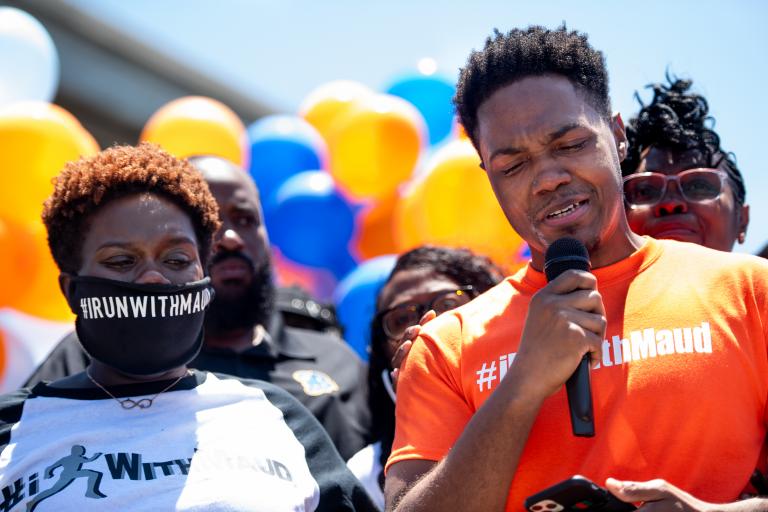
Ahmaud Arbery’s best friend, right, and his sister speak at a memorial event for Arbery on May 9, 2020. (Sean Rayford/Getty Images)
As Ahmaud Arbery fell to the ground, the sound of the gunshot that took his life echoed loudly throughout his Georgia neighborhood.
I rewound the video of his killing. Each time I viewed it, I was drawn first to the young black jogger’s seemingly carefree stride, which was halted by two white men in a white pickup truck.
Then I peered at Gregory McMichael, 64, and his son Trevor, 34, who confronted Arbery in their suburban community.
I knew that the McMichaels told authorities that they suspected Arbery of robbing a nearby home in the neighborhood. They were performing a citizen’s arrest, they said.
The video shows Arbery jogging down the street and the McMichaels blocking his path with their vehicle. First, a scuffle. Then, gunshots at point-blank range from Travis McMichael’s weapon.
My eyes traveled to the towering trees onscreen, which might have been the last things that Arbery saw. How many of those same trees, I wondered, had witnessed similar lynchings? And how many of those lynchings had been photographed, to offer a final blow of humiliation to the dying?
A series of modern lynchings
It may be jarring to see that word – lynching – used to describe Arbery’s Feb. 23, 2020, killing. But many black people have shared with me that his death – followed in rapid succession by Breonna Taylor’s and now George Floyd’s officer-involved murders – hearkens back to a long tradition of killing black people without repercussion.
Perhaps even more traumatizing is the ease with which some of these deaths can be viewed online. In my new book, “Bearing Witness While Black: African Americans, Smartphones and the New Protest #Journalism,” I call for Americans to stop viewing footage of black people dying so casually.
Instead, cellphone videos of vigilante violence and fatal police encounters should be viewed like lynching photographs – with solemn reserve and careful circulation. To understand this shift in viewing context, I believe it is useful to explore how people became so comfortable viewing black people’s dying moments in the first place.
Images of black people’s deaths pervasive
Every major era of domestic terror against African Americans – slavery, lynching and police brutality – has an accompanying iconic photograph.
The most familiar image of slavery is the 1863 picture of “Whipped Peter,” whose back bears an intricate cross-section of scars.
Famous images of lynchings include the 1930 photograph of the mob who murdered Thomas Shipp and Abram Smith in Marion, Indiana. A wild-eyed white man appears at the bottom of the frame, pointing upward to the black men’s hanged bodies. The image inspired Abel Meeropol to write the poem “Strange Fruit,” which was later turned into a song that blues singer Billie Holiday sang around the world.
Twenty-five years later, the 1955 photos of Emmett Till’s maimed body became a new generation’s cultural touchstone. The 14-year-old black boy was beaten, shot and thrown into a local river by white men after a white woman accused him of whistling at her. She later admitted that she lied.
Throughout the 1900s, and until today, police brutality against black people has been immortalized by the media too. Americans have watched government officials open firehoses on young civil rights protesters, unleash German shepherds and wield billy clubs against peaceful marchers, and shoot and tase today’s black men, women and children – first on the televised evening news, and, eventually, on cellphones that could distribute the footage online.
When I conducted the interviews for my book, many black people told me that they carry this historical reel of violence against their ancestors in their heads. That’s why, for them, watching modern versions of these hate crimes is too painful to bear.
Still, there are other groups of black people who believe that the videos do serve a purpose, to educate the masses about race relations in the U.S. I believe these tragic videos can serve both purposes, but it will take effort.
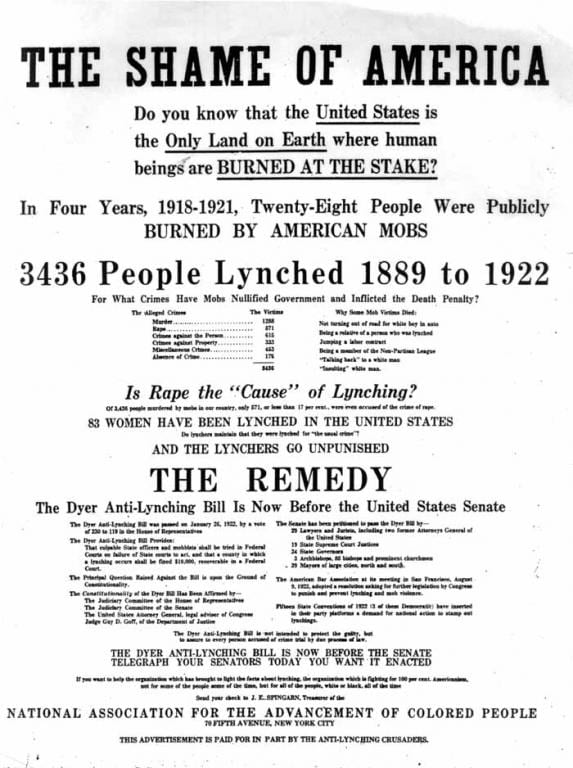
In 1922 the NAACP ran a series of full-page ads in The New York Times calling attention to lynchings. (New York Times, Nov. 23, 1922/American Social History Project)
Reviving the ‘shadow archive’
In the early 1900s, when the news of a lynching was fresh, some of the nation’s first civil rights organizations circulated any available images of the lynching widely, to raise awareness of the atrocity. They did this by publishing the images in black magazines and newspapers.
After that image reached peak circulation, it was typically removed from public view and placed into a “shadow archive,” within a newsroom, library or museum. Reducing the circulation of the image was intended to make the public’s gaze more somber and respectful.
The National Association for the Advancement of Colored People, known popularly as the NAACP, often used this technique. In 1916, for example, the group published a horrific photograph of Jesse Washington, a 17-year-old boy who was hanged and burned in Waco, Texas, in its flagship magazine, “The Crisis.”
Memberships in the civil rights organization skyrocketed as a result. Blacks and whites wanted to know how to help. The NAACP used the money to push for anti-lynching legislation. It purchased a series of costly full-page ads in The New York Times to lobby leading politicians.
Though the NAACP endures today, neither its website nor its Instagram page bears casual images of lynching victims. Even when the organization issued a statement about the Arbery killing, it refrained from reposting the chilling video within its missive. That restraint shows a degree of respect that not all news outlets and social media users have used.
A curious double standard
Critics of the shadow archive may argue that once a photograph reaches the internet, it is very difficult to pull back from future news reports.
This is, however, simply not true.
Images of white people’s deaths are removed from news coverage all the time.
It is difficult to find online, for example, imagery from any of the numerous mass shootings that have affected scores of white victims. Those murdered in the Sandy Hook Elementary School shooting of 2012, or at the Las Vegas music festival of 2017, are most often remembered in endearing portraits instead.
In my view, cellphone videos of black people being killed should be given this same consideration. Just as past generations of activists used these images briefly – and only in the context of social justice efforts – so, too, should today’s imagery retreat from view quickly.
The suspects in Arbery’s killing have been arrested. The Minneapolis police officers involved in Floyd’s death have been fired and placed under investigation. The videos of their deaths have served the purpose of attracting public outrage.
To me, airing the tragic footage on TV, in auto-play videos on websites and social media is no longer serving its social justice purpose, and is now simply exploitative.
Likening the fatal footage of Ahmaud Arbery and George Floyd to lynching photographs invites us to treat them more thoughtfully. We can respect these images. We can handle them with care. In the quiet, final frames, we can share their last moments with them, if we choose to. We do not let them die alone. We do not let them disappear into the hush of knowing trees.
[Insight, in your inbox each day. You can get it with The Conversation’s email newsletter.]
This article is republished from The Conversation, a non-profit website dedicated to spreading knowledge from academic experts, under a Creative Commons license.

About Allissa V. Richardson
Allissa V. Richardson is Assistant Professor of Journalism at the University of Southern California, Annenberg School for Communication and Journalism You can read more about the author here.
Previous Post

May 21, 2020
How do Buddhists handle coronavirus? The answer is not just meditation

Browse Our Archives
Select a Category Buddhism Christianity Hinduism Islam Judaism Religion and society Uncategorized
Select a Month July 2024 March 2024 February 2024 January 2024 December 2023 November 2023 October 2023 September 2023 August 2023 July 2023 January 2023 August 2022 July 2022 April 2022 February 2022 January 2022 October 2021 July 2021 June 2021 May 2021 April 2021 March 2021 February 2021 January 2021 December 2020 November 2020 October 2020 September 2020 August 2020 July 2020 June 2020 May 2020
Follow Us!
TAKE THE
Religious Wisdom Quiz
What book has the most references to the word "love" in the New Testament?
Select your answer to see how you score.
John Matthew Romans 1 John
Related posts from The Conversation


Electing A Virtuous President Would Make Immunity Irrelevant

Why The Olympic Games Are A ‘Civil Religious’...

The Catholic Church Is Using The Olympics To...
TRENDING AT PATHEOS Religion News

Catholic Integralists believe that religious values – specifically Christian ones – should...

Electing A Virtuous President Would Make Immunity Irrelevant
Presidential immunity can bring with it many risks. So how can we...

Why The Olympic Games Are A ‘Civil Religious’...
Sporting events form a vital space where Americans display their 'civil religious...

After more than a decade of news, research updates, and insights on...

Q: Why do Southern Baptists and like-minded Protestants...
THE RELIGION GUY’S ANSWER: Why? Simple. Because they believe that’s what the...

THE QUESTION: Is gambling evil? THE RELIGION GUY’S ANSWER: Analysts anticipate a...
view all Religion News blogs
Ad-Free & Subscriber Log-In Subscription Support
- About Us
- 2026 Calendar
- Videos
- Podcasts
- Library of World Religions
- Faith In Media Tracker
- Advertise With Us
- Write for Us
- Privacy Policy
- Terms of Service
- Do Not Sell My Data
- Contact Us
- Radiant Digital
- Manage Newsletter Subscriptions
- Unsubscribe From Notifications
- Sitemap
Copyright 2008-2026, Patheos. All rights reserved.
Subscription Support Ad-Free & Subscriber Log-In
Follow Patheos