
BuddhistCatholicContemplativeEvangelicalGeneral ChristianHinduJewishLatter-day SaintMuslimNew VisionsProgressive Christian
Beliefs
- Buddhist
- Catholic
- Contemplative
- Evangelical
- General Christian
- Hindu
- Jewish
- Latter-day Saint
- More Voices
- Muslim
- New Visions
- Pagan
- Progressive Christian
Topics
- Religion News
- Food and Religion
- Sports and Religion
- Religious Art
- Religious Music and Entertainment
- Religious Events
- History and Religion
- Style and Religion
- Politics and Religion
- Women in Religion
- Recreation Outdoors and Religion
- Business Finance and Religion
- Careers Workplace and Religion
- Education and Religion
- Family Parenting and Religion
- Health Fitness and Religion
- Home and Religion
- Relationships and Religion
- Technology and Religion
- Travel and Religion
Columnists
- Buddhist Columnists
- Business Finance and Religion Columnists
- Careers Workplace and Religion Columnists
- Catholic Columnists
- Contemplative Columnists
- Education and Religion Columnists
- Evangelists Columnists
- Family Parenting and Religion Columnists
- General Christian Columnists
- Health Fitness and Religion Columnists
- Hindu Columnists
- History and Religion Columnists
- Home and Religion Columnists
- Jewish Columnists
- More Voices Columnists
- Latter Day Columnists
- Muslim Columnists
- New Visions Columnists
- Nonreligious Columnists
- Pagan Columnists
- Politics and Religion Columnists
- Progressive Columnists
- Recreation Outdoors and Religion Columnists
- Relationships and Religion Columnists
- Religion News Columnists
- Religious Art Columnists
- Religious Events Columnists
- Religious Music and Entertainment Columnists
- Sports and Religion Columnists
- Style and Religion Columnists
- Technology and Religion Columnists
- Travel and Religion Columnists
- Women in Religion Columnists
Resource Library
- 2026 Calendar
- Library of World Religions
- The 100 Most Holy Places on Earth
- Patheos Answers
- Podcasts
- Videos
- Faith Leaders Database
- Anglican Episcopalian
- Bahai
- Baptist
- Buddhism
- Christianity
- Confucianism
- Eastern Orthodoxy
- Hinduism
- Holiness and Pentecostal
- ISKCON
- Islam
- Judaism
- Lutheran
- Methodist
- The Church of Jesus Christ of Latter-day Saints
- New Age
- Paganism
- Presbytarian and Reformed
- Protestantism
- Religion Behind the Scenes
- Roman Catholic
- Scientology
- Shia Islam
- Sikhism
- Sufism
- Sunni Islam
- Taoism
- Zen
- See all religions
Research Tools
 Ad-Free & Subscriber Log-In Subscription Support
Ad-Free & Subscriber Log-In Subscription Support
Follow Patheos 

- Trending:
- Forgiveness
- |
- Marriage
- |
- Consciousness
- |
- Death Penalty
- |
- Election
- |
- Halloween

- Home
- Religion News
- How do Buddhists handle coronavirus? The answer is not just meditation
How do Buddhists handle coronavirus? The answer is not just meditation
Last updated on: May 21, 2020 at 5:04 pm by The Conversation
How do Buddhists handle coronavirus? The answer is not just meditation 2020-05-21T17:04:36-04:00 The Conversation
Patheos Explore the world's faith through different perspectives on religion and spirituality! Patheos has the views of the prevalent religions and spiritualities of the world.
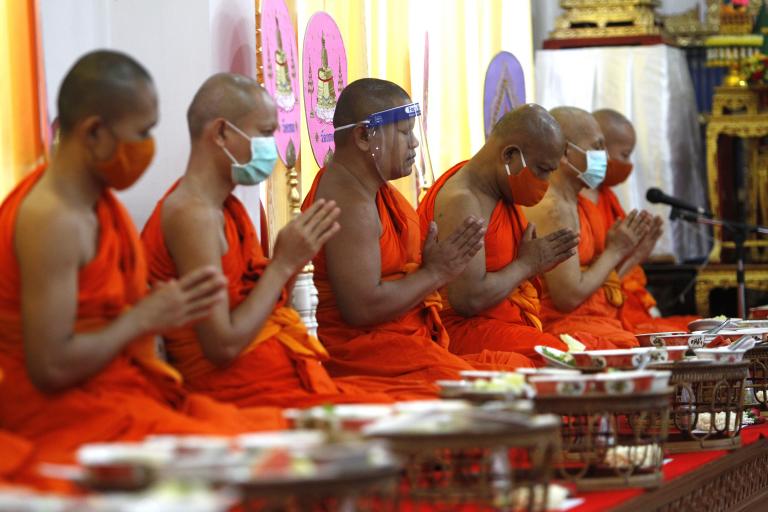
Buddhist monks in Thailand pray at Phleng temple amid the COVID-19 crisis, May 11, 2020. (Chaiwat Subprasom/SOPA Images/LightRocket via Getty Images)
By Pierce Salguero, Penn State
Millions of Buddhists seeking protection and healing from the novel coronavirus are turning to traditional religious rituals.
Since the emergence of COVID-19, the Dalai Lama, other senior monks and Buddhist organizations in Asia and worldwide have emphasized that this pandemic calls for meditation, compassion, generosity and gratitude. Such messages reinforce a common view in the West of Buddhism as more philosophy than religion – a spiritual, perhaps, but secular practice associated with mindfulness, happiness and stress reduction.
But for many people around the world Buddhism is a religion – a belief system that includes strong faith in supernatural powers. As such, Buddhism has a large repertoire of healing rituals that go well beyond meditation.
Having studied the interplay between Buddhism and medicine as a historian and ethnographer for the past 25 years, I have been documenting the role these ritual practices play in the coronavirus pandemic.
Talismans, prayer and ritual
Buddhism originated in India about two and a half millennia ago. Today, with well over a half-billion adherents across the world, it is a highly diverse tradition that has adapted to many cultural and social contexts.
There are three main schools of traditional Buddhism: Theravāda, practiced in most of Southeast Asia; Mahāyāna, the form most prevalent in East Asia; and Vajrayāna, commonly associated with Tibet and the Himalayan region.
In Buddhist-majority places, the official COVID-19 pandemic response includes conventional emergency health and sanitation measures like recommending face masks, hand-washing and stay-at-home orders. But within religious communities, Buddhist leaders also are using a range of ritual apotropaics – magical protection rites – to protect against disease.
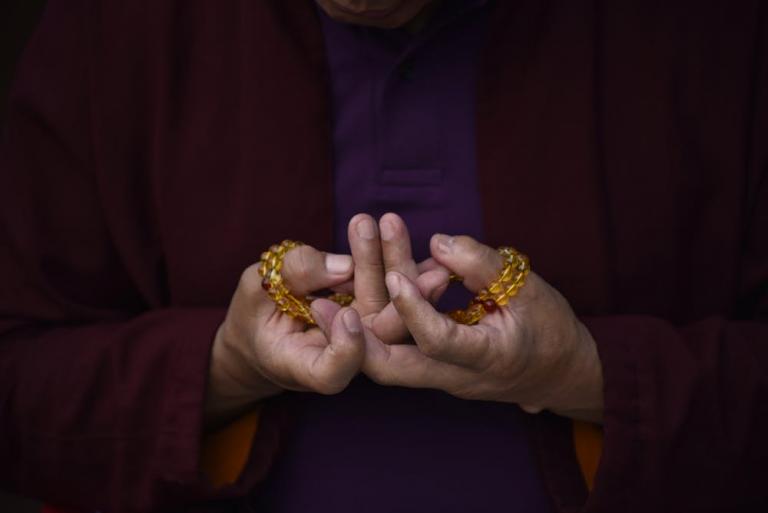
A Nepalese Buddhist monk offering ritual prayer, May 7, 2020. (Narayan Maharjan/NurPhoto via Getty Images)
In Thailand, for example, Theravāda temples are handing out “yant,” talismans bearing images of spirits, sacred syllables and Buddhist symbols. These blessed orange papers are a common ritual object among Buddhists in Southeast Asia who see crises such as epidemic illnesses as a sign that demonic forces are on the rise.
Theravāda amulets and charms trace their magical powers to repel evil spirits not only to the Buddha but also to beneficial nature spirits, demigods, charismatic monks and wizards.
Now, these blessed objects are being specifically formulated with the intention of protecting people from contracting the coronavirus.
Mahāyāna Buddhists use similar sacred objects, but they also pray to a whole pantheon of buddhas and bodhisattvas – another class of enlightened beings – for protection. In Japan, for example, Buddhist organizations have been conducting expulsion rites that call on Buddhist deities to help rid the land of the coronavirus.
Mahāyāna practitioners have faith that the blessings bestowed by these deities can be transmitted through statues or images. In a modern twist on this ancient belief, a priest affiliated with the Tōdaiji temple in Nara, Japan, in April tweeted a photo of the great Vairocana Buddha. He said the image would protect all who lay eyes upon it.
Vajrayāna practitioners also advocate a unique form of visualization where the practitioner generates a vivid mental image of a deity and then interacts with them on the level of subtle energy. Responses to COVID-19 suggested by leading figures in traditional Tibetan medicine frequently involve this kind of visualization practice.The third major form of Buddhism, Vajrayāna, which developed in the medieval period and is widely influential in Tibet, incorporates many rituals of earlier traditions. For example, the Dalai Lama has urged practitioners in Tibet and China to chant mantras to the bodhisattva Tārā, a female goddess associated with compassion and well-being, to gain her protection.
Buddhist modernism
Since the height of the colonial period in the 19th century, “Buddhist modernists” have carefully constructed an international image of Buddhism as a philosophy or a psychology. In emphasizing its compatibility with empiricism and scientific objectivity they have ensured Buddhism’s place in the modern world and paved the way for its popularity outside of Asia.
Many of these secular-minded Buddhists have dismissed rituals and other aspects of traditional Buddhism as “hocus pocus” lurking on the fringes of the tradition.
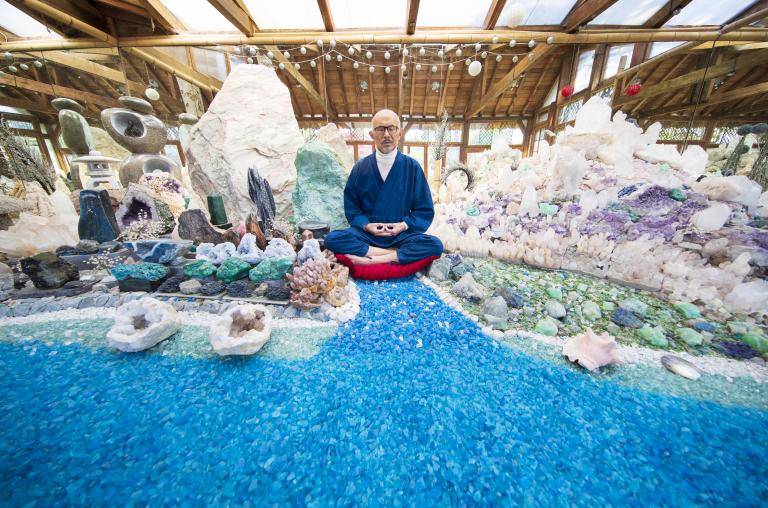
A former Buddhist monk practices visualization meditation during the coronavirus crisis, April 24, 2020. (Danny Lawson/PA Images via Getty Images)
Having documented the richness of the history and contemporary practice of Buddhist healing and protective rituals, however, I argue that these practices cannot be written off quite so easily.
In most living traditions of Buddhism, protective and healing rituals are taken seriously. They have sophisticated doctrinal justifications that often focus on the healing power of belief.
Increasingly, researchers are agreeing that faith in itself plays a role in promoting health. The anthropologist Daniel Moerman, for example, has identified what he calls the “meaning response.” This model accounts for how cultural and social beliefs and practices lead to “real improvements in human well-being.” Likewise, Harvard Medical School researcher Ted Kaptchuk has studied the neurobiological mechanisms for how rituals work to alleviate illnesses.
To date, there is no known way to prevent COVID-19 other than staying home to avoid contagion, and no miracle cure. But for millions worldwide, Buddhist talismans, prayers and protective rituals offer a meaningful way to confront the anxieties of the global coronavirus pandemic, providing comfort and relief.
And in a difficult time when both are in short supply, that’s nothing to discredit.
[You need to understand the coronavirus pandemic, and we can help. Read The Conversation’s newsletter.]
This article is republished from The Conversation under a Creative Commons license. Read the original article.

About Pierce Salguero
Associate Professor of Asian History & Religious Studies, Pennsylvania State University. In addition to university support, Pierce Salguero has received funding for his research on Buddhist healing practices from: the Kingdom of Thailand Royal Golden Jubilee Travel Grant; the Kolleg-Forschergruppe "Multiple Secularities" at Leipzig University and the Global Research Network Program of Korea's National Research Foundation. You can read more about the author here.


Browse Our Archives
Select a Category Buddhism Christianity Hinduism Islam Judaism Religion and society Uncategorized
Select a Month July 2024 March 2024 February 2024 January 2024 December 2023 November 2023 October 2023 September 2023 August 2023 July 2023 January 2023 August 2022 July 2022 April 2022 February 2022 January 2022 October 2021 July 2021 June 2021 May 2021 April 2021 March 2021 February 2021 January 2021 December 2020 November 2020 October 2020 September 2020 August 2020 July 2020 June 2020 May 2020
Follow Us!
TAKE THE
Religious Wisdom Quiz
What is the Christian teaching about temptation?
Select your answer to see how you score.
Ignore it Deny it exists Give in quickly Resist and pray for strength
Related posts from The Conversation


Electing A Virtuous President Would Make Immunity Irrelevant

Why The Olympic Games Are A ‘Civil Religious’...

The Catholic Church Is Using The Olympics To...
TRENDING AT PATHEOS Religion News

Catholic Integralists believe that religious values – specifically Christian ones – should...

Electing A Virtuous President Would Make Immunity Irrelevant
Presidential immunity can bring with it many risks. So how can we...

Why The Olympic Games Are A ‘Civil Religious’...
Sporting events form a vital space where Americans display their 'civil religious...

After more than a decade of news, research updates, and insights on...

Q: Why do Southern Baptists and like-minded Protestants...
THE RELIGION GUY’S ANSWER: Why? Simple. Because they believe that’s what the...

THE QUESTION: Is gambling evil? THE RELIGION GUY’S ANSWER: Analysts anticipate a...
view all Religion News blogs
Ad-Free & Subscriber Log-In Subscription Support
- About Us
- 2026 Calendar
- Videos
- Podcasts
- Library of World Religions
- Faith In Media Tracker
- Advertise With Us
- Write for Us
- Privacy Policy
- Terms of Service
- Do Not Sell My Data
- Contact Us
- Radiant Digital
- Manage Newsletter Subscriptions
- Unsubscribe From Notifications
- Sitemap
Copyright 2008-2026, Patheos. All rights reserved.
Subscription Support Ad-Free & Subscriber Log-In
Follow Patheos