
BuddhistCatholicContemplativeEvangelicalGeneral ChristianHinduJewishLatter-day SaintMuslimNew VisionsProgressive Christian
Beliefs
- Buddhist
- Catholic
- Contemplative
- Evangelical
- General Christian
- Hindu
- Jewish
- Latter-day Saint
- More Voices
- Muslim
- New Visions
- Pagan
- Progressive Christian
Topics
- Religion News
- Food and Religion
- Sports and Religion
- Religious Art
- Religious Music and Entertainment
- Religious Events
- History and Religion
- Style and Religion
- Politics and Religion
- Women in Religion
- Recreation Outdoors and Religion
- Business Finance and Religion
- Careers Workplace and Religion
- Education and Religion
- Family Parenting and Religion
- Health Fitness and Religion
- Home and Religion
- Relationships and Religion
- Technology and Religion
- Travel and Religion
Columnists
- Buddhist Columnists
- Business Finance and Religion Columnists
- Careers Workplace and Religion Columnists
- Catholic Columnists
- Contemplative Columnists
- Education and Religion Columnists
- Evangelists Columnists
- Family Parenting and Religion Columnists
- General Christian Columnists
- Health Fitness and Religion Columnists
- Hindu Columnists
- History and Religion Columnists
- Home and Religion Columnists
- Jewish Columnists
- More Voices Columnists
- Latter Day Columnists
- Muslim Columnists
- New Visions Columnists
- Nonreligious Columnists
- Pagan Columnists
- Politics and Religion Columnists
- Progressive Columnists
- Recreation Outdoors and Religion Columnists
- Relationships and Religion Columnists
- Religion News Columnists
- Religious Art Columnists
- Religious Events Columnists
- Religious Music and Entertainment Columnists
- Sports and Religion Columnists
- Style and Religion Columnists
- Technology and Religion Columnists
- Travel and Religion Columnists
- Women in Religion Columnists
Resource Library
- 2026 Calendar
- Library of World Religions
- The 100 Most Holy Places on Earth
- Patheos Answers
- Podcasts
- Videos
- Faith Leaders Database
- Anglican Episcopalian
- Bahai
- Baptist
- Buddhism
- Christianity
- Confucianism
- Eastern Orthodoxy
- Hinduism
- Holiness and Pentecostal
- ISKCON
- Islam
- Judaism
- Lutheran
- Methodist
- The Church of Jesus Christ of Latter-day Saints
- New Age
- Paganism
- Presbytarian and Reformed
- Protestantism
- Religion Behind the Scenes
- Roman Catholic
- Scientology
- Shia Islam
- Sikhism
- Sufism
- Sunni Islam
- Taoism
- Zen
- See all religions
Research Tools
 Ad-Free & Subscriber Log-In Subscription Support
Ad-Free & Subscriber Log-In Subscription Support
Follow Patheos 

- Trending:
- Forgiveness
- |
- Marriage
- |
- Consciousness
- |
- Death Penalty
- |
- Election
- |
- Halloween
 The Christian Revolution
- Home
- Evangelical
- Destroyer of the gods: Round Two
Destroyer of the gods: Round Two
Last updated on: May 30, 2017 at 5:52 pm by Taylor S. Brown
Destroyer of the gods: Round Two 2017-05-30T17:52:01-06:00 Taylor S. Brown
Patheos Explore the world's faith through different perspectives on religion and spirituality! Patheos has the views of the prevalent religions and spiritualities of the world.
If you can only read one book about the history of early Christianity this year (or this summer, whichever comes first), I would highly recommend Larry Hurtado’s recent monograph, Destroyer of the gods: Early Christian Distinctiveness in the Roman World (Baylor University Press, 2016). It was my top book in the New Testament/Early Christianity category in my “Top Books of 2016” list that I composed near the end of last year (it was very closely followed by John Barclay’s magisterial tome, Paul and the Gift; if I were to re-write the article today, I would make it an even tie between the two books, but I digress). I even wrote a review of it over at Seedbed.com.
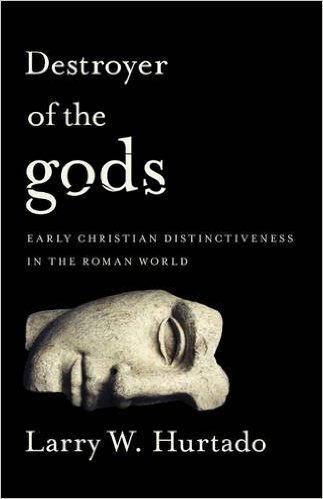
The folks over at First Things have just put up a fairly thorough review of the book by Joshua Kinlaw. It does a good job of both summarizing several of Hurtado’s key points in the book, and critically engaging with his work as to where it could be expanded further. One of my favorite sections from the review (which summarizes one of my favorite sections from the book), deals with just how revolutionary the Apostle Paul (representative of the earliest strata of Christian belief and practice) was in the ancient Greco-Roman world:
The ancient ideal of a “peace among the gods” lies behind Pliny’s worries, and this ideal also motivates both the official persecutions and the popular criticism of Christianity. Peace (and prosperity) among men depended upon the pax deorum, which correct sacrifice and rite could encourage, if not ensure. Historically, it has led to an orthopraxy-versus-orthodoxy distinction that, if logical, is decidedly out of favor. Hurtado’s accomplishment here is to transcend this academic chestnut by keeping his focus on a final, most significant distinctive: Christians wanted to change the world. The ultimate goal of the pax deorum, by contrast, was to maintain the status quo. However disappointed moderns may be in the lack of outright rebellion in St. Paul—whose Corinthian letters Hurtado reads closely and fruitfully—we must understand how countercultural he was. The significance of “idolatry” to the New Testament letters is one example: Paul gives the Greek word a pejorative sense that it had never had outside of Judaism. His prescription of agape, moreover, was simultaneously “preposterous” and “winsome” in its first-century context.
The review is very well written and reminded me of just how good Hurtado’s book is. If you are in need of some summer reading, I’d recommend reading the First Things book review. Then, I would highly recommend reading Hurtado’s book itself.
Previous Post

May 24, 2017
So What Is The Story of the Bible?
Next Post

June 6, 2017 "Living Stones": A Sermon on 1 Peter 2:2-10
Browse Our Archives
Select a Category Uncategorized
Select a Month July 2019 April 2019 January 2019 December 2018 November 2018 October 2018 September 2018 August 2018 July 2018 June 2018 May 2018 April 2018 March 2018 February 2018 January 2018 December 2017 November 2017 October 2017 September 2017 August 2017 July 2017 June 2017 May 2017 April 2017 March 2017 February 2017 January 2017 December 2016
Follow Us!
TAKE THE
Religious Wisdom Quiz
Which Gospel records the birth of John the Baptist?
Select your answer to see how you score.
Mark John Matthew Luke
Related posts from The Christian Revolution

A Post After Some Time Away....And a Big...

The Christian Response to Nation-States

TRENDING AT PATHEOS Evangelical

The REST of Your Life: A Creative Wrestles...
This week I had a conversation with a good friend from church....

How the author of the world's best hymn...
I've been working with John Newton for a while now. This makes...

Long before this Lectio Divina, Psalm 130 - the song - started...

What About the Trees? Another Living Parable
After I finished writing the last article about falling leaves as a...

Why Classical Education Is a Conversation, Not a...
Come and Read: Joy in Classical Education When I was a little...

Cornell University has received a great deal of negative publicity and intense...
view all Evangelical blogs
Ad-Free & Subscriber Log-In Subscription Support
- About Us
- 2026 Calendar
- Videos
- Podcasts
- Library of World Religions
- Faith In Media Tracker
- Advertise With Us
- Write for Us
- Privacy Policy
- Terms of Service
- Do Not Sell My Data
- Contact Us
- Radiant Digital
- Manage Newsletter Subscriptions
- Unsubscribe From Notifications
- Sitemap
Copyright 2008-2026, Patheos. All rights reserved.
Subscription Support Ad-Free & Subscriber Log-In
Follow Patheos