
BuddhistCatholicContemplativeEvangelicalGeneral ChristianHinduJewishLatter-day SaintMuslimNew VisionsProgressive Christian
Beliefs
- Buddhist
- Catholic
- Contemplative
- Evangelical
- General Christian
- Hindu
- Jewish
- Latter-day Saint
- More Voices
- Muslim
- New Visions
- Pagan
- Progressive Christian
Topics
- Religion News
- Food and Religion
- Sports and Religion
- Religious Art
- Religious Music and Entertainment
- Religious Events
- History and Religion
- Style and Religion
- Politics and Religion
- Women in Religion
- Recreation Outdoors and Religion
- Business Finance and Religion
- Careers Workplace and Religion
- Education and Religion
- Family Parenting and Religion
- Health Fitness and Religion
- Home and Religion
- Relationships and Religion
- Technology and Religion
- Travel and Religion
Columnists
- Buddhist Columnists
- Business Finance and Religion Columnists
- Careers Workplace and Religion Columnists
- Catholic Columnists
- Contemplative Columnists
- Education and Religion Columnists
- Evangelists Columnists
- Family Parenting and Religion Columnists
- General Christian Columnists
- Health Fitness and Religion Columnists
- Hindu Columnists
- History and Religion Columnists
- Home and Religion Columnists
- Jewish Columnists
- More Voices Columnists
- Latter Day Columnists
- Muslim Columnists
- New Visions Columnists
- Nonreligious Columnists
- Pagan Columnists
- Politics and Religion Columnists
- Progressive Columnists
- Recreation Outdoors and Religion Columnists
- Relationships and Religion Columnists
- Religion News Columnists
- Religious Art Columnists
- Religious Events Columnists
- Religious Music and Entertainment Columnists
- Sports and Religion Columnists
- Style and Religion Columnists
- Technology and Religion Columnists
- Travel and Religion Columnists
- Women in Religion Columnists
Resource Library
- 2026 Calendar
- Library of World Religions
- The 100 Most Holy Places on Earth
- Patheos Answers
- Podcasts
- Videos
- Faith Leaders Database
- Anglican Episcopalian
- Bahai
- Baptist
- Buddhism
- Christianity
- Confucianism
- Eastern Orthodoxy
- Hinduism
- Holiness and Pentecostal
- ISKCON
- Islam
- Judaism
- Lutheran
- Methodist
- The Church of Jesus Christ of Latter-day Saints
- New Age
- Paganism
- Presbytarian and Reformed
- Protestantism
- Religion Behind the Scenes
- Roman Catholic
- Scientology
- Shia Islam
- Sikhism
- Sufism
- Sunni Islam
- Taoism
- Zen
- See all religions
Research Tools
 Ad-Free & Subscriber Log-In Subscription Support
Ad-Free & Subscriber Log-In Subscription Support
Follow Patheos 

- Trending:
- Forgiveness
- |
- Marriage
- |
- Consciousness
- |
- Death Penalty
- |
- Election
- |
- Halloween
 The Christian Revolution
- Home
- Evangelical
- Michael Gungor and Misunderstanding Atonement
Michael Gungor and Misunderstanding Atonement
Last updated on: March 5, 2017 at 9:57 pm by Taylor S. Brown
Michael Gungor and Misunderstanding Atonement 2017-03-05T21:57:09-06:00 Taylor S. Brown
Patheos Explore the world's faith through different perspectives on religion and spirituality! Patheos has the views of the prevalent religions and spiritualities of the world.

In the American evangelical world you never really have to worry that debates about atonement theories will stop and come to some form of consensus. For when a peace of some sort begins to settle over the world as to whether Christus Victor, substitution, Girardian scapegoat, or some sort of neo-Abelardian moral exemplar theory is the predominant view of Christ’s atonement (for my money, I believe a combo of Christus Victor and substitutionary atonement is the primary, but not exclusive, atonement motif in the New Testament), rest assured that someone will stir things up again.
Enter Michael Gungor.
For those unaware, Michael Gungor is a very talented and Grammy-nominated musician who, with his wife Lisa, leads the eponymous musical collective, Gungor. Back in the late 2000s, Gungor (both the man and the band) rose quickly in popularity in the American Christian music world. And for good reason. Their work is very, very good.
However, Michael Gungor’s darling status in the evangelical world was soon called into question. You see, it came to light in 2014 that Gungor had called into question one of the sacred cows of certain, super-conservative, modernist camps within American evangelicalism. He said that he thought the primordial history section of Genesis (Gen. 1—11) was figurative. Publications like World Magazine and other super-conservative outlets quickly called into question Gungor’s Christianity. His expression of struggles with various doubts about his faith didn’t help to improve his image in the eyes of super-conservatives.
So what is the point of all this backstory? Well, it is important background info to show how Gungor has grown apart from the American evangelical world he grew up in. From what I understand about Gungor (and I am happy to be corrected if I am correct), he grew up in a fundamentalist setting where views like a six-day literal reading of Genesis were markers of one’s “true Christian” status. To begin to distance oneself from such views is to implicitly bring in gatekeeper voices who call into question your credibility as a person of Christian integrity. I know, I’ve been there. I’ve had more than a few people call into question my faith when I tell them that I am a theistic evolutionist (just like N.T. Wright, Scot McKnight, Francis Collins, and many others). These same critics ignore the fact that I (and others like me) wholeheartedly affirm every jot and tittle of the Apostle’s, Nicene, and Chalcedonian Creeds. But I digress.
With his distancing from the super-conservative evangelical fold, Gungor has begun to periodically make other controversial statements about what are often viewed as “conservative doctrines” (or talking about how he went on a personal retreat with Ram Dass). The most recent has been as series of tweets calling into question the validity of substitutionary atonement in the crucifixion of Christ.
On February 25th, Gungor put out a series of tweets saying:
I would love to hear more artists who sing to God and fewer who include a Father murdering a son in that endeavor… if you can’t think of anything to sing to God other than gratitude for taking your shame away through bloodshed, stop singing and look around… Now I certainly don’t mean to minimize the meaning and symbolism of the cross for billions of Christians through the centuries… I simply think blood sacrifice is a very limited and less than timely metaphor for what the cross can mean in our culture.
Two days later on February 27th, after several interchanges with people rightly critiquing his gross mischaracterization of substitutionary atonement, Gungor tweeted what is called an ad hominem fallacy:
What percentage of the people still tweeting at me about substitutionary atonement do you think voted for trump? And do you see the correlation between the two things? I do! 🙂
I hold to substitutionary atonement. And I most certainly did not vote for Trump.
This isn’t the first time that someone who has a chip on their shoulder from being burned by quasi-fundamentalism (haven’t we all in some way?) has terribly misrepresented substitutionary atonement. The caricatures of “cosmic child abuse” have been going on for a while now. Steve Chalke, ever the provocateur, used it as far back as 2003 in a book co-written with Alan Mann, The Lost Message of Jesus (Zondervan, 2003):
The fact is that the cross isn’t a form of cosmic child abuse—a vengeful Father, punishing his Son for an offence he has not even committed. Understandably, both people inside and outside of the Church have found this twisted version of events morally dubious and a huge barrier to faith. Deeper than that, however, is that such a concept stands in total contradiction to the statement: “God is love”. If the cross is a personal act of violence perpetrated by God towards humankind but borne by his Son, then it makes a mockery of Jesus’ own teaching to love your enemies and to refuse to repay evil with evil. (pp. 182-83)
This line of reasoning—shared also by Gungor in his tweets—has some truth to it. It is true that the cross isn’t “cosmic child abuse.” Nor is it “a Father murdering a son.” And this is precisely because the traditional doctrine of substitutionary atonement is understood within a Trinitarian framework. Only when we understand substitutionary atonement from a Trinitarian perspective do we understand it correctly. Paraphrasing John Stott, a Trinitarian substitutionary atonement is one that fundamentally sees the substitute as God Himself. Christ is God the Son, willfully substituting Himself in the place of the human race. In Jesus’s application of Isaiah 53 (the Suffering Servant) to Himself, God the Son explicitly and voluntarily identifies Himself as the Suffering Servant Who takes on the sin of others.
The view of substitutionary atonement as “cosmic child abuse” or “a Father murdering a son” is one that views Christ’s atonement not from a Trinitarian Christological paradigm, but from on an implicitly Arian Christological one. Whether figures like Gungor or Chalke realize it or not, their caricatures assume a Jesus who is alienated from the triune Godhead; a sort of super-human who has been unjustly cast in the role of whipping boy. John Stott addressed such Arian caricatures years ago:
In the one [caricatured] case Christ is pictured as intervening in order to pacify an angry God and wrest from him a grudging salvation. In the other [caricature], the intervention is ascribed to God, who proceeds to punish the innocent Jesus in place of us the guilty sinners who had deserved the punishment. In both cases God and Christ are sundered from one another: either Christ persuades God or God punishes Christ. What is characteristic of both presentations is they denigrate the Father. Reluctant to suffer himself, he victimizes Christ instead. Reluctant to forgive, he is prevailed on by Christ to do so. He is seen as a pitiless ogre whose wrath has to be assuaged, whose disinclination to act has to be overcome, by the loving self-sacrifice of Jesus.
Such crude interpretations of the cross still emerge in some of our evangelical illustrations, as when we describe Christ as coming to rescue us from the judgment of God, or when we portray him as a whipping-boy who is punished instead of the real culprit, or as the lightning conductor to which the lethal electrical charge is deflected.”
– The Cross of Christ (InterVarsity Press, 1986), 149-50
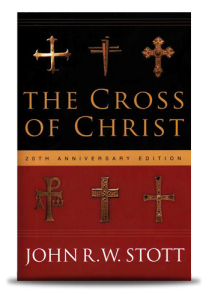
What Stott described in 1986 is precisely what Michael Gungor is doing with is tweets in 2017. It is an implicit “sundering” of God the Son and God the Father; an implicit Arian Christology.
In stark contrast to such caricatures of God’s self-substitution, Stott reminds us that the cross is fundamentally about God Himself voluntarily taking on the consequences of sin and evil—death—that the human race deserved:
“We must not, then, speak of God punishing Jesus or of Jesus persuading God, for to do so is to set them over against each other as if they acted independently of each other or were even in conflict with each other. We must never make Christ the object of God’s punishment or God the object of Christ’s persuasion, for both God and Christ were subjects not objects, taking the initiative together to save sinners. Whatever happened on the cross in terms of “God-forsakenness” was voluntarily accepted by both in the same holy love that made atonement necessary…There was no unwillingness in either. On the contrary, their wills coincided in the perfect self-sacrifice of love.” (p. 151)
I get Gungor’s angst about substitutionary atonement in our American religious context. I really do and I sympathize with him. Too many American evangelicals do indeed wrongly present the cross as “cosmic child abuse.” And Gungor is right to protest such an unjust and un-Christian view. However, rather than throwing out the substitutionary view of the atonement altogether, we instead need to return to a properly Trinitarian—a properly Christian—view of cross. For when see Christ’s substitutionary death on the cross, His taking upon Himself the punishment for humanity’s sins, through a Trinitarian lens, a startling transformation occurs. The cross is no longer “a Father murdering a son” but is instead the supreme act of both holy justice and holy love. The Creator God substituting Himself for a human race that deserved nothing less than death for the horrors we have committed, horrors like Auschwitz and Buchenwald. When we look at substitutionary atonement with a Trinitarian lens it shifts from an act of supreme cruelty to the act of supreme holy love.
Previous Post

March 1, 2017
The Task of Biblical Exegesis
Next Post

March 7, 2017 Roger Scruton and Human "Animals"
Browse Our Archives
Select a Category Uncategorized
Select a Month July 2019 April 2019 January 2019 December 2018 November 2018 October 2018 September 2018 August 2018 July 2018 June 2018 May 2018 April 2018 March 2018 February 2018 January 2018 December 2017 November 2017 October 2017 September 2017 August 2017 July 2017 June 2017 May 2017 April 2017 March 2017 February 2017 January 2017 December 2016
Follow Us!
TAKE THE
Religious Wisdom Quiz
Who brought to Jesus the woman taken in adultery?
Select your answer to see how you score.
The Apostles The Pharisees The Disciples The Publicans
Related posts from The Christian Revolution


A Post After Some Time Away....And a Big...

The Christian Response to Nation-States

TRENDING AT PATHEOS Evangelical

The REST of Your Life: A Creative Wrestles...
This week I had a conversation with a good friend from church....

How the author of the world's best hymn...
I've been working with John Newton for a while now. This makes...

Long before this Lectio Divina, Psalm 130 - the song - started...

What About the Trees? Another Living Parable
After I finished writing the last article about falling leaves as a...

Why Classical Education Is a Conversation, Not a...
Come and Read: Joy in Classical Education When I was a little...

Cornell University has received a great deal of negative publicity and intense...
view all Evangelical blogs
Ad-Free & Subscriber Log-In Subscription Support
- About Us
- 2026 Calendar
- Videos
- Podcasts
- Library of World Religions
- Faith In Media Tracker
- Advertise With Us
- Write for Us
- Privacy Policy
- Terms of Service
- Do Not Sell My Data
- Contact Us
- Radiant Digital
- Manage Newsletter Subscriptions
- Unsubscribe From Notifications
- Sitemap
Copyright 2008-2026, Patheos. All rights reserved.
Subscription Support Ad-Free & Subscriber Log-In
Follow Patheos