
BuddhistCatholicContemplativeEvangelicalGeneral ChristianHinduJewishLatter-day SaintMuslimNew VisionsProgressive Christian
Beliefs
- Buddhist
- Catholic
- Contemplative
- Evangelical
- General Christian
- Hindu
- Jewish
- Latter-day Saint
- More Voices
- Muslim
- New Visions
- Pagan
- Progressive Christian
Topics
- Religion News
- Food and Religion
- Sports and Religion
- Religious Art
- Religious Music and Entertainment
- Religious Events
- History and Religion
- Style and Religion
- Politics and Religion
- Women in Religion
- Recreation Outdoors and Religion
- Business Finance and Religion
- Careers Workplace and Religion
- Education and Religion
- Family Parenting and Religion
- Health Fitness and Religion
- Home and Religion
- Relationships and Religion
- Technology and Religion
- Travel and Religion
Columnists
- Buddhist Columnists
- Business Finance and Religion Columnists
- Careers Workplace and Religion Columnists
- Catholic Columnists
- Contemplative Columnists
- Education and Religion Columnists
- Evangelists Columnists
- Family Parenting and Religion Columnists
- General Christian Columnists
- Health Fitness and Religion Columnists
- Hindu Columnists
- History and Religion Columnists
- Home and Religion Columnists
- Jewish Columnists
- More Voices Columnists
- Latter Day Columnists
- Muslim Columnists
- New Visions Columnists
- Nonreligious Columnists
- Pagan Columnists
- Politics and Religion Columnists
- Progressive Columnists
- Recreation Outdoors and Religion Columnists
- Relationships and Religion Columnists
- Religion News Columnists
- Religious Art Columnists
- Religious Events Columnists
- Religious Music and Entertainment Columnists
- Sports and Religion Columnists
- Style and Religion Columnists
- Technology and Religion Columnists
- Travel and Religion Columnists
- Women in Religion Columnists
Resource Library
- 2026 Calendar
- Library of World Religions
- The 100 Most Holy Places on Earth
- Patheos Answers
- Podcasts
- Videos
- Faith Leaders Database
- Anglican Episcopalian
- Bahai
- Baptist
- Buddhism
- Christianity
- Confucianism
- Eastern Orthodoxy
- Hinduism
- Holiness and Pentecostal
- ISKCON
- Islam
- Judaism
- Lutheran
- Methodist
- The Church of Jesus Christ of Latter-day Saints
- New Age
- Paganism
- Presbytarian and Reformed
- Protestantism
- Religion Behind the Scenes
- Roman Catholic
- Scientology
- Shia Islam
- Sikhism
- Sufism
- Sunni Islam
- Taoism
- Zen
- See all religions
Research Tools
 Ad-Free & Subscriber Log-In Subscription Support
Ad-Free & Subscriber Log-In Subscription Support
Follow Patheos 

- Trending:
- Forgiveness
- |
- Marriage
- |
- Consciousness
- |
- Death Penalty
- |
- Election
- |
- Halloween
 The Christian Revolution
- Home
- Evangelical
- America’s Secular Paganism
America’s Secular Paganism
Last updated on: March 16, 2017 at 5:25 pm by Taylor S. Brown
America’s Secular Paganism 2017-03-16T17:25:15-06:00 Taylor S. Brown
Patheos Explore the world's faith through different perspectives on religion and spirituality! Patheos has the views of the prevalent religions and spiritualities of the world.

Over at The Atlantic Peter Beinart has a fantastic article on the fury and invective that rising secularism has brought about in socio-political discourse, particularly in the recent election. I won’t spoil the article for you (it really is a great piece) but, in essence, Beinart argues that the decline in religious participation—particularly traditionally Christian participation—has brought about what could be described as a sort of “post-Christendom neo-paganism.” At least that’s how I describe it.
Beinart notes how ideologues on both the political right and left, as they gravitate away from traditional religious belief—read, Judeo-Christian belief—have begun to root their hopes for revolutionary change in things like race, the state, or “blood and soil.” As Beinart observes of the alt-right:
Whatever the reason, when cultural conservatives disengage from organized religion, they tend to redraw the boundaries of identity, de-emphasizing morality and religion and emphasizing race and nation. Trump is both a beneficiary and a driver of that shift.
So is the alt-right. Read Milo Yiannopoulos and Allum Bokhari’s famous Breitbart.com essay, “An Establishment Conservative’s Guide to the Alt-Right.” It contains five references to “tribe,” seven to “race,” 13 to “the west” and “western” and only one to “Christianity.” That’s no coincidence. The alt-right is ultra-conservatism for a more secular age. Its leaders like Christendom, an old-fashioned word for the West. But they’re suspicious of Christianity itself, because it crosses boundaries of blood and soil. As a college student, the alt-right leader Richard Spencer was deeply influenced by Friedrich Nietzsche, who famously hated Christianity. Radix, the journal Spencer founded, publishes articles with titles like “Why I Am a Pagan.”
The “blood and soil” emphasis comes through quite eerily. Of course, Beinart notes that the left is also impacted by this shift, albeit very differently than the right. Using the Black Lives Matter movement as an example, Beinart notes how different the movement is from its 1950s and 60s Civil Rights predecessor:
This [secularizing] shift is crucial to understanding Black Lives Matter, a Millennial-led protest movement whose activists often take a jaundiced view of established African American religious leaders. Brittney Cooper, who teaches women’s and gender studies as well as Africana studies at Rutgers, writes that the black Church “has been abandoned as the leadership model for this generation.” As Jamal Bryant, a minister at an AME church in Baltimore, told The Atlantic’s Emma Green, “The difference between the Black Lives Matter movement and the civil-rights movement is that the civil-rights movement, by and large, was first out of the Church.”
Beinart also focuses in on one of BLM’s founders as a further example of the secularizing shift:
Patrisse Cullors, one of the movement’s founders, grew up as a Jehovah’s Witness but says she became alienated by the fact that the elders were “all men.” In a move that faintly echoes the way some in the alt-right have traded Christianity for religious traditions rooted in pagan Europe, Cullors has embraced the Nigerian religion of Ifa. To be sure, her motivations are diametrically opposed to the alt-right’s. Cullors wants a spiritual foundation on which to challenge white, male supremacy; the pagans of the alt-right are looking for a spiritual basis on which to fortify it. But both are seeking religions rooted in racial ancestry and disengaging from Christianity—which, although profoundly implicated in America’s apartheid history, has provided some common vocabulary across the color line.
The key to understanding this socio-political shift on both the right and left is found in that last sentence: “…both are seeking religions rooted in racial ancestry and disengaging from Christianity.”
(Note: I am not at all trying to equate the alt-right and Black Lives Matter, nor is Peter Beinart. Black Lives Matter, as an official movement, is trying to advocate for justice and equality. Even if I might disagree with a few of their methods, I still view them as a legitimate social movement with justifiable cause to advocate for black Americans. I do not view the alt-right as such. These were simply the two examples that Beinart provided in his article, and so I have discussed them accordingly here.)
This larger secularizing shift in socio-political discourse (particularly in the alt-right) is somewhat reminiscent of pre-Christian paganism. Of course, my use of the descriptor “paganism” is not at all meant as a pejorative term. I use it in the technical sense of a socio-religious belief system that roots its ultimate truth claims and telos in particular national, racial, animistic, cultural, polytheistic, etc., distinctives. Think of the paganism of ancient Roman religion, that connected piety to the gods with loyalty to the the Roman state, emperor, and people.
This is in stark contrast to universal truth claims and telic ends of faiths such as Judaism or Christianity, which believe that the ultimate Ground of all reality is one transcendent God, who created all people and races, and who calls for a universalized form of justice that does not ultimately favor any one race or nation-state.
This, of course, is why orthodox Christian theology—with its grounding claims of a Creator God who took on flesh to die for the salvation of all people, of a self-sacrificing love that is the ultimate weapon against evil, and of a new form of humanity where there is “no longer Jew nor Greek, there is neither slave nor free, there is neither male nor female, for you are all one in Christ Jesus (Gal 3:28)”—is antithetical to any secularized, socio-political movement that places race, nation, or “blood and soil” as its ultimate priority.
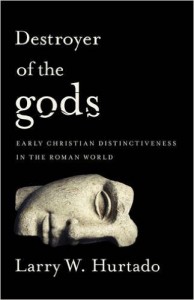
As the biblical scholar Larry Hurtado notes in his book, Destroyer of the gods: Early Christian Distinctiveness in the Roman World (Baylor University Press, 2016), the Christian belief in one, true, transcendent God who actually loves the whole of creation and humanity was utterly strange to the popular Greco-Roman paganism of the ancient world:
The notion that there is one true and transcendent God, and that this God loves the world/humanity, may have become subsequently so much a familiar notion, whether or not it is actively affirmed, that we cannot easily realize how utterly strange, even ridiculous, it was in the Roman era. . . We should certainly recognized that ancient people could have a genuine sense of religious awe, gratitude, and devotion to their various gods, and individuals could feel a particular affection for their favored deities. We do have references to this or that pagan deity as merciful or generous. But the notion that the gods love humanity with anything approaching relational intensity ascribed to God rather ubiquitously in early Christian texts is, to put it mildly, hard to find in pagan texts of the Greek or Roman period. (pp. 64-65)
Of course, the sad reality that Peter Beinart illustrates in his Atlantic article is that, in many segments of American life and culture, people are starting to once again view the Christian God of love as very “strange.” And this is because of a reversion to a far darker and more brutal view of the world, a view which a crucified and resurrected Galilean destroyed so many centuries ago. And it is a view that the Crucified and Risen One will defeat again, even if the darkness, at times, seems to have won out.
Previous Post

March 14, 2017
Longing For Home
Next Post

March 20, 2017 Thinking Clearly About the Christian Faith
Browse Our Archives
Select a Category Uncategorized
Select a Month July 2019 April 2019 January 2019 December 2018 November 2018 October 2018 September 2018 August 2018 July 2018 June 2018 May 2018 April 2018 March 2018 February 2018 January 2018 December 2017 November 2017 October 2017 September 2017 August 2017 July 2017 June 2017 May 2017 April 2017 March 2017 February 2017 January 2017 December 2016
Follow Us!
TAKE THE
Religious Wisdom Quiz
What does the rider of the White Horse in Revelations carry?
Select your answer to see how you score.
Scales A bow A sword A scroll
Related posts from The Christian Revolution


A Post After Some Time Away....And a Big...

The Christian Response to Nation-States

TRENDING AT PATHEOS Evangelical

The REST of Your Life: A Creative Wrestles...
This week I had a conversation with a good friend from church....

How the author of the world's best hymn...
I've been working with John Newton for a while now. This makes...

Long before this Lectio Divina, Psalm 130 - the song - started...

What About the Trees? Another Living Parable
After I finished writing the last article about falling leaves as a...

Why Classical Education Is a Conversation, Not a...
Come and Read: Joy in Classical Education When I was a little...

Cornell University has received a great deal of negative publicity and intense...
view all Evangelical blogs
Ad-Free & Subscriber Log-In Subscription Support
- About Us
- 2026 Calendar
- Videos
- Podcasts
- Library of World Religions
- Faith In Media Tracker
- Advertise With Us
- Write for Us
- Privacy Policy
- Terms of Service
- Do Not Sell My Data
- Contact Us
- Radiant Digital
- Manage Newsletter Subscriptions
- Unsubscribe From Notifications
- Sitemap
Copyright 2008-2026, Patheos. All rights reserved.
Subscription Support Ad-Free & Subscriber Log-In
Follow Patheos