
BuddhistCatholicContemplativeEvangelicalGeneral ChristianHinduJewishLatter-day SaintMuslimNew VisionsProgressive Christian
Beliefs
- Buddhist
- Catholic
- Contemplative
- Evangelical
- General Christian
- Hindu
- Jewish
- Latter-day Saint
- More Voices
- Muslim
- New Visions
- Pagan
- Progressive Christian
Topics
- Religion News
- Food and Religion
- Sports and Religion
- Religious Art
- Religious Music and Entertainment
- Religious Events
- History and Religion
- Style and Religion
- Politics and Religion
- Women in Religion
- Recreation Outdoors and Religion
- Business Finance and Religion
- Careers Workplace and Religion
- Education and Religion
- Family Parenting and Religion
- Health Fitness and Religion
- Home and Religion
- Relationships and Religion
- Technology and Religion
- Travel and Religion
Columnists
- Buddhist Columnists
- Business Finance and Religion Columnists
- Careers Workplace and Religion Columnists
- Catholic Columnists
- Contemplative Columnists
- Education and Religion Columnists
- Evangelists Columnists
- Family Parenting and Religion Columnists
- General Christian Columnists
- Health Fitness and Religion Columnists
- Hindu Columnists
- History and Religion Columnists
- Home and Religion Columnists
- Jewish Columnists
- More Voices Columnists
- Latter Day Columnists
- Muslim Columnists
- New Visions Columnists
- Nonreligious Columnists
- Pagan Columnists
- Politics and Religion Columnists
- Progressive Columnists
- Recreation Outdoors and Religion Columnists
- Relationships and Religion Columnists
- Religion News Columnists
- Religious Art Columnists
- Religious Events Columnists
- Religious Music and Entertainment Columnists
- Sports and Religion Columnists
- Style and Religion Columnists
- Technology and Religion Columnists
- Travel and Religion Columnists
- Women in Religion Columnists
Resource Library
- 2026 Calendar
- Library of World Religions
- The 100 Most Holy Places on Earth
- Patheos Answers
- Podcasts
- Videos
- Faith Leaders Database
- Anglican Episcopalian
- Bahai
- Baptist
- Buddhism
- Christianity
- Confucianism
- Eastern Orthodoxy
- Hinduism
- Holiness and Pentecostal
- ISKCON
- Islam
- Judaism
- Lutheran
- Methodist
- The Church of Jesus Christ of Latter-day Saints
- New Age
- Paganism
- Presbytarian and Reformed
- Protestantism
- Religion Behind the Scenes
- Roman Catholic
- Scientology
- Shia Islam
- Sikhism
- Sufism
- Sunni Islam
- Taoism
- Zen
- See all religions
Research Tools
 Ad-Free & Subscriber Log-In Subscription Support
Ad-Free & Subscriber Log-In Subscription Support
Follow Patheos 

- Trending:
- Forgiveness
- |
- Marriage
- |
- Consciousness
- |
- Death Penalty
- |
- Election
- |
- Halloween
 The Christian Revolution
- Home
- Evangelical
- Vanhoozer on Grace Alone and Faith Alone
Vanhoozer on Grace Alone and Faith Alone
Last updated on: January 9, 2017 at 2:22 pm by Taylor S. Brown
Vanhoozer on Grace Alone and Faith Alone 2017-01-09T14:22:54-06:00 Taylor S. Brown
Patheos Explore the world's faith through different perspectives on religion and spirituality! Patheos has the views of the prevalent religions and spiritualities of the world.
Travel is such a pain for multiple reasons. Of course one of these is that I sometimes cannot get to posting anything on here for a whole week, what with travel times, adjusting new schedules, restocking on groceries after being out of town for two weeks, etc. But I digress.
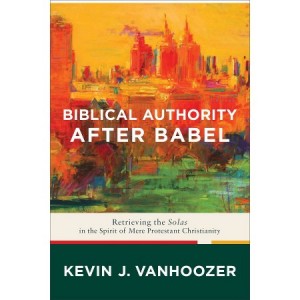
I have been very slowly—due to the aforementioned holiday season travels, as well as reading through about four other books—working my way through Kevin Vanhoozer’s latest book, Biblical Authority After Babel. I am about halfway through it and so far it has been very, very good. Vanhoozer’s larger project in the book is to retrieve the five, historically-rooted, Reformation solas (sola scriptura, sola fide, sola gratia, solus Christus, soli Deo Gloria) as a pattern of theological authority for what he terms “mere Protestantism.” Vanhoozer has heard the critiques of a subjective and naive biblicism among many American evangelicals from Catholic thinkers like Christian Smith in his The Bible Made Impossible and he agrees that this is a problem (Vanhoozer even wrote a blurb for Smith’s book). What Vanhoozer disagrees with is the need to turn to either a magisterium (as in the Roman Catholic Church) or to an aimless, relativistic hyper-subjectivism when it comes to the principal of theological authority for Christians.
Rather, Vanhoozer believes that supreme authority rests in the economy of grace of the Triune God. Sola gratia (grace alone) grounds us first and foremost in the fact that God’s self-revelation and redemption in Christ is an incongruous gift. As Vanhoozer notes, “Sola gratia is a permanent reminder that at the heart of Christianity is good news—the story of what the Triune God is doing in Jesus Christ” (p. 64). This is followed by sola fide (faith alone), the epistemic and volitional means by which such a gift and grounding of all theological authority is appropriated by Christians.
Contrary to many caricatures of the Reformers (particularly Luther), sola fide was not intended to fuel a sort-of “blank check mentality” toward religious authority in conjunction with sola scriptura. Rather, it was always meant to be rooted in both the authoritative apostolic testimony of the eyewitnesses to the risen Jesus, and in the larger interpretive context of the whole church:
“Faith alone” means that individual interpreters had best attend to the authoritative apostolic community (the primary fiduciary framework) as read in the context of the church (a secondary fiduciary framework). The church is not like other interpretive communities. Its reading must not be a function of this or that interpretive interest; the church must not “use” the text for its own purposes. For the church is a “creature of the Word”—an interpretive community that exists not to have its way with the text but to let the Word have its way with the interpreters. John Webster rightly states, “The reading of Holy Scripture is thus a field of divine activity; it is not simply human handling of a textual object. And that divine activity is God’s speech to which we are, quite simply, to attend.” (p. 102; Vanhoozer’s quote of John Webster is from Word and Church: Essays in Christian Dogmatics [Edinburgh: T&T Clark, 2001], p. 93)
Vanhoozer thus puts forward that the supreme authority principle in Christian theology and life is the Triune God and His triune economy of grace, which naturally includes Scripture as the chief, post-resurrection and post-apostolic means of His revelatory speak-acting:
The authority principle of mere Protestant Christianity is the say-so of the Triune God, a speak-acting that authorizes the created order and authors the Scriptures, diverse testimonies that make known the created order as it has come to be and to be restored in, through, and for Jesus Christ (p. 104)
Indeed, Vanhoozer affirms that, properly construed, both sola gratia and sola fide are to be understood chiefly within the context of the church as interpretive community and with a critical-realist epistemological framework that navigates between the Scylla of absolute objectivity and the Charybdis of subjective relativism:
Mere Protestant Christians believe that faith enables a way of interpreting Scripture that refuses both absolute certainty (idols of the tower) and relativistic skepticism (idols of the maze). . . . sola fide is the answer to skepticism, for faith yields knowledge but is not a “work.” Faith is, rather, perseveringly confident, patiently attentive, and properly basic¹— a warranted epistemic trust in biblical testimony. . . . True faith has to do not with an anti-intellectual fideism or private judgment, then, but rather with testimonial rationality and public trust, the trust of God’s people in the testimony of God’s Spirit to the reliability of God’s Word (pp. 105-07).
¹Vanhoozer footnotes here: “[Alvin] Plantinga’s term for a belief that does not need to be justified or inferred from any other belief in order to be deemed rational ([Plantinga], Warranted Christian Belief, 175-79).”
Like I said, the book is proving to be excellent so far, and I hope to interact with it a bit more in the future. Time-permitting I may even try and write a review of it.
Previous Post

January 2, 2017
Silence, Suffering, and Redemption
Next Post
January 12, 2017 Scot McKnight and The Reality of Angelic Beings
Browse Our Archives
Select a Category Uncategorized
Select a Month July 2019 April 2019 January 2019 December 2018 November 2018 October 2018 September 2018 August 2018 July 2018 June 2018 May 2018 April 2018 March 2018 February 2018 January 2018 December 2017 November 2017 October 2017 September 2017 August 2017 July 2017 June 2017 May 2017 April 2017 March 2017 February 2017 January 2017 December 2016
Follow Us!
TAKE THE
Religious Wisdom Quiz
What meal did the Israelites eat before leaving Egypt?
Select your answer to see how you score.
Firstfruits Passover Feast of Booths Day of Atonement meal
Related posts from The Christian Revolution


A Post After Some Time Away....And a Big...

The Christian Response to Nation-States

TRENDING AT PATHEOS Evangelical

The REST of Your Life: A Creative Wrestles...
This week I had a conversation with a good friend from church....

How the author of the world's best hymn...
I've been working with John Newton for a while now. This makes...

Long before this Lectio Divina, Psalm 130 - the song - started...

What About the Trees? Another Living Parable
After I finished writing the last article about falling leaves as a...

Why Classical Education Is a Conversation, Not a...
Come and Read: Joy in Classical Education When I was a little...

Cornell University has received a great deal of negative publicity and intense...
view all Evangelical blogs
Ad-Free & Subscriber Log-In Subscription Support
- About Us
- 2026 Calendar
- Videos
- Podcasts
- Library of World Religions
- Faith In Media Tracker
- Advertise With Us
- Write for Us
- Privacy Policy
- Terms of Service
- Do Not Sell My Data
- Contact Us
- Radiant Digital
- Manage Newsletter Subscriptions
- Unsubscribe From Notifications
- Sitemap
Copyright 2008-2026, Patheos. All rights reserved.
Subscription Support Ad-Free & Subscriber Log-In
Follow Patheos