
BuddhistCatholicContemplativeEvangelicalGeneral ChristianHinduJewishLatter-day SaintMuslimNew VisionsProgressive Christian
Beliefs
- Buddhist
- Catholic
- Contemplative
- Evangelical
- General Christian
- Hindu
- Jewish
- Latter-day Saint
- More Voices
- Muslim
- New Visions
- Pagan
- Progressive Christian
Topics
- Religion News
- Food and Religion
- Sports and Religion
- Religious Art
- Religious Music and Entertainment
- Religious Events
- History and Religion
- Style and Religion
- Politics and Religion
- Women in Religion
- Recreation Outdoors and Religion
- Business Finance and Religion
- Careers Workplace and Religion
- Education and Religion
- Family Parenting and Religion
- Health Fitness and Religion
- Home and Religion
- Relationships and Religion
- Technology and Religion
- Travel and Religion
Columnists
- Buddhist Columnists
- Business Finance and Religion Columnists
- Careers Workplace and Religion Columnists
- Catholic Columnists
- Contemplative Columnists
- Education and Religion Columnists
- Evangelists Columnists
- Family Parenting and Religion Columnists
- General Christian Columnists
- Health Fitness and Religion Columnists
- Hindu Columnists
- History and Religion Columnists
- Home and Religion Columnists
- Jewish Columnists
- More Voices Columnists
- Latter Day Columnists
- Muslim Columnists
- New Visions Columnists
- Nonreligious Columnists
- Pagan Columnists
- Politics and Religion Columnists
- Progressive Columnists
- Recreation Outdoors and Religion Columnists
- Relationships and Religion Columnists
- Religion News Columnists
- Religious Art Columnists
- Religious Events Columnists
- Religious Music and Entertainment Columnists
- Sports and Religion Columnists
- Style and Religion Columnists
- Technology and Religion Columnists
- Travel and Religion Columnists
- Women in Religion Columnists
Resource Library
- 2026 Calendar
- Library of World Religions
- The 100 Most Holy Places on Earth
- Patheos Answers
- Podcasts
- Videos
- Faith Leaders Database
- Anglican Episcopalian
- Bahai
- Baptist
- Buddhism
- Christianity
- Confucianism
- Eastern Orthodoxy
- Hinduism
- Holiness and Pentecostal
- ISKCON
- Islam
- Judaism
- Lutheran
- Methodist
- The Church of Jesus Christ of Latter-day Saints
- New Age
- Paganism
- Presbytarian and Reformed
- Protestantism
- Religion Behind the Scenes
- Roman Catholic
- Scientology
- Shia Islam
- Sikhism
- Sufism
- Sunni Islam
- Taoism
- Zen
- See all religions
Research Tools
 Ad-Free & Subscriber Log-In Subscription Support
Ad-Free & Subscriber Log-In Subscription Support
Follow Patheos 

- Trending:
- Forgiveness
- |
- Marriage
- |
- Consciousness
- |
- Death Penalty
- |
- Election
- |
- Halloween
 The Christian Revolution
- Home
- Evangelical
- Fleming Rutledge on Divine, Cruciform Justice
Fleming Rutledge on Divine, Cruciform Justice
Last updated on: January 27, 2017 at 1:37 pm by Taylor S. Brown
Fleming Rutledge on Divine, Cruciform Justice 2017-01-27T13:37:41-06:00 Taylor S. Brown
Patheos Explore the world's faith through different perspectives on religion and spirituality! Patheos has the views of the prevalent religions and spiritualities of the world.
In between papers and readings for a January-term intensive class, I’ve been slowly working my way through Fleming Rutledge’s mammoth book The Crucifixion: Understanding the Death of Jesus Christ (Eerdmans, 2015). Arguably Rutledge’s magnum opus, this book has received extremely high critical praise over the last year (it came out near the end of 2015). It even won the coveted “Book of the Year Award” from Christianity Today.
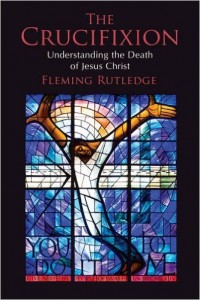
I’m only about 150 pages in, but so far it is living up to the hype. One of the greatest things that Rutledge does (at least so far) in the book is bring readers back to the core reasons why the crucifixion was necessary. Indeed, she shows why—contrary to many popular neo-Abelardian and Girardian atonement theories (if you don’t know what those are, don’t worry about it)—the substitutionary death of Christ was necessary to rectify the problem of Sin (Rutledge, consciously writing within the Barthian/Apocalyptic tradition, capitalizes the “s” in Sin to illustrate its reality as a power that has enslaved the world) and bring humanity into right relationality with God.
It has become popular in many modern and post-modern theological circles to shy away from speaking of the substitutionary nature of Christ’s crucifixion. Rutledge, thankfully, does not shy away though. She is adamant in saying that we as Christians must hold together the realities of divine justice and divine redemption that are manifested in Christ’s cross. Indeed, Rutledge sounds the necessary call to reclaim the proper understanding of divine wrath:
“The biblical message is that the outrage [about the evils and injustices of the world] is first of all in the heart of God. If we are resistant to the idea of the wrath of God, we might pause to reflect the next time we are outraged about something — about our property values being threatened, or our children’s educational opportunities being limited, or our tax breaks being eliminated. All of us are capable of anger about something. God’s anger, however, is pure. It does not have the maintenance of privilege as its object, but goes out on behalf of those who have no privileges. The wrath of God is not an emotion that flares up from time to time, as though God had temper tantrums; it is away of describing his absolute enmity against all wrong and his coming to set matters right.” (pp. 129-30)
In reclaiming the classical concepts of divine wrath and justice, Rutledge calls her readers to a more full-orbed view of Christ’s cruciform atonement. Indeed, the atonement is supreme forgiveness, but not a forgiveness that excludes righting the wrongs and evils that have been wrought upon God’s good world:
“The New Testament scholar Reginald Fuller wrote that ‘forgiveness is too weak a word’ to embrace the full scope of what Christ has done and what he calls us to. How can we begin to speak even of forgiveness, let alone transformation, in the worst of the worst situations? The extermination of millions does not cry out for forgiveness. Never mind millions; what about just one baby burned up in a microwave oven by its own father? ‘After such knowledge, what forgiveness?’ [T. S. Eliot, ‘Gerontion]. Forgiveness is not enough. There must be justice too. . . Forgiveness is not enough. Something is wrong and must be made right. Miroslav Volf concurs: ‘The cross is not forgiveness pure and simple, but God’s setting aright the world of injustice and deception” … “The incarnation of the Son of God should not be understood as the divine benediction on all that is. It was an incarnation unto the cross, and therefore an incarnation that sets a question mark over against the way things are. . . The Messiah came, not to a purified and enlightened world spiritually prepared for his arrival, but rather to a humanity no nearer to its original goodness than on the day Cain murdered his brother Abel. Indeed, the barbarity of crucifixion reveals precisely that diagnosis. From beginning to end, the Holy Scriptures testify that the predicament of fallen humanity is so serious, so grave, so irremediable from within, that nothing short of divine intervention can rectify it.” (pp. 126-27)
Rutledge’s book, and the vision of a classical, full-orbed view of the Christ’s atoning death that she puts forward, is a Godsend in the world we live in. Increasingly, we look around at a world that seems to cry out for justice and the rectification of horrendous evils. The horror that we so often refuse to admit though, is that each and every one of us has perpetrated or contributed to such injustices. We look out in the wake of our disillusionment with both modernity and post-modernity—at unborn lives being snuffed out, at refugees being denied safety, at our leaders seeking to use torture and so become like the enemies we fight—and we cry “Something is desperately wrong in our world, something that we, despite our best efforts, cannot set right.”
What Fleming Rutledge calls us to in her book is a reminder of our powerlessness against Sin. On our own, we cannot fix the problems in our own hearts, let alone the systemic problems of the world. It is only by the power of God that the world can be ultimately set right. What Rutledge reminds us is that this divine rectification looks like a crucifixion and a resurrection.
Previous Post

January 24, 2017
Reflecting on the Women's March and Pro-Choice Rhetoric
Next Post

January 31, 2017 The Political Idolatry of Eric Metaxas
Browse Our Archives
Select a Category Uncategorized
Select a Month July 2019 April 2019 January 2019 December 2018 November 2018 October 2018 September 2018 August 2018 July 2018 June 2018 May 2018 April 2018 March 2018 February 2018 January 2018 December 2017 November 2017 October 2017 September 2017 August 2017 July 2017 June 2017 May 2017 April 2017 March 2017 February 2017 January 2017 December 2016
Follow Us!
TAKE THE
Religious Wisdom Quiz
What did God put in the sky as a sign of His promise to Noah?
Select your answer to see how you score.
A rainbow A dove A cloud A star
Related posts from The Christian Revolution


A Post After Some Time Away....And a Big...

The Christian Response to Nation-States

TRENDING AT PATHEOS Evangelical

The REST of Your Life: A Creative Wrestles...
This week I had a conversation with a good friend from church....

How the author of the world's best hymn...
I've been working with John Newton for a while now. This makes...

Long before this Lectio Divina, Psalm 130 - the song - started...

What About the Trees? Another Living Parable
After I finished writing the last article about falling leaves as a...

Why Classical Education Is a Conversation, Not a...
Come and Read: Joy in Classical Education When I was a little...

Cornell University has received a great deal of negative publicity and intense...
view all Evangelical blogs
Ad-Free & Subscriber Log-In Subscription Support
- About Us
- 2026 Calendar
- Videos
- Podcasts
- Library of World Religions
- Faith In Media Tracker
- Advertise With Us
- Write for Us
- Privacy Policy
- Terms of Service
- Do Not Sell My Data
- Contact Us
- Radiant Digital
- Manage Newsletter Subscriptions
- Unsubscribe From Notifications
- Sitemap
Copyright 2008-2026, Patheos. All rights reserved.
Subscription Support Ad-Free & Subscriber Log-In
Follow Patheos