
BuddhistCatholicContemplativeEvangelicalGeneral ChristianHinduJewishLatter-day SaintMuslimNew VisionsProgressive Christian
Beliefs
- Buddhist
- Catholic
- Contemplative
- Evangelical
- General Christian
- Hindu
- Jewish
- Latter-day Saint
- More Voices
- Muslim
- New Visions
- Pagan
- Progressive Christian
Topics
- Religion News
- Food and Religion
- Sports and Religion
- Religious Art
- Religious Music and Entertainment
- Religious Events
- History and Religion
- Style and Religion
- Politics and Religion
- Women in Religion
- Recreation Outdoors and Religion
- Business Finance and Religion
- Careers Workplace and Religion
- Education and Religion
- Family Parenting and Religion
- Health Fitness and Religion
- Home and Religion
- Relationships and Religion
- Technology and Religion
- Travel and Religion
Columnists
- Buddhist Columnists
- Business Finance and Religion Columnists
- Careers Workplace and Religion Columnists
- Catholic Columnists
- Contemplative Columnists
- Education and Religion Columnists
- Evangelists Columnists
- Family Parenting and Religion Columnists
- General Christian Columnists
- Health Fitness and Religion Columnists
- Hindu Columnists
- History and Religion Columnists
- Home and Religion Columnists
- Jewish Columnists
- More Voices Columnists
- Latter Day Columnists
- Muslim Columnists
- New Visions Columnists
- Nonreligious Columnists
- Pagan Columnists
- Politics and Religion Columnists
- Progressive Columnists
- Recreation Outdoors and Religion Columnists
- Relationships and Religion Columnists
- Religion News Columnists
- Religious Art Columnists
- Religious Events Columnists
- Religious Music and Entertainment Columnists
- Sports and Religion Columnists
- Style and Religion Columnists
- Technology and Religion Columnists
- Travel and Religion Columnists
- Women in Religion Columnists
Resource Library
- 2026 Calendar
- Library of World Religions
- The 100 Most Holy Places on Earth
- Patheos Answers
- Podcasts
- Videos
- Faith Leaders Database
- Anglican Episcopalian
- Bahai
- Baptist
- Buddhism
- Christianity
- Confucianism
- Eastern Orthodoxy
- Hinduism
- Holiness and Pentecostal
- ISKCON
- Islam
- Judaism
- Lutheran
- Methodist
- The Church of Jesus Christ of Latter-day Saints
- New Age
- Paganism
- Presbytarian and Reformed
- Protestantism
- Religion Behind the Scenes
- Roman Catholic
- Scientology
- Shia Islam
- Sikhism
- Sufism
- Sunni Islam
- Taoism
- Zen
- See all religions
Research Tools
 Ad-Free & Subscriber Log-In Subscription Support
Ad-Free & Subscriber Log-In Subscription Support
Follow Patheos 

- Trending:
- Forgiveness
- |
- Marriage
- |
- Consciousness
- |
- Death Penalty
- |
- Election
- |
- Halloween
 The Christian Revolution
- Home
- Evangelical
- Reading Vanhoozer on “Mere Protestantism”
Reading Vanhoozer on “Mere Protestantism”
Last updated on: December 20, 2016 at 10:00 pm by Taylor S. Brown
Reading Vanhoozer on “Mere Protestantism” 2016-12-20T22:00:14-06:00 Taylor S. Brown
Patheos Explore the world's faith through different perspectives on religion and spirituality! Patheos has the views of the prevalent religions and spiritualities of the world.
I am still alive! Thanks to finals and road-tripping from Kentucky to Oklahoma, I haven’t been able to post anything since last Monday. But I’m back now and am hitting the ground running.
I’ve just started reading Kevin Vanhoozer’s recent book, Biblical Authority After Babel: Retrieving the Solas in the Spirit of Mere Protestant Christianity (Brazos, 2016). I’ve only read through the introduction so far, but Vanhoozer has already put forward some fascinating analysis and proposals.
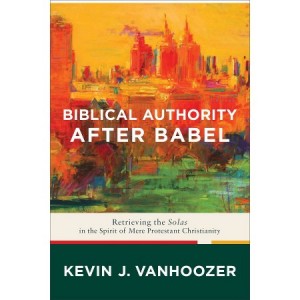
The overall purpose of the book is to argue for a theological retrieval of what Vanhoozer calls “mere Protestant Christianity.” This framework is one encapsulated by the five solas of the Reformation: sola scriptura (Scripture alone), sola fide (faith alone), sola gratia (grace alone), solus Christus (Christ alone), soli Deo Gloria (glory to God alone). This encapsulation is meant to allow for an overarching theological unity within diversity. As Vanhoozer states it:
…I make so bold as to suggest that the solas, taken together, represent what we might call the first theology of mere Protestant Christianity. The solas are not isolated doctrines; they are theological insights into the ontology, epistemology, and teleology of the gospel. The solas are not a substitute for creedal orthodoxy but its servants. The solas do not develop the doctrine of the Trinity but presuppose it. Indeed, their special function is to preserve the integrity of the triune economies of revelation and redemption. As such, they are guides to theological judgment that both generate and govern mere Protestant theology. They also provide resources with which to respond to the charge that the Reformation unintentionally loosed interpretive anarchy upon the world. (p. 28; emphasis in original)
In conjunction with this retrieval of the Reformation solas, Vanhoozer argues for a retrieval and re-emphasis of the key Protestant emphasis on the royal priesthood of all believers. Vanhoozer believes that a proper understanding of the royal priesthood of all believers can effectively reinstitute a pattern of ecclesial authority in the larger project of Protestant Christianity. Vanhoozer even states that this retrieval and re-emphasis takes on the weight of a virtual sixth sola:
I will therefore speak of the “royal priesthood of all believers” to signal my intent to retrieve not only the principle of authority (the Triune God speaking in the Scriptures) but also the pattern of authority, which is to say the pattern of interpretive authority, an economy that identifies Jesus Christ alone as king, but accords pride of interpretive place to his royal priesthood…to put it more provocatively: in retrieving the royal priesthood of all believers, I am pursuing what amounts to a virtual sixth sola: sola ecclesia (church alone). (p. 29)
In addition to these major emphases, Vanhoozer (quite rightly) states that a robust “mere Protestantism” must be teleologically oriented toward a broader, catholicity. This does not mean a monolithic unity, but rather a diversity-in-unity. Vanhoozer again:
Catholicity is the final principle of the Reformation insofar as it regulates the process of biblical interpretation and the end toward which it tends, not the monological institutional unity of Rome but a dialogical or “plural” unity. Catholicity is an “Ephesian moment”—Andrew Walls’s term for that quintessentially evangelical moment when churches take a step toward and even greater realization of the unity of the body Christ…Catholicity is not chaos, however. It is the standing challenge for the church to display its unity in Christ despite differences…Mere Protestant Christianity is catholic Christianity inflected by the Reformation. (pp. 30-31)
All of these combine within Vanhoozer’s proposed project to present a “mere Protestantism” that is rooted far more in creedal orthodoxy and catholic unity-in-diversity than what is often seen within American Evangelicalism’s often fragmented makeup. As Vanhoozer puts it
The kind of Protestantism that needs to live on is not the one that encourages individual autonomy or corporate pride but the one that encourages the church to hold fast to the gospel, and to one another. The only good Protestant is a catholic Protestant—one who learns from, and bears fruit for, the whole church. (p. 33)
I’m looking forward to working my way through Vanhoozer’s work and seeing how he constructs this retrieval project of a “mere Protestant Christianity.”
Previous Post
December 13, 2016
Christian "Atheists"
Next Post

December 24, 2016 The Baby Who Turned The World Upside Down
Browse Our Archives
Select a Category Uncategorized
Select a Month July 2019 April 2019 January 2019 December 2018 November 2018 October 2018 September 2018 August 2018 July 2018 June 2018 May 2018 April 2018 March 2018 February 2018 January 2018 December 2017 November 2017 October 2017 September 2017 August 2017 July 2017 June 2017 May 2017 April 2017 March 2017 February 2017 January 2017 December 2016
Follow Us!
TAKE THE
Religious Wisdom Quiz
What kind of animal swallowed Jonah?
Select your answer to see how you score.
A serpent A great fish A lion A camel
Related posts from The Christian Revolution


A Post After Some Time Away....And a Big...

The Christian Response to Nation-States

TRENDING AT PATHEOS Evangelical

The REST of Your Life: A Creative Wrestles...
This week I had a conversation with a good friend from church....

How the author of the world's best hymn...
I've been working with John Newton for a while now. This makes...

Long before this Lectio Divina, Psalm 130 - the song - started...

What About the Trees? Another Living Parable
After I finished writing the last article about falling leaves as a...

Why Classical Education Is a Conversation, Not a...
Come and Read: Joy in Classical Education When I was a little...

Cornell University has received a great deal of negative publicity and intense...
view all Evangelical blogs
Ad-Free & Subscriber Log-In Subscription Support
- About Us
- 2026 Calendar
- Videos
- Podcasts
- Library of World Religions
- Faith In Media Tracker
- Advertise With Us
- Write for Us
- Privacy Policy
- Terms of Service
- Do Not Sell My Data
- Contact Us
- Radiant Digital
- Manage Newsletter Subscriptions
- Unsubscribe From Notifications
- Sitemap
Copyright 2008-2026, Patheos. All rights reserved.
Subscription Support Ad-Free & Subscriber Log-In
Follow Patheos