
BuddhistCatholicContemplativeEvangelicalGeneral ChristianHinduJewishLatter-day SaintMuslimNew VisionsProgressive Christian
Beliefs
- Buddhist
- Catholic
- Contemplative
- Evangelical
- General Christian
- Hindu
- Jewish
- Latter-day Saint
- More Voices
- Muslim
- New Visions
- Pagan
- Progressive Christian
Topics
- Religion News
- Food and Religion
- Sports and Religion
- Religious Art
- Religious Music and Entertainment
- Religious Events
- History and Religion
- Style and Religion
- Politics and Religion
- Women in Religion
- Recreation Outdoors and Religion
- Business Finance and Religion
- Careers Workplace and Religion
- Education and Religion
- Family Parenting and Religion
- Health Fitness and Religion
- Home and Religion
- Relationships and Religion
- Technology and Religion
- Travel and Religion
Columnists
- Buddhist Columnists
- Business Finance and Religion Columnists
- Careers Workplace and Religion Columnists
- Catholic Columnists
- Contemplative Columnists
- Education and Religion Columnists
- Evangelists Columnists
- Family Parenting and Religion Columnists
- General Christian Columnists
- Health Fitness and Religion Columnists
- Hindu Columnists
- History and Religion Columnists
- Home and Religion Columnists
- Jewish Columnists
- More Voices Columnists
- Latter Day Columnists
- Muslim Columnists
- New Visions Columnists
- Nonreligious Columnists
- Pagan Columnists
- Politics and Religion Columnists
- Progressive Columnists
- Recreation Outdoors and Religion Columnists
- Relationships and Religion Columnists
- Religion News Columnists
- Religious Art Columnists
- Religious Events Columnists
- Religious Music and Entertainment Columnists
- Sports and Religion Columnists
- Style and Religion Columnists
- Technology and Religion Columnists
- Travel and Religion Columnists
- Women in Religion Columnists
Resource Library
- 2026 Calendar
- Library of World Religions
- The 100 Most Holy Places on Earth
- Patheos Answers
- Podcasts
- Videos
- Faith Leaders Database
- Anglican Episcopalian
- Bahai
- Baptist
- Buddhism
- Christianity
- Confucianism
- Eastern Orthodoxy
- Hinduism
- Holiness and Pentecostal
- ISKCON
- Islam
- Judaism
- Lutheran
- Methodist
- The Church of Jesus Christ of Latter-day Saints
- New Age
- Paganism
- Presbytarian and Reformed
- Protestantism
- Religion Behind the Scenes
- Roman Catholic
- Scientology
- Shia Islam
- Sikhism
- Sufism
- Sunni Islam
- Taoism
- Zen
- See all religions
Research Tools
 Ad-Free & Subscriber Log-In Subscription Support
Ad-Free & Subscriber Log-In Subscription Support
Follow Patheos 

- Trending:
- Forgiveness
- |
- Marriage
- |
- Consciousness
- |
- Death Penalty
- |
- Election
- |
- Halloween
 The Catholic Working Mother
- Home
- Catholic
- What Is the Reason for the Advent Season?
What Is the Reason for the Advent Season?
Last updated on: December 1, 2018 at 7:00 am by JoAnna Wahlund
What Is the Reason for the Advent Season? 2018-11-30T13:46:52-08:00 JoAnna Wahlund
Patheos Explore the world's faith through different perspectives on religion and spirituality! Patheos has the views of the prevalent religions and spiritualities of the world.
This is a guest post by Laurel Whitworth at Aquinas and More.
It’s drawing nearer, that time when we climb up to our dusty attics and seek out stacks of repurposed moving boxes marked “Christmas.” Out come the wreaths and garlands, the endless strings of tangled lights, the plastic lawn ornaments and light-up deer, and maybe even an occasional inflatable Grinch. If you’re lucky, among the tinsel and baubles, you’ll find a beautiful Advent calendar. Beyond the chocolate-a-day tradition, what is Advent? Why do we celebrate this particular season? And where did the tradition of the Advent calendar come from?
Advent: The Meaning of the Word
The word “advent” literally means “the arrival of a notable person, thing, or event.” Advent—which spans most of December—is a time of waiting and preparation for the second coming of Christ. This waiting is observed from three different perspectives. The first is the coming of Christ in the flesh at the Nativity. The second is his arrival in our hearts. The third is his arrival in glory at the end of time. Advent is a time when the devout openly share in the longing for the Second Coming.
When Advent Began
It’s unclear when Advent first began, though it’s believed that it’s been in existence since about 480. Records indicate that monks were ordered to fast every day in December around 567, though some say Saint Peter founded it. That said, it’s impossible to place an exact date of when the tradition was established. Some sources indicate that Advent was started by Bishop Perpetuus in the fifth century, beginning with the feast of Saint Martin. Therefore, Advent is also known as Lent of Saint Martin. In the fifth and sixth centuries, starting on November 11th, worshippers would fast three times per week until the coming of Christmas. In 581, France adopted the practice, and some of the most pious of believers went above and beyond the three-day-per-week requirement and fasted every day of Advent.
What Is the Difference Between Advent and Lent?
The early practices of Advent and Lent are so similar that it’s hard to differentiate between the two. Because early Advent tradition included fasting and was referred to as the Lent of Saint Martin, the Second Vatican Council emphasized the differences in the spirit of both traditions in 1963, noting that Advent is a season of the hope of Christ’s Second Coming.
The Wreath
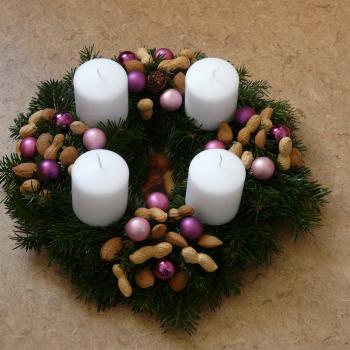
There are a handful of observed traditions during the Advent season, from liturgical colors to music and decorations. As a matter of fact, one of our most common Christmas decorations originates from the Advent season. The Advent wreath was a concept originated by 16th Century German Lutherans, but it took nearly three centuries for the modern Advent wreath to come about. The Advent wreath we know today is surrounded by candles which represent each celebrated Sunday of the season. German Pastor Johann Hinrich Wichern is behind the concept when, in 1839, he proposed that the lighting of wreath candles would teach children patience as they eagerly awaited the coming of Christmas.
The wreath is traditionally made of fir branches dotted with pine cones, laurel, holly, and mistletoe, and decorated with a red ribbon. The shape of the wreath, like that of a crown, represents victory. The four candles along the outside of the wreath represent the four Sundays before Christmas, the four cardinal virtues—prudence, justice, temperance, and fortitude, as well as the four seasons of the year. The fir tree symbolizes strength, and its green color represents hope. Laurel is a sign of victory over sin, and, because neither it nor holly drops its leaves, this represents the eternity of God. In early days, the Advent wreath was kept on a table in the center of the house for all to enjoy, and many households still uphold this tradition.
Liturgical Colors
Violet is the traditional liturgical color of Advent, though some Christian denominations use blue. Gaudete Sunday is the third Sunday of Advent, so called because “gaudete” is the Latin word for “rejoice.” On this day, purple, which is also the color for penance, is replaced by rose. Rose is a color representing joy, and it takes precedent over purple when the otherwise somber mood of Advent is overridden by the joyous anticipation of the Lord’s Second Coming.
The Four Sundays
Each Sunday of Advent represents a different theme. The first, known as Advent Sunday, represents the anticipation of the Second Coming. The Second Sunday recalls the teachings of John the Baptist, who speaks of preparing the way of the Lord. The Third Sunday, Gaudete Sunday, represents the joy of the second coming of Christ. The Fourth Sunday involves readings of Mary and Joseph and the birth of Jesus. Sundays during Advent should not be given to fasting, but instead to celebration, because we celebrate the resurrection of Our Lord each Sunday.
The Advent Calendar
The Advent calendar was introduced in the 19th and 20th centuries by German Lutherans and has now become a beloved tradition of the Christmas season. The calendar is used to count down the days until Christmas and traditionally features a manger scene and, sometimes, Saint Nicholas. Calendars take many forms, from traditional to modern, but the most popular ones feature small doors—one for each day of December up until Christmas Day. The cubbies behind these doors hold a small gift—either a trinket or a candy. This, like the lighting of the four Advent wreath candles, both satisfies and heightens the anticipation of children awaiting the coming of Christmas morning.
Celebrating Around the World
The most popular way to celebrate Advent is by both lighting wreath candles each Sunday as well as keeping an Advent calendar at home, but there are a few lesser-known traditions as well. In Italy, bagpipe players play in front of the shrines of Mary during the last days of Advent. It’s traditionally believed shepherds played bagpipes at the manger in Bethlehem, paying homage to baby Jesus.
No longer observed for obvious reasons, in Normandy farmers would send children running through the fields while wielding torches. Kids would set fire to piles of straw to drive out vermin, representative of driving out sin from worshippers’ hearts. In England, the custom was for the poor women of the region to carry around dolls representing both Jesus and Mary. Anyone who witnessed them was required to give the women a halfpenny. If they refused, it was said that bad luck would fall upon the household.
Most recently, the residents of Frankfurt, Germany adopted the tradition of creating an Advent labyrinth of 2,500 tea lights on the third Saturday of Advent. This sparkling labyrinth of fire is said to represent the journey of the wise men in search of the manger and Savior of the world by following the light of the stars.
Does your family have any special Advent traditions? Share your stories in the comments!
Image Credit: IMG_0220 by Alex Harden shared under the Creative Commons Attribution 2.0 Generic (CC BY 2.0) license.

About Laurel Whitworth
Laurel Whitworth is married to David and is a mom to four little people. She is the VP of Merchandise for Aquinas & More as well as the manager of all things family life. She and her family are enjoying their new life in Colorado with many trips into the mountains and forging new friendships in church and school. Laurel dreams of a world where all baptized Catholics rise up and follow their faith in every aspect of life. You can read more about the author here.
Previous Post

November 30, 2018
It Really Does Take a Village
Next Post

December 6, 2018 Book Review and Giveaway: "Lovely" by Amanda Martinez Beck
Browse Our Archives
Select a Category Abortion Abuse Scandal Advent Book News Book Reviews Catholic Teaching Catholic Witness Chesterton Christmas Commuting Cooking Cosplay CWM Profiles Daycare Family Gender at Work Giveaways Good Friday History Household Management Humor Instant Pot Life as a Catholic Working Mother Marriage and Family Maternity Leave Meal Planning Media Recommendations Miscarriage NFP Politics Pregnancy Pro-Life Pro-Life Pumping Racism Religious Education Reluctantly Working Rules and Regulations Sacraments Saints Scams TV Show Review Uncategorized Vocation Working for the Church
Select a Month January 2020 November 2019 October 2019 September 2019 August 2019 July 2019 June 2019 May 2019 April 2019 March 2019 February 2019 January 2019 December 2018 November 2018 October 2018 September 2018 August 2018 July 2018 June 2018 May 2018 April 2018 March 2018 February 2018 January 2018 November 2017 October 2017 July 2017 May 2017 April 2017 March 2017 October 2016 May 2016 April 2016 February 2016 December 2015 November 2015 September 2015 August 2015 July 2015 June 2015 May 2015 April 2015
Follow Us!
TAKE THE
Religious Wisdom Quiz
Which tribe first accepted David as king after Saul's death?
Select your answer to see how you score.
Judah Dan Ephraim Benjamin
Related posts from The Catholic Working Mother
Easy Advent Resources for Busy Moms

Book Review: Peggy Weber's "Enough as You Are"

An Update, and Some Exciting News!
What Does the Roman Catechism Teach about Working...
TRENDING AT PATHEOS Catholic

The Parable Of The Sower And The Word...
One of Christ’s most famous parables is that of the sower who...

Rejecting Doom: Christian Hope And Human Action
Christianity is a religion of hope. We are to have hope and...

Why I Choose the Eucharist Over the Sermon
Choose the Eucharist, Not the Sermon What are we supposed to get...

5 Design Elements Found in Spiritually Rooted Homes
Putting Spirituality Into Home Decor Our homes are more than our living...

Credo: A Story of God Told with the...
About 10 years ago, I began to imagine a personal "Credo" that...

The Anatomy of Divine Revelation in Catholic Thought
The claim that God has made Himself known to human beings is...
view all Catholic blogs
Ad-Free & Subscriber Log-In Subscription Support
- About Us
- 2026 Calendar
- Videos
- Podcasts
- Library of World Religions
- Faith In Media Tracker
- Advertise With Us
- Write for Us
- Privacy Policy
- Terms of Service
- Do Not Sell My Data
- Contact Us
- Radiant Digital
- Manage Newsletter Subscriptions
- Unsubscribe From Notifications
- Sitemap
Copyright 2008-2026, Patheos. All rights reserved.
Subscription Support Ad-Free & Subscriber Log-In
Follow Patheos