
BuddhistCatholicContemplativeEvangelicalGeneral ChristianHinduJewishLatter-day SaintMuslimNew VisionsProgressive Christian
Beliefs
- Buddhist
- Catholic
- Contemplative
- Evangelical
- General Christian
- Hindu
- Jewish
- Latter-day Saint
- More Voices
- Muslim
- New Visions
- Pagan
- Progressive Christian
Topics
- Religion News
- Food and Religion
- Sports and Religion
- Religious Art
- Religious Music and Entertainment
- Religious Events
- History and Religion
- Style and Religion
- Politics and Religion
- Women in Religion
- Recreation Outdoors and Religion
- Business Finance and Religion
- Careers Workplace and Religion
- Education and Religion
- Family Parenting and Religion
- Health Fitness and Religion
- Home and Religion
- Relationships and Religion
- Technology and Religion
- Travel and Religion
Columnists
- Buddhist Columnists
- Business Finance and Religion Columnists
- Careers Workplace and Religion Columnists
- Catholic Columnists
- Contemplative Columnists
- Education and Religion Columnists
- Evangelists Columnists
- Family Parenting and Religion Columnists
- General Christian Columnists
- Health Fitness and Religion Columnists
- Hindu Columnists
- History and Religion Columnists
- Home and Religion Columnists
- Jewish Columnists
- More Voices Columnists
- Latter Day Columnists
- Muslim Columnists
- New Visions Columnists
- Nonreligious Columnists
- Pagan Columnists
- Politics and Religion Columnists
- Progressive Columnists
- Recreation Outdoors and Religion Columnists
- Relationships and Religion Columnists
- Religion News Columnists
- Religious Art Columnists
- Religious Events Columnists
- Religious Music and Entertainment Columnists
- Sports and Religion Columnists
- Style and Religion Columnists
- Technology and Religion Columnists
- Travel and Religion Columnists
- Women in Religion Columnists
Resource Library
- 2026 Calendar
- Library of World Religions
- The 100 Most Holy Places on Earth
- Patheos Answers
- Podcasts
- Videos
- Faith Leaders Database
- Anglican Episcopalian
- Bahai
- Baptist
- Buddhism
- Christianity
- Confucianism
- Eastern Orthodoxy
- Hinduism
- Holiness and Pentecostal
- ISKCON
- Islam
- Judaism
- Lutheran
- Methodist
- The Church of Jesus Christ of Latter-day Saints
- New Age
- Paganism
- Presbytarian and Reformed
- Protestantism
- Religion Behind the Scenes
- Roman Catholic
- Scientology
- Shia Islam
- Sikhism
- Sufism
- Sunni Islam
- Taoism
- Zen
- See all religions
Research Tools
 Ad-Free & Subscriber Log-In Subscription Support
Ad-Free & Subscriber Log-In Subscription Support
Follow Patheos 

- Trending:
- Forgiveness
- |
- Marriage
- |
- Consciousness
- |
- Death Penalty
- |
- Election
- |
- Halloween
 The Catholic Working Mother
- Home
- Catholic
- Pope Francis Has Not Reversed Pope Pius XII on the Death Penalty
Pope Francis Has Not Reversed Pope Pius XII on the Death Penalty
Last updated on: August 5, 2018 at 5:08 pm by JoAnna Wahlund
Pope Francis Has Not Reversed Pope Pius XII on the Death Penalty 2018-08-05T17:08:55-08:00 JoAnna Wahlund
Patheos Explore the world's faith through different perspectives on religion and spirituality! Patheos has the views of the prevalent religions and spiritualities of the world.
The Catholic social media sphere has been abuzz this past week due to Pope Francis approving a edit to the Catechism of the Catholic Church, per the Congregation of the Doctrine of the Faith, that articulates development of doctrine regarding Catholic teaching on capital punishment.
Unsurprisingly, although sadly, this change has wrought much angst and anger among some Catholics. They claim that the prior teaching on the death penalty was infallible (not true), that the Pope is changing infallible teaching (not true), and that the new teaching contradicts past teaching (not true).
And some are spreading memes that allegedly “prove” that Pope Francis has reversed the Church’s teaching on the death penalty, such as this one (as seen on Twitter, here):
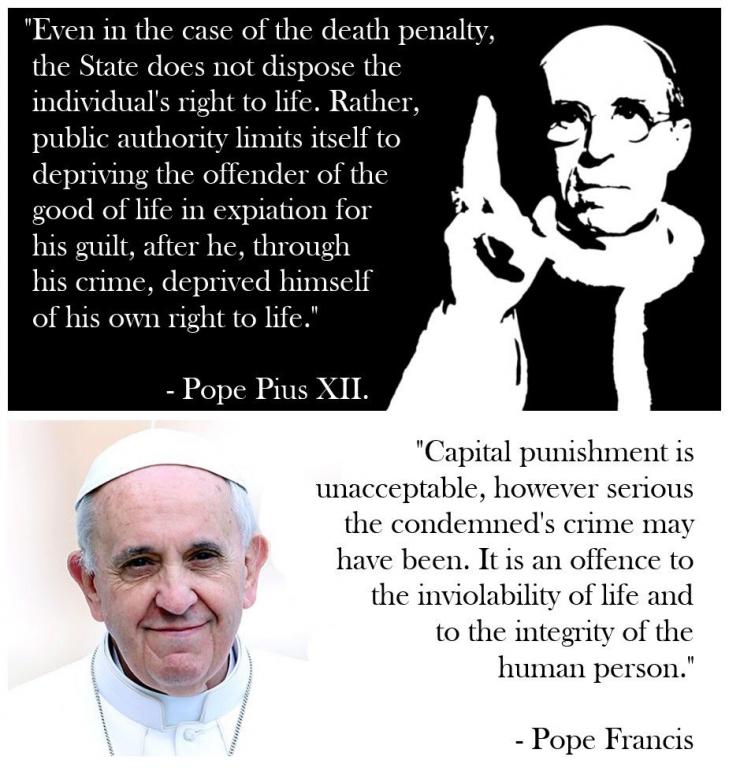
The quote from Pope Pius XII comes from an address (not an encyclical or apostolic letter or other “official” teaching document) given September 14, 1952 to the First International Congress on the Histopathology of the Nervous System.
The quote as found in the original document is as follows:
- Even when it is a question of the execution of a condemned man, the State does not dispose of the individual’s right to life. In this case it is reserved to the public power to deprive the condemned person of the <enjoyment> of life in expiation of his crime when, by his crime, he has already disposed himself of his right to live.
Compare the quote above to the quote in the meme:
Even in the case of the death penalty, the State does not dispose of the individual’s right to life. Rather, public authority limits itself to depriving the offender of the good of life in expiation for his guilt, after he, through his crime, deprived himself of his own right to life.
The two quotes are similar, but they aren’t the same. It is possible that the meme quote is a translation done by an unknown person from the Spanish or French of the original source at the Vatican, but I would prefer to trust the translations as found on EWTN as well as the National Catholic Bioethics Center (they are identical).
If you read the entire address in context, Pope Pius XII is not discussing capital punishment or the death penalty, but rather medical ethics — specifically, the importance of doctors obtaining informed consent from patients being treated for disease or participating in medical experiments. His comment about execution of a condemned man is said almost in passing, and he did not intend it to be a definitive or infallible pronouncement on the absolute good and necessity of capital punishment.
The Church has never taught that the the death penalty is a moral good. She has never given governments a quota for how many prisoners they must kill per year. Pope Pius XII even acknowledges in this quote that the State does not have the authority to dispose of an individual’s right to life — rather, he says that the individual has forfeited his own life by the act of murder.
The reformulated teaching of the Catechism says that since non-lethal means are sufficient to protect society, charity and our greater understanding of human dignity obliges the state to use them. Even if a murderer has forfeited his right to live by his actions does not mean that the State is therefore obligated to take his life from him. As G.K. Chesterton said, “To have a right to do a thing is not at all the same as to be right in doing it.”
Even a murderer has not and can not lose his personal dignity. This teaching is important because the easier it is to dehumanize human beings, the easier it is to oppress them and treat them cruelly. Proponents of legal abortion, for example, demonstrate this concept in their attempt to dehumanize unborn human beings in order to oppress them and deny them the right to life.
In terms of prisoners, the Church teaches that they must be treated fairly and humanely while receiving just punishment for their crimes, and their human dignity must always be respected. Part of respecting that human dignity is preferring the correction and repentance of sinners, instead of desiring their deaths. As Pope John Paul II said in Evangelium Vitae (quoted in the CDF’s letter to bishops),
And yet God, who is always merciful even when he punishes, “put a mark on Cain, lest any who came upon him should kill him” (Gen 4:15). He thus gave him a distinctive sign, not to condemn him to the hatred of others, but to protect and defend him from those wishing to kill him, even out of a desire to avenge Abel’s death. Not even a murderer loses his personal dignity, and God himself pledges to guarantee this. And it is precisely here that the paradoxical mystery of the merciful justice of God is shown forth. As Saint Ambrose writes: “Once the crime is admitted at the very inception of this sinful act of parricide, then the divine law of God’s mercy should be immediately extended. If punishment is forthwith inflicted on the accused, then men in the exercise of justice would in no way observe patience and moderation, but would straightaway condemn the defendant to punishment. … God drove Cain out of his presence and sent him into exile far away from his native land, so that he passed from a life of human kindness to one which was more akin to the rude existence of a wild beast. God, who preferred the correction rather than the death of a sinner, did not desire that a homicide be punished by the exaction of another act of homicide. (emphasis mine)
So if you see this meme floating around the Internet, please be assured that the teaching of Pope Pius XII and Pope Francis are not in opposition, but are in fact in perfect consistency.

Next Post

August 10, 2018 Working Mothers Are an Asset to Businesses, and Here's Why
Browse Our Archives
Select a Category Abortion Abuse Scandal Advent Book News Book Reviews Catholic Teaching Catholic Witness Chesterton Christmas Commuting Cooking Cosplay CWM Profiles Daycare Family Gender at Work Giveaways Good Friday History Household Management Humor Instant Pot Life as a Catholic Working Mother Marriage and Family Maternity Leave Meal Planning Media Recommendations Miscarriage NFP Politics Pregnancy Pro-Life Pro-Life Pumping Racism Religious Education Reluctantly Working Rules and Regulations Sacraments Saints Scams TV Show Review Uncategorized Vocation Working for the Church
Select a Month January 2020 November 2019 October 2019 September 2019 August 2019 July 2019 June 2019 May 2019 April 2019 March 2019 February 2019 January 2019 December 2018 November 2018 October 2018 September 2018 August 2018 July 2018 June 2018 May 2018 April 2018 March 2018 February 2018 January 2018 November 2017 October 2017 July 2017 May 2017 April 2017 March 2017 October 2016 May 2016 April 2016 February 2016 December 2015 November 2015 September 2015 August 2015 July 2015 June 2015 May 2015 April 2015
Follow Us!
TAKE THE
Religious Wisdom Quiz
Who said to Jesus, "Remember me when you come into your kingdom"?
Select your answer to see how you score.
The thief on the cross Mary Magdalene Thomas Peter
Related posts from The Catholic Working Mother
What Does the Roman Catechism Teach about Working...

Fr. Ripperger Reduces Fathers to a Penis and...
Tips for Making a Good Confession
Common Misconceptions: The Difference Between Grave Sin and...
TRENDING AT PATHEOS Catholic

Creation, Preservation, and Teleology in Catholic Theology
As I write this, it is very early Monday morning. Like millions...

The Parable Of The Sower And The Word...
One of Christ’s most famous parables is that of the sower who...

Rejecting Doom: Christian Hope And Human Action
Christianity is a religion of hope. We are to have hope and...

Why I Choose the Eucharist Over the Sermon
Choose the Eucharist, Not the Sermon What are we supposed to get...

5 Design Elements Found in Spiritually Rooted Homes
Putting Spirituality Into Home Decor Our homes are more than our living...

Credo: A Story of God Told with the...
About 10 years ago, I began to imagine a personal "Credo" that...
view all Catholic blogs
Ad-Free & Subscriber Log-In Subscription Support
- About Us
- 2026 Calendar
- Videos
- Podcasts
- Library of World Religions
- Faith In Media Tracker
- Advertise With Us
- Write for Us
- Privacy Policy
- Terms of Service
- Do Not Sell My Data
- Contact Us
- Radiant Digital
- Manage Newsletter Subscriptions
- Unsubscribe From Notifications
- Sitemap
Copyright 2008-2026, Patheos. All rights reserved.
Subscription Support Ad-Free & Subscriber Log-In
Follow Patheos