
BuddhistCatholicContemplativeEvangelicalGeneral ChristianHinduJewishLatter-day SaintMuslimNew VisionsProgressive Christian
Beliefs
- Buddhist
- Catholic
- Contemplative
- Evangelical
- General Christian
- Hindu
- Jewish
- Latter-day Saint
- More Voices
- Muslim
- New Visions
- Pagan
- Progressive Christian
Topics
- Religion News
- Food and Religion
- Sports and Religion
- Religious Art
- Religious Music and Entertainment
- Religious Events
- History and Religion
- Style and Religion
- Politics and Religion
- Women in Religion
- Recreation Outdoors and Religion
- Business Finance and Religion
- Careers Workplace and Religion
- Education and Religion
- Family Parenting and Religion
- Health Fitness and Religion
- Home and Religion
- Relationships and Religion
- Technology and Religion
- Travel and Religion
Columnists
- Buddhist Columnists
- Business Finance and Religion Columnists
- Careers Workplace and Religion Columnists
- Catholic Columnists
- Contemplative Columnists
- Education and Religion Columnists
- Evangelists Columnists
- Family Parenting and Religion Columnists
- General Christian Columnists
- Health Fitness and Religion Columnists
- Hindu Columnists
- History and Religion Columnists
- Home and Religion Columnists
- Jewish Columnists
- More Voices Columnists
- Latter Day Columnists
- Muslim Columnists
- New Visions Columnists
- Nonreligious Columnists
- Pagan Columnists
- Politics and Religion Columnists
- Progressive Columnists
- Recreation Outdoors and Religion Columnists
- Relationships and Religion Columnists
- Religion News Columnists
- Religious Art Columnists
- Religious Events Columnists
- Religious Music and Entertainment Columnists
- Sports and Religion Columnists
- Style and Religion Columnists
- Technology and Religion Columnists
- Travel and Religion Columnists
- Women in Religion Columnists
Resource Library
- 2026 Calendar
- Library of World Religions
- The 100 Most Holy Places on Earth
- Patheos Answers
- Podcasts
- Videos
- Faith Leaders Database
- Anglican Episcopalian
- Bahai
- Baptist
- Buddhism
- Christianity
- Confucianism
- Eastern Orthodoxy
- Hinduism
- Holiness and Pentecostal
- ISKCON
- Islam
- Judaism
- Lutheran
- Methodist
- The Church of Jesus Christ of Latter-day Saints
- New Age
- Paganism
- Presbytarian and Reformed
- Protestantism
- Religion Behind the Scenes
- Roman Catholic
- Scientology
- Shia Islam
- Sikhism
- Sufism
- Sunni Islam
- Taoism
- Zen
- See all religions
Research Tools
 Ad-Free & Subscriber Log-In Subscription Support
Ad-Free & Subscriber Log-In Subscription Support
Follow Patheos 

- Trending:
- Forgiveness
- |
- Marriage
- |
- Consciousness
- |
- Death Penalty
- |
- Election
- |
- Halloween
 The Catholic Working Mother
- Home
- Catholic
- It Is Impossible to Use NFP with a Contraceptive Mentality
It Is Impossible to Use NFP with a Contraceptive Mentality
Last updated on: March 29, 2018 at 3:23 pm by JoAnna Wahlund
It Is Impossible to Use NFP with a Contraceptive Mentality 2018-03-29T15:23:39-08:00 JoAnna Wahlund
Patheos Explore the world's faith through different perspectives on religion and spirituality! Patheos has the views of the prevalent religions and spiritualities of the world.
The term “contraceptive mentality” has a very specific meaning in Catholic theology.
It does not mean using NFP to avoid pregnancy for allegedly selfish or frivolous reasons.
It means the desire to divorce procreation from sex — you know, like actual contraception does — and thus strengthen the temptation to abort any children who are inadvertently conceived. Hence the term contraceptive mentality.
The whole reason that NFP is even licit to use to avoid pregnancy in Catholic teaching is entirely because NFP does not divorce procreation from sex.
Otherwise, it would be considered an intrinsic evil that Catholics may never use to avoid pregnancy, just like contraception.
In fact, Pope St. John Paul II was very careful to draw a clear distinction between avoiding pregnancy using NFP and avoiding pregnancy using contraception in his encyclical Evangelium Vitae:
It is frequently asserted that contraception, if made safe and available to all, is the most effective remedy against abortion. The Catholic Church is then accused of actually promoting abortion, because she obstinately continues to teach the moral unlawfulness of contraception. When looked at carefully, this objection is clearly unfounded. It may be that many people use contraception with a view to excluding the subsequent temptation of abortion. But the negative values inherent in the “contraceptive mentality”-which is very different from responsible parenthood, lived in respect for the full truth of the conjugal act-are such that they in fact strengthen this temptation when an unwanted life is conceived. Indeed, the pro- abortion culture is especially strong precisely where the Church’s teaching on contraception is rejected. Certainly, from the moral point of view contraception and abortion are specifically different evils: the former contradicts the full truth of the sexual act as the proper expression of conjugal love, while the latter destroys the life of a human being; the former is opposed to the virtue of chastity in marriage, the latter is opposed to the virtue of justice and directly violates the divine commandment “You shall not kill”.
Pope St. John Paul II, in referencing responsible parenthood, was referring to paragraph 10 of Pope Paul VI’s Humanae Vitae:
With regard to physical, economic, psychological and social conditions, responsible parenthood is exercised by those who prudently and generously decide to have more children, and by those who, for serious reasons and with due respect to moral precepts, decide not to have additional children for either a certain or an indefinite period of time.
HV goes on to give a very specific definition of contraception in paragraph 14:
…any action which, either in anticipation of the conjugal act [sexual intercourse], or in its accomplishment, or in the development of its natural consequences, proposes, whether as an end or as a means, to render procreation impossible.”
NFP is not an action (abstinence is the lack of an action), nor is it possible for it to render procreation impossible, so it clearly does not fit this definition and cannot be considered contraceptive.
In paragraph 16, HV explains why NFP may be used to avoid pregnancy, and also explains why contraception may not be used (emphasis mine):
Neither the Church nor her doctrine is inconsistent when she considers it lawful for married people to take advantage of the infertile period but condemns as always unlawful the use of means which directly prevent conception, even when the reasons given for the later practice may appear to be upright and serious. In reality, these two cases are completely different. In the former the married couple rightly use a faculty provided them by nature. In the later they obstruct the natural development of the generative process. It cannot be denied that in each case the married couple, for acceptable reasons, are both perfectly clear in their intention to avoid children and wish to make sure that none will result. But it is equally true that it is exclusively in the former case that husband and wife are ready to abstain from intercourse during the fertile period as often as for reasonable motives the birth of another child is not desirable. And when the infertile period recurs, they use their married intimacy to express their mutual love and safeguard their fidelity toward one another. In doing this they certainly give proof of a true and authentic love.”
Typically, when Catholics caution fellow Catholics that they should not use NFP with a contraceptive mentality, they really mean that Catholics should not use NFP with a selfish mentality. To which I generally reply:
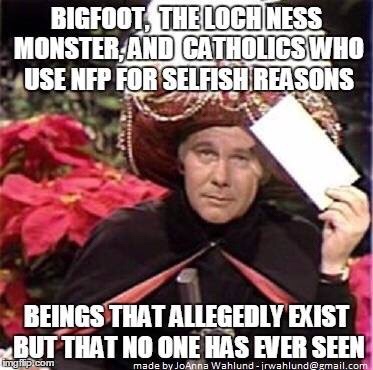
Using NFP to avoid pregnancy is often very difficult and frustrating. It requires heroic self-control and self-denial — both characteristics that are the antithesis of selfishness. In a way, this is a feature, not a bug. Self-control usually crumbles in the face of insufficient (i.e., selfish) motivation.
And even if there was that unicorn Catholic couple who were simultaneously devoted to and also completely oblivious to the Church’s teachings on responsible parenthood that they did use NFP to avoid pregnancy for selfish reasons — it actually isn’t an intrinsic evil to do so. Sinful, perhaps, but not intrinsically evil.
But it is an intrinsic evil to contracept.
Which makes you wonder why there are those who insist on policing the NFP use of their fellow Catholics while tacitly ignoring the 98% of Catholics who use contraception.
At any rate, the “contraceptive mentality” is not and cannot be present among NFP-using Catholics — and the sooner we stamp out that ridiculous notion, the better.
Previous Post

March 23, 2018
How Not to Win Friends and Influence People
Next Post
March 30, 2018 Watch Bp. Fulton Sheen's "His Last Words"
Browse Our Archives
Select a Category Abortion Abuse Scandal Advent Book News Book Reviews Catholic Teaching Catholic Witness Chesterton Christmas Commuting Cooking Cosplay CWM Profiles Daycare Family Gender at Work Giveaways Good Friday History Household Management Humor Instant Pot Life as a Catholic Working Mother Marriage and Family Maternity Leave Meal Planning Media Recommendations Miscarriage NFP Politics Pregnancy Pro-Life Pro-Life Pumping Racism Religious Education Reluctantly Working Rules and Regulations Sacraments Saints Scams TV Show Review Uncategorized Vocation Working for the Church
Select a Month January 2020 November 2019 October 2019 September 2019 August 2019 July 2019 June 2019 May 2019 April 2019 March 2019 February 2019 January 2019 December 2018 November 2018 October 2018 September 2018 August 2018 July 2018 June 2018 May 2018 April 2018 March 2018 February 2018 January 2018 November 2017 October 2017 July 2017 May 2017 April 2017 March 2017 October 2016 May 2016 April 2016 February 2016 December 2015 November 2015 September 2015 August 2015 July 2015 June 2015 May 2015 April 2015
Follow Us!
TAKE THE
Religious Wisdom Quiz
Which Psalm is a prayer of repentance after David's sin with Bathsheba?
Select your answer to see how you score.
Psalm 24 Psalm 7 Psalm 51 Psalm 23
Related posts from The Catholic Working Mother
What Does the Roman Catechism Teach about Working...

Fr. Ripperger Reduces Fathers to a Penis and...

Tips for Making a Good Confession
Common Misconceptions: The Difference Between Grave Sin and...
TRENDING AT PATHEOS Catholic

Creation, Preservation, and Teleology in Catholic Theology
As I write this, it is very early Monday morning. Like millions...

The Parable Of The Sower And The Word...
One of Christ’s most famous parables is that of the sower who...

Rejecting Doom: Christian Hope And Human Action
Christianity is a religion of hope. We are to have hope and...

Why I Choose the Eucharist Over the Sermon
Choose the Eucharist, Not the Sermon What are we supposed to get...

5 Design Elements Found in Spiritually Rooted Homes
Putting Spirituality Into Home Decor Our homes are more than our living...

Credo: A Story of God Told with the...
About 10 years ago, I began to imagine a personal "Credo" that...
view all Catholic blogs
Ad-Free & Subscriber Log-In Subscription Support
- About Us
- 2026 Calendar
- Videos
- Podcasts
- Library of World Religions
- Faith In Media Tracker
- Advertise With Us
- Write for Us
- Privacy Policy
- Terms of Service
- Do Not Sell My Data
- Contact Us
- Radiant Digital
- Manage Newsletter Subscriptions
- Unsubscribe From Notifications
- Sitemap
Copyright 2008-2026, Patheos. All rights reserved.
Subscription Support Ad-Free & Subscriber Log-In
Follow Patheos