
BuddhistCatholicContemplativeEvangelicalGeneral ChristianHinduJewishLatter-day SaintMuslimNew VisionsProgressive Christian
Beliefs
- Buddhist
- Catholic
- Contemplative
- Evangelical
- General Christian
- Hindu
- Jewish
- Latter-day Saint
- More Voices
- Muslim
- New Visions
- Pagan
- Progressive Christian
Topics
- Religion News
- Food and Religion
- Sports and Religion
- Religious Art
- Religious Music and Entertainment
- Religious Events
- History and Religion
- Style and Religion
- Politics and Religion
- Women in Religion
- Recreation Outdoors and Religion
- Business Finance and Religion
- Careers Workplace and Religion
- Education and Religion
- Family Parenting and Religion
- Health Fitness and Religion
- Home and Religion
- Relationships and Religion
- Technology and Religion
- Travel and Religion
Columnists
- Buddhist Columnists
- Business Finance and Religion Columnists
- Careers Workplace and Religion Columnists
- Catholic Columnists
- Contemplative Columnists
- Education and Religion Columnists
- Evangelists Columnists
- Family Parenting and Religion Columnists
- General Christian Columnists
- Health Fitness and Religion Columnists
- Hindu Columnists
- History and Religion Columnists
- Home and Religion Columnists
- Jewish Columnists
- More Voices Columnists
- Latter Day Columnists
- Muslim Columnists
- New Visions Columnists
- Nonreligious Columnists
- Pagan Columnists
- Politics and Religion Columnists
- Progressive Columnists
- Recreation Outdoors and Religion Columnists
- Relationships and Religion Columnists
- Religion News Columnists
- Religious Art Columnists
- Religious Events Columnists
- Religious Music and Entertainment Columnists
- Sports and Religion Columnists
- Style and Religion Columnists
- Technology and Religion Columnists
- Travel and Religion Columnists
- Women in Religion Columnists
Resource Library
- 2026 Calendar
- Library of World Religions
- The 100 Most Holy Places on Earth
- Patheos Answers
- Podcasts
- Videos
- Faith Leaders Database
- Anglican Episcopalian
- Bahai
- Baptist
- Buddhism
- Christianity
- Confucianism
- Eastern Orthodoxy
- Hinduism
- Holiness and Pentecostal
- ISKCON
- Islam
- Judaism
- Lutheran
- Methodist
- The Church of Jesus Christ of Latter-day Saints
- New Age
- Paganism
- Presbytarian and Reformed
- Protestantism
- Religion Behind the Scenes
- Roman Catholic
- Scientology
- Shia Islam
- Sikhism
- Sufism
- Sunni Islam
- Taoism
- Zen
- See all religions
Research Tools
 Ad-Free & Subscriber Log-In Subscription Support
Ad-Free & Subscriber Log-In Subscription Support
Follow Patheos 

- Trending:
- Forgiveness
- |
- Marriage
- |
- Consciousness
- |
- Death Penalty
- |
- Election
- |
- Halloween
 The Capstone
- Home
- Catholic
- College and vocation
College and vocation
Last updated on: June 25, 2015 at 3:13 pm by Tim Muldoon
College and vocation 2015-06-25T15:13:13-04:00 Tim Muldoon
Patheos Explore the world's faith through different perspectives on religion and spirituality! Patheos has the views of the prevalent religions and spiritualities of the world.
University of Chicago Press
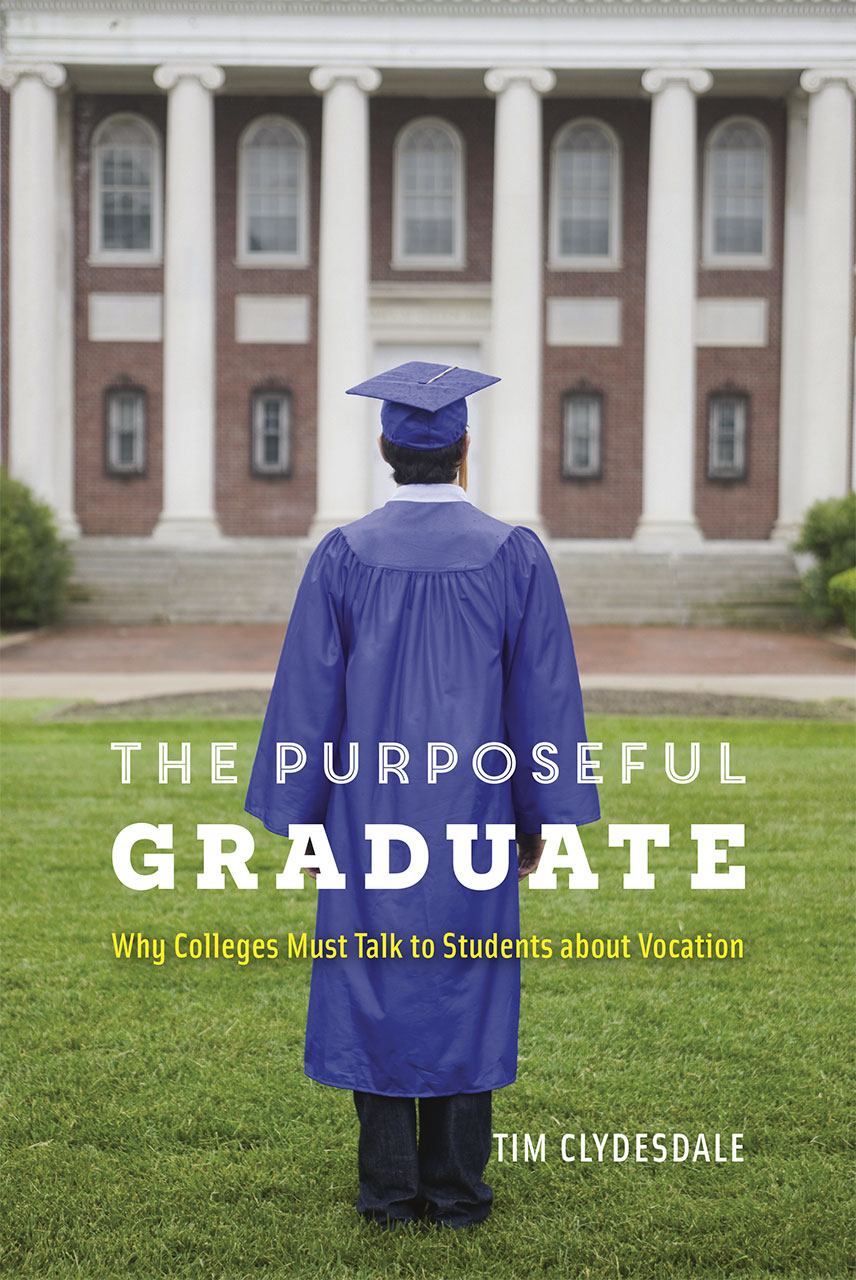
Colleen Flaherty of Inside Higher Ed recently interviewed Tim Clydesdale, professor of sociology at the College of New Jersey and author of the 2007 book The First Year Out: Understanding American Teens After High School (University of Chicago Press). His newest book is The Purposeful Graduate: Why Colleges Must Talk to Students About Vocation (University of Chicago Press).
Clydesdale studied programs at various religiously-affiliated colleges and universities which received grants from the Lilly Endownment to help students explore questions of vocation and meaning. Full disclosure: I work in an office at Boston College–the Division of University Mission and Ministry— that began because of seed money from one of these grants. Like many other of the 88 institutions that received grants, Boston College went on to fully fund the programs initiated by the grants.
Clydesdale focuses on how the Lilly grants opened new conversations about student formation and vocational discernment in the context of higher education.
What the national conversation about the value of college is missing is the very purpose of college itself: to educate and graduate thoughtful, purposeful and globally aware citizen leaders. We are not job training centers, and even our professional schools — which have the closest relationship to the workforce — seek to prepare leaders for tomorrow’s professions, not applicants for this month’s job openings.
The Lilly-funded programs opened up opportunities for students to consider questions beyond the immediate concerns for grades and jobs: questions about meaning, purpose, service, and faith.
The primacy of daily life management helps most teens successfully navigate the first year after high school, but at the cost of neglecting deeper identities and the wider world. … What my research for The Purposeful Graduate revealed was an important opening for engagement of deeper issues that came in the second year after high school….
Once settled into the college student role, and anchored by the relative stability of enrollment at a four-year college, many sophomore and junior students will ask bigger questions about themselves and the world.
We know from other studies that there is a gross disparity between students’ desire for exploring questions of life’s meaning and the general (un)willingness of professors to engage those questions.
Every student, therefore, should be invited to reflect on and explore ideas of purpose and calling, to do so among supportive peers, with service opportunities to tangibly explore their emerging interests, and with faculty and staff mentors who share a desire to live meaningfully and compassionately.
Yet what Clydesdale has found is that these programs benefit both students and faculty.
The effects on faculty and staff included revitalization of careers, more rewarding teaching experiences, greater appreciation for college or university mission, new scholarly research programs, more satisfying mentoring conversations with students and broader connections to the campus community, including more friendships across the faculty/staff divide.
We’ve seen these effects at Boston College. Some of the many exciting initiatives that have arisen from our interest in vocational discernment include the Intersections program, which draws together faculty to address questions about the mission of our institution. More recently, the initiative with which I have been associated, the Boston College Roundtable, has invited scholars across disciplines and institutions to reflect on the broad mission of Catholic higher education. We’ve developed a Center for Student Formation which offers students many opportunities to develop habits of reflective living, in addition to our long-established Campus Ministry program, which invites students into deeper immersion in Catholic liturgical and spiritual practices.
Clydesdale puts his finger on something important in the nature of the Lilly grants: namely, that they did not impose any external force on the dynamics of those institutions which received the grants: “campuses designed programs themselves that fit with their institutional histories and organizational cultures; these were not top-down, external programs that campuses had to implement.” In the case of Boston College, we were able to draw from centuries of reflection on the spiritual life, and in particular an Ignatian theology of discernment, to formulate a strategic answer to our question “how might we invite members of our university community to participate more fully in our mission?”
Our efforts are still in their infancy. What is significant from an historical perspective is the fact that there is no template for a fully modern Catholic university: that is, a university governed by a mostly lay board of trustees, committed to advancing the mission of Christ and the Church through education in the context of modernity (or postmodernity) and all the complexity represented in those terms. One important dimension of (post-)modernity, though, involves the fracturing of Western identity, and the consequent impact on societies and social mores. Young peoples’ thirst for meaning and direction–vocation, understood in Catholic tradition as a call from God rooted in receiving who God has made me to be–is one important manifestation of a particular challenge that Catholic universities are well-poised to address. Our own stories–stories of prophets and saints, thinkers and activists, entrepreneurs and parents, priests and vowed religious–are stories of listening carefully to God and building lives of grace. Ours is the great blessing of being in positions to share these gifts with peers and colleagues, students and their families, donors and friends. We can renew the face of the earth.
Previous Post

June 16, 2015
Guest post: two concepts of rationality, Francis M. McLaughlin
Next Post
July 8, 2015 Pope Francis address at Pontifical Catholic University of Ecuador
Browse Our Archives
Select a Category academic freedom Catholic intellectual tradition epigenetics humanities mission politics science teaching Theology Uncategorized university life
Select a Month November 2015 October 2015 September 2015 August 2015 July 2015 June 2015 May 2015 April 2015 March 2015 February 2015 January 2015 December 2014 November 2014 October 2014 September 2014 August 2014
Follow Us!
TAKE THE
Religious Wisdom Quiz
What river did the Israelites cross to enter the Promised Land?
Select your answer to see how you score.
Jordan River Euphrates River Nile River Red Sea
Related posts from The Capstone



Peer review and the sin of pride

Pope Francis address at Pontifical Catholic University of...
TRENDING AT PATHEOS Catholic

Rejecting Doom: Christian Hope And Human Action
Christianity is a religion of hope. We are to have hope and...

It’s What Comes From Within Which Matters
One of the most difficult things for us to understand is why...

Why I Choose the Eucharist Over the Sermon
Choose the Eucharist, Not the Sermon What are we supposed to get...

5 Design Elements Found in Spiritually Rooted Homes
Putting Spirituality Into Home Decor Our homes are more than our living...

Credo: A Story of God Told with the...
About 10 years ago, I began to imagine a personal "Credo" that...

The Anatomy of Divine Revelation in Catholic Thought
The claim that God has made Himself known to human beings is...
view all Catholic blogs
Ad-Free & Subscriber Log-In Subscription Support
- About Us
- 2026 Calendar
- Videos
- Podcasts
- Library of World Religions
- Faith In Media Tracker
- Advertise With Us
- Write for Us
- Privacy Policy
- Terms of Service
- Do Not Sell My Data
- Contact Us
- Radiant Digital
- Manage Newsletter Subscriptions
- Unsubscribe From Notifications
- Sitemap
Copyright 2008-2026, Patheos. All rights reserved.
Subscription Support Ad-Free & Subscriber Log-In
Follow Patheos