
BuddhistCatholicContemplativeEvangelicalGeneral ChristianHinduJewishLatter-day SaintMuslimNew VisionsProgressive Christian
Beliefs
- Buddhist
- Catholic
- Contemplative
- Evangelical
- General Christian
- Hindu
- Jewish
- Latter-day Saint
- More Voices
- Muslim
- New Visions
- Pagan
- Progressive Christian
Topics
- Religion News
- Food and Religion
- Sports and Religion
- Religious Art
- Religious Music and Entertainment
- Religious Events
- History and Religion
- Style and Religion
- Politics and Religion
- Women in Religion
- Recreation Outdoors and Religion
- Business Finance and Religion
- Careers Workplace and Religion
- Education and Religion
- Family Parenting and Religion
- Health Fitness and Religion
- Home and Religion
- Relationships and Religion
- Technology and Religion
- Travel and Religion
Columnists
- Buddhist Columnists
- Business Finance and Religion Columnists
- Careers Workplace and Religion Columnists
- Catholic Columnists
- Contemplative Columnists
- Education and Religion Columnists
- Evangelists Columnists
- Family Parenting and Religion Columnists
- General Christian Columnists
- Health Fitness and Religion Columnists
- Hindu Columnists
- History and Religion Columnists
- Home and Religion Columnists
- Jewish Columnists
- More Voices Columnists
- Latter Day Columnists
- Muslim Columnists
- New Visions Columnists
- Nonreligious Columnists
- Pagan Columnists
- Politics and Religion Columnists
- Progressive Columnists
- Recreation Outdoors and Religion Columnists
- Relationships and Religion Columnists
- Religion News Columnists
- Religious Art Columnists
- Religious Events Columnists
- Religious Music and Entertainment Columnists
- Sports and Religion Columnists
- Style and Religion Columnists
- Technology and Religion Columnists
- Travel and Religion Columnists
- Women in Religion Columnists
Resource Library
- 2026 Calendar
- Library of World Religions
- The 100 Most Holy Places on Earth
- Patheos Answers
- Podcasts
- Videos
- Faith Leaders Database
- Anglican Episcopalian
- Bahai
- Baptist
- Buddhism
- Christianity
- Confucianism
- Eastern Orthodoxy
- Hinduism
- Holiness and Pentecostal
- ISKCON
- Islam
- Judaism
- Lutheran
- Methodist
- The Church of Jesus Christ of Latter-day Saints
- New Age
- Paganism
- Presbytarian and Reformed
- Protestantism
- Religion Behind the Scenes
- Roman Catholic
- Scientology
- Shia Islam
- Sikhism
- Sufism
- Sunni Islam
- Taoism
- Zen
- See all religions
Research Tools
 Ad-Free & Subscriber Log-In Subscription Support
Ad-Free & Subscriber Log-In Subscription Support
Follow Patheos 

- Trending:
- Forgiveness
- |
- Marriage
- |
- Consciousness
- |
- Death Penalty
- |
- Election
- |
- Halloween
 The Capstone
- Home
- Catholic
- Theology Needs Science (and vice versa)
Theology Needs Science (and vice versa)
Last updated on: October 30, 2014 at 12:59 pm by Tim Muldoon
Theology Needs Science (and vice versa) 2014-10-30T12:59:20-04:00 Tim Muldoon
Patheos Explore the world's faith through different perspectives on religion and spirituality! Patheos has the views of the prevalent religions and spiritualities of the world.
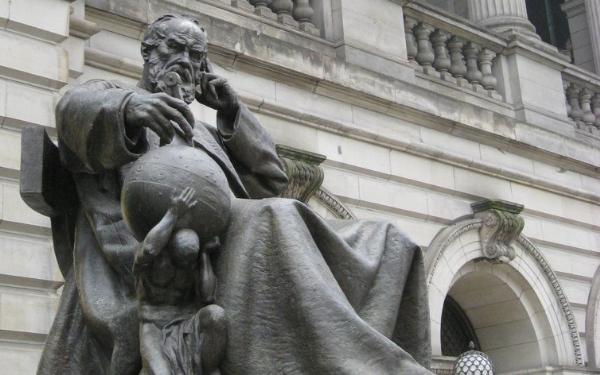 Theology needs science. So writes William C. Mattison, a moral theologian at the Catholic University of America in the most recent issue of Integritas. Or rather, to be more precise, Mattison suggests that human beings–we, who are thinking creatures–must ponder questions that demand science, while being unafraid to raise questions that are ultimately theological.
The reason why theology needs science, he writes, is that ultimately it is human beings who ask questions and who must use the various disciplines to answer them.
Though the varying disciplines have different scopes of inquiry and different methodologies, they require one another for a full understanding of the topic at hand, all the more so when the subject of inquiry […] is the human person.
(Omission refers to the title of the Spring Boston College Roundtable, “Science and the Human Person”)
All thinkers must recognize what knowledge their disciplinary lenses allow them to grasp, and with intellectual humility join into a larger conversation with others. Mattison again:
In the same way that a discipline like theology is accountable to the findings of the sciences, scientists (and indeed scholars in other disciplines) should recognize when they make claims about their findings that transcend the direct conclusions of their findings.
Mattison calls for a “common good approach to the disciplines,” envisioning the task of the university to be that of inviting scholars into conversation with one another both within disciplines and (more importantly, I think, in this age of intellectual fragmentation) outside of and beyond disciplines.
The Boston College Roundtable aims to do precisely that: encourage conversations that draw from the knowledge gained within disciplines, and apply it to advancing learning that transcends the limitations of disciplines. The very title of the journal, Integritas, points to a certain anthropology rooted in faith, itself a commentary on what Mattison proposes. Consider this question: are human beings knowers? Or this one: what happens when a person knows something? Too often we leap to the content of a question without considering the activity of questioning itself. If indeed human beings are knowers, then it is never the case that “science answers all questions.” Rather, “human beings answer questions,”– but the word “all” is impossible to include in that sentence, for whenever we gain an answer to a question a hundred others emerge.
There is a kind of “spirituality of the question,” a dynamic drive within human beings which stretches toward answering questions that arise spontaneously. Human beings are knowers. The cardinal sin of any university, then, is shutting down of questions and the conversations that drive them. Theology, in this context, is simply the self-transcending direction of questions: the Godward direction. Mattison writes:
What vision of the human person can be complete without attention to literature, poetry, and visual art? How can we understand who we are without a grasp of the biology, chemistry, and physics of ourselves and the world which we not only inhabit but to which we belong? How can we not employ mathematics, statistical analysis, and experimentation to better grasp our placement in the ecosystem? And what human life is complete without attention to ultimate questions about ourselves and especially the transcendent?
Notice, here, the implication for those who simply reject the transcendent: they say, effectively, “those questions about the transcendent are irrelevant and not worth pursuing.” An odd claim, from a purely anthropological perspective: billions of people raise those questions, and yet the epistemic position from which transcendence-rejectors make the claim suggests that these billions of questions are not worthy of consideration. At the very least, such an epistemology is hubristic. And in my view, it is also wrong.
The implicit, and often explicit epistemology of Catholic universities is that it is important to learn what kinds of knowing unfolds through deploying different disciplines. It is not enough to learn a profession, which exposes a person to only one or two disciplines. One must experience knowing as different people experience it: artists, physicists, philosophers, economists, psychologists, and so on. Ultimately, each person is responsible for his or her own knowing; and, like Socrates, each person must know the contours of his or her own ignorance. Every Catholic university leads students through a core curriculum precisely because we want each student to have an experience of these various ways of knowing. But ultimately we hope that these experiences lead to some kind of synthesis, integration (integritas) within the knowing person.
That integritas is not merely intellectual; intellect is one tool of the knower. Other tools include aesthetic, affective, psychic (in the Greek sense), and perhaps other capacities. We are not reducible to being scientists, theologians, poets, or accountants. We are human beings, fully enfleshed questioners who stretch toward the good, the true, and the beautiful. Our syntheses are thus never purely intellectual; what miserable creatures we would be once we left our labs at night if that were true! Instead, the synthesis we seek is fully human. Mattison again:
Though serving at a university as a scientist, a science professor is not simply a person who engages in scientific inquiry. She is a human person herself, whose research and scientific inquiry is integrated in her person. Beyond the immediate activity of her research she models to her students in the lab and in the classroom the integration of that activity with other arenas of inquiry. Her expertise is the science, but as a human person she is not and cannot be limited to the conclusions of her scientific methodology. This is why—though philosophers and theologians may lament it—it is understandable and possibly unavoidable for scientists to address the ramifications of their work to questions beyond the proper purview of their discipline. Our students witness this in their professors of science, God willing.
Mattison notes that scientists seek an “integration of their findings into an overall quest for wisdom of which their findings form a constitutive part.” They wish to make sense of the world in which they live, and help students similarly do so. Of course that wisdom will draw from their science, but the choices they make in their lives will of course transcend whatever data their studies provide. That wisdom–that quest for a life well lived– will benefit from a formation in not only the “disciplines of the true,” the intellectual disciplines, but also the disciplines of the good and the beautiful, the disciplines of the heart.
Read Mattison’s whole essay here.
Previous Post

October 23, 2014
Science and Catholic universities
Next Post
November 5, 2014 The spirituality of the question
Browse Our Archives
Select a Category academic freedom Catholic intellectual tradition epigenetics humanities mission politics science teaching Theology Uncategorized university life
Select a Month November 2015 October 2015 September 2015 August 2015 July 2015 June 2015 May 2015 April 2015 March 2015 February 2015 January 2015 December 2014 November 2014 October 2014 September 2014 August 2014
Follow Us!
TAKE THE
Religious Wisdom Quiz
In 3 John, what does John say he has no greater joy than?
Select your answer to see how you score.
Serving the church Seeing souls saved Preaching the gospel Hearing that his children are walking in the truth
Related posts from The Capstone




Peer review and the sin of pride
TRENDING AT PATHEOS Catholic

Rejecting Doom: Christian Hope And Human Action
Christianity is a religion of hope. We are to have hope and...

It’s What Comes From Within Which Matters
One of the most difficult things for us to understand is why...

Why I Choose the Eucharist Over the Sermon
Choose the Eucharist, Not the Sermon What are we supposed to get...

5 Design Elements Found in Spiritually Rooted Homes
Putting Spirituality Into Home Decor Our homes are more than our living...

Credo: A Story of God Told with the...
About 10 years ago, I began to imagine a personal "Credo" that...

The Anatomy of Divine Revelation in Catholic Thought
The claim that God has made Himself known to human beings is...
view all Catholic blogs
Ad-Free & Subscriber Log-In Subscription Support
- About Us
- 2026 Calendar
- Videos
- Podcasts
- Library of World Religions
- Faith In Media Tracker
- Advertise With Us
- Write for Us
- Privacy Policy
- Terms of Service
- Do Not Sell My Data
- Contact Us
- Radiant Digital
- Manage Newsletter Subscriptions
- Unsubscribe From Notifications
- Sitemap
Copyright 2008-2026, Patheos. All rights reserved.
Subscription Support Ad-Free & Subscriber Log-In
Follow Patheos