
BuddhistCatholicContemplativeEvangelicalGeneral ChristianHinduJewishLatter-day SaintMuslimNew VisionsProgressive Christian
Beliefs
- Buddhist
- Catholic
- Contemplative
- Evangelical
- General Christian
- Hindu
- Jewish
- Latter-day Saint
- More Voices
- Muslim
- New Visions
- Pagan
- Progressive Christian
Topics
- Religion News
- Food and Religion
- Sports and Religion
- Religious Art
- Religious Music and Entertainment
- Religious Events
- History and Religion
- Style and Religion
- Politics and Religion
- Women in Religion
- Recreation Outdoors and Religion
- Business Finance and Religion
- Careers Workplace and Religion
- Education and Religion
- Family Parenting and Religion
- Health Fitness and Religion
- Home and Religion
- Relationships and Religion
- Technology and Religion
- Travel and Religion
Columnists
- Buddhist Columnists
- Business Finance and Religion Columnists
- Careers Workplace and Religion Columnists
- Catholic Columnists
- Contemplative Columnists
- Education and Religion Columnists
- Evangelists Columnists
- Family Parenting and Religion Columnists
- General Christian Columnists
- Health Fitness and Religion Columnists
- Hindu Columnists
- History and Religion Columnists
- Home and Religion Columnists
- Jewish Columnists
- More Voices Columnists
- Latter Day Columnists
- Muslim Columnists
- New Visions Columnists
- Nonreligious Columnists
- Pagan Columnists
- Politics and Religion Columnists
- Progressive Columnists
- Recreation Outdoors and Religion Columnists
- Relationships and Religion Columnists
- Religion News Columnists
- Religious Art Columnists
- Religious Events Columnists
- Religious Music and Entertainment Columnists
- Sports and Religion Columnists
- Style and Religion Columnists
- Technology and Religion Columnists
- Travel and Religion Columnists
- Women in Religion Columnists
Resource Library
- 2026 Calendar
- Library of World Religions
- The 100 Most Holy Places on Earth
- Patheos Answers
- Podcasts
- Videos
- Faith Leaders Database
- Anglican Episcopalian
- Bahai
- Baptist
- Buddhism
- Christianity
- Confucianism
- Eastern Orthodoxy
- Hinduism
- Holiness and Pentecostal
- ISKCON
- Islam
- Judaism
- Lutheran
- Methodist
- The Church of Jesus Christ of Latter-day Saints
- New Age
- Paganism
- Presbytarian and Reformed
- Protestantism
- Religion Behind the Scenes
- Roman Catholic
- Scientology
- Shia Islam
- Sikhism
- Sufism
- Sunni Islam
- Taoism
- Zen
- See all religions
Research Tools
 Ad-Free & Subscriber Log-In Subscription Support
Ad-Free & Subscriber Log-In Subscription Support
Follow Patheos 

- Trending:
- Forgiveness
- |
- Marriage
- |
- Consciousness
- |
- Death Penalty
- |
- Election
- |
- Halloween
 The Capstone
- Home
- Catholic
- The cor curriculum
The cor curriculum
Last updated on: September 19, 2014 at 10:35 am by Tim Muldoon
The cor curriculum 2014-09-19T10:35:16-04:00 Tim Muldoon
Patheos Explore the world's faith through different perspectives on religion and spirituality! Patheos has the views of the prevalent religions and spiritualities of the world.
My university, Boston College, has developed an insightful new document describing what we hold dear in our core curriculum. Full disclosure: this post is cheerleading because I think we’ve got it right. And no, that title does not contain a typo. More below.
(Aside: this document is in the public view: see stories here and here.)
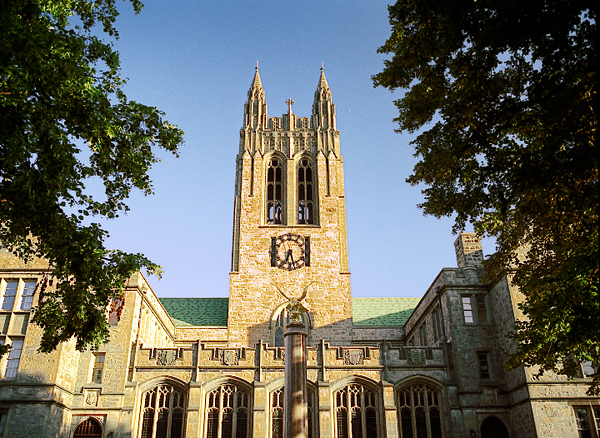
Gasson Hall, Boston College
It observes that Jesuit education from the 16th century onwards tried to balance the ideals of
- the university as the center of new thinking
- the humanistic model of formation of the person
In a word, our cor curriculum is about people. It is not about minds; employees; bodies; consumers; cogs in a machine. It aims not at the symptoms of disorder in a society: xenophobia; disregard of human life from conception to natural death; greed; sexual consumerism; and so on. Instead, it aims for the root, the heart (cor) of a person. It rests upon a theological anthropology rooted in the basic conviction that, in the words of Irenaeus of Lyons, “the glory of God is the living person” (gloria dei vivens homo). There is a corollary: the glory of God is the human family fully alive.
The document states:
The Spiritual Exercises [of Saint Ignatius of Loyola] provide a model of how teachers and students interact in Core courses. “[T]he quality of the relationship between the guide of the Spiritual Exercises and the person making them is the model for the relationship between teacher and student. Like the guide of the Exercises, the teacher is at the service of the student, alert to detect special gifts or special difficulties, personally concerned, and assisting in the development of the inner potential of each student.”
[the quote is taken from “The Characteristics of Jesuit Education: Some Characteristics of Jesuit Pedagogy,” in Vincent J. Duminuco, S.J., ed. The Jesuit Ratio Studiorum: 400th Anniversary Perspectives (New York: Fordham University Press, 2000), 212. Hyperlink added by me.
This “cor curriculum” or, if you will “exercise of the heart” (curriculum from currere, to run) is a training camp for becoming more fully a human being capable of loving what is worth loving, and applying all one’s talents toward the task of understanding the world in which a loving God has immersed us. It is also at the same time a place where the application of those talents yields new ways of knowing the world.
Perhaps most importantly, this vision of a cor curriculum rests on the conviction that all knowing is ultimately theonomic, to use a word coined by Protestant theologian Paul Tillich, referring to a dynamism within human understanding that reaches naturally toward God. As the document states: “the search for truth in any discipline is part of the search for God.” This is true no less in particle physics and epigenetics than in theology or philosophy. The document expands on this idea:
Becoming educated requires careful and conscientious study in fields from theology and history to philosophy and literature, from mathematics and physics to the arts to political science and beyond. The humanities and natural and social sciences help ground our understanding of who we are, what it means to be human, how the world works, where we come from, and where we are going.
Finally, a strength of the document is its recognition that education resides not in disciplines or ideas, but in persons.
Faculty teaching in the Core should be attentive to the context of their students’ lives, striving to teach these students, rather than simply a body of material, helping students to see why their Core courses matter in their lives.
All Jesuit colleges and universities (28 in the United States, scores worldwide), along with other Catholic colleges and universities, strive to form “men and women for others.” They do so primarily through friendship (see Marian K. Díaz on this topic in the most recent Integritas), lived teleologically toward discovery of the reality of the world. Discovery of that reality–taking a “long, loving look at the real“–will yield not only good persons, but also a good community.
Previous Post

September 18, 2014
Of science and other humanities
Next Post
September 25, 2014 Education for mercy
Browse Our Archives
Select a Category academic freedom Catholic intellectual tradition epigenetics humanities mission politics science teaching Theology Uncategorized university life
Select a Month November 2015 October 2015 September 2015 August 2015 July 2015 June 2015 May 2015 April 2015 March 2015 February 2015 January 2015 December 2014 November 2014 October 2014 September 2014 August 2014
Follow Us!
TAKE THE
Religious Wisdom Quiz
What Christian group believes in "soul sleep" after death?
Select your answer to see how you score.
Orthodox Baptists Seventh-day Adventists Methodists
Related posts from The Capstone



Peer review and the sin of pride

Pope Francis address at Pontifical Catholic University of...
TRENDING AT PATHEOS Catholic

Rejecting Doom: Christian Hope And Human Action
Christianity is a religion of hope. We are to have hope and...

It’s What Comes From Within Which Matters
One of the most difficult things for us to understand is why...

Why I Choose the Eucharist Over the Sermon
Choose the Eucharist, Not the Sermon What are we supposed to get...

5 Design Elements Found in Spiritually Rooted Homes
Putting Spirituality Into Home Decor Our homes are more than our living...

Credo: A Story of God Told with the...
About 10 years ago, I began to imagine a personal "Credo" that...

The Anatomy of Divine Revelation in Catholic Thought
The claim that God has made Himself known to human beings is...
view all Catholic blogs
Ad-Free & Subscriber Log-In Subscription Support
- About Us
- 2026 Calendar
- Videos
- Podcasts
- Library of World Religions
- Faith In Media Tracker
- Advertise With Us
- Write for Us
- Privacy Policy
- Terms of Service
- Do Not Sell My Data
- Contact Us
- Radiant Digital
- Manage Newsletter Subscriptions
- Unsubscribe From Notifications
- Sitemap
Copyright 2008-2026, Patheos. All rights reserved.
Subscription Support Ad-Free & Subscriber Log-In
Follow Patheos