
BuddhistCatholicContemplativeEvangelicalGeneral ChristianHinduJewishLatter-day SaintMuslimNew VisionsProgressive Christian
Beliefs
- Buddhist
- Catholic
- Contemplative
- Evangelical
- General Christian
- Hindu
- Jewish
- Latter-day Saint
- More Voices
- Muslim
- New Visions
- Pagan
- Progressive Christian
Topics
- Religion News
- Food and Religion
- Sports and Religion
- Religious Art
- Religious Music and Entertainment
- Religious Events
- History and Religion
- Style and Religion
- Politics and Religion
- Women in Religion
- Recreation Outdoors and Religion
- Business Finance and Religion
- Careers Workplace and Religion
- Education and Religion
- Family Parenting and Religion
- Health Fitness and Religion
- Home and Religion
- Relationships and Religion
- Technology and Religion
- Travel and Religion
Columnists
- Buddhist Columnists
- Business Finance and Religion Columnists
- Careers Workplace and Religion Columnists
- Catholic Columnists
- Contemplative Columnists
- Education and Religion Columnists
- Evangelists Columnists
- Family Parenting and Religion Columnists
- General Christian Columnists
- Health Fitness and Religion Columnists
- Hindu Columnists
- History and Religion Columnists
- Home and Religion Columnists
- Jewish Columnists
- More Voices Columnists
- Latter Day Columnists
- Muslim Columnists
- New Visions Columnists
- Nonreligious Columnists
- Pagan Columnists
- Politics and Religion Columnists
- Progressive Columnists
- Recreation Outdoors and Religion Columnists
- Relationships and Religion Columnists
- Religion News Columnists
- Religious Art Columnists
- Religious Events Columnists
- Religious Music and Entertainment Columnists
- Sports and Religion Columnists
- Style and Religion Columnists
- Technology and Religion Columnists
- Travel and Religion Columnists
- Women in Religion Columnists
Resource Library
- 2026 Calendar
- Library of World Religions
- The 100 Most Holy Places on Earth
- Patheos Answers
- Podcasts
- Videos
- Faith Leaders Database
- Anglican Episcopalian
- Bahai
- Baptist
- Buddhism
- Christianity
- Confucianism
- Eastern Orthodoxy
- Hinduism
- Holiness and Pentecostal
- ISKCON
- Islam
- Judaism
- Lutheran
- Methodist
- The Church of Jesus Christ of Latter-day Saints
- New Age
- Paganism
- Presbytarian and Reformed
- Protestantism
- Religion Behind the Scenes
- Roman Catholic
- Scientology
- Shia Islam
- Sikhism
- Sufism
- Sunni Islam
- Taoism
- Zen
- See all religions
Research Tools
 Ad-Free & Subscriber Log-In Subscription Support
Ad-Free & Subscriber Log-In Subscription Support
Follow Patheos 

- Trending:
- Forgiveness
- |
- Marriage
- |
- Consciousness
- |
- Death Penalty
- |
- Election
- |
- Halloween
 The Buddha Said
- Home
- Buddhist
- The Buddha’s First Sermon
The Buddha’s First Sermon
Last updated on: September 29, 2020 at 12:00 pm by Dr. Jay N. Forrest
The Buddha’s First Sermon 2020-09-28T23:44:31+06:00 Dr. Jay N. Forrest
Patheos Explore the world's faith through different perspectives on religion and spirituality! Patheos has the views of the prevalent religions and spiritualities of the world.
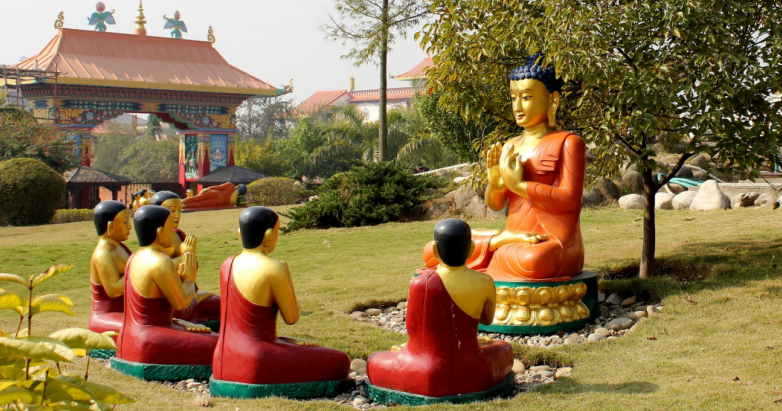
To understand what is important and foundational to a teacher’s philosophy, it is important to understand the first lecture they give. This lays the foundation for understanding everything else they say. Well, we actually know what the Buddha’s first sermon or discourse was. Here is an introduction and translation of it by me.
Introduction
The scripture is called the Dhammacakkappavattana Sutta, it means the turning of the wheel of the Teaching. It is located in the Samyutta Nikaya (Collection of Connected Discourses). According to Vinaya Pitaka of the Pali canon, this was the Buddha’s first discourse after his awakening (Mahāvagga I.6).
This discourse took place seven weeks after the Buddha’s great awakening. It was taught in the Deer Park at Varanasi to the group of five ascetics, named Kondañña, Assaji, Bhaddiya, Vappa, and Mahānāma. These were the same five ascetics that the Buddha-to-be was associated with during his many years of extreme asceticism, almost killing himself with self-torture and starvation.
It helps to understand the Buddha-to-be’s background. He was born Siddhartha Gotama (Sanskrit, Siddhārtha Gautama), of the Shakya tribe. He was born to a wealthy ruler, with great luxury all around him. He indulged in pleasure and comfort until the age of 29 when the reality of sickness, old age, and death hit home to him. From that moment on he strived for freedom from the world of frustration, suffering, and death.
It is with the background of his experiments in hedonism and asceticism that he lands upon the middle way. And from this, through deep meditation, he discovered the Four Noble Truths and the Noble Eightfold Path. This laid out the foundation for what would become the world’s fourth largest religion – Buddhism.
The translation below is my own translation based upon a dynamic equivalent theory of translation. I highly recommend that you read this in several translations. I suggest checking out SuttaCentral and Access to Insight.
The Translation
Turning the Wheel of the Teaching (SN 56.11 Forrest)
Thus have I heard.
At one time the Master was staying near (the city of) Benares, in the deer park at Isipatana. There the Master addressed the group of five (ascetic) practitioners:
Practitioners, these two extremes should not be practiced by one who has gone forth (into the homeless life). What two? (1) The (hedonistic) devotion to the enjoyment of sense pleasures, which is low, vulgar, worldly, ignoble, and not useful (for reaching the goal). (2) The (ascetic) devotion to self-mortification, which is unsatisfactory, ignoble, and not useful (for reaching the goal). Practitioners, by avoiding both these extremes, the Pathfinder has realized the middle way, which gives vision and knowledge, and leads to peace, to direct knowledge, to awakening, and to complete liberation.
And what is that middle way realized by the Pathfinder, which gives vision and knowledge, and leads to peace, to direct knowledge, to awakening, and to complete liberation? It is simply this Noble Eightfold Path, that is: right view, right motivation, right speech, right action, right livelihood, right effort, right mindfulness, and right meditation. This is that middle way, which gives vision and knowledge, and leads to peace, to direct knowledge, to awakening, and to complete liberation.
Now this is the noble truth of unsatisfactoriness. Rebirth is unsatisfactory, old age is unsatisfactory, sickness is unsatisfactory, death is unsatisfactory. Association with the disliked is unsatisfactory, separation from the liked is unsatisfactory. Not getting what you want is unsatisfactory. In brief, the five (mind-body) processes subject to grasping are unsatisfactory.
Now this is the noble truth of the origin of unsatisfactoriness. It’s the attachment that leads to future rebirth, connected with passionate delight, taking pleasure in various different realms. That is, attachment to sense pleasures, attachment to continue existence, and attachment to the extermination (of what is not liked).
Now this is the noble truth of the ending of unsatisfactoriness. It’s the fading away and ending of that very same attachment, giving it up, letting it go, freedom from it, and doing away with it.
Now this is the noble truth of the way that leads to the ending of unsatisfactoriness. It is simply this Noble Eightfold Path, that is: right view, right motivation, right speech, right action, right livelihood, right effort, right mindfulness, and right meditation.
‘This is the noble truth of unsatisfactoriness.’ Such was the vision, knowledge, wisdom, realization, and light that arose in me regarding teachings not learned before from another. ‘This noble truth of unsatisfactoriness should be completely understood.’ Such was the vision that arose in me … ‘This noble truth of unsatisfactoriness has been completely understood.’ Such was the vision that arose in me …
‘This is the noble truth of the origin of unsatisfactoriness.’ Such was the vision that arose in me … ‘This noble truth of the origin of unsatisfactoriness should be given up.’ Such was the vision that arose in me … ‘This noble truth of the origin of unsatisfactoriness has been given up.’ Such was the vision that arose in me …
‘This is the noble truth of the ending of unsatisfactoriness.’ Such was the vision that arose in me … ‘This noble truth of the ending of unsatisfactoriness should be realized.’ Such was the vision that arose in me … ‘This noble truth of the ending of unsatisfactoriness has been realized.’ Such was the vision that arose in me …
‘This is the noble truth of the way that leads to the ending of unsatisfactoriness.’ Such was the vision that arose in me … ‘This noble truth of the way that leads to the ending of unsatisfactoriness should be developed.’ Such was the vision that arose in me … ‘This noble truth of the way that leads to the ending of unsatisfactoriness has been developed.’ Such was the vision, knowledge, wisdom, realization, and light that arose in me regarding teachings not learned before from another.
As long as my true knowledge and vision about these Four Noble Truths was not fully purified in these three perspectives and twelve respects, I didn’t announce my supreme perfect awakening in this world with its angels, demons, and gods, this population with its renunciates and holy people, its royalty and common folk.
But when my true knowledge and vision about these Four Noble Truths was fully purified in these three perspectives and twelve respects, I announced my supreme perfect awakening in this world with its angels, demons, and gods, this population with its renunciates and holy people, its royalty and common folk.
Knowledge and vision arose in me: ‘My freedom is unshakable; this is my last rebirth; now there are no more future lives.’
That is what the Master said. Satisfied, the group of five practitioners were happy with what the Master said.
And while this discourse was being spoken, the stainless, immaculate vision of the Teaching arose in Venerable Kondanna: “Everything that has a beginning has an end.”
And when the Master turned the Wheel of the Teaching, the earth angels raised the cry: “Near Benares, in the deer park at Isipatana, the Master has rolled forth the supreme Wheel of the Teaching. And that wheel cannot be stopped by any renunciate or holy person or angel or demon or God, or by anyone in the world.”
Hearing the cry of the earth angels, the angels of the four great heavenly kings … the angels of the thirty-three … the angels of death … the joyful angels … the angels who love to create … the angels who control the creations of others … the angels of God’s host raised the cry: “Near Benares, in the deer park at Isipatana, the Master has rolled forth the supreme Wheel of Teaching. And that wheel cannot be rolled back by any renunciate or holy person or angel or demon or God, or by anyone in the world.”
And so at that moment, in that instant, the cry soared up to the Divine realm. And this cosmos shook and rocked and trembled. And an immeasurable, magnificent light appeared in the world, surpassing the glory of the angels.
Then the Master was inspired to exclaim: “Kondañña has really understood! Kondañña has really understood!”
And that’s how Venerable Kondañña came to be known as “Kondañña Who Understood”.
Copyright © 2020 Jay N. Forrest. All Rights Reversed.
Image by riteshman via Pixabay
About Jay N. Forrest
Dr. Jay N. Forrest is an American Buddhist teacher, an Ordained Humanist Minister, a Certified Meditation Teacher, and the author of over a dozen books. He is the host of the podcast “5 Minute Dharma” and a writer at Patheos. Following closely the Theravada tradition and the Pali Canon, Dr. Forrest gives you a reliable guide to the transforming truths of the historical Buddha. You can read more about the author here.
Previous Post

September 25, 2020
The Unawakened Life Sucks - The First Noble Truth
Next Post

October 2, 2020 Moral Character and Intention in the Dhammapada
Browse Our Archives
Select a Category Buddhism
Select a Month October 2020 September 2020 August 2020
Follow Us!
TAKE THE
Religious Wisdom Quiz
According to James, what does the prayer offered in faith do for the sick person?
Select your answer to see how you score.
Ease their pain Shorten their suffering Make them well, and the Lord will raise them up Comfort their spirit
Books by This Author Books by Dr. Jay N. Forrest
Related posts from The Buddha Said

Making a Business of the Dharma

Moral Character and Intention in the Dhammapada

The Unawakened Life Sucks - The First Noble...

TRENDING AT PATHEOS Buddhist

On Taking Refuge in the Dharma
(Here I continue the feature of sharing talks and essays by teachers...

(Continuing my intention to share talks and essays by other members of Empty...
The Subtle Art of Bowing: A Dharma Discourse
(This presentation was first offered by my dear friend Dharma Holder Tom...

Internal Family Systems Can Heal you Mentally &...
How IFS Helped Me Stop Fighting Myself Internal Family Systems (IFS) is...

The Bible No One Spoke About: A Family’s...
A mysterious family Bible, unspoken faith, and a journey from curiosity to...

How Uncertainty Can Transform Your Life in 2025
Embracing Uncertainty: A New Year’s Resolution for the Brave As 2025 approaches,...
view all Buddhist blogs
Ad-Free & Subscriber Log-In Subscription Support
- About Us
- 2026 Calendar
- Videos
- Podcasts
- Library of World Religions
- Faith In Media Tracker
- Advertise With Us
- Write for Us
- Privacy Policy
- Terms of Service
- Do Not Sell My Data
- Contact Us
- Radiant Digital
- Manage Newsletter Subscriptions
- Unsubscribe From Notifications
- Sitemap
Copyright 2008-2026, Patheos. All rights reserved.
Subscription Support Ad-Free & Subscriber Log-In
Follow Patheos