
BuddhistCatholicContemplativeEvangelicalGeneral ChristianHinduJewishLatter-day SaintMuslimNew VisionsProgressive Christian
Beliefs
- Buddhist
- Catholic
- Contemplative
- Evangelical
- General Christian
- Hindu
- Jewish
- Latter-day Saint
- More Voices
- Muslim
- New Visions
- Pagan
- Progressive Christian
Topics
- Religion News
- Food and Religion
- Sports and Religion
- Religious Art
- Religious Music and Entertainment
- Religious Events
- History and Religion
- Style and Religion
- Politics and Religion
- Women in Religion
- Recreation Outdoors and Religion
- Business Finance and Religion
- Careers Workplace and Religion
- Education and Religion
- Family Parenting and Religion
- Health Fitness and Religion
- Home and Religion
- Relationships and Religion
- Technology and Religion
- Travel and Religion
Columnists
- Buddhist Columnists
- Business Finance and Religion Columnists
- Careers Workplace and Religion Columnists
- Catholic Columnists
- Contemplative Columnists
- Education and Religion Columnists
- Evangelists Columnists
- Family Parenting and Religion Columnists
- General Christian Columnists
- Health Fitness and Religion Columnists
- Hindu Columnists
- History and Religion Columnists
- Home and Religion Columnists
- Jewish Columnists
- More Voices Columnists
- Latter Day Columnists
- Muslim Columnists
- New Visions Columnists
- Nonreligious Columnists
- Pagan Columnists
- Politics and Religion Columnists
- Progressive Columnists
- Recreation Outdoors and Religion Columnists
- Relationships and Religion Columnists
- Religion News Columnists
- Religious Art Columnists
- Religious Events Columnists
- Religious Music and Entertainment Columnists
- Sports and Religion Columnists
- Style and Religion Columnists
- Technology and Religion Columnists
- Travel and Religion Columnists
- Women in Religion Columnists
Resource Library
- 2026 Calendar
- Library of World Religions
- The 100 Most Holy Places on Earth
- Patheos Answers
- Podcasts
- Videos
- Faith Leaders Database
- Anglican Episcopalian
- Bahai
- Baptist
- Buddhism
- Christianity
- Confucianism
- Eastern Orthodoxy
- Hinduism
- Holiness and Pentecostal
- ISKCON
- Islam
- Judaism
- Lutheran
- Methodist
- The Church of Jesus Christ of Latter-day Saints
- New Age
- Paganism
- Presbytarian and Reformed
- Protestantism
- Religion Behind the Scenes
- Roman Catholic
- Scientology
- Shia Islam
- Sikhism
- Sufism
- Sunni Islam
- Taoism
- Zen
- See all religions
Research Tools
 Ad-Free & Subscriber Log-In Subscription Support
Follow Patheos 

- Trending:
- Advent
- |
- Forgiveness
- |
- Thanksgiving
- |
- Election
- |
- Seasonal Holidays
- |
- Marriage
 The Buddha Said
- Home
- Buddhist
- Understanding the Noble Quest
Understanding the Noble Quest
Last updated on: September 22, 2020 at 5:51 pm by Dr. Jay N. Forrest
Understanding the Noble Quest 2020-09-22T17:51:01+06:00 Dr. Jay N. Forrest
Patheos Explore the world's faith through different perspectives on religion and spirituality! Patheos has the views of the prevalent religions and spiritualities of the world.

The Buddha said:
“And what is the noble quest? It’s when someone who is themselves subject to rebirth, understanding the drawbacks in being subject to rebirth, seeks the unborn supreme shelter, full liberation. Themselves subject to old age, sickness, death, sorrow, and corruption, understanding the drawbacks in these things, they seek the unaging, unailing, undying, sorrowless, uncorrupted supreme shelter, full liberation. This is the noble quest” (MN 26).
A quest is a long or arduous search for something important that is often difficult to find. The noble quest is no different. But in order to understand the noble quest, you must first understand why such a quest is needed. The quest aims to solve a problem – a big, existential problem. Let me explain.
The Problem
A long long time ago, in northern India, lived a prince named Siddhartha. His father was the ruler of the Shakya people. The prince lived a very sheltered life, until the reality of sickness, aging, and death hit him. In a culture that believed in rebirth, the idea of endlessly cycling through birth, sickness, aging, and death was utterly distressing.
Such an existence was, for the young prince, unbearable. So at the age of 29, he left his wife and newborn son in the care of his royal family, and became a renunciate, in search of a way out. This was his noble quest. “It’s when someone who is themselves subject to rebirth, understanding the drawbacks in being subject to rebirth, seeks the unborn supreme shelter, full liberation.”
“Full liberation” is my translation of the Pali word nibbana. But you probably are more familiar with the Sanskrit version nirvana. If you have ever watched the movie Groundhog Day, starring Bill Murray and Harold Ramis, you have a good illustration of the way prince Siddhartha saw life. It is nothing but endless rounds of birth, suffering, and death. He called this in Pali, samsara.
The noble quest is about finding an escape from the cycle of rebirth. If you don’t believe in rebirth, the noble quest makes no sense. Yes, Buddhism does offer peace of mind, but so does Stoicism. Add a little mindfulness meditation to your Stoicism and you have the perfect religion for modern materialists, physicalists, and naturalists. But if you believe in rebirth, Stoicism does not offer a way out.
Buddhist Worldview
Every religion comes with a worldview and way of life, even if it doesn’t require the worship of Gods. Buddhism comes with a worldview, a conceptual framework that helps us understand and see the world. The American Heritage Dictionary has the best one sentence definition of a worldview, it is “The overall perspective from which one sees and interprets the world.”
Buddhism has a worldview, but many modern Buddhists don’t share it.
In the simile of the raft, the Buddha compares his Doctrine to a raft, saying that “it’s for crossing over, not for holding on” |(MN 22). And although there are many good teachings in it, one that people miss is the picture the simile paints of the Buddha’s worldview.
The Buddha said:
“Suppose there was a person in the course of a journey who saw a great expanse of water, whose near shore was dangerous and frightening, while the far shore was safe and free of peril. But there was no boat or bridge for crossing over” (MN 22).
So picture this. You are on a dangerous shore, and you look across a great river and see a paradise of safety. You have no way to cross the river. This is the situation the Buddha encountered when he saw the futility of an endless series of births and deaths. This is the Buddha’s worldview and it is the context in which he discovered the raft we call Buddhism. To fail to understand this is to fail to understand the Doctrine.
The Other Shore
In the simile of the raft, the Buddha calls full liberation “the far shore” that is “safe and free of peril” (MN 22). This occurs more than once in the Buddhist scriptures. For example, the Buddha said:
“Practitioners, when these eight things are developed and cultivated they lead to going from the near shore to the far shore. What eight? They are right view, right intention, right speech, right action, right livelihood, right effort, right mindfulness, and right meditation” (SN45.34).
In fact, to return for a minute to the simile of the raft, the Four Noble Truths and Noble Eightfold Path are the raft. If you want to leave the conditioned and arrive at the unconditioned, this is the raft that you need to take to do so. The noble quest begins by looking for this raft and then taking it. For “when these eight things are developed and cultivated they lead to going from the near shore to the far shore.”
The Conditioned and the Unconditioned
The Buddha said:
“there is an unborn, unoriginated, uncreated, unconditioned, therefore you can discern an escape from the born, originated, created, and conditioned” (Udana 8.3).
This only makes sense in a world where rebirth is a reality. This existence is “the born, originated, created, and conditioned.” This is what we are trying to “escape from.” It is a prison of suffering, stress, and loss. This round of rebirth makes life suck even more. Happiness will never last, not even in heaven, which is also temporary, according to the Buddha.
Nirvana, which I am translating as full liberation, is the “unborn, unoriginated, uncreated, unconditioned.” You will never get out of the cycle of rebirth until you attain complete awakening. And this only happens when you take the raft, that is, believe the Four Noble Truths and ardently practice the Noble Eightfold Path.
The Noble Quest
Now we can properly understand the noble quest. “It’s when someone who is themselves subject to rebirth, old age, sickness, death, sorrow, and corruption, understanding the drawbacks in these things, they seek the unaging, unailing, undying, sorrowless, uncorrupted supreme shelter, full liberation.”
You must first understand just how bad your situation is before you realize what a great gift the Buddha’s Doctrine is. He provides the only escape from “rebirth, old age, sickness, death, sorrow, and corruption.” You have already spent eons and eons in every possible realm and experience untold heartaches. The round of rebirth “has no beginning” (SN 15.1). And, until you are awakened, it has no possible ending. “For such a long time you have undergone suffering, agony, and disaster, swelling the cemeteries. This is quite enough for you to become disillusioned, dispassionate, and freed regarding all conditions” (SN 15.1).
The noble quest is the search for a way out of this endless cycle of birth, suffering, and death. Until you are pursuing that goal, you are not yet on the noble quest.
Yes, the Buddha could be wrong. But what if he is right and you are stuck in the Matrix? As Morpheus said, “Unfortunately, no one can be told what The Matrix is. You’ll have to see it for yourself.” But stop and again hear the words of Morpheus, “What you know you can’t explain, but you feel it. You’ve felt it your entire life, that there’s something wrong with the world. You don’t know what it is, but it’s there, like a splinter in your mind, driving you mad.” Samsara is the Matrix.
Copyright © 2020 Jay N. Forrest. All Rights Reversed.
All scripture quotations, unless otherwise indicated, are by the author, some of which are modifications of the public domain translation by Bhikkhu Sujato for SuttaCentral.
Image by Upxoong on Unsplash
About Jay N. Forrest
Dr. Jay N. Forrest is an American Buddhist teacher, an Ordained Humanist Minister, a Certified Meditation Teacher, and the author of over a dozen books. He is the host of the podcast “5 Minute Dharma” and a writer at Patheos. Following closely the Theravada tradition and the Pali Canon, Dr. Forrest gives you a reliable guide to the transforming truths of the historical Buddha. You can read more about the author here.
Previous Post
August 11, 2020
Are the Mahayana Sutras Authentic?
Next Post
August 18, 2020 The Denial of Rebirth
Browse Our Archives
Select a Category Buddhism
Select a Month October 2020 September 2020 August 2020
Follow Us!
TAKE THE
Religious Wisdom Quiz
Which country has the largest number of Christians?
Select your answer to see how you score.
Germany Brazil Russia United States
Books by This Author Books by Dr. Jay N. Forrest
Related posts from The Buddha Said

Making a Business of the Dharma

Moral Character and Intention in the Dhammapada
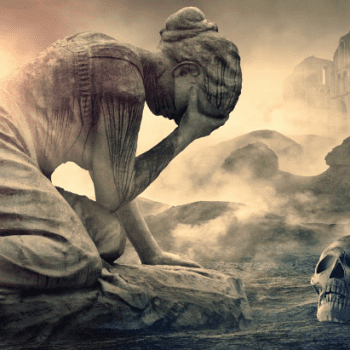
The Unawakened Life Sucks - The First Noble...
TRENDING AT PATHEOS Buddhist
On Taking Refuge in the Dharma
(Here I continue the feature of sharing talks and essays by teachers...
(Continuing my intention to share talks and essays by other members of Empty...
The Subtle Art of Bowing: A Dharma Discourse
(This presentation was first offered by my dear friend Dharma Holder Tom...

Internal Family Systems Can Heal you Mentally &...
How IFS Helped Me Stop Fighting Myself Internal Family Systems (IFS) is...

The Bible No One Spoke About: A Family’s...
A mysterious family Bible, unspoken faith, and a journey from curiosity to...

How Uncertainty Can Transform Your Life in 2025
Embracing Uncertainty: A New Year’s Resolution for the Brave As 2025 approaches,...
view all Buddhist blogs
Ad-Free & Subscriber Log-In Subscription Support
- About Us
- 2026 Calendar
- Videos
- Podcasts
- Library of World Religions
- Faith In Media Tracker
- Advertise With Us
- Write for Us
- Privacy Policy
- Terms of Service
- Do Not Sell My Data
- Contact Us
- Radiant Digital
- Manage Newsletter Subscriptions
- Unsubscribe From Notifications
- Sitemap
Copyright 2008-2026, Patheos, part of the Radiant Digital network of media brands. All rights reserved.
Subscription Support Ad-Free & Subscriber Log-In
Follow Patheos