
BuddhistCatholicContemplativeEvangelicalGeneral ChristianHinduJewishLatter-day SaintMuslimNew VisionsProgressive Christian
Beliefs
- Buddhist
- Catholic
- Contemplative
- Evangelical
- General Christian
- Hindu
- Jewish
- Latter-day Saint
- More Voices
- Muslim
- New Visions
- Pagan
- Progressive Christian
Topics
- Religion News
- Food and Religion
- Sports and Religion
- Religious Art
- Religious Music and Entertainment
- Religious Events
- History and Religion
- Style and Religion
- Politics and Religion
- Women in Religion
- Recreation Outdoors and Religion
- Business Finance and Religion
- Careers Workplace and Religion
- Education and Religion
- Family Parenting and Religion
- Health Fitness and Religion
- Home and Religion
- Relationships and Religion
- Technology and Religion
- Travel and Religion
Columnists
- Buddhist Columnists
- Business Finance and Religion Columnists
- Careers Workplace and Religion Columnists
- Catholic Columnists
- Contemplative Columnists
- Education and Religion Columnists
- Evangelists Columnists
- Family Parenting and Religion Columnists
- General Christian Columnists
- Health Fitness and Religion Columnists
- Hindu Columnists
- History and Religion Columnists
- Home and Religion Columnists
- Jewish Columnists
- More Voices Columnists
- Latter Day Columnists
- Muslim Columnists
- New Visions Columnists
- Nonreligious Columnists
- Pagan Columnists
- Politics and Religion Columnists
- Progressive Columnists
- Recreation Outdoors and Religion Columnists
- Relationships and Religion Columnists
- Religion News Columnists
- Religious Art Columnists
- Religious Events Columnists
- Religious Music and Entertainment Columnists
- Sports and Religion Columnists
- Style and Religion Columnists
- Technology and Religion Columnists
- Travel and Religion Columnists
- Women in Religion Columnists
Resource Library
- 2026 Calendar
- Library of World Religions
- The 100 Most Holy Places on Earth
- Patheos Answers
- Podcasts
- Videos
- Faith Leaders Database
- Anglican Episcopalian
- Bahai
- Baptist
- Buddhism
- Christianity
- Confucianism
- Eastern Orthodoxy
- Hinduism
- Holiness and Pentecostal
- ISKCON
- Islam
- Judaism
- Lutheran
- Methodist
- The Church of Jesus Christ of Latter-day Saints
- New Age
- Paganism
- Presbytarian and Reformed
- Protestantism
- Religion Behind the Scenes
- Roman Catholic
- Scientology
- Shia Islam
- Sikhism
- Sufism
- Sunni Islam
- Taoism
- Zen
- See all religions
Research Tools
 Ad-Free & Subscriber Log-In Subscription Support
Ad-Free & Subscriber Log-In Subscription Support
Follow Patheos 

- Trending:
- Forgiveness
- |
- Marriage
- |
- Consciousness
- |
- Death Penalty
- |
- Election
- |
- Halloween
 The Buddha Said
- Home
- Buddhist
- Is Buddhism a Religion?
Is Buddhism a Religion?
Last updated on: September 22, 2020 at 5:55 pm by Dr. Jay N. Forrest
Is Buddhism a Religion? 2020-09-22T17:55:58+06:00 Dr. Jay N. Forrest
Patheos Explore the world's faith through different perspectives on religion and spirituality! Patheos has the views of the prevalent religions and spiritualities of the world.
The Buddha said:
“The practitioner will find great joy and attain the state of final rest by having confidence in the Buddha’s religion, discovering the happiness of ending mental conditioning” (Dhp 381).
Is Buddhism a Religion? It seems like a simple question until you realize that there is little agreement on what Buddhism is or what religion is. Let’s start with the word religion.
What is Religion?
The social scientist J. Milton Yinger states, “Many studies of religion stumble over the first hurdle: the problem of definition” (3). This is because “there is no universally accepted definition of religion” (Crawford 3). It seems there are as many definitions as there are academic disciplines. As John Hick writes:
“Religion is one thing to the anthropologists, another to the sociologist, another to the psychologist (and again another to the next psychologist!), another to the Marxist, another to the mystic, another to the Zen Buddhist and yet another to the Jew or Christian. As a result there is a great variety of religious theories of the nature of religion. There is, consequently, no universally accepted definition of religion, and quite possibly there never will be” (Crawford 3).
But religion is a useful word. It helps us distinguish a human activity that is different from what animals do. Only humans are religious. As Tim Crane writes, “We should try to understand religion because without such an understanding we lack an adequate sense of a fundamental part of human civilization and its history, and we therefore lack a proper understanding of ourselves” (xi).
In approaching the word religion, it is good to remember the words of Jonathan Z. Smith, “Religion is solely the creation of the scholar’s study. It is created for the scholar’s analytic purposes by his imaginative acts of comparison and generalization” (xi). Its purpose, therefore, is to help us understand a human phenomenon.
Worship of God
The Paperback Oxford Dictionary defines religion as, “the belief in and worship of a God or gods.” This is the only kind of religion Westerners knew for centuries. They knew of the gods of ancient Greece and Rome, and the Pagans. But to them, religion was mostly dealing with Judaism, Christianity, and Islam. So religion had to do with God and the worship of God. But such a definition is short-sighted.
But as the religions of the East began to be known, they didn’t fit this mold. Buddhism, Daoism, and Jainism have no personal creator God like the Western religions, and so their religion has little to do with worshiping God. So if religion is defined by belief and worship of God, Buddhism, Daoism, and Jainism are not religions.
But since when does the world revolve around the West. Just because a religion is not like our religion doesn’t make it not a religion. Religion isn’t what we say it is, it should be descriptive of activities that deal with the transcendent or sacred. There is no other word for these human concerns. But our definition of religion should be descriptive not prescriptive.
A Definition of Religion
Buddhism, Daoism, and Jainism are religions and any definition of religion must not exclude them. So we need a definition of religion that is not too broad, not too narrow, and not biased. Too broad would be defining religion as “Ultimate Concern.” Too narrow would be defining religion as “the belief in and worship of a God or gods.” Too biased would be defining religion as a “virus” or an “illusion.”
Two definitions are really good. The first is from Tim Crane, he defines religion as “a systematic and practical attempt by human beings to find meaning in the world and their place in it, in terms of their relationship to something transcendent” (6). The second definition is by William E. Paden, he says “religion is generally used to mean a system of language and practice that organize the world in terms of what is deemed sacred” (10).
Others take a more functional approach to religion. As Michael Molloy states, “We may accept as a ‘religion’ whatever manifests a reasonable number of the following characteristics:” He then lists belief system, community, ethics, characteristic emotions (like devotion, liberation, inner peace, and bliss), ritual, and sacredness (7).
My definition of religion is that it is a worldview and way of life that is related to the Divine or sacred. That means that there are at least three elements in a religion, a worldview, a way of life, and something sacred. A worldview is the belief system or conceptual framework we use to see and interpret the world. A way of life deals with the personal, ethical, and social ways that we act in the world. And both these are related to the Divine or sacred. Judaism, Christianity, and Islam are all worldviews and ways of life related to God.
The Sacred in Buddhism
Buddhism is not a worldview and way of life that is related to God. You could say that early Buddhism was polytheistic since it acknowledges many “angels, demons, and Gods” (AN 4.23). But these gods are of little relevance to Buddhism, because they are, just like humans, stuck in the same cycle of rebirth. This is called samsara, which I translate as the “prison of rebirth.”
The bottom line is that these Gods are of no help in attaining freedom from the unsatisfactoriness of conditioned existence. So Buddhism is not related to the Divine, but it is related to the sacred. By sacred I mean, that which is honored, respected, and even reverenced.
In Buddhism, it is the Three Jewels that are sacred. They are the Buddha, the Doctrine (Pali, dhamma), and the Community (Pali, sangha). These are honored, respected, and reverenced by all Buddhists. I would argue that life itself is also sacred in Buddhism, since abstaining from taking life is the first of the Five Precepts of Buddhism.
Buddhist Worldview
The Buddhist worldview sees life through the conceptual framework of the Four Noble Truths. The first truth is that suffering characterizes the unawakened life. Suffering, which is better translated as unsatisfactoriness, refers to the unsatisfactoriness nature of life, which is a prison of endless suffering in a cycle of births and deaths. Suffering is all around us. Everything around us changes, breaks, dies, and fails to give lasting happiness. You can’t count on anything.
The second truth is that the cause of this suffering is craving, which goes back to ignorance of the true nature of reality. From ignorance spring attachment and aversion, which causes suffering.
The third truth is that we can awaken and cease our attachments and aversions, and therefore we can end suffering.
And the fourth truth is that the Buddha taught the Eightfold Noble Path that leads to the end of ignorance, attachment, and aversion, and therefore it leads to the end of suffering.
Buddhist Way of Life
The Dhammapada, the most popular Buddhist scripture, sums up the Buddhist way of life this way, “Avoid doing harm, cultivate good conduct, and purify one’s mind: This is the instruction of the Buddhas” (Dhp 183). In this one line, we have the ethical and spiritual aspirations of Buddhism.
The ethical code for Buddhists, in general, is summarized in the Five Precepts, there are more for monks and nuns. The Five Precepts are (1) to abstain from taking life; (2) to abstain from taking what is not given; (3) to abstain from sexual misconduct; (4) to abstain from false speech; and (5) to abstain from intoxicants that cloud the mind.
In addition to the ethical way of life, there is also a religious way of life. This includes developing virtues such as generosity, compassion, lovingkindness, and equanimity. And it includes spiritual disciplines such as chanting and meditation.
The Buddhist Religion
So Buddhism is a religion. In Pali, it is called Buddha-sasana. Bhikkhu Sucitto defines Buddha-sasana as “the Buddhist religion” (Sucitto 52). Here are two translations of the Dhammapada:
“When a bhikkhu applies himself when still young to the religion of the Buddha, he illuminates the world, like the moon breaking breaking away from a cloud” (Richards Dhp 382).
Here is an older translation.
“The monk yet young, who unto Buddha’s religion devoteth himself, brighteneth this world, as the moon from cloud set free” (Edmunds Dhp 382).
Buddhism is a religion because it is a worldview and way of life that is related to the sacred. But it is a unique religion. Most religions talk about getting right with God through repentance, faith, and obedience. To them, the problem is human sin. But Buddhism goes further.
The problem is not your relationship to God, your problem is your relationship to reality. You are in a prison of your own making, “hindered by ignorance and chained by craving” (SN 15.1). God did not make the law of karma, it is part of the system. God is subject to karma.
Is murder wrong because God forbids it, or does God forbid it because it’s wrong? Buddhism says the moral law existed before God. God forbids it because it is the law of conditioned existence. God is obligated to obey the moral law. As Alfred North Whitehead pointed out, “The actual world must always mean the community of all actual entities, including the primordial actual entity called ‘God’ and the temporal actual entities” (65).
Works Cited
- Crane, Tim. The Meaning of Belief: Religion from an Atheist’s Point of View. Cambridge, MA: Harvard University Press, 2017.
- Crawford, Robert G. What is Religion?: An Introducing the Study of Religion New York: Routledge, 2002.
- Edmunds, Albert Joseph, trans. Hymns of the Faith (Dhammapada): Being an Ancient Anthology Preserved in the Short Collection of the Sacred Scriptures of the Buddhists Chicago, IL: Open Court Publishing Company (1902).
- Molloy, Michael. Experiencing the World’s Religions: Tradition, Challenge, and Change. Mountain View, CA: Mayfield Publishing Company, 1999.
- Paden, William E. Religious Worlds: The Comparative Study of Religion. Boston: Beacon Press, 1994.
- Richards, John, trans. The Dhammapada. Pasadena, CA: Theosophical University Press, 1980. PDF file.
- Smith, Jonathan Z. Imagining Religion: From Babylon to Jonestown. New Haven: Yale University Press, 1987.
- Sucitto, Bhikkhu. Sangha Words: a Manual for Forest Sangha Publications. Revised Edition Version 1.2. Hemel Hempstead, England: Amaravati Publications, 2016. PDF file.
- Whitehead, Alfred North. Process and Reality: Corrected Edition. Ed. David Ray Giffin and Donald W. Sherburne. New York: The Free Press, 1985.
- Yinger, J. Milton. The Scientific Study of Religion. New York: MacMillan Publishing Co,, 1970.
Copyright © 2020 Jay N. Forrest. All Rights Reversed.
All scripture quotations, unless otherwise indicated, are by the author, some of which are modifications of the public domain translation by Bhikkhu Sujato for SuttaCentral.
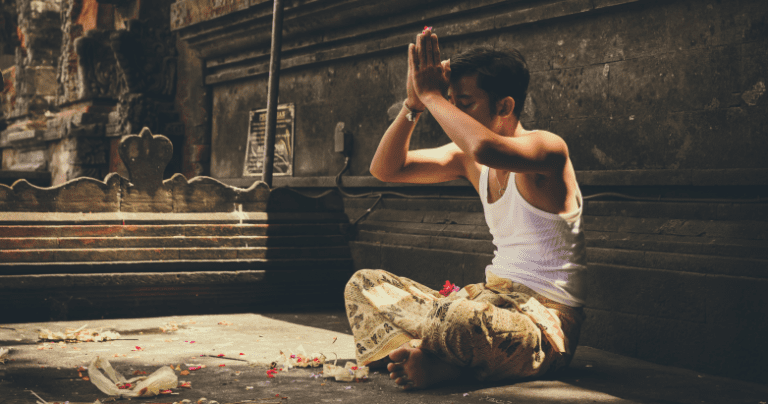
Image by Artem Beliaikin via Unsplash
About Jay N. Forrest
Dr. Jay N. Forrest is an American Buddhist teacher, an Ordained Humanist Minister, a Certified Meditation Teacher, and the author of over a dozen books. He is the host of the podcast “5 Minute Dharma” and a writer at Patheos. Following closely the Theravada tradition and the Pali Canon, Dr. Forrest gives you a reliable guide to the transforming truths of the historical Buddha. You can read more about the author here.
Previous Post

August 21, 2020
This Prison of Rebirth
Next Post

August 28, 2020 Attaining Nirvana - Complete Liberation
Browse Our Archives
Select a Category Buddhism
Select a Month October 2020 September 2020 August 2020
Follow Us!
TAKE THE
Religious Wisdom Quiz
What does 2 Peter say will come like a thief?
Select your answer to see how you score.
Judgment The Spirit The day of the Lord The end
Books by This Author Books by Dr. Jay N. Forrest
Related posts from The Buddha Said

Making a Business of the Dharma
Moral Character and Intention in the Dhammapada
The Unawakened Life Sucks - The First Noble...
TRENDING AT PATHEOS Buddhist

On Taking Refuge in the Dharma
(Here I continue the feature of sharing talks and essays by teachers...

(Continuing my intention to share talks and essays by other members of Empty...
The Subtle Art of Bowing: A Dharma Discourse
(This presentation was first offered by my dear friend Dharma Holder Tom...

Internal Family Systems Can Heal you Mentally &...
How IFS Helped Me Stop Fighting Myself Internal Family Systems (IFS) is...

The Bible No One Spoke About: A Family’s...
A mysterious family Bible, unspoken faith, and a journey from curiosity to...

How Uncertainty Can Transform Your Life in 2025
Embracing Uncertainty: A New Year’s Resolution for the Brave As 2025 approaches,...
view all Buddhist blogs
Ad-Free & Subscriber Log-In Subscription Support
- About Us
- 2026 Calendar
- Videos
- Podcasts
- Library of World Religions
- Faith In Media Tracker
- Advertise With Us
- Write for Us
- Privacy Policy
- Terms of Service
- Do Not Sell My Data
- Contact Us
- Radiant Digital
- Manage Newsletter Subscriptions
- Unsubscribe From Notifications
- Sitemap
Copyright 2008-2026, Patheos. All rights reserved.
Subscription Support Ad-Free & Subscriber Log-In
Follow Patheos