
BuddhistCatholicContemplativeEvangelicalGeneral ChristianHinduJewishLatter-day SaintMuslimNew VisionsProgressive Christian
Beliefs
- Buddhist
- Catholic
- Contemplative
- Evangelical
- General Christian
- Hindu
- Jewish
- Latter-day Saint
- More Voices
- Muslim
- New Visions
- Pagan
- Progressive Christian
Topics
- Religion News
- Food and Religion
- Sports and Religion
- Religious Art
- Religious Music and Entertainment
- Religious Events
- History and Religion
- Style and Religion
- Politics and Religion
- Women in Religion
- Recreation Outdoors and Religion
- Business Finance and Religion
- Careers Workplace and Religion
- Education and Religion
- Family Parenting and Religion
- Health Fitness and Religion
- Home and Religion
- Relationships and Religion
- Technology and Religion
- Travel and Religion
Columnists
- Buddhist Columnists
- Business Finance and Religion Columnists
- Careers Workplace and Religion Columnists
- Catholic Columnists
- Contemplative Columnists
- Education and Religion Columnists
- Evangelists Columnists
- Family Parenting and Religion Columnists
- General Christian Columnists
- Health Fitness and Religion Columnists
- Hindu Columnists
- History and Religion Columnists
- Home and Religion Columnists
- Jewish Columnists
- More Voices Columnists
- Latter Day Columnists
- Muslim Columnists
- New Visions Columnists
- Nonreligious Columnists
- Pagan Columnists
- Politics and Religion Columnists
- Progressive Columnists
- Recreation Outdoors and Religion Columnists
- Relationships and Religion Columnists
- Religion News Columnists
- Religious Art Columnists
- Religious Events Columnists
- Religious Music and Entertainment Columnists
- Sports and Religion Columnists
- Style and Religion Columnists
- Technology and Religion Columnists
- Travel and Religion Columnists
- Women in Religion Columnists
Resource Library
- 2026 Calendar
- Library of World Religions
- The 100 Most Holy Places on Earth
- Patheos Answers
- Podcasts
- Videos
- Faith Leaders Database
- Anglican Episcopalian
- Bahai
- Baptist
- Buddhism
- Christianity
- Confucianism
- Eastern Orthodoxy
- Hinduism
- Holiness and Pentecostal
- ISKCON
- Islam
- Judaism
- Lutheran
- Methodist
- The Church of Jesus Christ of Latter-day Saints
- New Age
- Paganism
- Presbytarian and Reformed
- Protestantism
- Religion Behind the Scenes
- Roman Catholic
- Scientology
- Shia Islam
- Sikhism
- Sufism
- Sunni Islam
- Taoism
- Zen
- See all religions
Research Tools
 Ad-Free & Subscriber Log-In Subscription Support
Ad-Free & Subscriber Log-In Subscription Support
Follow Patheos 

- Trending:
- Forgiveness
- |
- Marriage
- |
- Consciousness
- |
- Death Penalty
- |
- Election
- |
- Halloween
 The Ash Grove
- Home
- Pagan
- Traditions in Transition: Gender & Biology
Traditions in Transition: Gender & Biology
Last updated on: April 4, 2019 at 7:31 pm by Ashleigh “FoxBat” Smiley
Traditions in Transition: Gender & Biology 2019-04-04T19:31:12+00:00 Ashleigh “FoxBat” Smiley
Patheos Explore the world's faith through different perspectives on religion and spirituality! Patheos has the views of the prevalent religions and spiritualities of the world.
Sex, gender, and sexual orientation. These are three distinct forms of identity, and we each have our own combination of all three.
Gender (at least, my understanding of gender), is that thing which we feel about who we are and how we present ourselves to the world. I believe that gender is not something we choose; it is something integral to who we are, and we discover it over time for ourselves.
In the United States and much of the Western World, the dominant perception is that there are two genders: men, and women. You may have heard some folks refer to this system as the Gender Binary, meaning that in this system, there are only two gendered ways of being. I have purposefully chosen to say “men” instead of “male” and “women” instead of “female” to avoid some confusion later on.
There are of course, other cultures that recognize more than two genders. The Bugis people of Indonesia, for example, recognize five distinct gender identities: oroane (manly men), makkunrai (womanly women), calabai (womanly men), calalai (manly women), and bissu (half-male and half-female). Here is an article that discusses the Bugis and nine other cultures where there is more than one recognized gender identity. Wikipedia also does a fair job of explaining more in depth how other cultures have more gender diversity, and Independent Lens put out a “Map of Gender Diverse Cultures,” in 2015, which I highly recommend taking a peek at.
In the West, within the binary system, when we say “women,” we tend to identify femininity (a quality of gender) with people who have ovaries and a uterus (gonads and internal sex organs), and when we say “men,” we tend to mean that masculinity (again, a quality of gender) belongs to individuals who have a penis and testicles (external genitalia and gonads).
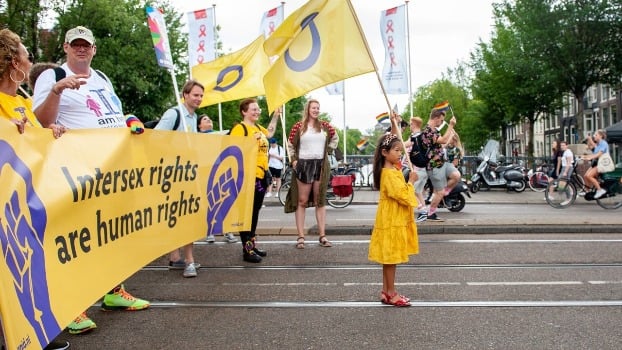
Romy Arroyo Fernandez/NurPhoto
Within the Pagan Community, there has been some disagreement around what are commonly referred to as “gendered spaces.” Pagan Spirit Gathering, for example, hosts rites of passage for adolescents, which are divided into two gendered categories: young men, and young women (i.e., boys and girls).
Most traditions of Dianic Wicca also exclude male (meaning people who have a penis and testicles) membership or participation in ritual. In some Dianic Covens, where men are not allowed, trans women (meaning here, people who identify as women, but who were born with what is perceived as male anatomy), present a conflict.
If, we define “women,” as only those born with a uterus and ovaries, and “men” as those born with a penis and testicles, then trans women are to be viewed as men, which is in direct conflict with their own gender identity. Furthermore, if we only recognize men and women by these sets of genital and gonad combinations, we entirely erase people who are intersex.
If you haven’t heard this term before, you’re not alone. Intersex, is the preferred term for folks who were born with a different combination of genitalia, gonads, chromosomes, internal sex organs, hormone production, hormone response, and secondary sexual characteristics (like body hair), than what is deemed “typical,” within a binary understanding of sex and gender.
And this… Is where things start to really break down.
I’ve had a few folks comment on previous articles in this series, discussing the “realities” of “biology.” How while gender is an experiential thing, biology is pretty black and white. How it is appropriate to have ritual spaces that are divided by what anatomical equipment we happen to possess. These folks cite science; they describe how bodies come in two forms, and that other forms are somehow deviant, outliers, or abnormal.
In her TED Talk video, “The way we think about biological sex is wrong,” intersex advocate, Emily Quinn, outlines some facts which are worth noting.
“Intersex people represent around 2% of the population. That’s the same percentage as genetic redheads. It’s about 150 million people, roughly, which is more than the entire population of Russia.”
Over the past decade, as recognition of transgender and intersex people has become more widespread, there have been misunderstandings and occasionally blatant bigotry, within the Pagan Community about what folks mean when they title things like, “Men’s Ritual,” or “Women’s Ritual.”
When we as a community qualify the ability of someone to participate in a ritual or group by what their anatomy is, rather than how they feel about themselves, we buy into the gender binary system. We affirm that there are only men and women; male and female. And, we deny the existence of trans people, non-binary people, and intersex people.
I find this particularly interesting, and sad, given the multiplicity within our own spiritual practices.
There are people on this planet who have XY chromosomes, who have male anatomy (penis/testicles), and people on this planet who have XY chromosomes, like Emily Quinn, who have both male and female anatomy (vagnia/internal testicles, no penis/uterus). There are many, many, many, combinations of chromosomes, hormone levels, and body parts, which all add up to biological sex… And none of which 100% determine someone’s gender identity.
I am very curious what those who advocate for “women-born-women” ritual spaces would do, or have done, when presented with someone like Emily Quinn… Someone who has half of what they consider to be female/correct, and half of what they consider to be male. Is is the external genitalia that matters? Which gonads we have? What our chromosomes say about us? Whether or not we bleed?
(I did take a moment to search Dianic.org for “transgender” and “intersex.” No search results.)
Again, I return to children. Intersex and transgender people have been purposefully erased from the mainstream for centuries. The mainstream has deemed their bodies inadequate, demanded that they be surgically “fixed,” and sought to push them firmly into the realm of sideshow curiosity. Children have been lied to, operated upon, and forced into identities that feel wrong, all in the name of “normalcy,” and perpetuating the binary systems of sex and gender.
I think, as Pagans, we’re better than that. I think we can be proactive in how we address these issues and teach the mainstream how it’s done.
Previous Post

March 31, 2019
Traditions in Transition: Transgender Children
Next Post
April 11, 2019 Traditions in Transition: Men as Mothers
Browse Our Archives
Select a Category Gender Issues Sabbat Solstice Uncategorized Winter Solstice Yule Yuletide
Select a Month April 2019 March 2019 March 2018 January 2018 December 2017
Follow Us!
TAKE THE
Religious Wisdom Quiz
What did Solomon build for foreign wives that angered God?
Select your answer to see how you score.
Ships at Tarshish Armies City walls High places (shrines)
Related posts from The Ash Grove
Traditions in Transition: Men as Mothers
Traditions in Transition: Transgender Children
Traditions in Transition: Rites of Passage for Trans...
Reflections on Nonprofits, Social Media, and "Normalcy"
TRENDING AT PATHEOS Pagan

I was recently chatting with someone on Instagram. She asked me what...

While there are many people who share their results, the end of...

On July 23, I saw Christopher Nolan's The Odyssey which is Homer’s...

As I write this two big events have just finished up. One...

Restoring the Watershed of Divine Love
Perhaps cooperation is not something we manufacture through legislation, ideology, or moral...

Many UUs don’t pray because of bad experiences in a previous religion,...
view all Pagan blogs
Ad-Free & Subscriber Log-In Subscription Support
- About Us
- 2026 Calendar
- Videos
- Podcasts
- Library of World Religions
- Faith In Media Tracker
- Advertise With Us
- Write for Us
- Privacy Policy
- Terms of Service
- Do Not Sell My Data
- Contact Us
- Radiant Digital
- Manage Newsletter Subscriptions
- Unsubscribe From Notifications
- Sitemap
Copyright 2008-2026, Patheos. All rights reserved.
Subscription Support Ad-Free & Subscriber Log-In
Follow Patheos