
BuddhistCatholicContemplativeEvangelicalGeneral ChristianHinduJewishLatter-day SaintMuslimNew VisionsProgressive Christian
Beliefs
- Buddhist
- Catholic
- Contemplative
- Evangelical
- General Christian
- Hindu
- Jewish
- Latter-day Saint
- More Voices
- Muslim
- New Visions
- Pagan
- Progressive Christian
Topics
- Religion News
- Food and Religion
- Sports and Religion
- Religious Art
- Religious Music and Entertainment
- Religious Events
- History and Religion
- Style and Religion
- Politics and Religion
- Women in Religion
- Recreation Outdoors and Religion
- Business Finance and Religion
- Careers Workplace and Religion
- Education and Religion
- Family Parenting and Religion
- Health Fitness and Religion
- Home and Religion
- Relationships and Religion
- Technology and Religion
- Travel and Religion
Columnists
- Buddhist Columnists
- Business Finance and Religion Columnists
- Careers Workplace and Religion Columnists
- Catholic Columnists
- Contemplative Columnists
- Education and Religion Columnists
- Evangelists Columnists
- Family Parenting and Religion Columnists
- General Christian Columnists
- Health Fitness and Religion Columnists
- Hindu Columnists
- History and Religion Columnists
- Home and Religion Columnists
- Jewish Columnists
- More Voices Columnists
- Latter Day Columnists
- Muslim Columnists
- New Visions Columnists
- Nonreligious Columnists
- Pagan Columnists
- Politics and Religion Columnists
- Progressive Columnists
- Recreation Outdoors and Religion Columnists
- Relationships and Religion Columnists
- Religion News Columnists
- Religious Art Columnists
- Religious Events Columnists
- Religious Music and Entertainment Columnists
- Sports and Religion Columnists
- Style and Religion Columnists
- Technology and Religion Columnists
- Travel and Religion Columnists
- Women in Religion Columnists
Resource Library
- 2026 Calendar
- Library of World Religions
- The 100 Most Holy Places on Earth
- Patheos Answers
- Podcasts
- Videos
- Faith Leaders Database
- Anglican Episcopalian
- Bahai
- Baptist
- Buddhism
- Christianity
- Confucianism
- Eastern Orthodoxy
- Hinduism
- Holiness and Pentecostal
- ISKCON
- Islam
- Judaism
- Lutheran
- Methodist
- The Church of Jesus Christ of Latter-day Saints
- New Age
- Paganism
- Presbytarian and Reformed
- Protestantism
- Religion Behind the Scenes
- Roman Catholic
- Scientology
- Shia Islam
- Sikhism
- Sufism
- Sunni Islam
- Taoism
- Zen
- See all religions
Research Tools
 Ad-Free & Subscriber Log-In Subscription Support
Ad-Free & Subscriber Log-In Subscription Support
Follow Patheos 

- Trending:
- Forgiveness
- |
- Marriage
- |
- Consciousness
- |
- Death Penalty
- |
- Election
- |
- Halloween
 The 40 Day Journey
- Home
- Progressive Christian
- Food and Religion
- Day 34: Setting the Table
Day 34: Setting the Table
Last updated on: March 28, 2015 at 1:01 am by Guest Contributor
Day 34: Setting the Table 2015-03-25T20:56:05-06:00 Guest Contributor
Patheos Explore the world's faith through different perspectives on religion and spirituality! Patheos has the views of the prevalent religions and spiritualities of the world.
(We’re revisiting this post from 2014.)
Setting the Table
by Jennifer Baker-Trinity
It’s quiet. The task is so mundane. Unfold the paper napkin. In the center, lay down the knife, then the fork, and then the spoon to make a wobbly tower and roll. Fold in the sides, roll away from you and fold some more. Take a strip of recycled paper (an old menu, perhaps), make a ring around the center and tape. Voila! The silverware is ready. It’s time to set the table.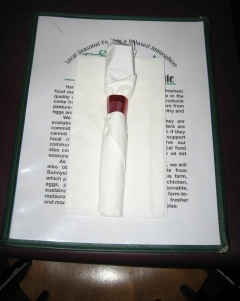
I am setting tables these days at a small restaurant in central Pennsylvania called Emma’s Food for Life. Emma’s specializes in local foods with much of the meat supplied by Emma’s own farm. When I scrape off the uneaten food from diners’ dirty dishes, it goes into a plastic bucket which, in turn, gets fed to the pigs, who then, in due time, become part of the BLT, ham melt or cider-glazed pork chops. For meat eaters, this is farm-to-table in the best sense of that phrase.
Some dine at Emma’s simply because they know good food when they taste it. Others come because they intentionally seek out local, humanely raised food. For them, eating local is a food justice issue. Once they have become aware of the high cost of America’s cheap, industrialized “food,” they try to make a difference by literally putting their money where their mouth is.
For those who can afford it or for those willing to sacrifice other expenses, they grace their tables with food grown or raised on land they have seen and from farmers they have met. Food, then, is not merely something bought and consumed; it is about caring for the relationships between the eater, the grower and the land. This care for right relationships is what we also call “justice.”
Years ago I had another mundane task as the sacristan of our seminary chapel. I spent some evenings laundering and ironing altar linens. Sometimes the work involved stain or wax removal. These tasks, like rolling silverware, were not exciting, but such quotidian chores were necessary to set another table, the weekly communion table.
In the book of Proverbs, we meet Lady Wisdom setting her table:
Wisdom has built her house, she has hewn her seven pillars. She has slaughtered her animals, she has mixed her wine, she has also set her table. She has sent out her servant-girls, she calls from the highest places in the town, ‘You that are simple, turn in here!’ To those without sense she says, ‘Come, eat of my bread and drink of the wine I have mixed. (Proverbs 9:1-5)
Here is a passage about the mundane stuff of living off of the land: building, slaughtering, mixing, and setting a table. This leads to the invitation, calling those, even the most “simple” to come and eat.
For those inside the church, we might hear the phrase “food justice” and call to mind work outside of the church’s primary gathering, the Sunday liturgy. We might think of canned food drives, food pantries, or community dinners. Food justice seems to be about what we do out there in the world; it can mean charity.
Without devaluing this necessary and holy work, I wonder, though, if we often overlook that first step in food justice: care for the table and those who gather around it. How much attention do worship leaders give to hospitality, to how the table is set and for whom? Does communion involve real bread? Do we know who baked it? Are the leftovers treated reverently? As we are sent back to our homes, how do we set and invite others to the table? Do we readily make the connections between the sanctuary table and the kitchen table? (For a profound example of how the Sunday communion table has been linked to a food pantry ministry, see the work of Sara Miles, especially her book Take this Bread.)
Justice is about right relationships. When I think about the many layers of food injustice, particularly as they relate to who eats and who does not, what we eat and at whose expense, I can be overwhelmed. I participate in systems that are unjust. I don’t always eat locally (as when I write this and sip my Starbuck’s latte!) Nor does the congregation where I serve as a church musician always make good choices, especially when the value of thrift outweighs the values of eating healthy or local.
Seeking wisdom in the area of food justice can lead us into a web of complicated relationships. Yet we can begin by noticing the simple things such as carefully setting the table.
In both church and home, we also clean the table and take care of the leftovers. In our home, we’ve begun a new post-meal ritual. I bring home a bucket from the restaurant. What scraps we don’t compost (to give life to our garden) go into this bucket. My two-year old drops in her scraps and says “pig” or “oink.” What formerly went in the trash now goes back to the restaurant then back to the farm to feed the pigs. Just as we don’t discard leftover communion bread into the trash but scatter it for the birds, likewise our home’s discarded sandwich crusts go to feed the earth’s creatures.
Setting and cleaning up, those chores we learned in childhood might not seem like much. During Lent, we attend to spiritual housecleaning, engaging in practices that call us more deeply into relationship with God and with one another. It might be something really revolutionary. Or it could be being surprised with how God shows up in the messy, everyday stuff of life, serving us wisdom when we least expect it, perhaps when setting the table or feeding the pigs.
———————
Photos by Jennifer Baker-Trinity
Jennifer Baker-Trinity lives and writes in Middleburg, Pennsylvania, a rural town in the heart of the Susquehanna Valley. A church musician, she enjoys creating, thinking, and writing at the intersections of music, worship and theology. She serves as church musician at Beaver Lutheran Church in Beaver Springs, Pennsylvania. She is married to Nathan Baker-Trinity and they have three young children. As the “Baker” in Baker-Trinity, she is passionate about real food and the stewardship of God’s good earth. She contributes to publications by Augsburg Fortress Publishers and blogs at giftsabounding.blogspot.com.
———————————-
Lenten Calendar for MARCH 28
Read Daniel 1:1-21. Do you feel that your faith commands you to make particular food choices? Discuss them with someone.
————————————
Sign up to receive the daily meditations by email, or like us on Facebook.
We need your stories!
We’re already looking ahead to the 40 Days for Food Justice Project for 2016 and we’re looking for more stories, experiences, prayers and resources about food justice and food injustice.
If you would like to contribute – or would like to recommend a contributor – please send us an email and let us know.
About:
In addition to being the founder and editor-in-chief of the “40 Days for Food Justice Project”, the Rev. MargaretAnne Overstreet is a mom, a Presbyterian pastor, and a certified Health Coach. She does ministry with and among the good people of Westminster Presbyterian Church in Belleville, Illinois, where she gets her hands dirty in the community garden and, every Sunday, preaches with bare feet. She treasures family time, relishes every opportunity to teach and write about food justice, and loves to play outside with her dogs. Find out more about her at www.AnInBetweenPlace.com

Previous Post

March 27, 2015
Day 33: Love Your New Hampshire Red as Yourself
Browse Our Archives
Select a Category Food Justice
Select a Month March 2015 February 2015 April 2014 March 2014 January 2014
Follow Us!
TAKE THE
Religious Wisdom Quiz
How many men did Gideon keep from the 32,000?
Select your answer to see how you score.
500 200 300 400
Related posts from The 40 Day Journey
Day 33: Love Your New Hampshire Red as...
Day 32: Food Justice Through Agroecology
TRENDING AT PATHEOS Progressive Christian

What Being a Modern-Day Apostle Means to Me
In my last column, I discussed the ins and outs of modern-day...

Did Ancient China Once Worship the God of...
Across human history, a common thread weaves through the origins of the...

Love Your Neighbor – Including Earth-Kin: Lev. 19,...
God’s command to love your neighbor means acting in an ethical and...

Lead a Church Study of “Jesus and Lao...
Guest writer Jack Thomas (The Irreverent Reverend) reflects on leading his church...

Pastoral Wisdom for Responding to Sermon Pushback
Getting sermon pushback on your social justice sermon? Learn practical, Proverbs-based strategies...

Principles for Understanding the Apostolic Ministry Today
Whenever people discover that my formal ministry title is "apostle," as in...
view all Progressive Christian blogs
Ad-Free & Subscriber Log-In Subscription Support
- About Us
- 2026 Calendar
- Videos
- Podcasts
- Library of World Religions
- Faith In Media Tracker
- Advertise With Us
- Write for Us
- Privacy Policy
- Terms of Service
- Do Not Sell My Data
- Contact Us
- Radiant Digital
- Manage Newsletter Subscriptions
- Unsubscribe From Notifications
- Sitemap
Copyright 2008-2026, Patheos. All rights reserved.
Subscription Support Ad-Free & Subscriber Log-In
Follow Patheos