
BuddhistCatholicContemplativeEvangelicalGeneral ChristianHinduJewishLatter-day SaintMuslimNew VisionsProgressive Christian
Beliefs
- Buddhist
- Catholic
- Contemplative
- Evangelical
- General Christian
- Hindu
- Jewish
- Latter-day Saint
- More Voices
- Muslim
- New Visions
- Pagan
- Progressive Christian
Topics
- Religion News
- Food and Religion
- Sports and Religion
- Religious Art
- Religious Music and Entertainment
- Religious Events
- History and Religion
- Style and Religion
- Politics and Religion
- Women in Religion
- Recreation Outdoors and Religion
- Business Finance and Religion
- Careers Workplace and Religion
- Education and Religion
- Family Parenting and Religion
- Health Fitness and Religion
- Home and Religion
- Relationships and Religion
- Technology and Religion
- Travel and Religion
Columnists
- Buddhist Columnists
- Business Finance and Religion Columnists
- Careers Workplace and Religion Columnists
- Catholic Columnists
- Contemplative Columnists
- Education and Religion Columnists
- Evangelists Columnists
- Family Parenting and Religion Columnists
- General Christian Columnists
- Health Fitness and Religion Columnists
- Hindu Columnists
- History and Religion Columnists
- Home and Religion Columnists
- Jewish Columnists
- More Voices Columnists
- Latter Day Columnists
- Muslim Columnists
- New Visions Columnists
- Nonreligious Columnists
- Pagan Columnists
- Politics and Religion Columnists
- Progressive Columnists
- Recreation Outdoors and Religion Columnists
- Relationships and Religion Columnists
- Religion News Columnists
- Religious Art Columnists
- Religious Events Columnists
- Religious Music and Entertainment Columnists
- Sports and Religion Columnists
- Style and Religion Columnists
- Technology and Religion Columnists
- Travel and Religion Columnists
- Women in Religion Columnists
Resource Library
- 2026 Calendar
- Library of World Religions
- The 100 Most Holy Places on Earth
- Patheos Answers
- Podcasts
- Videos
- Faith Leaders Database
- Anglican Episcopalian
- Bahai
- Baptist
- Buddhism
- Christianity
- Confucianism
- Eastern Orthodoxy
- Hinduism
- Holiness and Pentecostal
- ISKCON
- Islam
- Judaism
- Lutheran
- Methodist
- The Church of Jesus Christ of Latter-day Saints
- New Age
- Paganism
- Presbytarian and Reformed
- Protestantism
- Religion Behind the Scenes
- Roman Catholic
- Scientology
- Shia Islam
- Sikhism
- Sufism
- Sunni Islam
- Taoism
- Zen
- See all religions
Research Tools
 Ad-Free & Subscriber Log-In Subscription Support
Ad-Free & Subscriber Log-In Subscription Support
Follow Patheos 

- Trending:
- Forgiveness
- |
- Marriage
- |
- Consciousness
- |
- Death Penalty
- |
- Election
- |
- Halloween
 The Big Picture
- Home
- Careers, Workplace and Religion
- A different war on poverty
A different war on poverty
Last updated on: March 24, 2014 at 8:59 pm by Made to Flourish
A different war on poverty 2014-03-15T21:45:05+00:00 Made to Flourish
Patheos Explore the world's faith through different perspectives on religion and spirituality! Patheos has the views of the prevalent religions and spiritualities of the world.
 Greg Forster
America recently celebrated a troublesome anniversary – the 50th year of its “war on poverty.” To understand why poverty has proved so stubborn in the face of so many huge programs designed to combat it, we must look even further back. The story of aid for the poor in the last century reveals the sharp distinction between fighting a war with carnal weapons and fighting a war with divine power (II Corinthians 10:4).
In the late 19th century, evangelicals created the urban missions movement amid a sense of crisis about the conditions of America’s growing cities. Older models of aid for the poor were originally designed for an agricultural society, with its slow pace of change and almost unbreakable familial and tribal bonds. These models took for granted that people would rely on each other in household units, that people who were able to work would do so, that destructive behavioral issues would be confronted by family and society, and so forth. In the new context of growing industrial cities, however, these approaches began to facilitate alcoholism, detachment from work, family breakdown, and dependency.
The urban missions movement created an entirely new model of help for the poor. It provided material assistance for short-term needs, but its primary focus was building and rebuilding relationships, developing the capacity for work, training people in social skills, and confronting behavioral problems such as alcoholism, family breakdown, and detachment. The results were transformative and helped countless thousands of people emerge from poverty into the dignity of self-support. This beautiful story of pastoral entrepreneurship is chronicled in Marvin Olasky’s “The Tragedy of American Compassion.”
Unfortunately, as Olasky’s title suggests, the next chapter of the story was less heartening. The leading national institutions of American culture – government, business, and church denominations alike – looked at this success and thought they could do even better. If concerted efforts for the poor led by small, local, loosely organized and poorly funded missions churches were highly effective, just think how much could be accomplished by a huge, well-organized, and lavishly funded national bureaucracy!
The story from there became a long, slow process of quantitative growth and qualitative decline. The urban missions movement gave people money and resources for short-term needs, but their focus was on fighting poverty with spiritual weapons: the gospel, restorative relationships, personal development, confronting behavioral issues. As efforts transitioned from local, entrepreneurial, church-based programs to large government bureaucracies, the focus inevitably shifted to carnal weapons – primarily money.
For a long time, this shift was hidden from view because the new programs promised to sustain the relational focus of the old programs. They continued to swear loyalty to the supreme value of relationships, development, and work. They insisted they were going to end dependency, not create it.
Lyndon Johnson’s “unconditional declaration of war on poverty” in 1964, which represented the culmination of this trend away from local churches to government bureaucracies, was no exception. Attorney General Robert Kennedy appeared before Congress to invoke the legacy of his assassinated brother in the name of completely eliminating not only poverty, but also dependency. Later that year, when Johnson signed the Economic Opportunity Act, he said bluntly:
This is not in any sense a cynical proposal to exploit the poor with a promise of a handout or a dole…We want to offer the forgotten fifth of our people opportunity and not doles…The days of the dole in our country are numbered. I firmly believe that as of this moment a new day of opportunity is dawning and a new era of progress is opening for us all.
But it didn’t turn out that way. The carnal weapon of money proved incapable of cultivating relationships, developing people, and confronting behavioral issues.
Worse, it turned out that carnal weapons could do more harm than good. The implicit lesson of the new programs was that money, not work and relationships, was the supreme value of economic life. In this light, it became almost impossible for people to view work as something that had intrinsic dignity or meaning. And as poverty programs offered themselves to mothers as breadwinners, the traditional role of the husband as a provider was diminished. Without the economic independence of the household, which is the basis of the economic interdependence of husband and wife, marriage no longer made sense or seemed highly valuable to many people.
In a chapter he contributed to a book about Christian leadership and black Americans, “Keep Your Head Up,” Bruce Fields of Trinity Evangelical Divinity School drew upon wisdom from Augustine to illustrate why spiritual weapons should return to the forefront of our war on poverty. He wrote:
The Great Society had noble goals. Many involved in the formulation and implementation of the program wanted “abundance and liberty for all, an end to poverty, an end to racial injustice.” But harmful developments in the black family began to emerge, despite good intentions and government “equalization” programs.
From a biblical/theological perspective, I believe that the Great Society invited a radical departure from a focus and dependence upon God and his ways for solutions to the problems facing blacks in America. The embrace of the Great Society was essentially the movement from dependence on the one true God to dependence on the human institution of government.
This effect was not limited to black Americans. The contribution of welfare programs to the decline of family and work among white Americans has been nearly identical.
The good news is, as Luther said, that the Spirit and the gifts are ours. God’s steadfast love and mercies are new every morning (Lamentations 3:22-23). We can create alternative approaches. Many churches and ministries are already doing so.
The presence of carnal programs does present an obstacle. It is a lot harder to draw people into relationship and wholeness when they can just walk down the street for a welfare check. But the obstacle is not insurmountable. While evangelicals were busy with other things, the Mormon faith community has been hard at work on this problem for a century, with impressive results.
Nothing but our own lack of imagination and entrepreneurial drive is holding us back from developing approaches to poverty focused on fighting with spiritual weapons. Let’s roll up our sleeves and get to work.
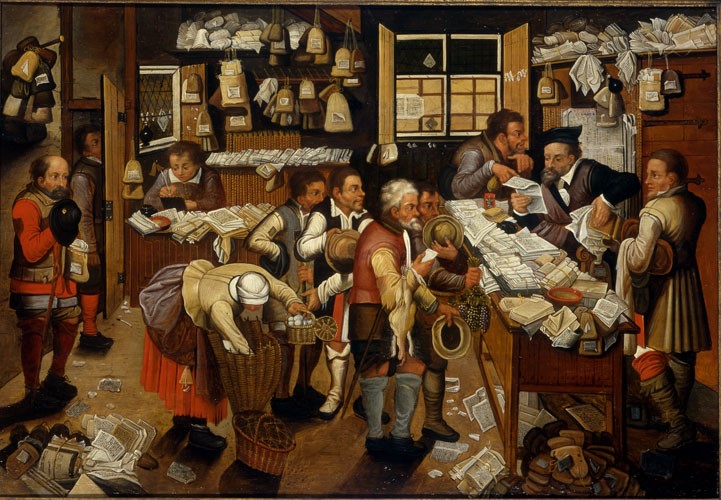
From the Kern Pastors Network. Image: Pieter Brueghel the Younger, “The Peasant Lawyer.” Courtesy of the Grohmann Museum at the Milwaukee School of Engineering.
Previous Post

March 20, 2014
Christian creativity
Next Post
March 26, 2014 The foundations of finance are created by God
Browse Our Archives
Select a Category Common Good Economics Entrepreneurship
Select a Month April 2014 March 2014 February 2014 January 2014 December 2013
TAKE THE
Religious Wisdom Quiz
Which book comes last in the New Testament?
Select your answer to see how you score.
Acts Jude Revelation 2 Peter
Related posts from The Big Picture

Five myths about the millennial worker

Do you need resources? Of course you do
Does the moral consensus on human trafficking apply...

TRENDING AT PATHEOS Careers, Workplace and Religion

St. Francis by Bill Droel Pope Leo XIV declares 2026 as “Year...

Catholics are schooled in the faith by memorizing dogmatic points and lots...

The Good News of Our Human Limitations -...
After another day of trying to meet deadlines and working on projects,...

Quiet Holy Attentiveness (podcast) with Sarah Clarkson
We know that quiet is an essential aspect of the spiritual life,...

Every Vocation Everywhere All At Once
What is a vocation? How does it endure through the years? Can...

I promise this is not going to become a Taylor Swift Studies...
view all Careers, Workplace and Religion blogs
Ad-Free & Subscriber Log-In Subscription Support
- About Us
- 2026 Calendar
- Videos
- Podcasts
- Library of World Religions
- Faith In Media Tracker
- Advertise With Us
- Write for Us
- Privacy Policy
- Terms of Service
- Do Not Sell My Data
- Contact Us
- Radiant Digital
- Manage Newsletter Subscriptions
- Unsubscribe From Notifications
- Sitemap
Copyright 2008-2026, Patheos. All rights reserved.
Subscription Support Ad-Free & Subscriber Log-In
Follow Patheos