
BuddhistCatholicContemplativeEvangelicalGeneral ChristianHinduJewishLatter-day SaintMuslimNew VisionsProgressive Christian
Beliefs
- Buddhist
- Catholic
- Contemplative
- Evangelical
- General Christian
- Hindu
- Jewish
- Latter-day Saint
- More Voices
- Muslim
- New Visions
- Pagan
- Progressive Christian
Topics
- Religion News
- Food and Religion
- Sports and Religion
- Religious Art
- Religious Music and Entertainment
- Religious Events
- History and Religion
- Style and Religion
- Politics and Religion
- Women in Religion
- Recreation Outdoors and Religion
- Business Finance and Religion
- Careers Workplace and Religion
- Education and Religion
- Family Parenting and Religion
- Health Fitness and Religion
- Home and Religion
- Relationships and Religion
- Technology and Religion
- Travel and Religion
Columnists
- Buddhist Columnists
- Business Finance and Religion Columnists
- Careers Workplace and Religion Columnists
- Catholic Columnists
- Contemplative Columnists
- Education and Religion Columnists
- Evangelists Columnists
- Family Parenting and Religion Columnists
- General Christian Columnists
- Health Fitness and Religion Columnists
- Hindu Columnists
- History and Religion Columnists
- Home and Religion Columnists
- Jewish Columnists
- More Voices Columnists
- Latter Day Columnists
- Muslim Columnists
- New Visions Columnists
- Nonreligious Columnists
- Pagan Columnists
- Politics and Religion Columnists
- Progressive Columnists
- Recreation Outdoors and Religion Columnists
- Relationships and Religion Columnists
- Religion News Columnists
- Religious Art Columnists
- Religious Events Columnists
- Religious Music and Entertainment Columnists
- Sports and Religion Columnists
- Style and Religion Columnists
- Technology and Religion Columnists
- Travel and Religion Columnists
- Women in Religion Columnists
Resource Library
- 2026 Calendar
- Library of World Religions
- The 100 Most Holy Places on Earth
- Patheos Answers
- Podcasts
- Videos
- Faith Leaders Database
- Anglican Episcopalian
- Bahai
- Baptist
- Buddhism
- Christianity
- Confucianism
- Eastern Orthodoxy
- Hinduism
- Holiness and Pentecostal
- ISKCON
- Islam
- Judaism
- Lutheran
- Methodist
- The Church of Jesus Christ of Latter-day Saints
- New Age
- Paganism
- Presbytarian and Reformed
- Protestantism
- Religion Behind the Scenes
- Roman Catholic
- Scientology
- Shia Islam
- Sikhism
- Sufism
- Sunni Islam
- Taoism
- Zen
- See all religions
Research Tools
 Ad-Free & Subscriber Log-In Subscription Support
Ad-Free & Subscriber Log-In Subscription Support
Follow Patheos 

- Trending:
- Forgiveness
- |
- Marriage
- |
- Consciousness
- |
- Death Penalty
- |
- Election
- |
- Halloween
 The Big Picture
- Home
- Careers, Workplace and Religion
- Business as moral community
Business as moral community
Last updated on: February 18, 2014 at 8:10 pm by Made to Flourish
Business as moral community 2014-02-18T20:10:48+00:00 Made to Flourish
Patheos Explore the world's faith through different perspectives on religion and spirituality! Patheos has the views of the prevalent religions and spiritualities of the world.
 By Drew Cleveland
“Can the business firm produce goods and services, excel at serving the customer, make money, create wealth for shareholders, and also be a moral community for the development of human character?” –Bill Pollard
Integrating faith with the demands of work is a challenge many Christians face. Two men with a lot of insight on faith, business ethics, integrity, and leadership recently sat down to discuss this challenge: Al Erisman of Seattle Pacific University and Bill Pollard, retired CEO of ServiceMaster and professor emeritus at Wheaton College. They recorded a video conversation about the God-honoring business model, thoughts on Peter Drucker, and the struggles of godly leaders in corporate management.
In that conversation Pollard states that he believes leadership is an awesome responsibility, and one we shouldn’t be too quick to pursue. Leadership is a means, not the ends, and the ends are the people who follow: “We don’t lead and manage things, we lead and manage people.”
In order to do this well, a leader needs to understand the human condition. As human beings, who are we? What kind of people are we becoming? How does our work contribute or detract from this?
Work, workplaces, and indeed, whole corporate structures are opportunities for character formation, for “becoming,” and for productive service. Leaders and managers are responsible for cultivating such opportunities. Pollard tells a story of a newly hired manager whom he challenged to take true ownership of his managerial responsibilities – which, in Pollard’s view, included the flourishing of all the individual workers under the manager’s care.
But isn’t the real point of business to make money? Doesn’t this sound like an overly idealistic, unsustainable “people over profit” model? So Pollard asks: “Can the business firm produce goods and services, excel at serving the customer, make money, create wealth for shareholders, and also be a moral community for the development of human character?”
In other places, Pollard has told the story of how he illustrated this tension with his senior executives. The four objectives of ServiceMaster are:
- Honor God in All We Do
- Help People Develop
- Pursue Excellence
- Grow Profitably
Pollard had each phrase carved into a little wooden block, and placed each block on a larger wooden platform. They line up perfectly, neatly displaying the values of the company. But then he added a small triangle underneath the platform to represent the reality of daily operations and decision-making. No matter how hard you tried, when you placed the blocks on the platform, and the platform on the triangle, it would always tip over, causing the blocks to tumble across the desk.
Core values are necessary for healthy businesses–and churches. They look great on the website and seem feasible on paper, but we all know things get messy in the reality of daily life and ministry. The blocks will never balance perfectly this side of glory. But by God’s grace, that doesn’t mean the institution is thoroughly corrupt, or that we shouldn’t strive to create value through economic enterprise.
Pastors**,** here’s a thought to ponder. Your church probably has a mission statement, a set of core values, and/or a strategic plan, which may include things like “loving God and loving your neighbor,” “making and nurturing faithful disciples of Jesus,” and remaining faithful to biblical doctrines, creeds, and/or church structure. How often do you perfectly live up to those aims?
In reality, perhaps only some of your congregants show up on Sunday, and perhaps only half of them listen to your sermon. Maybe there’s some internal drama among your leadership over some petty issue, your own kids might be the worst in the youth group, or biblical illiteracy may be rampant. The “blocks are tumbling across your desk,” as it were.
So when you hear people advocating the virtues of business, free markets, and economic flourishing, remember they are speaking about the purpose and potential of an enterprise (as an institution). No institutions fully live into their intended purpose or up to their God-designed potential, but that doesn’t discount their vital role in society.
In a similar way, the institution of church often fails to live into, and up to, its created design and mandate. Why are we comfortable extending grace to the broken community of the institutional church, but often not to the collective daily work of Christians in the business world – or any other institution for that matter? Do not believers – the church – do their daily work for the glory of God in each of those institutions?
I’m grateful for people like Bill Pollard who faithfully wrestle with the realities of a God-honoring, value-creating, for-profit business model. In a business environment, he has helped provide opportunities for tens of thousands of people to live into the productive potential God made them for – and in doing so, created moral communities that cultivated character and raised the question of God in many hearts.
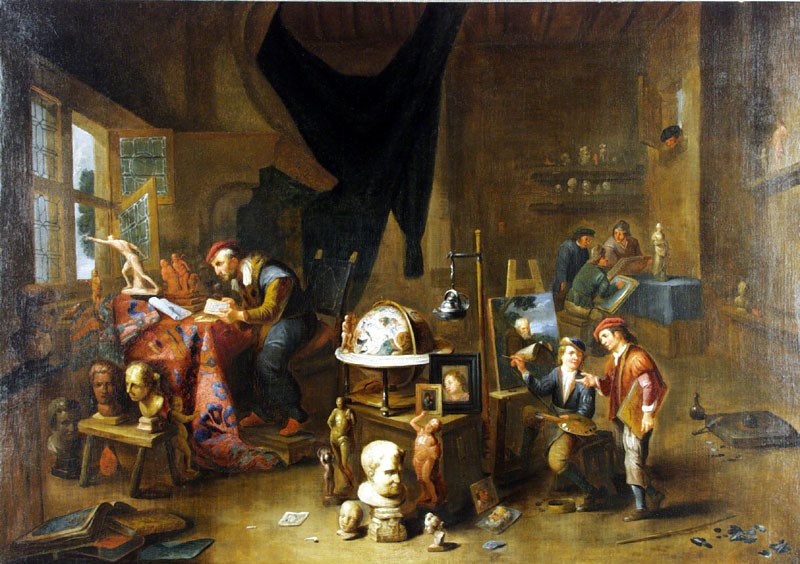
Adapted from the Kern Pastors Network. Image: “Studio of a Painter and Sculptor,” Gerard Thomas. Courtesy of the Grohmann Museum.
Previous Post

April 26, 2014
Five myths about the millennial worker
Next Post
December 20, 2013 Pastors, seminary students, and economics
Browse Our Archives
Select a Category Common Good Economics Entrepreneurship
Select a Month April 2014 March 2014 February 2014 January 2014 December 2013
TAKE THE
Religious Wisdom Quiz
What did Israel ask Samuel for despite his warnings?
Select your answer to see how you score.
A prophet A new Tabernacle A palace A king
Related posts from The Big Picture

Five myths about the millennial worker

Do you need resources? Of course you do

Does the moral consensus on human trafficking apply...

TRENDING AT PATHEOS Careers, Workplace and Religion

St. Francis by Bill Droel Pope Leo XIV declares 2026 as “Year...

Catholics are schooled in the faith by memorizing dogmatic points and lots...

The Good News of Our Human Limitations -...
After another day of trying to meet deadlines and working on projects,...

Quiet Holy Attentiveness (podcast) with Sarah Clarkson
We know that quiet is an essential aspect of the spiritual life,...

Every Vocation Everywhere All At Once
What is a vocation? How does it endure through the years? Can...

I promise this is not going to become a Taylor Swift Studies...
view all Careers, Workplace and Religion blogs
Ad-Free & Subscriber Log-In Subscription Support
- About Us
- 2026 Calendar
- Videos
- Podcasts
- Library of World Religions
- Faith In Media Tracker
- Advertise With Us
- Write for Us
- Privacy Policy
- Terms of Service
- Do Not Sell My Data
- Contact Us
- Radiant Digital
- Manage Newsletter Subscriptions
- Unsubscribe From Notifications
- Sitemap
Copyright 2008-2026, Patheos. All rights reserved.
Subscription Support Ad-Free & Subscriber Log-In
Follow Patheos