
BuddhistCatholicContemplativeEvangelicalGeneral ChristianHinduJewishLatter-day SaintMuslimNew VisionsProgressive Christian
Beliefs
- Buddhist
- Catholic
- Contemplative
- Evangelical
- General Christian
- Hindu
- Jewish
- Latter-day Saint
- More Voices
- Muslim
- New Visions
- Pagan
- Progressive Christian
Topics
- Religion News
- Food and Religion
- Sports and Religion
- Religious Art
- Religious Music and Entertainment
- Religious Events
- History and Religion
- Style and Religion
- Politics and Religion
- Women in Religion
- Recreation Outdoors and Religion
- Business Finance and Religion
- Careers Workplace and Religion
- Education and Religion
- Family Parenting and Religion
- Health Fitness and Religion
- Home and Religion
- Relationships and Religion
- Technology and Religion
- Travel and Religion
Columnists
- Buddhist Columnists
- Business Finance and Religion Columnists
- Careers Workplace and Religion Columnists
- Catholic Columnists
- Contemplative Columnists
- Education and Religion Columnists
- Evangelists Columnists
- Family Parenting and Religion Columnists
- General Christian Columnists
- Health Fitness and Religion Columnists
- Hindu Columnists
- History and Religion Columnists
- Home and Religion Columnists
- Jewish Columnists
- More Voices Columnists
- Latter Day Columnists
- Muslim Columnists
- New Visions Columnists
- Nonreligious Columnists
- Pagan Columnists
- Politics and Religion Columnists
- Progressive Columnists
- Recreation Outdoors and Religion Columnists
- Relationships and Religion Columnists
- Religion News Columnists
- Religious Art Columnists
- Religious Events Columnists
- Religious Music and Entertainment Columnists
- Sports and Religion Columnists
- Style and Religion Columnists
- Technology and Religion Columnists
- Travel and Religion Columnists
- Women in Religion Columnists
Resource Library
- 2026 Calendar
- Library of World Religions
- The 100 Most Holy Places on Earth
- Patheos Answers
- Podcasts
- Videos
- Faith Leaders Database
- Anglican Episcopalian
- Bahai
- Baptist
- Buddhism
- Christianity
- Confucianism
- Eastern Orthodoxy
- Hinduism
- Holiness and Pentecostal
- ISKCON
- Islam
- Judaism
- Lutheran
- Methodist
- The Church of Jesus Christ of Latter-day Saints
- New Age
- Paganism
- Presbytarian and Reformed
- Protestantism
- Religion Behind the Scenes
- Roman Catholic
- Scientology
- Shia Islam
- Sikhism
- Sufism
- Sunni Islam
- Taoism
- Zen
- See all religions
Research Tools
 Ad-Free & Subscriber Log-In Subscription Support
Ad-Free & Subscriber Log-In Subscription Support
Follow Patheos 

- Trending:
- Forgiveness
- |
- Marriage
- |
- Consciousness
- |
- Death Penalty
- |
- Election
- |
- Halloween

- Home
- Catholic
- Religion News
- Election of Bishop Sithembele Sipuka And Synod on Synodality
Election of Bishop Sithembele Sipuka And Synod on Synodality
Last updated on: October 30, 2024 at 7:29 am by Laurika Nxumalo
Election of Bishop Sithembele Sipuka And Synod on Synodality 2024-10-30T07:29:24+02:00 Laurika Nxumalo
Patheos Explore the world's faith through different perspectives on religion and spirituality! Patheos has the views of the prevalent religions and spiritualities of the world.
In October 2021, Pope Francis opened the Synod on Synodality; a 3-year cycle of listening, discernment, and dialogue, which is set to conclude this month. As this cycle comes to a close, it opens a new chapter in South Africa. On Wednesday, 16 October 2024, Bishop Sithembele Anton Sipuka, the current President of the Southern African Catholic Bishops Conference (SACBC) was elected, unopposed as the new President of the South African Council of Churches (SACC) The election took place at the council’s triennial conference.
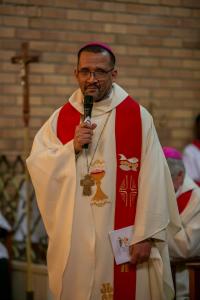
Bishop Sithembele Sipuka. Photo by Sacred Photos (Facebook)
The South African Council of Churches (SACC) is South Africa’s ecumenical council, which has had a significant impact on the country’s religious, political, and social landscape. Since its inception in 1968, the SACC has amplified the prophetic voice of Christian churches to advocate for social justice, pushing churches to be actively involved in fighting any injustice in the South African society. Due to its involvement in the anti-apartheid movement and post-apartheid reconstruction, the South African Council of Churches has been a very influential faith based council in the Republic of South Africa.
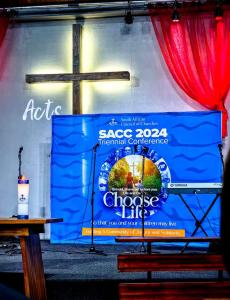
Photo by Author
The SACC has struggled to preserve its relevance in a democratic South Africa since the end of apartheid. As the political landscape changed, some questioned the SACC’s purpose, citing the decreased necessity for churches to serve as the primary opposition to any failure in government. Nonetheless, the council has refocused its goal to address current issues such as poverty, injustice, and corruption.
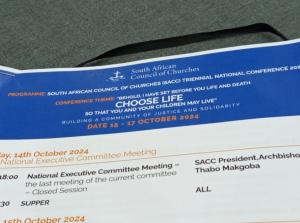
Photo by Author
The South African Council of Churches goals align with the mission of the Catholic Church. As a member church, the Catholic Church, through its leadership, has been working with other denominations to support the SACC’s mission of promoting social justice, addressing poverty, and bringing peace. Even though the Catholic Church remains distinct in its theological practices, being affiliated to the SACC highlights the Church’s commitment to ecumenism, which emphasizes collaboration among Christians of different traditions for the greater good of society.
The election of Bishop Sipuka presents a unique opportunity to advance the ecumenical mission of the Church in South Africa. The principles of synodality—listening, dialogue, and discernment—are also key to ecumenism. By fostering a culture of dialogue within Christian churches, the synodal process can spill over into ecumenical dialogue, making the Catholic Church more open to hearing the voices and experiences of other Christian communities.
In a 2019 interview with the Southern Cross, a Catholic publication in South Africa, Bishop Sipuka was asked about his take on the priorities and challenges that South Africa has to deal with – he said,
“The Church needs to play a critical part in engaging civil servants in government and remind them of their call to serve instead of behaving like feudal lords who do what they like with impunity.
Yet, as we try to improve the material wellbeing of all South Africans, we must also stay awake to the danger of materialism and individualism.”
Bishop Sithembele is a member of the Catholic clergy who is known to be determined, reliable, and practical. One prominent characteristic of his is persistence. When he believes in something, he will work tirelessly to see it through. He is someone who is not easily deterred or discouraged from his mission. Bishop Sithembele is not driven by fleeting passion but by a deep, internal sense of purpose. He approaches social justice with practicality. He sees the world not as it should be, but as it is, and works from that foundation to create realistic, achievable goals. His pragmatic mindset allows him to break down complex social issues into manageable parts, making his action plan strategic and effective. His grounded nature allows him to see through lofty promises and rhetoric; he is then able to focus on actions that will lead to measurable change.
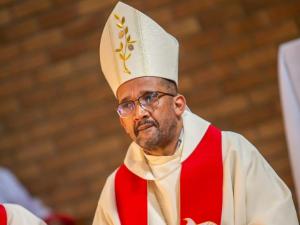
Photo by Sacred Photos (Facebook)
Moreover, Bishop Sipuka’s resourceful approach ensures that he is able to maximize the impact of the resources at his disposal. This practicality makes him an effective leader within social justice movements, as he inspires others to take concrete steps toward change rather than getting lost in abstract ideals. Bishop Sithembele is someone who’s able to build strong relationships with other people and create a network of trust and support; this promotes solidarity, an essential component of successful social justice work. He values collaboration and is willing to support others, making him a dependable team player in any collective effort.
In the current South Africa, this is the kind of leader who is needed to advance the principles of Synod on Synodality.
The Synod on Synodality and ecumenism in South Africa are two interconnected movements that have the potential to shape the future of the country in a significant way. Through the synodal process, the Catholic Church has the opportunity to listen to the voices of its members, discern the path forward, and engage in deeper dialogue with other Christian denominations. By embracing both ecumenism and synodality the Church can become a strong forte for unity, justice, and reconciliation in South Africa; thus contributing to the healing of a nation that still suffers from divisions caused by apartheid. Synod on Synodality will not only be a platform for internal renewal for the Catholic Church but it will also be a catalyst for broader Christian collaboration and social transformation in South Africa.
Religion News
Politics and Religion
Previous Post

October 12, 2024
Ethel Kennedy - A Matriarch Of Strong Faith
Next Post
February 20, 2025 Catholic Relief Services Faces Crisis After Aid Freeze
Recent Comments
"The Beautiful Game of football is life in full flow. Several Cardinals in Rome are ..."
Professing Faith Through Football
"Participants say they have been truly energized. Synod on Synodality has been a meaningful spiritual ..."
Synod on Synodality – A Response ..."
"Grandmothers are Wisdom Banks. They want their grandchildren to be happy and successful. “May my ..."
The Roots of Pope Francis – ..."
"A few theologians believe clericalism and churchianity are detrimental to the spirit of Christianity as ..."
Clericalism – The Difficult Task Ahead ..."
Browse Our Archives
Select a Category Catechism Church History Current Affairs Emotions Eucharist Faith Home Israel Laudato Si' LGBTQ+ Marriage Mary Pope Emeritus Benedict XVI Pope Francis Pope Leo XIV Prayer Religious Affairs Rosary Sacraments Saints Science Synod on Synodality Trending Topics Trump Uncategorized Vocations Women in the Church
Select a Month October 2026 July 2026 January 2026 June 2025 May 2025 April 2025 February 2025 October 2024 September 2024 April 2024 March 2024 February 2024 November 2023 October 2023 September 2023 June 2023 May 2023 April 2023 March 2023 January 2023 December 2022 October 2022 August 2022 July 2022 June 2022 February 2022 July 2021 February 2021 January 2021
Follow Us!
TAKE THE
Religious Wisdom Quiz
What city did David capture and make his capital?
Select your answer to see how you score.
Jerusalem Hebron Gibeon Bethlehem
Related posts from Tea in Laurika's Garden

Professing Faith Through Soccer
Synod on Synodality - A Response Of Faith

The Cardinal Taking Over From Pope Francis
The Roots of Pope Francis - The People's...
TRENDING AT PATHEOS Catholic

Creation, Preservation, and Teleology in Catholic Theology
As I write this, it is very early Monday morning. Like millions...

The Parable Of The Sower And The Word...
One of Christ’s most famous parables is that of the sower who...

Rejecting Doom: Christian Hope And Human Action
Christianity is a religion of hope. We are to have hope and...

Why I Choose the Eucharist Over the Sermon
Choose the Eucharist, Not the Sermon What are we supposed to get...

5 Design Elements Found in Spiritually Rooted Homes
Putting Spirituality Into Home Decor Our homes are more than our living...

Credo: A Story of God Told with the...
About 10 years ago, I began to imagine a personal "Credo" that...
view all Catholic blogs
What Are Your Thoughts?leave a comment
Ad-Free & Subscriber Log-In Subscription Support
- About Us
- 2026 Calendar
- Videos
- Podcasts
- Library of World Religions
- Faith In Media Tracker
- Advertise With Us
- Write for Us
- Privacy Policy
- Terms of Service
- Do Not Sell My Data
- Contact Us
- Radiant Digital
- Manage Newsletter Subscriptions
- Unsubscribe From Notifications
- Sitemap
Copyright 2008-2026, Patheos. All rights reserved.
Subscription Support Ad-Free & Subscriber Log-In
Follow Patheos