
BuddhistCatholicContemplativeEvangelicalGeneral ChristianHinduJewishLatter-day SaintMuslimNew VisionsProgressive Christian
Beliefs
- Buddhist
- Catholic
- Contemplative
- Evangelical
- General Christian
- Hindu
- Jewish
- Latter-day Saint
- More Voices
- Muslim
- New Visions
- Pagan
- Progressive Christian
Topics
- Religion News
- Food and Religion
- Sports and Religion
- Religious Art
- Religious Music and Entertainment
- Religious Events
- History and Religion
- Style and Religion
- Politics and Religion
- Women in Religion
- Recreation Outdoors and Religion
- Business Finance and Religion
- Careers Workplace and Religion
- Education and Religion
- Family Parenting and Religion
- Health Fitness and Religion
- Home and Religion
- Relationships and Religion
- Technology and Religion
- Travel and Religion
Columnists
- Buddhist Columnists
- Business Finance and Religion Columnists
- Careers Workplace and Religion Columnists
- Catholic Columnists
- Contemplative Columnists
- Education and Religion Columnists
- Evangelists Columnists
- Family Parenting and Religion Columnists
- General Christian Columnists
- Health Fitness and Religion Columnists
- Hindu Columnists
- History and Religion Columnists
- Home and Religion Columnists
- Jewish Columnists
- More Voices Columnists
- Latter Day Columnists
- Muslim Columnists
- New Visions Columnists
- Nonreligious Columnists
- Pagan Columnists
- Politics and Religion Columnists
- Progressive Columnists
- Recreation Outdoors and Religion Columnists
- Relationships and Religion Columnists
- Religion News Columnists
- Religious Art Columnists
- Religious Events Columnists
- Religious Music and Entertainment Columnists
- Sports and Religion Columnists
- Style and Religion Columnists
- Technology and Religion Columnists
- Travel and Religion Columnists
- Women in Religion Columnists
Resource Library
- 2026 Calendar
- Library of World Religions
- The 100 Most Holy Places on Earth
- Patheos Answers
- Podcasts
- Videos
- Faith Leaders Database
- Anglican Episcopalian
- Bahai
- Baptist
- Buddhism
- Christianity
- Confucianism
- Eastern Orthodoxy
- Hinduism
- Holiness and Pentecostal
- ISKCON
- Islam
- Judaism
- Lutheran
- Methodist
- The Church of Jesus Christ of Latter-day Saints
- New Age
- Paganism
- Presbytarian and Reformed
- Protestantism
- Religion Behind the Scenes
- Roman Catholic
- Scientology
- Shia Islam
- Sikhism
- Sufism
- Sunni Islam
- Taoism
- Zen
- See all religions
Research Tools
 Ad-Free & Subscriber Log-In Subscription Support
Ad-Free & Subscriber Log-In Subscription Support
Follow Patheos 

- Trending:
- Forgiveness
- |
- Marriage
- |
- Consciousness
- |
- Death Penalty
- |
- Election
- |
- Halloween

- Home
- Catholic
- Religious Events
- All Saints’ Day – Remembering The Holy Men And Women
All Saints’ Day – Remembering The Holy Men And Women
Last updated on: October 14, 2024 at 3:30 pm by Laurika Nxumalo
All Saints’ Day – Remembering The Holy Men And Women 2024-10-14T15:30:46+02:00 Laurika Nxumalo
Patheos Explore the world's faith through different perspectives on religion and spirituality! Patheos has the views of the prevalent religions and spiritualities of the world.
All Saints’ Day is observed every year on November 1st – it is a significant and revered day in the Catholic Church. This holy day of obligation is a time when Catholics around the world honor the saints, both known and unknown, who have dedicated their lives to living in accordance with God’s will.
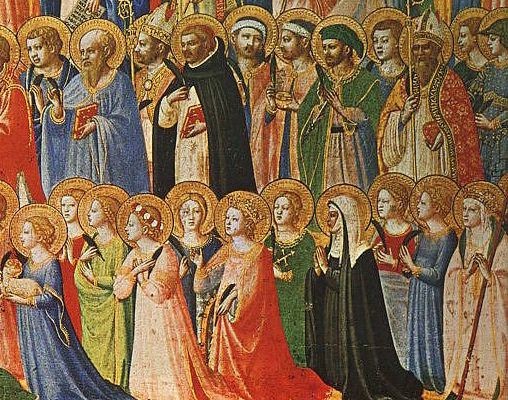
The Saints, via Pinterest
It is a day of reflection, veneration, and gratitude for the countless holy men and women who have set an example for the faithful.
Historical Origins
The roots of All Saints’ Day can be traced back to the early Christian Church. In the 4th century, Christians began to commemorate martyrs who had given their lives for their faith. By the 7th century, the Church had expanded this celebration to include all saints, whether martyrs or not. Pope Gregory III established November 1st as the official date for All Saints’ Day, a decision that continues to be followed by the Catholic Church until today.
Theological Significance
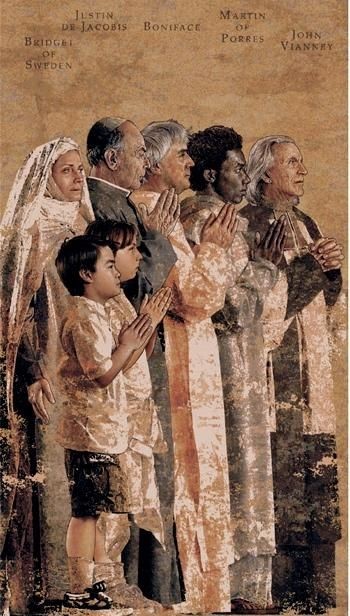
Communion of Saints, via Pinterest
All Saints’ Day is a powerful reminder of the Church’s belief in the “Communion of Saints.” This doctrine emphasizes the interconnectedness of all members of the Church, living and deceased. The Church teaches that while the faithful on earth are the “Church Militant,” those in heaven are the “Church Triumphant.” All Saints’ Day serves as a reminder of this unity, allowing the living to seek the intercession of the saints in heaven.
Celebrations and Traditions
Choir Singing, via Pinterest
Attendance at Mass – All Saints’ Day is a holy day of obligation in the Catholic Church, meaning that Catholics are expected to attend Mass. The day presents an opportunity for the faithful to come together and remember the saints and martyrs who have gone before them.
Recitation the Litany of the Saints – At Mass, it is common to recite the Litany of the Saints, a lengthy prayer that invokes the names of numerous saints. The prayer is a symbolic way of acknowledging the vast number of saints who have been recognized by the Church.
Honoring Known and Unknown Saints – While there are many well-known saints, All Saints’ Day also honors those who are not officially canonized but led righteous lives. This inclusive approach reflects the belief that countless souls have achieved sainthood without formal recognition.
Reflection and Prayer – For many Catholics, All Saints’ Day is a time for personal reflection and prayer, seeking inspiration from the lives of the saints and considering how to emulate their virtues.
Who Are The Saints?
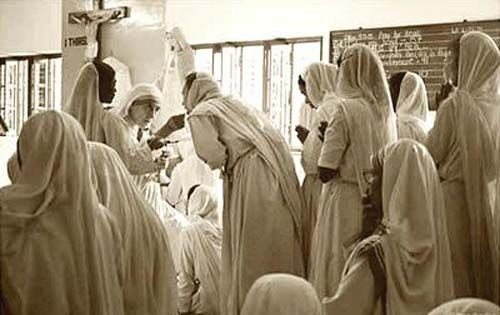
St. Teresa of Calcutta Giving Communion, via Pinterest
A person only becomes a saint through canonization. Canonization is a sacred and intricate process by which individuals are recognized as saints, joining the ranks of revered figures like St. Francis of Assisi, St. Teresa of Calcutta, and St. John Paul II. This process involves rigorous investigation and verification of a candidate’s life, holiness, and the miracles attributed to them.
The Path to Sainthood
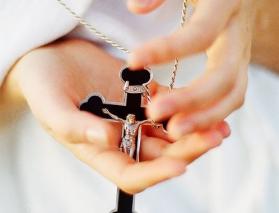
Person Holding Cross, via Pinterest
Servant of God – The journey towards canonization begins when a person’s life is considered for sainthood. This individual is referred to as a “Servant of God.” The process usually does not commence until after the candidate’s death. However, exceptions can be made, particularly in cases of martyrs who die for their faith.
Venerable – The next step is for the candidate to be declared “Venerable” by the Pope. To achieve this status, the candidate’s life and deeds are scrutinized to ensure they lived a life of heroic virtue. This involves a thorough examination of their writings, actions, and reputation.
Beatification – For the individual to progress further, evidence of at least one miracle attributed to their intercession is required. Once verified, the Pope can declare the candidate “Blessed.” Beatification essentially acknowledges that the candidate is in heaven and interceding on behalf of the faithful.
Canonization – The final step in the process of canonization is the declaration of sainthood. To become a saint, the candidate must be associated with at least one more verifiable miracle. Upon confirmation by the Church and approval by the Pope, the individual is officially declared a saint. This is often celebrated with a formal canonization ceremony.
The Significance of Canonization
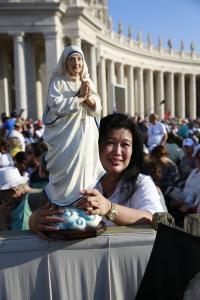
Woman at Canonization Mass of St. Teresa of Calcutta Holding Statue, via Pinterest
Intercession – The canonization of saints is not merely a historical event but holds great significance for Catholics worldwide. Saints are believed to be in the presence of God and can intercede on behalf of individuals. Devotees often seek the prayers and protection of saints in their daily lives.
Role Models – Saints serve as role models of Christian virtue and holiness. Their lives are studied and emulated by the faithful to guide their own spiritual journeys. The stories of saints offer inspiration and encouragement to live a life in accordance with Christian principles.
Patronage – Many saints are associated with specific causes, occupations, or regions. For example, St. Francis of Assisi is the patron saint of animals, and St. Joseph is the patron of workers. Catholics turn to these saints for guidance and protection in various aspects of life.
Communal Unity – The canonization process is a communal endeavour, involving the participation of the Church, historians, theologians, and the faithful. It strengthens shared values among Catholics who continue to celebrate and venerate these holy people.
The process of canonization in the Catholic Church is a profound and deliberate journey that leads to the recognition of individuals as saints. It not only celebrates their exemplary lives but also offers spiritual guidance, intercession, and unity to the worldwide Catholic community. Canonization demonstrates the Church’s commitment to preserving the memory of those who have lived lives of extraordinary holiness and devotion to their faith.
The Church shows such commitment through the commemoration of days such as All Saints’ Day. The day invites the faithful to contemplate the lives of saints, both celebrated and unknown, who have exemplified their dedication to God. The day serves as a source of inspiration for individuals striving to live in accordance with God’s will. In honouring the saints, All Saints’ Day reinforces the timeless belief that holiness is attainable for all who earnestly seek it.
“To be saints is not a privilege for the few, but a vocation for everyone.” Pope Francis
All holy men and women – Pray for us
Religious Events
History and Religion
Previous Post
October 31, 2023
Contemplating on the Mysteries of the Rosary
Next Post

November 3, 2023 All Souls' Day - Praying for the Souls in Purgatory
Recent Comments
"The Beautiful Game of football is life in full flow. Several Cardinals in Rome are ..."
Professing Faith Through Football
"Participants say they have been truly energized. Synod on Synodality has been a meaningful spiritual ..."
Synod on Synodality – A Response ..."
"Grandmothers are Wisdom Banks. They want their grandchildren to be happy and successful. “May my ..."
The Roots of Pope Francis – ..."
"A few theologians believe clericalism and churchianity are detrimental to the spirit of Christianity as ..."
Clericalism – The Difficult Task Ahead ..."
Browse Our Archives
Select a Category Catechism Church History Current Affairs Emotions Eucharist Faith Home Israel Laudato Si' LGBTQ+ Marriage Mary Pope Emeritus Benedict XVI Pope Francis Pope Leo XIV Prayer Religious Affairs Rosary Sacraments Saints Science Synod on Synodality Trending Topics Trump Uncategorized Vocations Women in the Church
Select a Month October 2026 July 2026 January 2026 June 2025 May 2025 April 2025 February 2025 October 2024 September 2024 April 2024 March 2024 February 2024 November 2023 October 2023 September 2023 June 2023 May 2023 April 2023 March 2023 January 2023 December 2022 October 2022 August 2022 July 2022 June 2022 February 2022 July 2021 February 2021 January 2021
Follow Us!
TAKE THE
Religious Wisdom Quiz
Who was the mother of Samuel?
Select your answer to see how you score.
Deborah Mary Sarah Hannah
Related posts from Tea in Laurika's Garden
5 Design Elements Found in Spiritually Rooted Homes

Professing Faith Through Soccer
Synod on Synodality - A Response Of Faith
Clericalism - The Difficult Task Ahead of Pope...
TRENDING AT PATHEOS Catholic

Creation, Preservation, and Teleology in Catholic Theology
As I write this, it is very early Monday morning. Like millions...

The Parable Of The Sower And The Word...
One of Christ’s most famous parables is that of the sower who...

Rejecting Doom: Christian Hope And Human Action
Christianity is a religion of hope. We are to have hope and...

Why I Choose the Eucharist Over the Sermon
Choose the Eucharist, Not the Sermon What are we supposed to get...

5 Design Elements Found in Spiritually Rooted Homes
Putting Spirituality Into Home Decor Our homes are more than our living...

Credo: A Story of God Told with the...
About 10 years ago, I began to imagine a personal "Credo" that...
view all Catholic blogs
What Are Your Thoughts?leave a comment
Ad-Free & Subscriber Log-In Subscription Support
- About Us
- 2026 Calendar
- Videos
- Podcasts
- Library of World Religions
- Faith In Media Tracker
- Advertise With Us
- Write for Us
- Privacy Policy
- Terms of Service
- Do Not Sell My Data
- Contact Us
- Radiant Digital
- Manage Newsletter Subscriptions
- Unsubscribe From Notifications
- Sitemap
Copyright 2008-2026, Patheos. All rights reserved.
Subscription Support Ad-Free & Subscriber Log-In
Follow Patheos