
BuddhistCatholicContemplativeEvangelicalGeneral ChristianHinduJewishLatter-day SaintMuslimNew VisionsProgressive Christian
Beliefs
- Buddhist
- Catholic
- Contemplative
- Evangelical
- General Christian
- Hindu
- Jewish
- Latter-day Saint
- More Voices
- Muslim
- New Visions
- Pagan
- Progressive Christian
Topics
- Religion News
- Food and Religion
- Sports and Religion
- Religious Art
- Religious Music and Entertainment
- Religious Events
- History and Religion
- Style and Religion
- Politics and Religion
- Women in Religion
- Recreation Outdoors and Religion
- Business Finance and Religion
- Careers Workplace and Religion
- Education and Religion
- Family Parenting and Religion
- Health Fitness and Religion
- Home and Religion
- Relationships and Religion
- Technology and Religion
- Travel and Religion
Columnists
- Buddhist Columnists
- Business Finance and Religion Columnists
- Careers Workplace and Religion Columnists
- Catholic Columnists
- Contemplative Columnists
- Education and Religion Columnists
- Evangelists Columnists
- Family Parenting and Religion Columnists
- General Christian Columnists
- Health Fitness and Religion Columnists
- Hindu Columnists
- History and Religion Columnists
- Home and Religion Columnists
- Jewish Columnists
- More Voices Columnists
- Latter Day Columnists
- Muslim Columnists
- New Visions Columnists
- Nonreligious Columnists
- Pagan Columnists
- Politics and Religion Columnists
- Progressive Columnists
- Recreation Outdoors and Religion Columnists
- Relationships and Religion Columnists
- Religion News Columnists
- Religious Art Columnists
- Religious Events Columnists
- Religious Music and Entertainment Columnists
- Sports and Religion Columnists
- Style and Religion Columnists
- Technology and Religion Columnists
- Travel and Religion Columnists
- Women in Religion Columnists
Resource Library
- 2026 Calendar
- Library of World Religions
- The 100 Most Holy Places on Earth
- Patheos Answers
- Podcasts
- Videos
- Faith Leaders Database
- Anglican Episcopalian
- Bahai
- Baptist
- Buddhism
- Christianity
- Confucianism
- Eastern Orthodoxy
- Hinduism
- Holiness and Pentecostal
- ISKCON
- Islam
- Judaism
- Lutheran
- Methodist
- The Church of Jesus Christ of Latter-day Saints
- New Age
- Paganism
- Presbytarian and Reformed
- Protestantism
- Religion Behind the Scenes
- Roman Catholic
- Scientology
- Shia Islam
- Sikhism
- Sufism
- Sunni Islam
- Taoism
- Zen
- See all religions
Research Tools
 Ad-Free & Subscriber Log-In Subscription Support
Ad-Free & Subscriber Log-In Subscription Support
Follow Patheos 

- Trending:
- Forgiveness
- |
- Marriage
- |
- Consciousness
- |
- Death Penalty
- |
- Election
- |
- Halloween

- Home
- Catholic
- Religious Events
- The Cloud Is Moving For The Laity: August 2022 Consistory
The Cloud Is Moving For The Laity: August 2022 Consistory
Last updated on: October 14, 2024 at 3:31 pm by Laurika Nxumalo
The Cloud Is Moving For The Laity: August 2022 Consistory 2024-10-14T15:31:41+02:00 Laurika Nxumalo
Patheos Explore the world's faith through different perspectives on religion and spirituality! Patheos has the views of the prevalent religions and spiritualities of the world.
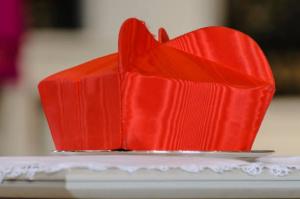
Cardinal`s Red Hat
On Sunday, May 29, 2022, Pope Francis announced a consistory for August 27, 2022 in which the Pontiff will create 21 new cardinals – 16 of the clergymen are under the age of 80 and thus eligible to vote for the next bishop of Rome in a conclave. On August 29-30, 2022 another consistory will follow; in this consistory, all of the Church`s cardinals will gather to discuss the Roman Curia`s new apostolic constitution, “Praedicate Evangelium” (“Proclaiming the Gospel”) decreed by Pope Francis on March 19 which was his ninth anniversary as a Pope.
The Fact of the Matter
Among the effected changes in the apostolic constitution is the role of the laity in key leadership roles within the Church. The new Roman Curia constitution Praedicate evangelium, gives the lay faithful an opportunity to head departments in the Curia and assume roles and functions in offices that were once reserved for the clergy only.
Following the decree of the new apostolic constitution, Cardinal-designate, Fr. Gianfranco Ghirlanda, S.J, a senior Canon Law lawyer who assisted in drafting the document, said it is possible for the lay faithful to head Curia departments because “the power of governance in the Church doesn’t come from the sacrament of Holy Orders, but from the canonical mission.” In May 2022, Pope Francis reinforced Fr. Ghirlanda’s statement when he published a rescript announcing the possibility of the laity being able to head religious orders; this means non-ordained religious would have canonical authority of governance over ordained members of an order, including the authority to remove and grant sacramental capacities of the clergy within their jurisdiction.
History
Around the turn of the nineteenth century prior to the Second Vatican Council, a huge divided existed between the Catholic ecclesiastic hierarchies and lay Catholics. The lay faithful saw the clergy as isolated and detached people, and in turn, the hierarchy had attached negative connotations of the laity. In the 1906 encyclical Vehementer nos, Pius X unequivocally stated that, “the one duty of the multitude is to allow themselves to be led and, like a docile flock, to follow the Pastors.” The text eventually changed in the documents of the Second Vatican Council because it carried a negative undertone.
Vatican II
As a way to respond to the challenges the Church was experiencing, Saint John XXIII convened the Second Vatican Council. However, before convening the Council, John XXIII acknowledged that he would need like-minded clergymen to help him, so he started appointing new cardinals. He also invited over 2,600 prelates to submit agenda items. After the collating and editing of the agenda, it ran to nineteen volumes with over five hundred pages each.
Among others, the Council focused on the relationship between the clergy and laity in two documents, namely, Apostolicam actuositatem addressed directly to the laity, and Lumen Gentium, addressed to the entire Church*.* The purpose of the two documents was of a pastoral nature, meant to direct the Church in understanding its constitution. All John XXIII wanted was for the Church to be a teacher and a mother (Mater et Magistra).
After detailing the hierarchy of the Church in the first three chapters, Lumen Gentium reiterated that the laity should play a vital role in the life of the Church – this was the pronouncement made by the Second Vatican Council. It eventually became possible for the Church to move beyond the dogmatic constitution, ending in Saint John Paul II’s “Code of Canon Law” which acknowledged the institute of the lay faithful. The foundation was nonetheless laid for the empowerment of lay Catholics because a structure within the organized life of the Church was established for the involvement of the laity.
In Apostolicam actuositatem released in 1965, the Council concluded that the lay faithful are “true apostles” – both documents reiterate that the laity should be active members of the Church as they play an important role in the growth of the Church.
John Paul II`s Perspective
In an address in Lisbon on Wednesday, May 12, 1982, Saint John Paul II said, “The Church must be present in all areas of human activity, and nothing that is human can remain extraneous to it. And it is principally you, dear lay people, who must make it present.” Six years later, the Saint penned a 100 page post-Synodal apostolic exhortation, Christifideles Laici, on the vocation and the mission of the lay faithful in the Church and in the world. He wrote the following,
“The lay faithful have their part to fulfill in the formation of these ecclesial communities, not only through an active and responsible participation in the life of the community, in other words, through a testimony that only they can give, but also through a missionary zeal and activity towards the many people who still do not believe and who no longer live the faith received at Baptism.”
The Philosophy
God always intended that for the lay faithful to be actively involved in the mission of the Church, and that is why He is qualifying them in our day – Paul said to the Ephesians,
“And he gave some as apostles, others as prophets, others as evangelists, others as pastors and teachers”
When it comes to God, there is a season and time for everything – this is the season and time for the lay faithful. The clergy by virtue of the sacrament of Holy Orders are not the only ones who are meant to realize the mission of the Church in the world but the laity are also meant to realize that mission. Through their baptism, the laity takes part in the prophetic and priestly mission of Christ; their role in the Church emanates from their baptismal vows.
Just as a child goes through different stages of life until he or she grows into an adult, the same happens to the Church – She “grows up”. During this time of growth, since the birth of the Church, the Hierarchy and the Religious Orders have gone through numerous phases of development; the time has finally come for the Laity to develop. Could this be the reason why God has permitted the decline in vocations – to make space for the lay faithful to “grow up”?
We can only wait and see in which direction is Pope Francis leading the Church, particularly with regard to the participation of the laity in the leadership of the Church. ‘The cloud is moving’ – for the Children of Israel it meant an upheaval, but it also meant moving even more closely to God.
Religious Events
Religion News
History and Religion
Previous Post

July 23, 2022
The Red Papal Shoes - Walking In The Footsteps of Jesus
Next Post
October 1, 2022 Archangel Michael, Pray For Us And Our Families
Recent Comments
"The Beautiful Game of football is life in full flow. Several Cardinals in Rome are ..."
Professing Faith Through Football
"Participants say they have been truly energized. Synod on Synodality has been a meaningful spiritual ..."
Synod on Synodality – A Response ..."
"Grandmothers are Wisdom Banks. They want their grandchildren to be happy and successful. “May my ..."
The Roots of Pope Francis – ..."
"A few theologians believe clericalism and churchianity are detrimental to the spirit of Christianity as ..."
Clericalism – The Difficult Task Ahead ..."
Browse Our Archives
Select a Category Catechism Church History Current Affairs Emotions Eucharist Faith Home Israel Laudato Si' LGBTQ+ Marriage Mary Pope Emeritus Benedict XVI Pope Francis Pope Leo XIV Prayer Religious Affairs Rosary Sacraments Saints Science Synod on Synodality Trending Topics Trump Uncategorized Vocations Women in the Church
Select a Month October 2026 July 2026 January 2026 June 2025 May 2025 April 2025 February 2025 October 2024 September 2024 April 2024 March 2024 February 2024 November 2023 October 2023 September 2023 June 2023 May 2023 April 2023 March 2023 January 2023 December 2022 October 2022 August 2022 July 2022 June 2022 February 2022 July 2021 February 2021 January 2021
Follow Us!
TAKE THE
Religious Wisdom Quiz
What is the Jewish day of rest called?
Select your answer to see how you score.
Sabbath Passover Hanukkah Purim
Related posts from Tea in Laurika's Garden
5 Design Elements Found in Spiritually Rooted Homes

Professing Faith Through Soccer
Synod on Synodality - A Response Of Faith
Clericalism - The Difficult Task Ahead of Pope...
TRENDING AT PATHEOS Catholic

Rejecting Doom: Christian Hope And Human Action
Christianity is a religion of hope. We are to have hope and...

It’s What Comes From Within Which Matters
One of the most difficult things for us to understand is why...

Why I Choose the Eucharist Over the Sermon
Choose the Eucharist, Not the Sermon What are we supposed to get...

5 Design Elements Found in Spiritually Rooted Homes
Putting Spirituality Into Home Decor Our homes are more than our living...

Credo: A Story of God Told with the...
About 10 years ago, I began to imagine a personal "Credo" that...

The Anatomy of Divine Revelation in Catholic Thought
The claim that God has made Himself known to human beings is...
view all Catholic blogs
What Are Your Thoughts?leave a comment
Ad-Free & Subscriber Log-In Subscription Support
- About Us
- 2026 Calendar
- Videos
- Podcasts
- Library of World Religions
- Faith In Media Tracker
- Advertise With Us
- Write for Us
- Privacy Policy
- Terms of Service
- Do Not Sell My Data
- Contact Us
- Radiant Digital
- Manage Newsletter Subscriptions
- Unsubscribe From Notifications
- Sitemap
Copyright 2008-2026, Patheos. All rights reserved.
Subscription Support Ad-Free & Subscriber Log-In
Follow Patheos