
BuddhistCatholicContemplativeEvangelicalGeneral ChristianHinduJewishLatter-day SaintMuslimNew VisionsProgressive Christian
Beliefs
- Buddhist
- Catholic
- Contemplative
- Evangelical
- General Christian
- Hindu
- Jewish
- Latter-day Saint
- More Voices
- Muslim
- New Visions
- Pagan
- Progressive Christian
Topics
- Religion News
- Food and Religion
- Sports and Religion
- Religious Art
- Religious Music and Entertainment
- Religious Events
- History and Religion
- Style and Religion
- Politics and Religion
- Women in Religion
- Recreation Outdoors and Religion
- Business Finance and Religion
- Careers Workplace and Religion
- Education and Religion
- Family Parenting and Religion
- Health Fitness and Religion
- Home and Religion
- Relationships and Religion
- Technology and Religion
- Travel and Religion
Columnists
- Buddhist Columnists
- Business Finance and Religion Columnists
- Careers Workplace and Religion Columnists
- Catholic Columnists
- Contemplative Columnists
- Education and Religion Columnists
- Evangelists Columnists
- Family Parenting and Religion Columnists
- General Christian Columnists
- Health Fitness and Religion Columnists
- Hindu Columnists
- History and Religion Columnists
- Home and Religion Columnists
- Jewish Columnists
- More Voices Columnists
- Latter Day Columnists
- Muslim Columnists
- New Visions Columnists
- Nonreligious Columnists
- Pagan Columnists
- Politics and Religion Columnists
- Progressive Columnists
- Recreation Outdoors and Religion Columnists
- Relationships and Religion Columnists
- Religion News Columnists
- Religious Art Columnists
- Religious Events Columnists
- Religious Music and Entertainment Columnists
- Sports and Religion Columnists
- Style and Religion Columnists
- Technology and Religion Columnists
- Travel and Religion Columnists
- Women in Religion Columnists
Resource Library
- 2026 Calendar
- Library of World Religions
- The 100 Most Holy Places on Earth
- Patheos Answers
- Podcasts
- Videos
- Faith Leaders Database
- Anglican Episcopalian
- Bahai
- Baptist
- Buddhism
- Christianity
- Confucianism
- Eastern Orthodoxy
- Hinduism
- Holiness and Pentecostal
- ISKCON
- Islam
- Judaism
- Lutheran
- Methodist
- The Church of Jesus Christ of Latter-day Saints
- New Age
- Paganism
- Presbytarian and Reformed
- Protestantism
- Religion Behind the Scenes
- Roman Catholic
- Scientology
- Shia Islam
- Sikhism
- Sufism
- Sunni Islam
- Taoism
- Zen
- See all religions
Research Tools
 Ad-Free & Subscriber Log-In Subscription Support
Ad-Free & Subscriber Log-In Subscription Support
Follow Patheos 

- Trending:
- Forgiveness
- |
- Marriage
- |
- Consciousness
- |
- Death Penalty
- |
- Election
- |
- Halloween

- Home
- Catholic
- Why Do Catholics Pray To Mary?
Why Do Catholics Pray To Mary?
Last updated on: October 14, 2024 at 3:31 pm by Laurika Nxumalo
Why Do Catholics Pray To Mary? 2024-10-14T15:31:44+02:00 Laurika Nxumalo
Patheos Explore the world's faith through different perspectives on religion and spirituality! Patheos has the views of the prevalent religions and spiritualities of the world.
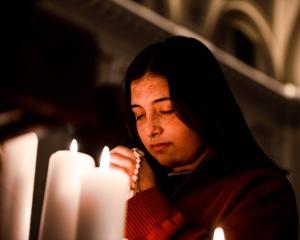
Woman praying the Rosary
“Prayer is the raising of one`s mind and heart to God or the requesting of good things from God” – Catechism of the Catholic Church (CCC 2559).
Catholics pray to and praise Mary as a way of raising their minds and hearts to God, they praise her as the Mother of God, as a Vessel, and as a Queen. Catholics praise Mary the same way the Angel Gabriel praised her in his salutation in Luke 1:28, “Hail, favored one! The Lord is with you.”
Praising Mary
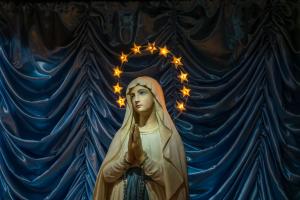
Blessed Virgin Mary with a halo of stars
Catholics praise Mary through the ‘Hail Mary’, ‘Hail Holy Queen’, the Angelus, ‘Memorare’, the Rosary, and ‘Sub tuum praesidium’. These are called Marian prayers or Marian devotions; they are classified as prayers of intercession. The Catechism of the Catholic Church teaches the following about the prayer of intercession:
2634 Intercession is a prayer of petition, which leads us to pray as Jesus did. He is the one intercessor with the Father on behalf of all men, especially sinners. He is “able for all time to save those who draw near to God through him, since he always lives to make intercession for them.” The Holy Spirit “himself intercedes for us and intercedes for the saints according to the will of God.”
2635 Since Abraham, intercession – asking on behalf of another has been characteristic of a heart attuned to God’s mercy. In the age of the Church, Christian intercession participates in Christ’s, as an expression of the communion of saints. In intercession, he who prays looks “not only to his own interests, but also to the interests of others,” even to the point of praying for those who do him harm.
2636 The first Christian communities lived this form of fellowship intensely. Thus the Apostle Paul gives them a share in his ministry of preaching the Gospel but also intercedes for them. The intercession of Christians recognizes no boundaries: “for all men, for kings and all who are in high positions,” for persecutors, for the salvation of those who reject the Gospel.
Therefore, through the Marian devotions, Catholics ask the Virgin Mary to intercede for them because by being chosen by God to be the mother of the Saviour, she is able to save those who draw near to God through her.
Catholics also praise the Virgin Mary through hymns known as the Marian antiphons. The four main antiphons are Alma Redemptoris Mater, Ave Regina caelorum, Regina Caeli, and Salve Regina. They sing to her as she sang to God in the Magnificat (Magnificat, The Canticle of Mary) in Luke 1: 46-55.
Praying to Mary
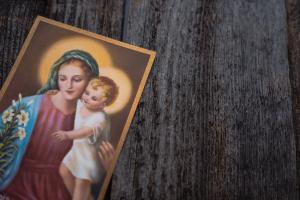
Prayer card of the Blessed Virgin Mary
The Catechism of the Catholic Church goes on to teach the following about the way of prayer in communion with the holy Mother of God
2673 In prayer the Holy Spirit unites us to the person of the only Son, in his glorified humanity, through which and in which our filial prayer unites us in the Church with the Mother of Jesus.
2674 Mary gave her consent in faith at the Annunciation and maintained it without hesitation at the foot of the Cross. Ever since, her motherhood has extended to the brothers and sisters of her Son “who still journey on earth surrounded by dangers and difficulties.” Jesus, the only mediator, is the way of our prayer; Mary, his mother and ours, is wholly transparent to him: she “shows the way” (hodigitria), and is herself “the Sign” of the way, according to the traditional iconography of East and West.
2675 Beginning with Mary’s unique cooperation with the working of the Holy Spirit, the Churches developed their prayer to the holy Mother of God, centering it on the person of Christ manifested in his mysteries. In countless hymns and antiphons expressing this prayer, two movements usually alternate with one another: the first “magnifies” the Lord for the “great things” he did for his lowly servant and through her for all human beings. The second entrusts the supplications and praises of the children of God to the Mother of Jesus, because she now knows the humanity which, in her, the Son of God espoused.
2676 This twofold movement of prayer to Mary has found a privileged expression in the Ave Maria:
Hail Mary [or Rejoice, Mary]: the greeting of the angel Gabriel opens this prayer. It is God himself who, through his angel as intermediary, greets Mary. Our prayer dares to take up this greeting to Mary with the regard God had for the lowliness of his humble servant and to exult in the joy he finds in her.
Full of grace, the Lord is with thee: These two phrases of the angel’s greeting shed light on one another. Mary is full of grace because the Lord is with her. The grace with which she is filled is the presence of him who is the source of all grace. “Rejoice, O Daughter of Jerusalem, the Lord your God is in your midst.” Mary, in whom the Lord himself has just made his dwelling, is the daughter of Zion in person, the ark of the covenant, the place where the glory of the Lord dwells. She is “the dwelling of God with men.” Full of grace, Mary is wholly given over to him who has come to dwell in her and whom she is about to give to the world.
Blessed art thou among women and blessed is the fruit of thy womb, Jesus. After the angel’s greeting, we make Elizabeth’s greeting our own. “Filled with the Holy Spirit,” Elizabeth is the first in the long succession of generations who have called Mary “blessed.” “Blessed is she who believed….” Mary is “blessed among women” because she believed in the fulfillment of the Lord’s word. Abraham, because of his faith, became a blessing for all the nations of the earth. Mary, because of her faith, became the mother of believers, through whom all nations of the earth receive him who is God’s own blessing: Jesus, the “fruit of thy womb.”2677 Holy Mary, Mother of God: With Elizabeth we marvel, “and why is this granted me, that the mother of my Lord should come to me?” Because she gives us Jesus, her son, Mary is Mother of God and our mother; we can entrust all our cares and petitions to her: she prays for us as she prayed for herself: “Let it be to me according to your word.” By entrusting ourselves to her prayer, we abandon ourselves to the will of God together with her: “Thy will be done.”
Pray for us sinners, now and at the hour of our death: By asking Mary to pray for us, we acknowledge ourselves to be poor sinners and we address ourselves to the “Mother of Mercy,” the All-Holy One. We give ourselves over to her now, in the Today of our lives and our trust broadens further, already at the present moment, to surrender “the hour of our death” wholly to her care. May she be there as she was at her son’s death on the cross. May she welcome us as our mother at the hour of our passing to lead us to her son, Jesus, in paradise.2678 Medieval piety in the West developed the prayer of the rosary as a popular substitute for the Liturgy of the Hours. In the East, the litany called the Akathistos and the Paraclesis remained closer to the choral office in the Byzantine churches, while the Armenian, Coptic, and Syriac traditions preferred popular hymns and songs to the Mother of God. But in the Ave Maria, the theotokia, the hymns of St. Ephrem or St. Gregory of Narek, the tradition of prayer is basically the same.
2679 Mary is the perfect Orans (prayer), a figure of the Church. When we pray to her, we are adhering with her to the plan of the Father, who sends his Son to save all men. Like the beloved disciple we welcome Jesus’ mother into our homes, for she has become the mother of all the living. We can pray with and to her; the prayer of the Church is sustained by the prayer of Mary and united with it in hope.
This is why Catholics pray to Mary
Catechism of the Catholic Church
Previous Post

July 7, 2022
What Is Confirmation In The Catholic Church?
Next Post
July 23, 2022 The Red Papal Shoes - Walking In The Footsteps of Jesus
Recent Comments
"The Beautiful Game of football is life in full flow. Several Cardinals in Rome are ..."
Professing Faith Through Football
"Participants say they have been truly energized. Synod on Synodality has been a meaningful spiritual ..."
Synod on Synodality – A Response ..."
"Grandmothers are Wisdom Banks. They want their grandchildren to be happy and successful. “May my ..."
The Roots of Pope Francis – ..."
"A few theologians believe clericalism and churchianity are detrimental to the spirit of Christianity as ..."
Clericalism – The Difficult Task Ahead ..."
Browse Our Archives
Select a Category Catechism Church History Current Affairs Emotions Eucharist Faith Home Israel Laudato Si' LGBTQ+ Marriage Mary Pope Emeritus Benedict XVI Pope Francis Pope Leo XIV Prayer Religious Affairs Rosary Sacraments Saints Science Synod on Synodality Trending Topics Trump Uncategorized Vocations Women in the Church
Select a Month October 2026 July 2026 January 2026 June 2025 May 2025 April 2025 February 2025 October 2024 September 2024 April 2024 March 2024 February 2024 November 2023 October 2023 September 2023 June 2023 May 2023 April 2023 March 2023 January 2023 December 2022 October 2022 August 2022 July 2022 June 2022 February 2022 July 2021 February 2021 January 2021
Follow Us!
TAKE THE
Religious Wisdom Quiz
Who cried out, "My God, my God, why have you forsaken me?" while dying?
Select your answer to see how you score.
Jesus David Paul Stephen
Related posts from Tea in Laurika's Garden
5 Design Elements Found in Spiritually Rooted Homes
Synod on Synodality - A Response Of Faith
Clericalism - The Difficult Task Ahead of Pope...
Walking In The Footsteps Of Mary
TRENDING AT PATHEOS Catholic

Rejecting Doom: Christian Hope And Human Action
Christianity is a religion of hope. We are to have hope and...

It’s What Comes From Within Which Matters
One of the most difficult things for us to understand is why...

Why I Choose the Eucharist Over the Sermon
Choose the Eucharist, Not the Sermon What are we supposed to get...

5 Design Elements Found in Spiritually Rooted Homes
Putting Spirituality Into Home Decor Our homes are more than our living...

Credo: A Story of God Told with the...
About 10 years ago, I began to imagine a personal "Credo" that...

The Anatomy of Divine Revelation in Catholic Thought
The claim that God has made Himself known to human beings is...
view all Catholic blogs
What Are Your Thoughts?leave a comment
Ad-Free & Subscriber Log-In Subscription Support
- About Us
- 2026 Calendar
- Videos
- Podcasts
- Library of World Religions
- Faith In Media Tracker
- Advertise With Us
- Write for Us
- Privacy Policy
- Terms of Service
- Do Not Sell My Data
- Contact Us
- Radiant Digital
- Manage Newsletter Subscriptions
- Unsubscribe From Notifications
- Sitemap
Copyright 2008-2026, Patheos. All rights reserved.
Subscription Support Ad-Free & Subscriber Log-In
Follow Patheos