
BuddhistCatholicContemplativeEvangelicalGeneral ChristianHinduJewishLatter-day SaintMuslimNew VisionsProgressive Christian
Beliefs
- Buddhist
- Catholic
- Contemplative
- Evangelical
- General Christian
- Hindu
- Jewish
- Latter-day Saint
- More Voices
- Muslim
- New Visions
- Pagan
- Progressive Christian
Topics
- Religion News
- Food and Religion
- Sports and Religion
- Religious Art
- Religious Music and Entertainment
- Religious Events
- History and Religion
- Style and Religion
- Politics and Religion
- Women in Religion
- Recreation Outdoors and Religion
- Business Finance and Religion
- Careers Workplace and Religion
- Education and Religion
- Family Parenting and Religion
- Health Fitness and Religion
- Home and Religion
- Relationships and Religion
- Technology and Religion
- Travel and Religion
Columnists
- Buddhist Columnists
- Business Finance and Religion Columnists
- Careers Workplace and Religion Columnists
- Catholic Columnists
- Contemplative Columnists
- Education and Religion Columnists
- Evangelists Columnists
- Family Parenting and Religion Columnists
- General Christian Columnists
- Health Fitness and Religion Columnists
- Hindu Columnists
- History and Religion Columnists
- Home and Religion Columnists
- Jewish Columnists
- More Voices Columnists
- Latter Day Columnists
- Muslim Columnists
- New Visions Columnists
- Nonreligious Columnists
- Pagan Columnists
- Politics and Religion Columnists
- Progressive Columnists
- Recreation Outdoors and Religion Columnists
- Relationships and Religion Columnists
- Religion News Columnists
- Religious Art Columnists
- Religious Events Columnists
- Religious Music and Entertainment Columnists
- Sports and Religion Columnists
- Style and Religion Columnists
- Technology and Religion Columnists
- Travel and Religion Columnists
- Women in Religion Columnists
Resource Library
- 2026 Calendar
- Library of World Religions
- The 100 Most Holy Places on Earth
- Patheos Answers
- Podcasts
- Videos
- Faith Leaders Database
- Anglican Episcopalian
- Bahai
- Baptist
- Buddhism
- Christianity
- Confucianism
- Eastern Orthodoxy
- Hinduism
- Holiness and Pentecostal
- ISKCON
- Islam
- Judaism
- Lutheran
- Methodist
- The Church of Jesus Christ of Latter-day Saints
- New Age
- Paganism
- Presbytarian and Reformed
- Protestantism
- Religion Behind the Scenes
- Roman Catholic
- Scientology
- Shia Islam
- Sikhism
- Sufism
- Sunni Islam
- Taoism
- Zen
- See all religions
Research Tools
 Ad-Free & Subscriber Log-In Subscription Support
Ad-Free & Subscriber Log-In Subscription Support
Follow Patheos 

- Trending:
- Forgiveness
- |
- Marriage
- |
- Consciousness
- |
- Death Penalty
- |
- Election
- |
- Halloween
 Teaching Nonviolent Atonement
- Home
- Progressive Christian
- How Forgiveness Can Transform Our Violence and Build a World of Belonging
How Forgiveness Can Transform Our Violence and Build a World of Belonging
Last updated on: October 16, 2019 at 12:50 pm by Lindsey Paris-Lopez
How Forgiveness Can Transform Our Violence and Build a World of Belonging 2019-10-16T12:50:32-05:00 Lindsey Paris-Lopez
Patheos Explore the world's faith through different perspectives on religion and spirituality! Patheos has the views of the prevalent religions and spiritualities of the world.

We live in a nation built on a foundation of violence. But that’s not where we belong.
We belong where our deepest longings can be fulfilled, our longings for peace, joy, a life of dignity and respect, a haven that nurtures us to be our fullest, sweetest selves. For some, these longings go largely under or unfulfilled under stifling oppressive or violent conditions. But none of us can fully realize the fulfillment of our longings until we recognize that the only way for any of us to fully belong is together. We belong in a world built by Love, for Love, as living embodiments of Love.
So how do we get there from here?
To begin to answer this question, I will explore:
- Why connections create conflict and how communities are built on exclusion
- How Jesus – God as our victim – exposes, forgives, and transforms our violence
- How even Jesus’s revelation has been folded back into the systemic violence of scapegoating
- How forgiveness itself is weaponized… and how it might reach its full potential.
A NATION BUILT ON EXCLUSION
I seek ways to create belonging for all in a nation where belonging for some has been built explicitly on the exploitation and dehumanization of others.
Where segregation and prejudice have circumscribed the lives of people of color.
Where Muslims living in nations our military bombs are banned from entering ours, descendants of immigrants build walls to keep other immigrants away, and the fate of the LGBTQIA community hangs precariously in the balance of the Supreme Court.
A nation founded on the destruction of some will, in the end, be unable to hold up anyone. As Jesus once said, “Every kingdom divided against itself is laid waste, and no city or house divided against itself will stand.”
Of course, Jesus wasn’t talking about the United States, though his words apply, but about every human culture built and fueled on violence. The building of community on the exclusion of others is universal.
The only way we can fully understand and transform the destructive nature of our violence is if we first look at its constructive nature, at the purpose it serves in creating bonds over and against scapegoats.

THE MEANING BEHIND THE MADNESS OF SCAPEGOATING
Mimetic theory reveals that the same driving force that can potentially lead to cooperation, empathy, and love often leads to conflict, enmity, and hate. That force is our human connection itself. (Check out the Intro to Mimetic Theory series to learn more about Mimetic Theory)
We are not isolated individuals but interdividuals, formed only in relationship with one another. To be human is to need one another, not only to learn information, but to take emotional cues and receive our desires from one another. We are not programmed with single-path instincts but open to a variety of models who shape what we know, what we want, and who we are.
Conflicts can arise from an unwillingness to share mutual desires. As we compete with rivals for prizes of influence, power, wealth, or fame, we are fueled by their passion as they come between us and the object of our desires (which we desire all the more because of their desire).
The harder they fight, the harder we fight.
This pattern of mutual, exclusive desire leading to rivalry leading to ever-escalating violence has captivated humanity from the beginning. Violence spreads like a contagion as desire sparks wildfires of passion and fury. But from ancient civilizations through today, when crises of conflict erupted, they could be quelled by channeling accusation and violent energy against a particular victim.
The convergence of blame, hatred, and violence on the scapegoat happens quickly because of our imitative nature; one who stands out for an arbitrary reason can capture someone’s attention, and that attention multiplies rapidly. People are unconscious of the scapegoat mechanism at work within them, truly believing their scapegoats to be guilty.
When people converge upon a scapegoat, they can bond with each other over and against their declared enemy and feel a transcendent catharsis when that enemy is purged – often by murder or expulsion – from the community. From the beginning, people mistook that catharsis for the divine.
The peace in the wake of the scapegoat’s expulsion reinforces the myth that the scapegoat was responsible for the crisis of violence. But that peace is short-lived, because we remain blind to the origin of our violence and how to transform it.
It crucial to recognize how scapegoats have served a foundational function in our cultural evolution, how our cultures themselves have been forged by bonds over and against others. Shared enemies bind communities – from cliques to international alliances – together.
A BETTER WAY TO FORM COMMUNITY
A world built on scapegoating works… until it doesn’t anymore. In a world of such broken relationships, where our connections become our divisions as we compete and violence becomes our connection as we unite in misplaced blame, we are vulnerable to the destruction we unconsciously wield.
That’s what Jesus came to save us from. Our own violence.
When humanity thought it found God in the purging of a victim, God came among us as our victim.
Jesus came and stood with those who were marginalized and cast out. The “sinners” with whom the “good people” would never be caught dead. The blind, the lame, the lepers, those thought to be punished by God. The demoniac against whom a town measured its goodness.
Jesus came not only to restore those who had been pushed out, but to transform communities formed by their exclusion into communities of inclusion.
He died the death of a criminal to restore all who had gone the same way – those who had perhaps lived and certainly died by the sword. He died… and death could not hold him, because he refused to be enthralled in the process by which we unconsciously destroy others and thus ourselves.
And he rose to bring new life – a life in which we don’t rely on the death of others. It’s a life that calls us to recognize our interconnection, to recognize that when we seek to get ahead at the expense of others, we ultimately harm ourselves, because we are connected.
Jesus brings us into that new life by exposing our violence and answering it with mercy. In revealing himself to be the God who suffers with victims but forgives victimizers, Jesus reveals that the ultimate power that fulfills and restores us is not violence, but love. In the light of his forgiveness, we see our victims in all their humanity, and our deepest humanity can be restored as we confront and work through our fears in the shelter of grace.
Forgiveness says to us, “Stop! Don’t be afraid! I know the worst of you. And I still love you. I am giving you the freedom to live into the goodness for which you were born.”
It makes repentance and reconciliation possible.
But the possibility of repentance and reconciliation, even the eventuality of it, is not the present actualization of it. Humanity is still deeply entrenched in conflict and rivalry, and still largely blind to our own scapegoating. Nations are still built on the scapegoating mechanism. And the United States is no exception.
THE WEAPONIZATION OF CHRISTIANITY
And the terrible truth is that the light of Christ’s revelation – that God is Love, God stands with the victims of violence, and that the deepest and strongest bonds we can form are in service to each other rather than elevation over and against others – was dimmed and twisted in our nation’s earliest colonial days.
Colonial expansion, displacement and killing of indigenous people, and slave labor that shaped our nation: all were rationalized by tragic misinterpretations of Christianity. New, brutal manifestations of scapegoating were justified in the name of the One who became humanity’s scapegoat in order to expose scapegoating!
And the misuse of scripture and religion to exclude and condemn did not stop with racism. The revelation that was meant to lead us out of our rivalry was turned into a weapon against other faiths. Scripture has been interpreted to condemn the LGBTQIA community when, in fact, it does not expound on the loving same-gendered relationships of today but does warn against judgment. When we condemn others, we stand under the same condemnation – that is, human condemnation – because we are blind to the harm we cause.
Antisemitism, xenophobia, Islamophobia, homophobia… all continue to be wrongly justified in the name of the fully human One who taught that our full humanity is found bound up in one another.
Which is not at all to say that God’s infinite mercy has been ineffective in exposing and healing the brokenness in our hearts and relationships. God’s mercy has opened our eyes to those on the underside of injustice around the world.
Models of mercy have influenced generations of peacemakers in all times and places.
Abolition, the Civil Rights Movement, progress in interfaith dialogue, open and affirming churches and communities of faith… all are outgrowth’s of God’s compassion reaching into our hearts and igniting our own.
But.
Too many people are still hurt by institutional and personal scapegoating. While the revelation of the cross has been a mitigating factor, the weaponization of Christianity has been an exacerbating factor.
Perhaps you have felt estranged from an unwelcoming place of worship. Perhaps you are vulnerable to some of the incarnations of systemic violence in this nation. Perhaps you have seen religion used to reinforce rather than challenge injustice.
Perhaps you are uncomfortably awakening to ways you have scapegoated others, or ways social structures built on scapegoating have benefited you at their expense.
Our society has a long way to go as new rationalizations for scapegoating arise. In a nation built on militarism over and against others, on cognitive dissonance between the land of opportunity our nation claims to be and the land of inequity it has been from the beginning, we need healing from all manifestations of personal and systemic violence.
FORGIVENESS: FROM REINFORCING THE STATUS QUO TO TRANSFORMING VIOLENCE
And forgiveness can open the space for that healing.
But right now, there is confusion and polarization over what forgiveness means and how it is used.
Marginalized people and people on the underside of power dynamics suffer under the weaponization of forgiveness when it is folded into a placating ritual meant to stifle dissent and keep people complacent with the systemic violence of a status quo built on scapegoating.
Far too often, public displays of forgiveness are exploited to demand “respectability” of those in pain, discrediting protests and movements aimed and changing systems and demanding accountability.
But just as Christianity was weaponized when the very revelation meant to expose and heal our scapegoating was folded back into our rivalrous identities, so forgiveness is weaponized when the very force that can transform our violence allows us to continue in our violence.
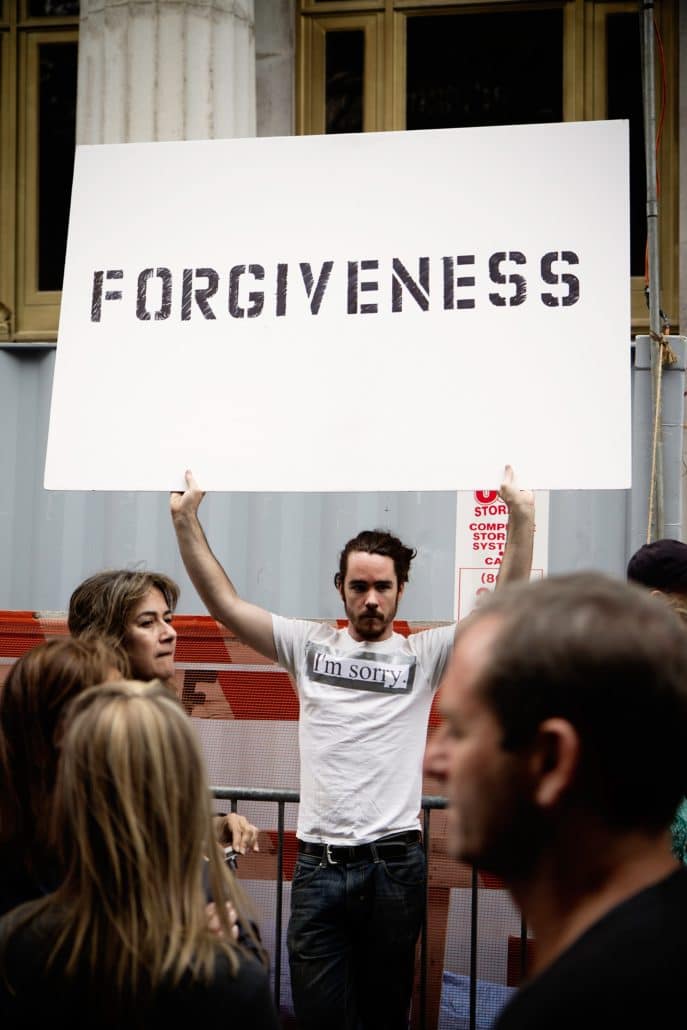
When forgiveness diffuses the urgency for transformation rather than make the space for transformation, it is twisted from its intended purpose. Victimizers remain trapped in blindness, victims in oppression. In many ways, we remain trapped in both of these roles and conditions. But some suffer more than others when forgiveness fails.
The potential for forgiveness to create space for healing goes unfulfilled when it is not received with repentance.
The good news, for those who have suffered the weaponization of forgiveness, is that people are realizing that Jesus – and every prophet of forgiveness before and since – never intended forgiveness as a substitute for accountability. “Love your enemies,” necessarily includes speaking truth about the harm they cause. Jesus does this continually.
Every time we see forgiveness misused to stifle calls for justice, we can respond that forgiveness is one step in creating justice. Forgiveness reframes justice from retribution toward restoration, but only if we continue to expose the brokenness where restoration is necessary.
And there is further good news.
When it comes to facing the violence in which we participate or are complicit, we are already forgiven. And therefore we can look honestly at our violence without the paralysis of fear and guilt. Those natural feelings will come, but we can push through them knowing that we are loved, and that because we are loved, we can do better.
We can do this as individuals, as members of our social spheres, as a nation, and as a humanity. We can find courage through the infinite love of God to be honest about the ways forming our identities over and against scapegoats and enemies has hurt people. And we can let love light our way forward as we turn ourselves out of dead-end identity formation at the expense of others and move into the fullness of living for others.
CONCLUSION
When we ourselves are on the underside of injustice, we can take comfort in the embrace of the One who formed us and loves us exactly as we are. We can affirm our belonging in Love, from which no power of hate can cast us out.
And for all the ways we have tried to assert ourselves at the expense of others, we can recognize the forgiveness we have already received. In light of that forgiveness, we can have the courage to repent of our broken relationships with one another and with God.
We can live into our interconnection with one-another, rooted in the depths of our being as children of the God who is Love. We can trust that our deepest needs will be fulfilled – not just our material needs, but our longings for peace, dignity, and joy – as we feel the Love in which we were made by living for, not against, one another. This is how we – or rather, God working through us – will transform our world of divisions into the kindom of Love in which we all belong.
Previous Post

September 19, 2019
Jesus Unmasked: God's Economy and How to Cheat the System Ethically
Next Post
November 26, 2019 Reflections on Indigenous Wisdom For Healing A Wounded World
Browse Our Archives
Select a Category Atonement and Current Events Curriculum Faith and Families Interviews Jesus the Forgiving Victim Lent Montessori politics Reviews The Bible Explained Uncategorized Valentine's Day Wednesday Sermon Who is God?
Select a Month July 2020 November 2019 October 2019 September 2019 August 2019 July 2019 June 2019 May 2019 April 2019 March 2019 February 2019 January 2019 December 2018 November 2018 October 2018 September 2018 August 2018 July 2018 June 2018 May 2018 April 2018 March 2018 February 2018 January 2018 December 2017 November 2017 October 2017 September 2017 August 2017 July 2017 June 2017 May 2017 April 2017 March 2017 February 2017 January 2017 December 2016 November 2016 October 2016 September 2016 August 2016 June 2016 May 2016 April 2016 March 2016 February 2016 January 2016 December 2015 November 2015 October 2015 September 2015 August 2015 July 2015 June 2015 May 2015 April 2015 March 2015 February 2015 January 2015 December 2014 November 2014 October 2014 September 2014 August 2014 July 2014 June 2014 May 2014 April 2014 March 2014 January 2014 December 2013 September 2013 August 2013 July 2013
Follow Us!
TAKE THE
Religious Wisdom Quiz
What Christian group believes in "baptism by immersion only"?
Select your answer to see how you score.
Baptists Catholics Lutherans Presbyterians
Related posts from Teaching Nonviolent Atonement

Toxic Christianity: 3 Things We Can Do That...

Forgiveness in the Time of COVID-19 by Julia...

Reflections on Indigenous Wisdom For Healing A Wounded...

Jesus Unmasked: God's Economy and How to Cheat...
TRENDING AT PATHEOS Progressive Christian

What Being a Modern-Day Apostle Means to Me
In my last column, I discussed the ins and outs of modern-day...

Did Ancient China Once Worship the God of...
Across human history, a common thread weaves through the origins of the...

Love Your Neighbor – Including Earth-Kin: Lev. 19,...
God’s command to love your neighbor means acting in an ethical and...

Lead a Church Study of “Jesus and Lao...
Guest writer Jack Thomas (The Irreverent Reverend) reflects on leading his church...

Pastoral Wisdom for Responding to Sermon Pushback
Getting sermon pushback on your social justice sermon? Learn practical, Proverbs-based strategies...

Principles for Understanding the Apostolic Ministry Today
Whenever people discover that my formal ministry title is "apostle," as in...
view all Progressive Christian blogs
Ad-Free & Subscriber Log-In Subscription Support
- About Us
- 2026 Calendar
- Videos
- Podcasts
- Library of World Religions
- Faith In Media Tracker
- Advertise With Us
- Write for Us
- Privacy Policy
- Terms of Service
- Do Not Sell My Data
- Contact Us
- Radiant Digital
- Manage Newsletter Subscriptions
- Unsubscribe From Notifications
- Sitemap
Copyright 2008-2026, Patheos. All rights reserved.
Subscription Support Ad-Free & Subscriber Log-In
Follow Patheos