
BuddhistCatholicContemplativeEvangelicalGeneral ChristianHinduJewishLatter-day SaintMuslimNew VisionsProgressive Christian
Beliefs
- Buddhist
- Catholic
- Contemplative
- Evangelical
- General Christian
- Hindu
- Jewish
- Latter-day Saint
- More Voices
- Muslim
- New Visions
- Pagan
- Progressive Christian
Topics
- Religion News
- Food and Religion
- Sports and Religion
- Religious Art
- Religious Music and Entertainment
- Religious Events
- History and Religion
- Style and Religion
- Politics and Religion
- Women in Religion
- Recreation Outdoors and Religion
- Business Finance and Religion
- Careers Workplace and Religion
- Education and Religion
- Family Parenting and Religion
- Health Fitness and Religion
- Home and Religion
- Relationships and Religion
- Technology and Religion
- Travel and Religion
Columnists
- Buddhist Columnists
- Business Finance and Religion Columnists
- Careers Workplace and Religion Columnists
- Catholic Columnists
- Contemplative Columnists
- Education and Religion Columnists
- Evangelists Columnists
- Family Parenting and Religion Columnists
- General Christian Columnists
- Health Fitness and Religion Columnists
- Hindu Columnists
- History and Religion Columnists
- Home and Religion Columnists
- Jewish Columnists
- More Voices Columnists
- Latter Day Columnists
- Muslim Columnists
- New Visions Columnists
- Nonreligious Columnists
- Pagan Columnists
- Politics and Religion Columnists
- Progressive Columnists
- Recreation Outdoors and Religion Columnists
- Relationships and Religion Columnists
- Religion News Columnists
- Religious Art Columnists
- Religious Events Columnists
- Religious Music and Entertainment Columnists
- Sports and Religion Columnists
- Style and Religion Columnists
- Technology and Religion Columnists
- Travel and Religion Columnists
- Women in Religion Columnists
Resource Library
- 2026 Calendar
- Library of World Religions
- The 100 Most Holy Places on Earth
- Patheos Answers
- Podcasts
- Videos
- Faith Leaders Database
- Anglican Episcopalian
- Bahai
- Baptist
- Buddhism
- Christianity
- Confucianism
- Eastern Orthodoxy
- Hinduism
- Holiness and Pentecostal
- ISKCON
- Islam
- Judaism
- Lutheran
- Methodist
- The Church of Jesus Christ of Latter-day Saints
- New Age
- Paganism
- Presbytarian and Reformed
- Protestantism
- Religion Behind the Scenes
- Roman Catholic
- Scientology
- Shia Islam
- Sikhism
- Sufism
- Sunni Islam
- Taoism
- Zen
- See all religions
Research Tools
 Ad-Free & Subscriber Log-In Subscription Support
Ad-Free & Subscriber Log-In Subscription Support
Follow Patheos 

- Trending:
- Forgiveness
- |
- Marriage
- |
- Consciousness
- |
- Death Penalty
- |
- Election
- |
- Halloween
 Teaching Nonviolent Atonement
- Home
- Progressive Christian
- Perfect Love Casts Out Fear, But Can It Whittle Away White Supremacy?
Perfect Love Casts Out Fear, But Can It Whittle Away White Supremacy?
Last updated on: August 8, 2019 at 4:51 pm by Lindsey Paris-Lopez
Perfect Love Casts Out Fear, But Can It Whittle Away White Supremacy? 2019-08-08T16:51:11-05:00 Lindsey Paris-Lopez
Patheos Explore the world's faith through different perspectives on religion and spirituality! Patheos has the views of the prevalent religions and spiritualities of the world.

“Perfect love casts out fear.”
Good. Let’s start here. Let’s begin in the hope that there is something stronger than hate, in faith that there is a power capable of overcoming this violence. We need hope, because right now the world is a frightening place.
We are all vulnerable, aren’t we? We could be in Walmart or at our house of worship or in a night club. We could be in a movie theater or at school or a concert. We could be walking along the street on a warm summer evening or in the crisp, cool air of a fall morning. It could happen anywhere. Our reality could be punctuated by a burst of gunfire, we could experience the shock and the panic… it could be our loved ones, it could be us…
I fear I’ve strayed too far from the hope I was trying to hold onto.
The truth is, I don’t go around worrying about whether I could be next, even though it is possible, because there really isn’t a place safe from the terror of gun violence. But though there have already been more mass shootings than days of the year in 2019 (255 as of August 5th), I live in relative safety. I am a middle-class white woman, and I am not a target of the daily violence of systemic injustice faced by people of color.
I do not live in fear of being told to go back to my country, or being stopped and frisked, or questioned about my citizenship status.
I live in relative safety and security that elude many right here in this country.
The hideous truth is that this nation is so fractured along racial divisions that white people can live side-by-side people of color and still never know the daily injustices and fears that they face. We can be completely ignorant of the fact that African American segregation persists not only because of a wealth gap created by generations of unpaid and underpaid work and past discrimination policies that have created hurdles difficult to overcome, but also because modern day policies and attitudes remain so hostile to black people that many don’t feel safe or comfortable integrating into majority-white neighborhoods. We might be unaware of the fact that our Latinx neighbors are being questioned about their citizenship and their rights to remain in the country, frightened into carrying passports and sometimes denied renewal of passports because they are profiled as potentially having gained citizenship illegally. Indigenous peoples are fighting to have their continued existence recognized. And discrimination against Asian peoples goes largely unrecognized. The different but parallel struggles faced by people of color are born from racist policies and attitudes that send the message: “You do not belong.”
Those of us who are white do not see all of these struggles or suffer from these anxieties. For the most part, we don’t have to live in the fear of the fear of others because of our color. No amount of money or education can immunize people of color to the hostilities of systemic, institutionalized racism and the prejudices that permeate the air and manifest in the clutching of purses or the panicked phone calls to police. White people who don’t bear the brunt of these injustices must look more closely in order to even notice them.
But when we hear of yet another mass shooting, a wave of vulnerability washes over us. I am praying that we can use this fleeting time of mutual vulnerability to deepen our empathy and recognize the ongoing risks for people of color who, in addition to being targeted (rather than caught in the crossfire) by white supremacist domestic terrorists, must live with daily aggression and threats.
Yes, we need sensible gun control; that is the most obvious and effective protection against mass shootings. But the violence in our nation goes much deeper than mass shootings. It’s built into our very structure, and its most devastating effects fall on people of color. But it slowly kills white people too, by feeding lies and stoking fears that keep us divided, by letting wounds of discriminatory policies of the past and the present fester and metastasize, by keeping many of us from truly knowing each other either because of physical segregation or because of the awkwardness surrounding and shutting down too many conversations about race. And when racism is obscured or excused or denied, the chasm of division grows deeper and deadlier.
Racism is deadly. And exposing and naming racism within our culture and within ourselves is not about shaming or demonizing; it’s about diagnosing a disease. It is a necessary step for healing, and it’s urgent.
Yet some politicians downplay the threat and pervasiveness of white supremacist ideology. Some pundits claim that talk about racism is only further dividing people. People wonder aloud how comments that question the Americanness of four congresswomen or the willingness of human beings to live in Baltimore can be racist if skin color isn’t directly mentioned. All of this is discouraging and a hindrance to progress. There are so many ways racism permeates our culture that it is difficult to understand them all, and we need patience as we learn and grow. But some forms of racism are obvious. And failure to acknowledge racism is killing us all, some of us faster than others.
So I return to the comforting words of scripture, that perfect love casts out fear.
Can perfect love help us to whittle away white supremacy, too?
Because here is what I really want to say: We are all perfectly loved. And perfect love can empower us to face our mistakes and failings and even deeply entrenched and generationally-reproduced violence head on. Knowing we are perfectly loved can encourage us to see the discrepancies between who we are and who we wish to be instead of hiding from ourselves in denial or projecting our faults onto others. Knowing we are loved can open our eyes to the truth that can set us free.
And the truth is that we must come to understand racism in the United States as the system of injustice that has privileged lighter skin over darker skin. The concept of race was socially constructed to dehumanize and economically exploit darker-skinned people. The motive of greed was veiled with bad theology and pseudoscience, and institutional structures were forged along the fault lines of this lie. Bigotry and prejudice can run in any direction, but racism in the United States is a one-way street.
The further truth is that white responsibility is the flip side of white privilege. White people today are not responsible for the sin and ignorance of those who came before us, but we are responsible for recognizing how deep and pervasive it is and for the role we must play in dismantling and transforming it. Many of us don’t want to accept the collective responsibility for dismantling racism because we want to be recognized as individuals, not beneficiaries of a system we did not create. But what we may fail to realize when we say, “Treat me as an individual!” is that we take back our individuality precisely by dismantling the system of racism. Systemic racism that perpetuates difference in opportunity and experience along racial lines harms us all, and recognizing this truth will move us forward so we can each realize our fullest potential.
But committing ourselves to listening, learning, and acting takes humility and vulnerability. Segregation of experience keeps us from understanding the depth of the problem, limits our knowledge, and skews our perspective in ways we won’t understand unless we immerse ourselves in the learning and the work, and that level of commitment will always come with making mistakes.
We must listen, and we must open ourselves up to the vulnerability that we will encounter our own biases and mistakes as we listen. This is a daunting task; it scares me… but I know it is necessary. Can we open ourselves up to that vulnerability knowing we are loved? Can we open ourselves to that vulnerability as we recognize the vulnerability it takes for people of color to advise and critique us, so that we don’t recoil in defensiveness but accept critique in gratitude, as an investment of trust that may develop into a better relationship for us all?
Because that is how we will dismantle so much of the hate that explodes in mass shootings but also leaks out in countless other ways. Commitment to dismantling racism begins with dismantling our own defensiveness, and dismantling defensiveness can only be done when we allow trust to chip away at our fear. If we know we are loved, if we know that our worth doesn’t change because of our mistakes, then we may learn to take criticism not as accusation but as a prophetic call to live into our better selves. When we first listen in the security of love, then we can act out of the gratitude and compassion that comes from love. We can let love guide and propel us into anti-racism actions, including transforming the structures that keep racism entrenched within our nation. Every action we can take, from sharing multicultural literature with our children to petitioning our legislators on policies from sanctuary cities to prison reform, will come from a space of humility and an openness to learning if we undertake these actions in love. Perhaps our most important action will simply be reminding ourselves and one another not only to speak but also to receive the truth in love. Criticism is hard, especially when we’re trying, but receiving it in love helps us to use it to go forward rather than shut down. That is how we will truly desegregate, bridge the divides not only of physical but of experiential and emotional distance. That’s how we build reconciliation and find security in community with rather than isolation from one another.
If perfect love – not sentiment but action, not single deed but total life embodied – can cast out fear, then it must also transform white supremacy. Let’s open our hearts to perfect love and put our love to work.
Editor’s Note: I am eagerly anticipating the release of Ibram X. Kendi’s new book, “How To Be An Antiracist.” I plan to read it and explore how I may put its ideas to use in September. I invite readers to join me in reading and reflecting upon it.
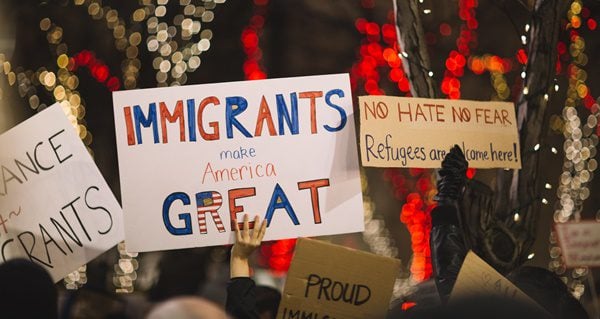
Image: 123rf.com
Previous Post

August 5, 2019
St. Francis Preaches on Violence
Next Post
August 9, 2019 Jesus Unmasked: Where Is Your Treasure? [Video]
Browse Our Archives
Select a Category Atonement and Current Events Curriculum Faith and Families Interviews Jesus the Forgiving Victim Lent Montessori politics Reviews The Bible Explained Uncategorized Valentine's Day Wednesday Sermon Who is God?
Select a Month July 2020 November 2019 October 2019 September 2019 August 2019 July 2019 June 2019 May 2019 April 2019 March 2019 February 2019 January 2019 December 2018 November 2018 October 2018 September 2018 August 2018 July 2018 June 2018 May 2018 April 2018 March 2018 February 2018 January 2018 December 2017 November 2017 October 2017 September 2017 August 2017 July 2017 June 2017 May 2017 April 2017 March 2017 February 2017 January 2017 December 2016 November 2016 October 2016 September 2016 August 2016 June 2016 May 2016 April 2016 March 2016 February 2016 January 2016 December 2015 November 2015 October 2015 September 2015 August 2015 July 2015 June 2015 May 2015 April 2015 March 2015 February 2015 January 2015 December 2014 November 2014 October 2014 September 2014 August 2014 July 2014 June 2014 May 2014 April 2014 March 2014 January 2014 December 2013 September 2013 August 2013 July 2013
Follow Us!
TAKE THE
Religious Wisdom Quiz
Who was the Roman governor that sentenced Jesus to be crucified?
Select your answer to see how you score.
Caesar Augustus Felix Herod Pontius Pilate
Related posts from Teaching Nonviolent Atonement

Forgiveness in the Time of COVID-19 by Julia...

Jesus Unmasked: On Being Lost And Found: Sheep,...

Jesus Unmasked: Humility Is Not A Competition [Video]
Strippers Will Lead Us Into the Kingdom of...
TRENDING AT PATHEOS Progressive Christian

What Being a Modern-Day Apostle Means to Me
In my last column, I discussed the ins and outs of modern-day...

Did Ancient China Once Worship the God of...
Across human history, a common thread weaves through the origins of the...

Love Your Neighbor – Including Earth-Kin: Lev. 19,...
God’s command to love your neighbor means acting in an ethical and...

Lead a Church Study of “Jesus and Lao...
Guest writer Jack Thomas (The Irreverent Reverend) reflects on leading his church...

Pastoral Wisdom for Responding to Sermon Pushback
Getting sermon pushback on your social justice sermon? Learn practical, Proverbs-based strategies...

Principles for Understanding the Apostolic Ministry Today
Whenever people discover that my formal ministry title is "apostle," as in...
view all Progressive Christian blogs
Ad-Free & Subscriber Log-In Subscription Support
- About Us
- 2026 Calendar
- Videos
- Podcasts
- Library of World Religions
- Faith In Media Tracker
- Advertise With Us
- Write for Us
- Privacy Policy
- Terms of Service
- Do Not Sell My Data
- Contact Us
- Radiant Digital
- Manage Newsletter Subscriptions
- Unsubscribe From Notifications
- Sitemap
Copyright 2008-2026, Patheos. All rights reserved.
Subscription Support Ad-Free & Subscriber Log-In
Follow Patheos