
BuddhistCatholicContemplativeEvangelicalGeneral ChristianHinduJewishLatter-day SaintMuslimNew VisionsProgressive Christian
Beliefs
- Buddhist
- Catholic
- Contemplative
- Evangelical
- General Christian
- Hindu
- Jewish
- Latter-day Saint
- More Voices
- Muslim
- New Visions
- Pagan
- Progressive Christian
Topics
- Religion News
- Food and Religion
- Sports and Religion
- Religious Art
- Religious Music and Entertainment
- Religious Events
- History and Religion
- Style and Religion
- Politics and Religion
- Women in Religion
- Recreation Outdoors and Religion
- Business Finance and Religion
- Careers Workplace and Religion
- Education and Religion
- Family Parenting and Religion
- Health Fitness and Religion
- Home and Religion
- Relationships and Religion
- Technology and Religion
- Travel and Religion
Columnists
- Buddhist Columnists
- Business Finance and Religion Columnists
- Careers Workplace and Religion Columnists
- Catholic Columnists
- Contemplative Columnists
- Education and Religion Columnists
- Evangelists Columnists
- Family Parenting and Religion Columnists
- General Christian Columnists
- Health Fitness and Religion Columnists
- Hindu Columnists
- History and Religion Columnists
- Home and Religion Columnists
- Jewish Columnists
- More Voices Columnists
- Latter Day Columnists
- Muslim Columnists
- New Visions Columnists
- Nonreligious Columnists
- Pagan Columnists
- Politics and Religion Columnists
- Progressive Columnists
- Recreation Outdoors and Religion Columnists
- Relationships and Religion Columnists
- Religion News Columnists
- Religious Art Columnists
- Religious Events Columnists
- Religious Music and Entertainment Columnists
- Sports and Religion Columnists
- Style and Religion Columnists
- Technology and Religion Columnists
- Travel and Religion Columnists
- Women in Religion Columnists
Resource Library
- 2026 Calendar
- Library of World Religions
- The 100 Most Holy Places on Earth
- Patheos Answers
- Podcasts
- Videos
- Faith Leaders Database
- Anglican Episcopalian
- Bahai
- Baptist
- Buddhism
- Christianity
- Confucianism
- Eastern Orthodoxy
- Hinduism
- Holiness and Pentecostal
- ISKCON
- Islam
- Judaism
- Lutheran
- Methodist
- The Church of Jesus Christ of Latter-day Saints
- New Age
- Paganism
- Presbytarian and Reformed
- Protestantism
- Religion Behind the Scenes
- Roman Catholic
- Scientology
- Shia Islam
- Sikhism
- Sufism
- Sunni Islam
- Taoism
- Zen
- See all religions
Research Tools
 Ad-Free & Subscriber Log-In Subscription Support
Ad-Free & Subscriber Log-In Subscription Support
Follow Patheos 

- Trending:
- Forgiveness
- |
- Marriage
- |
- Consciousness
- |
- Death Penalty
- |
- Election
- |
- Halloween
 Teaching Nonviolent Atonement
- Home
- Progressive Christian
- Jesus Unmasked: Episode 2 – Pride and the Nonviolent God of Jesus
Jesus Unmasked: Episode 2 – Pride and the Nonviolent God of Jesus
Last updated on: June 28, 2019 at 9:13 am by Adam Ericksen
Jesus Unmasked: Episode 2 – Pride and the Nonviolent God of Jesus 2019-06-28T09:13:00-05:00 Adam Ericksen
Patheos Explore the world's faith through different perspectives on religion and spirituality! Patheos has the views of the prevalent religions and spiritualities of the world.
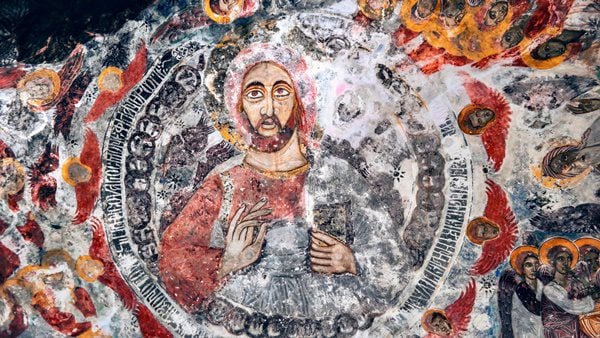
Welcome to Jesus Unmasked, a weekly exploration of scripture that delves into Jesus’s life and teachings. Over the centuries, Jesus has been obscured by prejudice and bigotry. God in flesh, crucified by human violence, has been invoked to inflict ever more violence on others. Racism, homophobia, transphobia, xenophobia and prejudice against people of other faiths have all been waged in the name of Jesus. These forms of fear and hatred are masks that obscure the truth: that Jesus is Love Embodied. We seek to pull back the masks that hide and distort Jesus so that his love can be revealed and we can follow in his way. We unmask Jesus even as Jesus unmasks us, lifting the blinders of prejudice from our own eyes. We welcome you to join us live, Wednesdays at 10:30 AM CT, on the Raven Foundation Facebook page. This episode explores Luke 9:51-62 and Galatians 5:1, 13-25.
Show Notes
We celebrate that LGBTQ community every month, but it’s the last week of Pride Month. And we have some fascinating Bible passages to discuss in relation to our dear LGBTQ siblings!
Luke 9:51-62: Unlearning a Violent God
Let’s send some Shock and Awe on those Samaritans!
If you do that, Jesus will rebuke you. Hard.
Jesus and his buddies journey to Samaria and enter some villages seeking some good old hospitality and to spread the Good News. But one Samaritan town says, “No thank you!” and sends Jesus and his friends on their way.
John and James – the “Sons of Thunder” – want some divine revenge on those Samaritan jerks! So they say to Jesus, “How about we call on Heaven to send some fire down on those ungrateful Samaritans?!?”
And, you know, the Sons of Thunder had some biblical precedent for this request. Sodom and Gomorrah, anyone? There some Christians (a growing minority, thank God!) who claim that Sodom and Gomorrah is about homosexuality. But it’s not. Do you remember what happened? Some angels came to visit Sodom. They were going to sleep for the night in the town square, but Lot told them that was a very bad idea. Why? Because the men of the town were not very nice.
The men of Sodom were actually heterosexuals. They had children and wives. But they wanted to show the newcomers who was boss of Sodom. The men of Sodom were not homosexuals living in same-sex committed relationships. Rather, they were heterosexuals who used rape to gain power over these strangers.
The sin of Sodom and Gomorrah was not homosexuality. It was the fact that they refused to show hospitality. And in Genesis, God basically imitates the men of Sodom – only instead of rape, God murders them with fire from heaven.
And so James and John want to do the same thing to this Samaritan town. And why not? God did it before. Shouldn’t God do it again?
Jesus says “No.” This story is part of the radical transformation of the human understanding of God that Jesus brings to us. As Yoda says, “You must unlearn what you have learned.”
Jesus came to help us unlearn violent images of God. That’s why Jesus rebuked his own disciples. You can picture Jesus #facepalm in response to James and John’s request. “You guys still don’t get it.” After Jesus rebuked them, some ancient manuscripts have Jesus explain, “You do not know what spirit you are of, for the Son of Man has not come to destroy the lives of human beings but to save them.”
Jesus rebuked his disciples because they wanted to destroy human life. And Jesus rebukes us when we want to destroy other. Some Christians today refer to the Sodom and Gomorrah story as justification to be against the LGBTQ community, but Jesus reveals that we can no longer read the story that way. We must unlearn the violent understanding of God so that we can come to know the God of Jesus, who has nothing to do with violence. Or, in the words of the prophet Hosea, so that we can learn about the God who “desires mercy, not sacrifice.”
Galatians 5:1-13-25: The Fruit of the Spirit
Paul goes straight to the point by cribbing something Jesus said. “For the whole law is summed up in a single commandment, ‘You shall your neighbor as yourself’” (v. 14).
PAUL! THAT’S ENOUGH! PLEASE STOP!
But Paul liked to talk. A lot. And he didn’t think it was enough. So he went on to tell us all kinds of ways that we fail to love our neighbors as ourselves. You are probably familiar with the list – sexual immorality, idolatry, dissensions, factions, envy, anger, drunkenness. Paul makes a large list and then gives up by concluding “and things like these.”
Basically, just don’t be a jerk, okay guys?
But have you ever been drunk? Maybe sexually immoral at some point? Have you ever been angry? Maybe you fear that you have committed the “unforgivable sin,” whatever that is.
Relax. Paul says that those who “do” such things will not inherit eternal life. The word for “do” in Greek is “peripateo.” It means “to walk.” Are you walking in a way that consistently leads you to neglect the law to love your neighbor as yourself? Paul simply lists what that “walk” looks like so that we can choose to walk a different path.
Then Paul creates a contrast. Paul says that the Spirit of God can be seen by its fruits. And you carry those fruits. Like in a basket? Is that how the metaphor works? I don’t know. But the fruits of the spirit are “love, joy, peace, patience, kindness, generosity, faithfulness, gentleness, and self-control.”
So, let’s stop calling for Heaven to send fire on our enemies. That’s not what God is like. And let’s relax, because God loves you. The fruit of the Spirit is already alive in you. You are loved. Relax into that love as you walk the path of sharing that love with your neighbors.
Photo by Fatih Özdemir on Unsplash
Previous Post

June 24, 2019
The Politics of Jesus - Legion and Immigrant Children Detention Centers
Next Post
June 28, 2019 Pride: In The Name Of Love, Living Our Lives Unbound By Death
Browse Our Archives
Select a Category Atonement and Current Events Curriculum Faith and Families Interviews Jesus the Forgiving Victim Lent Montessori politics Reviews The Bible Explained Uncategorized Valentine's Day Wednesday Sermon Who is God?
Select a Month July 2020 November 2019 October 2019 September 2019 August 2019 July 2019 June 2019 May 2019 April 2019 March 2019 February 2019 January 2019 December 2018 November 2018 October 2018 September 2018 August 2018 July 2018 June 2018 May 2018 April 2018 March 2018 February 2018 January 2018 December 2017 November 2017 October 2017 September 2017 August 2017 July 2017 June 2017 May 2017 April 2017 March 2017 February 2017 January 2017 December 2016 November 2016 October 2016 September 2016 August 2016 June 2016 May 2016 April 2016 March 2016 February 2016 January 2016 December 2015 November 2015 October 2015 September 2015 August 2015 July 2015 June 2015 May 2015 April 2015 March 2015 February 2015 January 2015 December 2014 November 2014 October 2014 September 2014 August 2014 July 2014 June 2014 May 2014 April 2014 March 2014 January 2014 December 2013 September 2013 August 2013 July 2013
Follow Us!
TAKE THE
Religious Wisdom Quiz
Who wore a coat of many colors?
Select your answer to see how you score.
Moses Abel Joseph Jacob
Related posts from Teaching Nonviolent Atonement

Forgiveness in the Time of COVID-19 by Julia...


Reflections on Indigenous Wisdom For Healing A Wounded...

How Forgiveness Can Transform Our Violence and Build...
TRENDING AT PATHEOS Progressive Christian

What Being a Modern-Day Apostle Means to Me
In my last column, I discussed the ins and outs of modern-day...

Did Ancient China Once Worship the God of...
Across human history, a common thread weaves through the origins of the...

Love Your Neighbor – Including Earth-Kin: Lev. 19,...
God’s command to love your neighbor means acting in an ethical and...

Lead a Church Study of “Jesus and Lao...
Guest writer Jack Thomas (The Irreverent Reverend) reflects on leading his church...

Pastoral Wisdom for Responding to Sermon Pushback
Getting sermon pushback on your social justice sermon? Learn practical, Proverbs-based strategies...

Principles for Understanding the Apostolic Ministry Today
Whenever people discover that my formal ministry title is "apostle," as in...
view all Progressive Christian blogs
Ad-Free & Subscriber Log-In Subscription Support
- About Us
- 2026 Calendar
- Videos
- Podcasts
- Library of World Religions
- Faith In Media Tracker
- Advertise With Us
- Write for Us
- Privacy Policy
- Terms of Service
- Do Not Sell My Data
- Contact Us
- Radiant Digital
- Manage Newsletter Subscriptions
- Unsubscribe From Notifications
- Sitemap
Copyright 2008-2026, Patheos. All rights reserved.
Subscription Support Ad-Free & Subscriber Log-In
Follow Patheos