
BuddhistCatholicContemplativeEvangelicalGeneral ChristianHinduJewishLatter-day SaintMuslimNew VisionsProgressive Christian
Beliefs
- Buddhist
- Catholic
- Contemplative
- Evangelical
- General Christian
- Hindu
- Jewish
- Latter-day Saint
- More Voices
- Muslim
- New Visions
- Pagan
- Progressive Christian
Topics
- Religion News
- Food and Religion
- Sports and Religion
- Religious Art
- Religious Music and Entertainment
- Religious Events
- History and Religion
- Style and Religion
- Politics and Religion
- Women in Religion
- Recreation Outdoors and Religion
- Business Finance and Religion
- Careers Workplace and Religion
- Education and Religion
- Family Parenting and Religion
- Health Fitness and Religion
- Home and Religion
- Relationships and Religion
- Technology and Religion
- Travel and Religion
Columnists
- Buddhist Columnists
- Business Finance and Religion Columnists
- Careers Workplace and Religion Columnists
- Catholic Columnists
- Contemplative Columnists
- Education and Religion Columnists
- Evangelists Columnists
- Family Parenting and Religion Columnists
- General Christian Columnists
- Health Fitness and Religion Columnists
- Hindu Columnists
- History and Religion Columnists
- Home and Religion Columnists
- Jewish Columnists
- More Voices Columnists
- Latter Day Columnists
- Muslim Columnists
- New Visions Columnists
- Nonreligious Columnists
- Pagan Columnists
- Politics and Religion Columnists
- Progressive Columnists
- Recreation Outdoors and Religion Columnists
- Relationships and Religion Columnists
- Religion News Columnists
- Religious Art Columnists
- Religious Events Columnists
- Religious Music and Entertainment Columnists
- Sports and Religion Columnists
- Style and Religion Columnists
- Technology and Religion Columnists
- Travel and Religion Columnists
- Women in Religion Columnists
Resource Library
- 2026 Calendar
- Library of World Religions
- The 100 Most Holy Places on Earth
- Patheos Answers
- Podcasts
- Videos
- Faith Leaders Database
- Anglican Episcopalian
- Bahai
- Baptist
- Buddhism
- Christianity
- Confucianism
- Eastern Orthodoxy
- Hinduism
- Holiness and Pentecostal
- ISKCON
- Islam
- Judaism
- Lutheran
- Methodist
- The Church of Jesus Christ of Latter-day Saints
- New Age
- Paganism
- Presbytarian and Reformed
- Protestantism
- Religion Behind the Scenes
- Roman Catholic
- Scientology
- Shia Islam
- Sikhism
- Sufism
- Sunni Islam
- Taoism
- Zen
- See all religions
Research Tools
 Ad-Free & Subscriber Log-In Subscription Support
Ad-Free & Subscriber Log-In Subscription Support
Follow Patheos 

- Trending:
- Forgiveness
- |
- Marriage
- |
- Consciousness
- |
- Death Penalty
- |
- Election
- |
- Halloween
 Teaching Nonviolent Atonement
- Home
- Progressive Christian
- Exorcising The Demons of Violence And White Supremacy: Gerasene Demoniac, Juneteenth, and Reparations
Exorcising The Demons of Violence And White Supremacy: Gerasene Demoniac, Juneteenth, and Reparations
Last updated on: June 23, 2019 at 3:20 am by Lindsey Paris-Lopez
Exorcising The Demons of Violence And White Supremacy: Gerasene Demoniac, Juneteenth, and Reparations 2019-06-23T03:20:44-05:00 Lindsey Paris-Lopez
Patheos Explore the world's faith through different perspectives on religion and spirituality! Patheos has the views of the prevalent religions and spiritualities of the world.
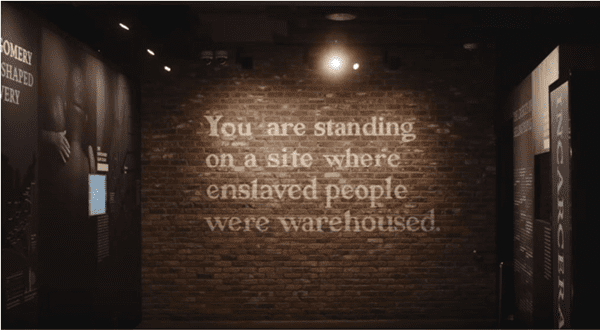
Jesus then asked him, “What is your name?” He said, “Legion”; for many demons had entered him.
This week’s Gospel reading, Luke 8: 26-39, follows a week that included Juneteenth. We know the Spirit is crying out to us when the story of the Gerasene demoniac falls so close to the anniversary of the partial and incomplete exorcism of our nation’s original sin of slavery. At a time when Congress is debating whether or not to even study reparations for slavery and segregation, a two-thousand-year-old story of an occupied nation, a man tormented by internalized violence and suffering, Love-enfleshed who calmed the storm within, and a town terrified of change can speak volumes to us today. Let’s look closely at the story of the Gerasene demoniac with our eyes open to the hope of transformation and healing, mindful of the ways fear can hold us back, but with the courage to listen and act upon the truth as the Spirit reveals it to us.
Calming the Raging Storm Within
Jesus has just come from calming a storm on the Sea of Galilee only to confront another raging storm distilled into a single person. There is a man possessed by demons, naked and living amongst the tombs. He is kept under guard with chains and shackles, which he regularly breaks with violent convulsions. When Jesus asks the name of the demon who resides within him, the answer comes back, “Legion.”
The man is living under the occupation of the Roman Empire. So, too, are the townspeople, who don’t appear to be possessed by demons. But generations of war, captivity, and exile, with brief reprieves only to be conquered again, have shaped the lives of the people. The demoniac has probably suffered more than most. His life may have been shaped by loss of home, loss of loved ones, pain and suffering and violence that has seeped into his skin and taken hold of him from the inside-out. Yet all have suffered something. The whole town needs healing from the violence that has circumscribed their existence and shaped their collective memories and culture.
Jesus, though also living under Roman occupation, represents an existence unbound by the violence and dehumanization that plague this man. He does not live trapped in a world of over-and-against, where identity is found in conquest or defeat. In a world where storms of violence rage and tear people and communities apart, Jesus finds himself on an unwavering foundation that lets him step out onto raging waters and reach out to tormented souls. He lives not in rivalry against others but in full communion with Love. Love exudes from Jesus and reaches out to this man, casting out the fear, suffering and pain that had tormented him.
Legion, the embodied damage of generations of violence, begs not to be cast into the abyss of fear and anger and hatred from which they generated. So Jesus casts them into a nearby herd of pigs, whereupon they rush over a cliff and are drowned in the abyss anyway.
I always felt sorry for the pigs, but as Dr. Anthony Bartlett writes in Virtually Christian points out, “If we think of the thousands upon thousands killed in military actions in that area alone and then, expanding from there throughout history, the pigs are simply an anthropological code for the immense violence of humanity that always seeks to displace itself in a surrogate.” In other words, without a scapegoat, without a demoniac against whom the town could measure their own worth, the violence in which they all lived would have consumed them too, as it consumed the pigs. The demoniac had served to remind the people that things could always be worse, that at least they weren’t as bad as the raving lunatic chained up among the tombs. When the demons were displaced into the pigs, the town saw what could happen to them now that the pain and suffering which weighed upon them no longer had an outlet. No wonder they were terrified and asked Jesus to leave!
Juneteenth and Exorcising the Demon of Slavery
My thoughts shift to Juneteenth and the town of Galveston, Texas. Slaves had legally been freed in the rebellious states with the Emancipation Proclamation two and a half years prior. But, of course, the Confederacy, not recognizing President Lincoln’s authority, clung to their slaves. Yet by Juneteenth, the war had been over for two months, and thus the Confederacy was no more. The slaves should have been free, but no one had told them so. They should, of course, have been free from the beginning; their humanity should have been recognized from the outset. True freedom is rooted in the Love from whom we come, but lies of demonization and division bind us all. The slaves of Galveston were bound not by law but by human hatred and fear. They were bound by a lack of creative and compassionate imagination. They were bound by those who didn’t know how to live without scapegoating – enslaving and exploiting – others. The disease of white supremacy, an embodiment of violence, bound the whole town, but some chains are more literal than others.
But on June 19, 1865, Major General Gordon Granger of the Union army gave General Order 3, which reads as follows:
The people of Texas are informed that in accordance with a Proclamation from the Executive of the United States, all slaves are free. This involves an absolute equality of rights and rights of property between former masters and slaves, and the connection heretofore existing between them becomes that between employer and free laborer.
As suddenly as the demons were expelled from the Gerasene man, official slavery was finally expelled from the last hold-out of the Confederacy. With liberation came jubilation, even as life remained uncertain. It would be another three years before the former slaves would be nominally granted the rights of citizenship with the passage of the 14th Amendment. With no guarantees and a precarious road ahead, many former slaves headed north in search of long-separated family or simply a new life away from the trauma that surrounded the town that had kept them bound.
Integration as Liberation
Leaving home, however, was not an option for the liberated former demoniac. He longed to follow Jesus out of the place that had tormented him for so long, but Jesus said “No.” Rather, he charged the man to proclaim what God had done for him.
Was this cruel of Jesus, to insist that the man remain among the very townspeople who had kept him in chains? I know if I were that man, I would want to leave too. But Jesus knew that this man’s liberation from demons was only the very beginning. The whole town was possessed by a mindset of violence that had come from living in a world of violence. They needed to see what it meant to be freed from the torturous death throes of fear, anger, pain and suffering. The town needed testimony to the power of Love to inaugurate a new way of life. This man, whom they had seen as the last and least among them, would now be the first fruits of Love. And through this liberated man, who sought no vengeance because he was free of pain to pass along to others, the town could be exorcised of its own demons and learn how to care for one-another so that, even in the midst of the storm of Roman violence surrounding them, they could find peace.
In seeing the man they had demonized walk free from chains, agony, and the judgment that had equated him with a monster, the townspeople could become free of their own demons. Their liberation would depend on whether they recognized his full humanity and how they welcomed him back among the community. But we do not see that in this story. We do not know how their story ends. We can only have a say in how our own story will proceed.
Making Peace Means Making Reparations
Slavery has officially been over for 154 years, but the demonization continues. The exorcism of the original sin of the United States is incomplete. The long shadow of slavery, Jim Crow, segregation, and the prison-industrial complex looms over our nation.
Jesus sent the man freed from his demons to reintegrate into his society, but full integration of African Americans has been blocked over generations – by black codes and vagrancy laws, by lynching, by redlining and housing discrimination, by segregated schools and denied access to higher education and employment, and now by a criminal justice system that disproportionately targets African Americans for arrest and sentences them to longer prison terms than their white counterparts. While laws have changed (although not enough, and some changes, like the Voting Rights Act, have been rolled back), generations of impediments to progress leave lasting damage. As Ibrahim X. Kendi explains, “For every $100 of wealth that white families hold, black families hold just $5. … The racial wealth gap will not repair itself. And it is growing.” The wealth gap, as well as the gap in experience and treatment, amounts to de-facto segregation, a society divided along racial lines among others. A nation born from the deliberate scapegoating of darker-skinned people that went on to amass great wealth at their expense has a gaping wound at its core that cannot be healed without deliberate action.
Until reparations heal the wound at the heart of our nation, we all live our lives circumscribed by violence and injustice.
I do worry, however, that if reparations are seen only as a transfer of wealth from white people to people of color, resentment will grow and any progress may be short-lived as inevitable backlash occurs. Thus, reparations should be viewed not through a lens of violence, as over-and-against taking, but as an investment in reconciliation and the healing of our nation. It will involve money, much of which could come from divesting from dehumanizing wars abroad to invest in peace and in people. But beyond money, reparations put renunciation of the national original sin of white supremacy into action. They acknowledge the damage done to relationships across and within racial boundaries on so many fronts, and dare to put in the deliberate care, compassion, and imagination needed to repair those relationships. Reparations involve listening to understand problems, implementing proven solutions, and searching for new solutions that center people over profits. They focus not only on closing wealth gaps, but on dissipating fear and building friendship.
Reparations are the work of building foundations of respect and cooperation that can calm the storm of racial tensions. For Jesus was able to calm the storm raging on the waters and the storm raging within the demoniac because he was grounded in Love. Reparations are that love in action. If we are to transform our nation from scapegoating and exploitation into beloved community, we need to tend carefully to the wounds that have festered and deepened for so long. And when we have the courage to say that our healing is worth the cost in time, imagination, and treasure, when we can recognize that the price of continued division is tearing us apart while an investment in healing is what it will take to make us whole, then a new force beyond what we can yet imagine will begin to emerge. An investment in reparations is an investment in peacemaking, in grounding our identities in the community we build together rather than the false divisions that diminish us.
Let us find the courage to repair what is broken, cast out the demon of white supremacy once and for all, and see what a beautiful new world we can build together.
Image: Screenshot from Youtube: “Pain and Terror: America Remembers Its Past,” by The Guardian.
Previous Post

June 16, 2019
God Is She Who Delights In You - Discovering the Divine Feminine
Next Post
June 24, 2019 The Politics of Jesus - Legion and Immigrant Children Detention Centers
Browse Our Archives
Select a Category Atonement and Current Events Curriculum Faith and Families Interviews Jesus the Forgiving Victim Lent Montessori politics Reviews The Bible Explained Uncategorized Valentine's Day Wednesday Sermon Who is God?
Select a Month July 2020 November 2019 October 2019 September 2019 August 2019 July 2019 June 2019 May 2019 April 2019 March 2019 February 2019 January 2019 December 2018 November 2018 October 2018 September 2018 August 2018 July 2018 June 2018 May 2018 April 2018 March 2018 February 2018 January 2018 December 2017 November 2017 October 2017 September 2017 August 2017 July 2017 June 2017 May 2017 April 2017 March 2017 February 2017 January 2017 December 2016 November 2016 October 2016 September 2016 August 2016 June 2016 May 2016 April 2016 March 2016 February 2016 January 2016 December 2015 November 2015 October 2015 September 2015 August 2015 July 2015 June 2015 May 2015 April 2015 March 2015 February 2015 January 2015 December 2014 November 2014 October 2014 September 2014 August 2014 July 2014 June 2014 May 2014 April 2014 March 2014 January 2014 December 2013 September 2013 August 2013 July 2013
Follow Us!
TAKE THE
Religious Wisdom Quiz
Who wore a coat of many colors?
Select your answer to see how you score.
Moses Abel Joseph Jacob
Related posts from Teaching Nonviolent Atonement
Racism: Survivors and Perpetrators Find Healing in Africa
Coronation Before Crucifixion: The Ominous, Subversive Politics of...

Reuniting Families Is Not Enough. Now, Let's Let...
TRENDING AT PATHEOS Progressive Christian

What Being a Modern-Day Apostle Means to Me
In my last column, I discussed the ins and outs of modern-day...

Did Ancient China Once Worship the God of...
Across human history, a common thread weaves through the origins of the...

Love Your Neighbor – Including Earth-Kin: Lev. 19,...
God’s command to love your neighbor means acting in an ethical and...

Lead a Church Study of “Jesus and Lao...
Guest writer Jack Thomas (The Irreverent Reverend) reflects on leading his church...

Pastoral Wisdom for Responding to Sermon Pushback
Getting sermon pushback on your social justice sermon? Learn practical, Proverbs-based strategies...

Principles for Understanding the Apostolic Ministry Today
Whenever people discover that my formal ministry title is "apostle," as in...
view all Progressive Christian blogs
Ad-Free & Subscriber Log-In Subscription Support
- About Us
- 2026 Calendar
- Videos
- Podcasts
- Library of World Religions
- Faith In Media Tracker
- Advertise With Us
- Write for Us
- Privacy Policy
- Terms of Service
- Do Not Sell My Data
- Contact Us
- Radiant Digital
- Manage Newsletter Subscriptions
- Unsubscribe From Notifications
- Sitemap
Copyright 2008-2026, Patheos. All rights reserved.
Subscription Support Ad-Free & Subscriber Log-In
Follow Patheos